FinOps Inform · Cost Alerting
Benefits of automated cloud cost alerts for CTOs
Discover the benefits of automated cloud cost alerts for CTOs. Improve anomaly detection, prevent budget overruns, and achieve financial accountability.

Automated cloud cost alerts are notifications triggered by real-time analysis of cloud spending that detect unexpected cost changes the moment they occur. For CTOs and engineering leaders managing workloads across AWS, Google Cloud, or Azure, the benefits of automated cloud cost alerts go far beyond simple notifications. They create a financial feedback loop that catches anomalies early, prevents budget overruns, and builds the kind of cost accountability that FinOps frameworks demand. Without them, your teams are flying blind until the invoice arrives.
1. Benefits of automated cloud cost alerts: faster anomaly detection
The most immediate advantage is speed. Native cloud billing alerts often carry detection lags of 24–48 hours, meaning a runaway Lambda function or misconfigured autoscaling group can burn through budget for two full days before anyone notices. That is not a monitoring gap. That is a financial liability.
Custom hourly anomaly monitors can reduce detection time to under four hours, limiting the blast radius of any cost incident dramatically. Experienced teams supplement native alerts with serverless functions triggered directly by Cloud Cost and Usage Reports, cutting detection latency to under an hour. The difference between a £500 incident and a £50,000 incident is often just how fast you found it.

| Alert type | Detection speed | Primary use case |
|---|---|---|
| Native billing alerts | 24–48 hours | Baseline budget thresholds |
| Custom hourly monitors | Under 4 hours | Anomaly detection and spend spikes |
| Serverless CUR-based monitors | Under 1 hour | Real-time incident response |
| Forecast-based alerts | Pre-breach | Mid-cycle corrective action |
Pro Tip: Layer all four alert types rather than choosing one. Native alerts catch gross overruns, custom monitors catch anomalies, and forecast alerts give you time to act before month-end.
2. Proactive budget management before overruns happen
Reactive cost management is the norm at most organisations. Teams discover they have overspent when the invoice arrives. Automated alerting changes that dynamic entirely.
Forecast-based budget alerts enable teams to address budget overruns before they occur, allowing mid-cycle corrective actions rather than post-mortem explanations. If your current spend trajectory puts you 30% over budget by month-end, a forecast alert fires today, not on the last day of the billing cycle. That window is where real savings happen. You can rightsize instances, pause non-critical workloads, or renegotiate reserved capacity before the damage is done.
This is the core difference between cloud budgeting automation and traditional financial controls. Spreadsheet-based reviews happen monthly. Automated alerts happen continuously.
3. Reduced financial waste through continuous visibility
Cloud waste is not caused by ignorance. It is caused by a lack of visibility at the right moment. Idle resources, orphaned snapshots, and over-provisioned databases do not announce themselves. They quietly accumulate charges until someone runs a manual audit.
Real-time cloud cost monitoring turns vague spending fears into live data that engineering teams can investigate and act on continuously. Teams that adopt continuous monitoring aligned with FinOps frameworks reduce cloud waste significantly. The mechanism is straightforward: when engineers see cost data in real time, they make better architectural decisions. When they only see it monthly, they do not connect their code to its financial consequences.
Reducing cloud expenses through continuous visibility is not a one-time exercise. It is an ongoing practice that compounds over time as teams build cost intuition.
4. Financial benefits that show up on the balance sheet
The financial advantages of automated cost alerts are concrete and measurable. Here are the outcomes engineering and finance teams consistently see after adoption:
- Cost avoidance: Anomalies caught within hours prevent small incidents from becoming large ones. A misconfigured data transfer route caught in two hours costs a fraction of one caught two days later.
- Fewer invoice surprises: Continuous budget visibility means finance teams stop receiving unexpected end-of-month bills. Forecasts and actuals align more closely.
- Reduced waste from idle resources: Alerts tied to utilisation thresholds flag underused instances for rightsizing or termination before they accumulate weeks of unnecessary charges.
- Better capital allocation: When teams trust their cost data, they can make confident decisions about reserved instances and savings plans rather than over-provisioning as a buffer.
- Shared accountability: Routing alerts to the teams that own the resources creates a direct link between engineering decisions and financial outcomes.
The FinOps cultural shift matters here. Cost transparency, supported by shared responsibility billing practices, turns cloud spending from a finance problem into an engineering discipline.
5. Operational improvements across engineering workflows
Automated alerts do not just save money. They change how engineering teams work. The operational improvements are often as valuable as the direct cost savings.
Routing alerts to responsible teams builds accountability and daily cost awareness rather than sending generic notifications to a shared inbox that nobody owns. When the team that deployed a service receives the cost alert for that service, resolution times drop and repeat incidents become less frequent. This is alert design as organisational design.
Alert fatigue is the main reason cost alerting programmes fail. Tiered threshold alerts with actionable notifications routed to owning teams solve this directly. Broad, low-severity alerts catch gradual spend creep. Aggressive alerts handle verified anomalies requiring immediate action. The two tiers serve different purposes and should never be conflated.
Pro Tip: Integrate cost alerts with tools like Slack, PagerDuty, or ServiceNow. Alerts integrated with operational tools improve responsiveness and embed cost management into everyday engineering operations rather than treating it as a separate finance function.
Infrastructure as Code tools complement alerts further. When IaC and cost alerting work together, teams can trigger automated remediation responses, not just notifications. A Lambda function that detects an anomaly can automatically scale down a non-critical environment while simultaneously paging the responsible team.
6. Cultural shift from reactive to proactive cost management
The deepest benefit of cloud cost monitoring is cultural, not technical. Automated alerting changes how engineers think about the resources they deploy.
Automated cost alerting fosters a cost-aware engineering culture by creating shared ownership and moving teams from reactive to proactive cost management. Engineers who receive real-time cost feedback start asking "what will this cost?" before they deploy, not after. That question, asked consistently, is worth more than any single alert. The FinOps framework formalises this cultural shift, but automated alerts are the mechanism that makes it real in daily practice.
Cost culture does not emerge from quarterly reviews or annual audits. It emerges from continuous, specific, and timely feedback. Automated alerts provide exactly that.
7. Key features to look for in alerting tools
Not all alerting tools deliver equal value. When evaluating options, CTOs and engineering leaders should assess against these feature categories:
| Feature category | What to look for | Why it matters |
|---|---|---|
| Detection granularity | Hourly or sub-hourly data | Catches anomalies before significant damage occurs |
| Custom threshold flexibility | Per-service, per-team thresholds | Reduces noise and improves alert relevance |
| Forecast-based alerting | Spend trajectory projections | Enables mid-cycle corrective action |
| Integration depth | Slack, PagerDuty, ServiceNow, ticketing | Embeds cost management into engineering workflows |
| Multi-cloud and multi-account support | AWS, Google Cloud, Azure in one view | Prevents blind spots across complex environments |
| Automated remediation triggers | Serverless function integration | Moves from notification to action without manual steps |
Detection speed and integration depth are the two features that separate effective alerting from performative alerting. A tool that detects anomalies in 24 hours and sends emails to a shared inbox will not change behaviour. A tool that detects anomalies in under an hour and routes them to the right team in Slack will.
Multi-cloud support matters more than most teams anticipate at the outset. Organisations that start on a single cloud provider rarely stay there. Building alerting infrastructure that covers cloud infrastructure costs across all providers from the beginning avoids a painful rebuild later.
Key takeaways
Automated cloud cost alerts are the most direct mechanism for converting real-time spending data into engineering decisions that prevent waste and protect budgets.
| Point | Details |
|---|---|
| Speed of detection is critical | Custom monitors reduce anomaly detection to under four hours, limiting cost damage significantly. |
| Forecast alerts prevent overruns | Proactive alerting fires before month-end, giving teams time to take corrective action. |
| Alert routing drives accountability | Sending alerts to owning teams builds cost ownership and reduces repeat incidents. |
| Tiered thresholds prevent alert fatigue | Separating low-severity and high-severity alerts keeps teams engaged and responsive. |
| Cultural change requires continuous feedback | Real-time alerts embed cost awareness into daily engineering practice, not just monthly reviews. |
What I have learned about alerts and engineering culture
The teams I see getting the most from automated alerting are not the ones with the most sophisticated tooling. They are the ones who have thought carefully about who receives each alert and what action that person is expected to take.
Most organisations set up alerts and then route everything to a central platform team or a shared ops inbox. That approach produces two outcomes: the platform team becomes a bottleneck, and the engineers who actually control the costs never feel the feedback. The alerts exist, but the accountability does not.
The shift that actually changes behaviour is when the engineer who wrote the code that caused the cost spike receives the alert directly. Not their manager. Not a central team. Them. That directness is uncomfortable at first. Engineers are not used to thinking about their code in financial terms. But discomfort is precisely how habits change.
I would also push back on the instinct to alert on everything. Alert fatigue is real, and it kills programmes faster than any technical failure. Start with three or four high-signal alerts that are always actionable. Build trust in the system. Then expand. A team that responds to every alert is more valuable than a team that ignores all of them because there are too many.
The cost culture guide for engineering teams covers this in more depth, but the principle is simple: alerts are a communication tool. Design them like one.
— Kori
How Koritsu AI supports automated cloud cost alerting
Koritsu AI combines an AI platform with hands-on expert advice to give engineering teams the visibility and guidance they need to act on cost data, not just receive it.
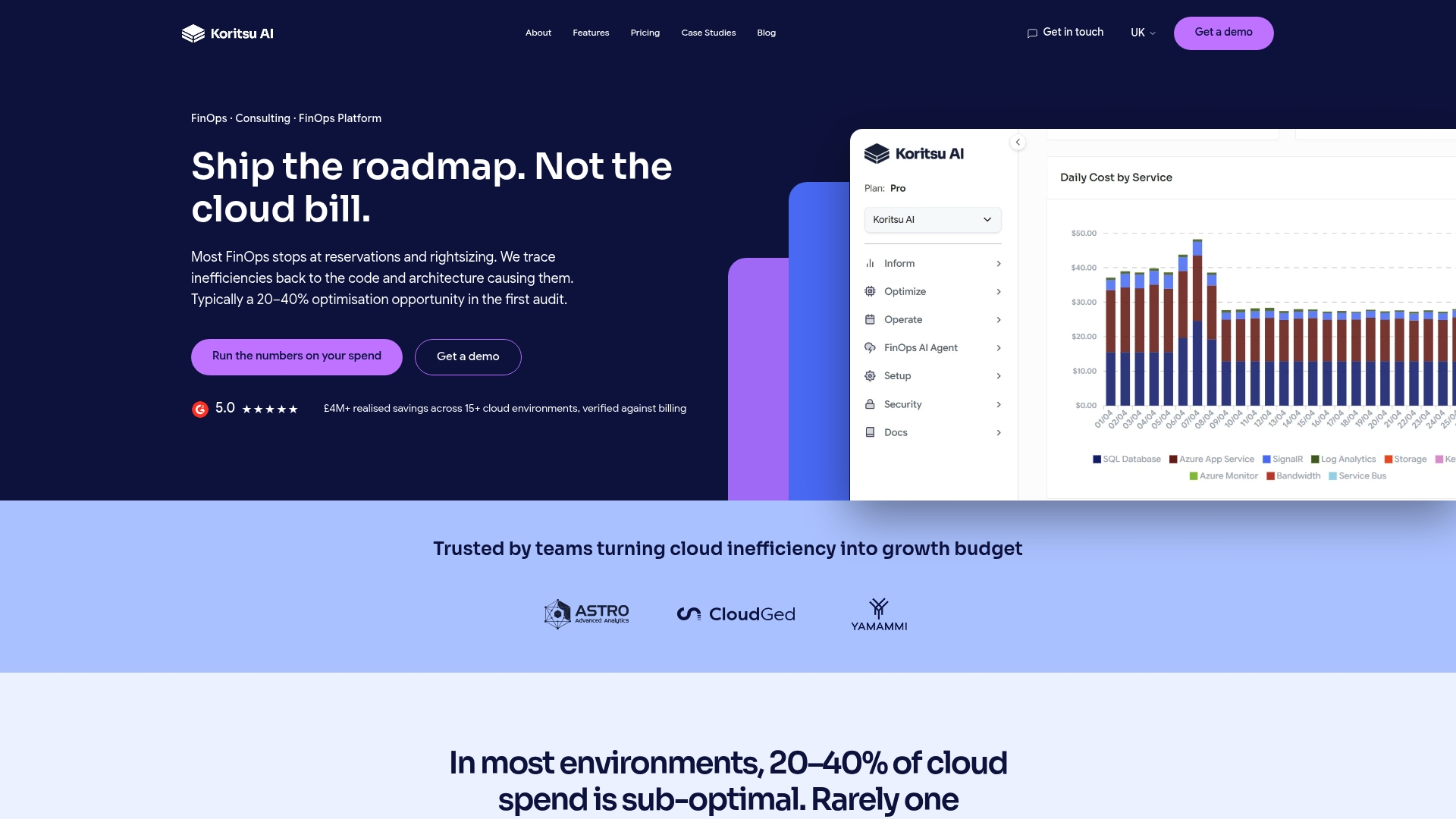
Kori, Koritsu AI's AI agent, continuously analyses cloud spending across AWS, Google Cloud, and Azure, surfacing anomalies and inefficiencies that standard alerts miss. The platform identifies where money is being lost at the infrastructure and code level, not just at the billing level. Koritsu AI's specialists then help teams act on those findings. One financial services client achieved a 96% reduction in AWS Lambda costs after working with Koritsu AI to address inefficiencies buried in how their functions were built. Koritsu AI charges only on savings delivered, starting with a free cloud cost assessment.
FAQ
What are automated cloud cost alerts?
Automated cloud cost alerts are notifications triggered by real-time analysis of cloud spending that fire when costs exceed defined thresholds or deviate from expected patterns. They enable engineering teams to detect and respond to anomalies without waiting for monthly billing cycles.
How quickly can automated alerts detect cost anomalies?
Custom hourly monitors can detect anomalies in under four hours, compared to the 24–48 hour lag typical of native cloud billing alerts. Serverless function monitors built on Cloud Cost and Usage Reports can reduce detection time to under one hour.
How do automated alerts prevent alert fatigue?
Tiered threshold design separates low-severity alerts for gradual spend creep from high-severity alerts for verified anomalies. Routing each alert type to the team responsible for the relevant resources keeps notifications specific and actionable rather than generic.
Do automated cost alerts work across multiple cloud providers?
Effective alerting tools support AWS, Google Cloud, and Azure in a single view. Multi-cloud and multi-account support prevents blind spots in organisations running workloads across more than one provider.
How do cost alerts support a FinOps culture?
Automated alerts create the continuous, specific feedback loop that FinOps frameworks require. By routing alerts to owning teams, organisations build shared accountability and move engineers from reactive to proactive cost management as a daily practice.