FinOps Inform · Cost Optimisation
Cloud architecture cost review: a practical guide for 2026
Unlock savings with our cloud architecture cost review guide for 2026. Learn to evaluate costs effectively and optimize your cloud strategy.

A cloud architecture cost review is the systematic evaluation of architectural decisions to understand and control cloud expenditure before and during deployment. Most organisations running on AWS, Google Cloud, or Azure discover that their largest cost inefficiencies are structural, not operational. They are baked into how workloads were placed, how services were selected, and how data flows between regions. The industry term for this discipline is cost architecture review, and it sits at the intersection of FinOps and architectural governance. Getting it right requires shift-left costing, the right cloud architecture cost analysis tools, and a continuous review cadence that keeps cost aligned with business objectives.
What does a cloud architecture cost review actually cover?
A cloud architecture cost review maps architectural decisions to cost outcomes, rather than auditing invoices after the fact. This distinction matters enormously. Many cost factors become fixed after deployment, including data gravity, control plane overhead, and cross-region egress patterns. These structural factors cannot be corrected by rightsizing alone.
The scope of a thorough review covers compute placement, storage tier selection, egress modelling, managed service trade-offs, and control plane sprawl. Each of these dimensions carries a cost signature that is determined at design time. A review that only examines billing data misses the upstream decisions that produced those bills.

For AWS users, the Well-Architected Framework provides a cost optimisation pillar as a starting point. Google Cloud and Azure offer equivalent frameworks. However, framework checklists alone do not constitute a cost architecture review. The review must connect specific architectural choices to specific cost outcomes, with evidence.
What tools and prerequisites do you need?
Effective cloud cost analysis starts with the right inputs and the right tooling. You need three categories of data before any review begins: architectural diagrams with workload placement decisions, billing exports at a granular resource level, and operational metrics covering throughput, request rates, and data transfer volumes.
The tooling landscape has matured considerably. Here is a comparison of the primary categories of cloud architecture cost analysis tools available in 2026:
| Tool category | Primary function | Multi-cloud support | Automation capability |
|---|---|---|---|
| IaC analysers (e.g. AWS Well-Architected IaC Analyser) | Detect cost inefficiencies in Terraform and CloudFormation | AWS-native, expanding | CI/CD integration, what-if analysis |
| Cloud-native cost explorers (AWS Cost Explorer, Azure Cost Management) | Billing visibility and trend analysis | Single-cloud per tool | Alerting, budget thresholds |
| AI-driven platforms (e.g. Koritsu AI) | Continuous architectural cost analysis | AWS, Google Cloud, Azure | Automated anomaly detection, recommendations |
| FinOps modelling tools | Pre-deployment TCO modelling | Varies | Manual and semi-automated |
AI-powered tools can evaluate over 1,100 Terraform resources and provide what-if scenarios during CI/CD phases. That capability means engineers receive cost feedback at the point of code review, not weeks later when a bill arrives.
Stakeholder alignment is equally important. Architects, finance teams, and platform operations must all participate. Without finance involvement, cost targets remain abstract. Without architect involvement, recommendations lack implementation context.
Pro Tip: Embed cost assessment checks directly into your CI/CD pipeline using an IaC analyser. This creates a feedback loop where engineers see the cost impact of infrastructure changes before they merge, not after they deploy.
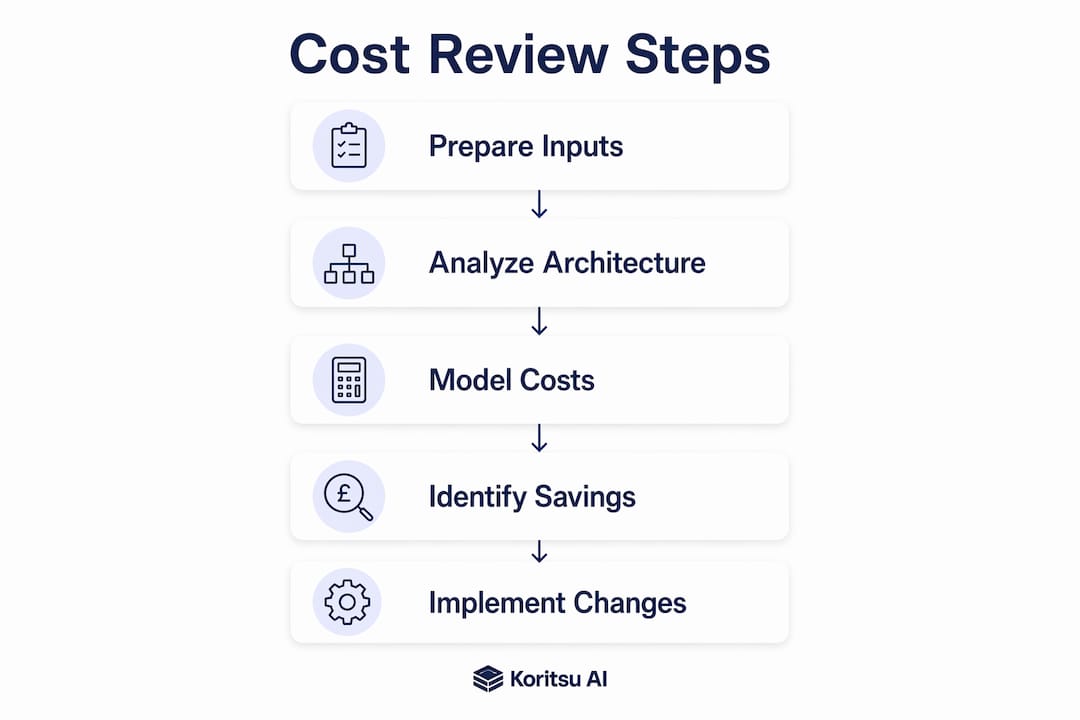
How to conduct a cloud architecture cost review step by step
The review process follows a logical sequence. Skipping steps, particularly the early modelling stages, produces incomplete findings and missed savings.
-
Collect architectural cost drivers. Document every service in use, its placement, and its data flow relationships. Pay particular attention to cross-region and cross-availability-zone traffic, which carries egress charges that compound at scale.
-
Map Cost Authority. Identify which team owns each architectural component and whether that team is accountable for the resulting spend. Cost Authority Inversion occurs when the team making architecture choices is not responsible for the cloud bill. This misalignment is one of the most common causes of unchecked spending.
-
Conduct workload placement analysis. Evaluate whether each workload is in the right service tier and the right region for its cost profile. A batch processing job running in a primary production region may be a straightforward candidate for relocation to a lower-cost region or a spot-instance fleet.
-
Model egress and data transfer costs. Egress is frequently underestimated at design time. Build a data flow map and apply current provider pricing to quantify transfer costs between services, regions, and external endpoints.
-
Assess total cost of ownership. Managed PaaS and SaaS services can reduce operational labour costs despite higher unit prices. IaaS offers lower unit cost but demands higher management effort. The review must account for both dimensions to produce an accurate TCO picture.
-
Generate cost model scenarios. Use cost calculators and predictive models to project spend under different architectural configurations. This is where shift-left costing delivers its greatest value. Pre-deployment cost modelling allows teams to compare options before any infrastructure is provisioned.
-
Prioritise findings by cost impact and implementation effort. Not every finding warrants immediate action. Rank recommendations by the ratio of potential saving to engineering effort required.
Microsoft recommends triggering reviews at major feature releases, cost spikes, and quarterly planning cycles. This cadence keeps the review process connected to real business events rather than becoming a periodic compliance exercise.
Pro Tip: Avoid anchoring your review to invoice data alone. Invoice data tells you what was spent. Architectural cost models tell you what will be spent and why. Forward-looking models are the more useful instrument for decision-making.
What are the common pitfalls in cloud cost architecture reviews?
The most damaging mistakes in a cloud architecture cost review are not technical errors. They are process failures and misaligned incentives.
-
Reactive invoice audits. Reviewing bills without reviewing the architecture that produced them treats symptoms rather than causes. Structural cost drivers like data gravity and control plane sprawl cannot be resolved at the billing layer.
-
Ignoring operational costs. A review that focuses only on cloud service unit prices misses the labour cost of managing infrastructure. Switching from a managed database service to a self-managed alternative may reduce the cloud bill while increasing engineering overhead significantly.
-
Cutting compute headroom without impact assessment. Aggressive rightsizing without load testing creates fragility. Cost reduction without considering reliability creates reliability debt, increasing latency and system fragility. The cost of an incident often exceeds the saving from the optimisation that caused it.
-
Cost Authority Inversion. When the team designing architecture does not own the budget, cost discipline breaks down. Fixing this requires organisational change, not just tooling.
-
Control plane sprawl. Each additional managed service, orchestration layer, or API gateway adds control plane costs that are easy to overlook individually but significant in aggregate.
The underlying principle is that cost is a design constraint alongside latency and availability. Any architectural change that affects spend requires the same level of evidence and review as a change that affects performance.
How to integrate cost reviews into ongoing governance
A one-time review produces a point-in-time snapshot. Continuous reviews produce a cost-aware engineering culture. The difference in outcome is substantial.
| Dimension | One-time review | Continuous review |
|---|---|---|
| Trigger | Pre-launch or audit request | Feature releases, cost alerts, quarterly planning |
| Output | Report with recommendations | Living decision log with cost gates |
| Stakeholder involvement | Periodic | Embedded in approval workflows |
| Cost culture impact | Minimal | Transforms cost into a design property |
| Tooling requirement | Manual analysis | Automated monitoring and alerting |
Embedding cost governance requires pre-deployment cost gates and decision logs as standard parts of architecture approval. Any architectural proposal that exceeds a defined cost threshold should require a cost model covering egress, storage, GPU assumptions, and regional replication costs before approval is granted.
Daily or monthly billing exports combined with automated alerts help teams track changes against budgets and surface anomalies before they compound. This is not a substitute for architectural review, but it provides the signal that triggers one.
Governance also requires clear role definitions. Architects own cost model accuracy. Finance owns budget alignment. Platform operations own ongoing monitoring. Without these boundaries, accountability diffuses and costs drift.
Pro Tip: Use your cloud provider's native alerting alongside an AI-driven analysis platform to create two layers of cost vigilance. Provider alerts catch billing anomalies. Architectural analysis catches the structural decisions that cause them. You need both.
For a detailed pre-deployment checklist, the cloud deployment cost checklist covers the governance steps that should precede any major release.
Key takeaways
A cloud architecture cost review is only effective when cost is treated as a design constraint from the outset, not a metric to be managed after deployment.
| Point | Details |
|---|---|
| Start before deployment | Shift-left costing catches structural cost drivers before they become fixed in production. |
| Map Cost Authority | Align spend ownership with architectural decision-making to prevent unchecked cost growth. |
| Include TCO, not just unit prices | Operational labour costs must be factored in alongside cloud service pricing. |
| Embed reviews in governance | Cost gates and decision logs in architecture approvals create lasting cost discipline. |
| Use continuous triggers | Reviews tied to feature releases, cost spikes, and planning cycles outperform periodic audits. |
The uncomfortable truth about cloud cost culture
From where I sit, the biggest obstacle to effective cost architecture reviews is not tooling. It is the persistent belief that cloud cost is a finance problem rather than an engineering problem.
I have seen organisations invest in sophisticated FinOps dashboards and still watch their bills climb quarter after quarter. The dashboards show the spend. They do not change the architectural decisions that produce it. Until engineers treat cost as a first-class design property, alongside latency and availability, the reviews will surface findings that nobody acts on.
The shift-left costing movement is genuinely changing this, but slowly. The organisations making the most progress are the ones that have embedded cost gates into their architecture approval process. When an engineer cannot merge an infrastructure change without a cost model attached, the culture shifts. Cost becomes part of the design conversation, not an afterthought that finance raises in a quarterly review.
The other lesson I keep returning to is the reliability trade-off. Aggressive cost cutting without architectural evidence creates fragility that is expensive to fix. I have seen teams reduce their cloud bill by 20% and then spend twice that recovering from the incidents that followed. The review process must hold both dimensions simultaneously. Cost and reliability are not competing priorities. They are co-dependent design constraints.
The organisations that get this right treat their cost architecture review as a continuous engineering discipline, not a one-off audit. That is the standard worth aiming for.
How Koritsu AI supports continuous cost architecture reviews
Koritsu AI combines an AI analysis platform with hands-on specialist support to make continuous cost architecture reviews practical for engineering and finance teams. Kori, the AI agent at the core of the platform, surfaces structural cost inefficiencies across AWS, Google Cloud, and Azure, covering the architectural cost drivers that billing dashboards miss. For teams looking to see what this looks like in practice, the UK bidding platform case study shows a 52% reduction in cloud costs achieved through architectural review and targeted remediation. Koritsu AI operates on a shared-savings model, so the engagement starts with a free assessment and fees are tied to results delivered. Explore the Koritsu AI platform to see how continuous architectural cost analysis works in your environment.
FAQ
What is a cloud architecture cost review?
A cloud architecture cost review is the structured evaluation of architectural decisions to identify and address cost drivers before and during deployment. It differs from a billing audit by focusing on structural factors like workload placement, egress patterns, and service selection rather than invoice line items.
How often should a cloud architecture cost review be conducted?
Reviews should be triggered by major feature releases, significant cost spikes, and quarterly planning cycles rather than run on a fixed calendar. Microsoft's Azure Well-Architected Framework recommends this event-driven cadence to keep cost analysis connected to real architectural changes.
What is Cost Authority Inversion?
Cost Authority Inversion occurs when the team making architectural decisions is not accountable for the resulting cloud spend. This misalignment removes the incentive to design for cost efficiency and is one of the most common structural causes of cloud overspending.
What is shift-left costing in cloud architecture?
Shift-left costing moves cost evaluation into the design phase, so teams model the cost impact of architectural choices before infrastructure is provisioned. This approach prevents structural cost inefficiencies from becoming fixed in production where they are far more expensive to address.
How do IaC analysers support cost reviews?
Infrastructure-as-code analysers, such as the AWS Well-Architected IaC Analyser, automatically detect cost inefficiencies in Terraform and CloudFormation templates during code review. They provide what-if analysis across thousands of resources without requiring manual billing data, giving engineers cost feedback at the point of change.