FinOps Inform · Cost Optimisation
Cloud budget forecasting: a guide for finance teams
Discover what is cloud budget forecasting and how it helps finance teams control spending. Improve accuracy and make smarter financial decisions.

Cloud budget forecasting is the practice of projecting future cloud costs by analysing historical spend data, usage trends, and business drivers to produce financial predictions that inform planning and control expenditure. The industry term for this discipline within financial governance is cloud spend forecasting, and it sits at the heart of the FinOps framework. Teams with mature FinOps practices achieve forecast accuracy within 5–10% variance from actual spend, outperforming less disciplined approaches by 3.3 times. That gap matters enormously when cloud bills run into millions of pounds annually. Getting forecasting right is not a technical luxury. It is a financial governance requirement.
What is cloud budget forecasting and which models does it use?
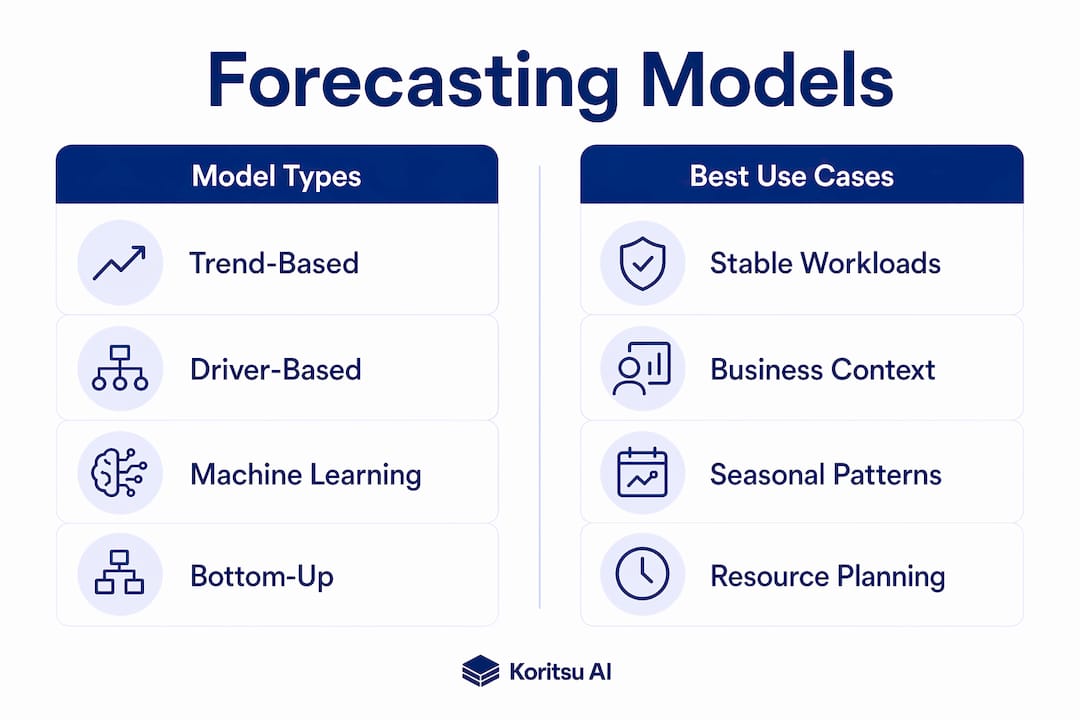
Four core forecasting models underpin cloud spend forecasting, and each suits a different business context. Choosing the wrong one is one of the most common reasons forecasts miss their targets.

Trend-based forecasting extrapolates historical billing data into the future. Trend-based forecasting uses 12–18 months of historical data to project a growth curve. It works well for stable workloads with predictable, linear growth, but it fails the moment a product launch or infrastructure migration disrupts the pattern.
Driver-based forecasting layers business context on top of historical spend. Driver-based models incorporate business events such as product launches, migrations, and capacity changes to model specific cost drivers. This approach is far more accurate for growing products because it connects cloud costs directly to the decisions that cause them.
Machine learning forecasting detects seasonality, cyclical patterns, and complex correlations that simpler models miss. ML forecasting requires 12 or more months of clean billing data to produce reliable results. Without that history, the model has too little signal to work with.
Bottom-up forecasting builds cost estimates from unit economics or resource plans. An engineering team estimates the number of compute instances, storage volumes, and data transfer costs for a given project, then prices each component individually. This method is the most granular and the most labour-intensive, but it produces the most defensible numbers for new workloads with no billing history.
| Model | Best suited for | Key limitation |
|---|---|---|
| Trend-based | Stable, mature workloads | Breaks down during growth or change |
| Driver-based | Growing products with planned events | Requires accurate business input data |
| Machine learning | Complex, seasonal workloads | Needs 12+ months of clean billing data |
| Bottom-up | New workloads, greenfield projects | Time-intensive to build and maintain |
Most finance teams achieve the best results by blending models. You might use trend-based forecasting for a stable legacy service, driver-based for a product in active development, and bottom-up for a new workload with no history. Treating all cloud spend as one aggregate number is where accuracy breaks down.
Pro Tip: Break your cloud estate into logical scopes before choosing a model. A single forecasting method applied to your entire AWS or Azure account will almost always underperform a blended approach applied per project or service.
How accurate should cloud budget forecasts be?
Accuracy targets for cloud spend forecasting depend on the maturity and stability of the workload. A ±5% variance is achievable for stable SaaS products. A ±10% variance is a reasonable target for growing products with active development. A forecast variance above 15% signals that the forecasting method itself needs to change, not just the inputs.
That 15% threshold is a useful diagnostic. If your team consistently misses by more than 15%, the problem is structural. You are either using the wrong model, missing a key cost driver, or failing to account for pricing commitment changes.
Confidence intervals improve forecast quality significantly. Rather than presenting a single number, a well-constructed forecast expresses uncertainty as a range. Confidence intervals provide forecast bands such as £42,000–£48,000 at 80% confidence, reflecting real uncertainty rather than false precision. Finance leaders who receive a single point estimate are making decisions on incomplete information.
The operational practices that sustain accuracy are just as important as the model itself:
- Conduct weekly variance reviews to catch anomalies before they compound into large budget overruns.
- Reforecast monthly to incorporate new usage data, pricing changes, and updated business plans.
- Decompose forecasts by project or team rather than presenting a single account-wide total. Single-point total forecasts fail to explain the causes of variance when actuals diverge.
- Document assumptions explicitly so that when a forecast misses, the team can identify which assumption broke down.
Pro Tip: Present forecasts to finance stakeholders as ranges with confidence levels, not single figures. A range of £42,000–£48,000 is more honest and more useful than a single £45,000 estimate, and it builds credibility when actuals land within the band.
Weekly variance reviews combined with monthly reforecasting create a continuous feedback loop that keeps forecasts aligned with operational reality. Teams that treat forecasting as a quarterly exercise lose that feedback loop entirely.
What are the common pitfalls in cloud budget forecasting?
The most damaging forecasting mistakes are not mathematical errors. They are process failures. Understanding them is the first step to avoiding them.
Forecast variance is most often caused by unmodelled pricing commitment changes, such as expiring Savings Plans or Reserved Instance shifts, rather than inaccurate usage estimates. Explicitly modelling these factors is required for reliable accuracy.
Pricing commitments affect forecast accuracy in ways that catch teams off guard. A Savings Plan expiring mid-year can increase effective spend by 20–30% overnight, with no change in actual usage. If your forecast model does not explicitly account for commitment schedules, it will miss this entirely.
The other common pitfalls are:
- Forecasting at the wrong level of granularity. A single account-wide forecast tells you very little. When actuals diverge, you cannot identify which project or team drove the variance. Forecasting by project or team scope is the only way to explain and manage variances effectively.
- Treating forecasting as a one-time event. Annual or quarterly forecasting cycles are incompatible with the pace of cloud cost change. Pricing updates, architectural changes, and business pivots all affect cloud spend within weeks, not quarters.
- Ignoring uncertainty. Single-point forecasts create false confidence. When actuals miss the single number, stakeholders lose trust in the entire process. Confidence intervals prevent this by making uncertainty explicit from the outset.
- Failing to model new workloads separately. Blending a new, rapidly growing service into an aggregate trend model distorts the forecast for everything else. New workloads need their own bottom-up or driver-based model until they have sufficient billing history.
The underlying theme across all these pitfalls is the same. Cloud cost is not a technology problem. It is a process problem. The tools and data are available. The discipline to use them consistently is what separates teams that forecast well from those that do not.
How do you integrate cloud forecasting into financial planning?
Effective cloud financial management requires forecasting to be embedded in governance processes, not treated as a standalone finance exercise. The connection between forecasts, budgets, and operational decisions is what gives forecasting its value.
Forecasts support planning while budgets enforce accountability. The forecast tells you what cloud spend is likely to be. The budget sets the limit and triggers alerts when spend approaches it. Both are necessary, and they work together rather than in isolation.
A practical integration follows this sequence:
- Tag all cloud resources by project, team, and environment. Without accurate tagging, you cannot decompose costs by ownership, and forecasting at the project level becomes impossible. Tagging is the foundation of granular cloud financial management.
- Assign cost ownership to engineering and product teams. Finance cannot forecast cloud costs in isolation. The teams building and running the infrastructure hold the context needed to model driver-based changes. Cross-functional collaboration between engineering, finance, and product is not optional. It is the mechanism by which forecasts stay accurate.
- Connect forecasts to budget alerts. Set budget thresholds at the project level and configure automated alerts when spend reaches 80% and 100% of the forecast. This gives teams time to investigate and respond before an overrun becomes a crisis.
- Run monthly reforecasting as a formal process. Treat the monthly reforecast as a structured review, not an ad hoc update. Engineering leads present usage changes. Finance updates pricing assumptions. Product teams flag upcoming launches or decommissions. The output is a revised forecast with updated confidence intervals.
- Use forecasting insights to prioritise cost optimisation. When a forecast reveals that a specific service or project is tracking above budget, that is the signal to investigate rightsizing, reserved capacity, or architectural changes. Forecasting without a connected optimisation workflow produces insight without action.
Embedding these steps into a FinOps framework creates the governance structure that sustains forecast accuracy over time. Without that structure, forecasting reverts to a periodic exercise that loses relevance between cycles.
Key takeaways
Cloud budget forecasting delivers reliable results only when teams combine the right model for each workload, review variances continuously, and connect forecasts directly to budget governance and optimisation workflows.
| Point | Details |
|---|---|
| Choose models by workload type | Use trend-based for stable services, driver-based for growing products, and bottom-up for new workloads. |
| Target ±5–10% variance | A variance above 15% signals the forecasting method needs to change, not just the inputs. |
| Use confidence intervals | Present forecasts as ranges rather than single figures to reflect real uncertainty and build stakeholder trust. |
| Reforecast monthly | Weekly variance reviews and monthly reforecasting keep forecasts aligned with operational reality. |
| Tag resources by ownership | Accurate tagging by project and team is the foundation of granular, explainable cloud forecasting. |
Why most cloud forecasts fail before they start
I have worked with finance and engineering teams across organisations of every size, and the pattern is consistent. The forecast fails not because the model is wrong, but because the process around it is broken.
The most common barrier I encounter is data silos. Engineering teams hold the context about upcoming infrastructure changes. Finance teams hold the budget constraints. Product teams hold the roadmap that drives usage growth. When these groups do not share information in a structured, regular cadence, the forecast is built on incomplete assumptions from the start.
The second barrier is governance. Forecasting done once a year, or even once a quarter, is not forecasting. It is historical reporting dressed up as planning. Cloud spend changes week to week. A forecast that is not reviewed and updated at the same cadence is stale before it is even presented.
What I have seen work is treating the monthly reforecast as a non-negotiable cross-functional meeting. Not a finance exercise. Not an engineering task. A shared accountability process where each team brings its piece of the picture. When that discipline is in place, forecast accuracy improves quickly, and more importantly, the organisation starts making better decisions because of it.
The cloud cost culture that supports this kind of forecasting maturity does not happen by accident. It requires leaders who treat cloud financial management as a core operational capability, not a back-office function.
How Koritsu AI supports cloud budget forecasting
Koritsu AI combines an AI platform with hands-on expert guidance to give finance and engineering teams continuous visibility into cloud spend and forecast accuracy.
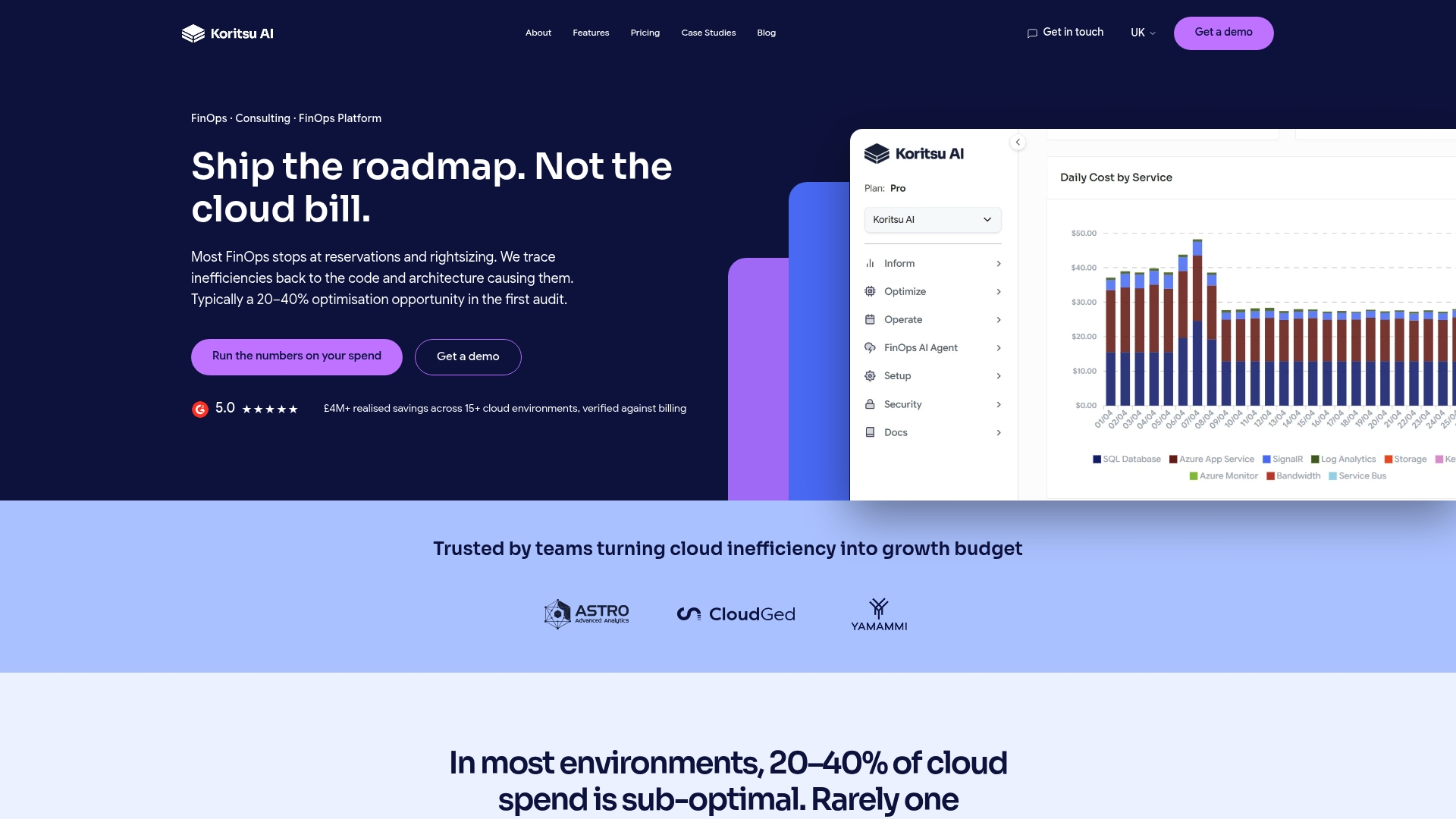
Kori, Koritsu AI's AI agent, continuously analyses cloud spending across AWS, Google Cloud, and Azure, surfacing variances and flagging where forecasts are drifting from actuals. The platform supports per-project cost decomposition, automated budget alerts, and ongoing reforecasting, so your team is never working from stale numbers. Koritsu AI's specialists work alongside your teams to act on what the data reveals, not just report it. Clients start with a free cloud assessment and pay only from the savings delivered. If you want to see what accurate, continuous cloud forecasting looks like in practice, the UK bidding platform case study shows a 52% cost reduction achieved through this approach.
FAQ
What is cloud budget forecasting?
Cloud budget forecasting is the process of estimating future cloud costs using historical spend data, usage trends, and business drivers. It sits within the FinOps framework and informs financial planning, budget setting, and cost optimisation decisions.
What forecast accuracy should finance teams expect?
Teams with mature FinOps practices achieve forecast accuracy within ±5–10% variance. A variance above 15% indicates the forecasting model needs to change rather than simply be refined.
What is the difference between a cloud forecast and a cloud budget?
A forecast predicts what cloud spend is likely to be based on data. A budget sets the approved spend limit and triggers alerts when that limit is approached. Both work together within a cloud financial management process.
How often should cloud forecasts be updated?
Cloud forecasts should be reviewed weekly for variance analysis and reforecast monthly to incorporate new usage data, pricing changes, and updated business plans. Annual or quarterly cycles are too infrequent for cloud environments.
Why do cloud forecasts miss their targets?
The most common cause is unmodelled pricing commitment changes, such as expiring Reserved Instances or Savings Plans, rather than inaccurate usage estimates. Forecasting at the total account level without per-project decomposition also hides the root causes of variance.