FinOps Inform
Triage Cloud Cost Root Causes in Hour One with FOCUS & AI, Engineers
Triage cloud cost spikes like outages. Capture hour one evidence, run CUR delta analysis, apply FOCUS billing schema, correlate telemetry, and verify savings.

When a cloud bill spikes, triage it like an outage: anchor the alert to a timeframe and scope, pull your Cost and Usage Report (CUR/CUR2), and get the likely owners on a call within the hour. That is hour one. By the end of week one, you should have a documented root cause, a post-mortem following the FinOps Framework's anomaly management approach, and a first remediation shipped. This is the standard approach applied when an AI agent flags an anomaly for a client.
TL;DR:
- Most unexpected cloud cost spikes originate from repeated causes such as unbounded autoscaling, orphaned resources, or increased logging costs, which can often be identified early.
- Effective investigation involves triaging, delta analysis, log correlation, owner identification, short-term mitigation, and a detailed post-mortem to prevent recurrence.
- Proper operational data, including resource metrics and consistent tagging, is crucial for quick root cause analysis, with standardized schemas aiding multi-cloud investigations.
- Immediate fixes should stop the damage, like throttling or shutting down resources, while medium-term actions focus on rightsizing, setting safe autoscaling limits, and implementing cost guardrails.
- AI tools continuously analyze billing and operations data to flag likely causes early and help implement verified, savings-driven solutions without upfront costs.
Common root causes of unexpected cloud cost spikes
Most cost spikes trace back to a small set of repeat offenders. Before you launch a full investigation, check these first: they resolve a large share of incidents without needing deep log correlation.
- A cron job or batch process that started running more often, or stopped terminating correctly.
- Autoscaling rules with no upper bound, often triggered by a traffic spike or a scaling loop feeding on its own metrics.
- Test or staging environments left running at production scale after a project wrapped up.
- Logging and observability costs climbing after a change to ingestion volume or retention settings.
- Data transfer charges from cross-region traffic or unoptimised egress paths.
- Orphaned resources: unattached volumes, idle load balancers, forgotten snapshots still accruing storage fees.
- A third-party or vended service changing its pricing or usage pattern without warning.
Anomaly detection tools typically rely on machine learning models that can run with a lag in some providers to confirm complete billing data, according to the FinOps Foundation's anomaly management guidance. That lag matters: do not assume an alert captures the full blast radius on day one. Start your check in the top contributors view of your cost explorer, sorted by delta rather than absolute spend, since the biggest mover is usually the fastest clue.
Practical investigation playbook: step-by-step
Once you know roughly where the spend is coming from, the investigation itself follows a repeatable sequence. Treat it the same way you would an application outage: evidence first, blame later.
- Triage. Capture the alert, the exact timeframe, the affected account or project, and the estimated cost impact. Pause any automated remediation that might delete or restart resources before you have evidence.
- Pull billing exports. Run a delta analysis on your CUR or CUR2 data, grouped by account, tag, service and usage type, to isolate which line items actually moved.
- Correlate with telemetry. Match the billing delta against VPC Flow Logs, DNS query logs, CloudTrail or equivalent audit logs, and infrastructure metrics. This is the step that turns "spend went up" into "this resource did it". AWS's own guidance on tracing billing charges through log correlation describes a four-step method: CUR analysis, flow log correlation, DNS mapping, then root-cause synthesis, built specifically for tracing Data Transfer Out charges.
- Identify the owner. Use tags, IAM principals or deployment pipeline metadata to find who is responsible, then contact them with the specific evidence rather than a vague "costs are up" message.
- Mitigate short-term. Apply a throttle, cap, or scheduled shutdown that stops the bleeding without destroying the evidence you might need for the post-mortem.
- Run the post-mortem. Record the hypotheses tested, the evidence for each, the mitigation applied, and the durable fix. AWS Cost Anomaly Detection's enhanced root-cause analysis now attributes dollar contributions across up to ten dimensions such as service, account, region and usage type, which gives you a structured starting point for exactly this kind of record.
They save the next engineer from repeating your dead ends.
Operational signals, schemas and data you must collect
Fast root cause analysis depends on having the right data in the right shape before the incident starts, not scrambling to find it mid-investigation.
A coherent billing export matters more than people expect. The FOCUS specification defines a common schema, including columns like BilledCost and EffectiveCost, so that delta analysis and amortised cost accounting work the same way across providers. Without it, every multi-cloud investigation starts with a translation problem.
- Resource-level metrics, VPC Flow Logs, DNS query logs and CloudTrail or audit logs, mapped to the billing line items they generate.
- Consistent tag keys covering owner, environment, team and service, enforced at creation rather than retrofitted.
- A recovery process for untagged resources: deployment pipeline metadata or IAM principal history can often reconstruct ownership when tags are missing.
- A plan for common gaps like sparse tagging or flattened billing exports: backfilling tags, scoping projects, or building smart views to compensate.
- Tracked KPIs: number of anomalies, cost impact per anomaly, and mean time to resolution for cost incidents.
Immediate mitigations and durable remediations
The fix you apply in hour one is rarely the fix that prevents a repeat. Keep the two separate.
Short-term, you are stopping the damage: throttle the offending service, schedule shutdowns for non-production environments outside working hours, revert the change that triggered the spike, or temporarily raise your budget alert threshold so you are not firefighting two problems at once.
Medium and long-term, you are closing the gap that allowed it: rightsizing instances, setting autoscaling policies with sane upper bounds, routing traffic through VPC endpoints to avoid unnecessary egress, capping log ingestion and retention, and adding cost guardrails to CI/CD pipelines so the same misconfiguration cannot ship twice.
- Enforce a tag policy with validation at deployment, not as a quarterly clean-up exercise.
- Build a standing playbook for cost anomalies and route alerts into the same incident management system you use for outages.
- Validate every fix against a before and after billing delta, using amortised cost where reservations or commitments are in play.
Cost Anomaly Detection's root-cause attribution links findings directly to Cost Explorer, according to AWS, which makes it straightforward to confirm a fix actually worked rather than assuming it did.
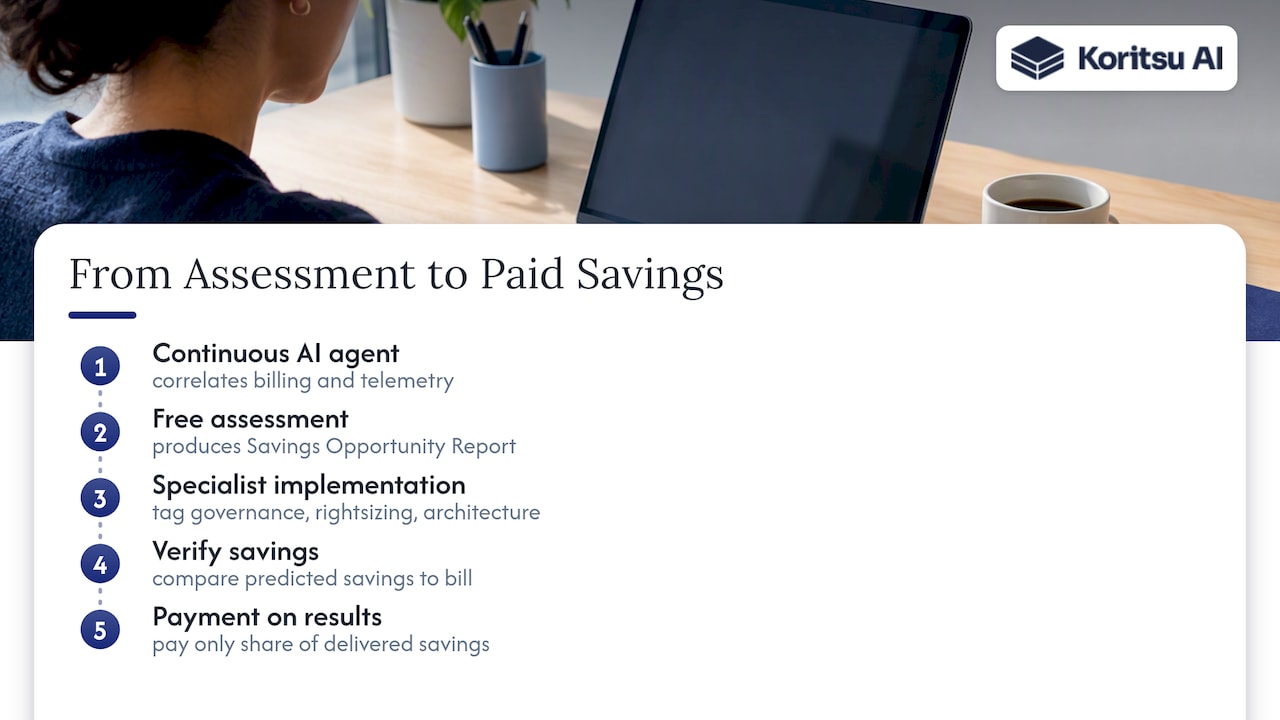
An AI agent continuously correlates billing data with operational telemetry to surface likely root causes before they become a crisis, the same correlation work described in step three above, run at scale. Clients start with a free assessment that becomes a Savings Opportunity Report, then specialists implement the fix directly, whether that is tag governance, rightsizing, or a deeper architectural change, and verify the saving against the actual bill. Payment is only required as a share of savings actually delivered.
A short engineering leader perspective
Cost incidents deserve the same discipline as outages: a named owner, a timed response, a written post-mortem. Treat anomalies as something to fix once, not something to re-discover every quarter.
Getting hands-on help when the root cause is architectural
Spotting a spike is the easy part. Tracing it to the exact service, team and architectural decision behind it is where most in-house efforts stall, and where generic dashboards tend to stop short. This approach pairs continuous analysis with engineers who implement the fix and verify the result against the actual bill, with no upfront cost: payment is a share of what is genuinely saved.
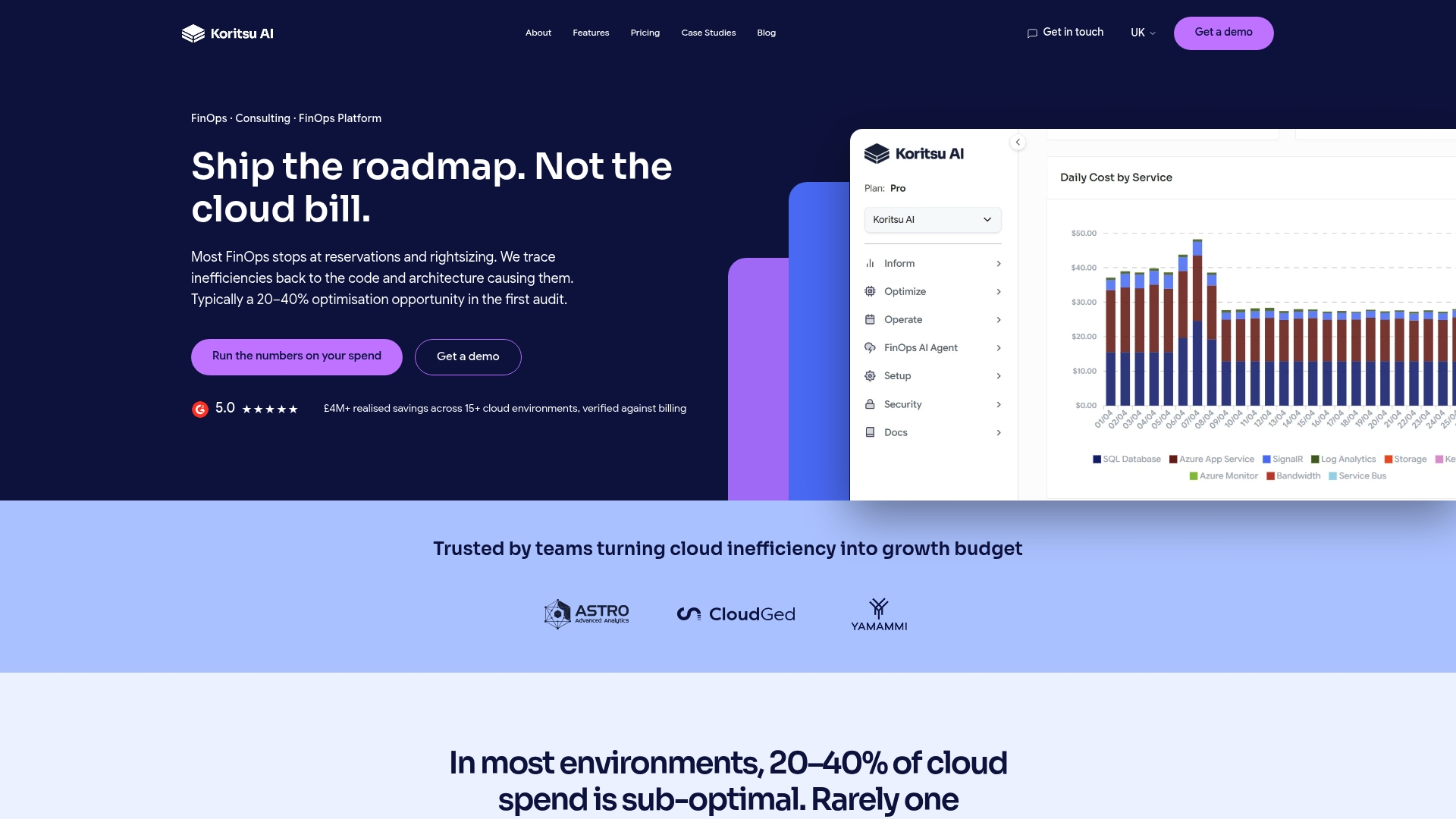
If you want a concrete starting point, request a Savings Opportunity Report to see what Koritsu's platform and specialists find in your own billing data, or review the success-fee pricing model before you start.
FAQ
How to reduce cloud costs?
Reducing cloud costs reliably means pairing detection with execution: find the anomaly, trace it to a resource and owner, then fix the underlying configuration rather than just the symptom. Durable savings tend to come from rightsizing, autoscaling guardrails, and fixing egress paths, not one-off discount hunting.
What are 5 disadvantages of cloud storage?
Common drawbacks include unpredictable costs from usage-based pricing, data transfer and egress charges that are easy to underestimate, dependency on a provider's availability and pricing changes, the risk of orphaned resources quietly accruing charges, and the complexity of allocating shared costs accurately across teams.
What are the four pillars of cost optimization in the cloud?
Definitions vary across frameworks, but a widely used version from the FinOps Foundation groups cost optimisation around visibility, allocation, optimisation and governance, with anomaly management sitting inside the operate phase. Most mature FinOps programmes treat these as ongoing capabilities rather than a one-time checklist.
Why is cloud more expensive than on premise?
Cloud costs often exceed expectations because usage-based pricing punishes inefficiency that a fixed on-premise budget would hide, including idle resources, unoptimised scaling and unmonitored data transfer. The gap usually comes from how the infrastructure is built and run, not from the cloud provider's base pricing.