FinOps Inform · Cloud Governance
Cloud environment management best practices for 2026
Discover essential cloud environment management best practices for 2026. Control costs, enhance security, and boost operational stability today!

Cloud environment management is defined as the set of processes, policies, and tools that govern how organisations provision, monitor, secure, and optimise resources across AWS, Google Cloud, Azure, and multi-cloud estates. Without a disciplined approach, cloud costs spiral, security gaps widen, and engineering teams spend more time firefighting than building. The cloud cost problem is not a technology problem. It is a process problem. Applying cloud environment management best practices gives IT leaders a repeatable framework to control spend, enforce compliance, and maintain operational stability at scale.
1. Why automation is the cornerstone of cloud environment management
Automation is the single most effective lever for reducing manual errors and operational toil in cloud infrastructure management. Infrastructure as Code (IaC) tools such as Terraform and AWS CloudFormation let teams define environments declaratively, so every deployment is consistent and auditable. Without IaC, configuration drift accumulates silently until it causes an outage or a compliance failure.

Policy as Code takes automation further by enforcing compliance at the pipeline level. When a developer attempts to deploy an unencrypted database, Policy as Code blocks it automatically, removing the need for manual audits after the fact. Manual audits are insufficient because developers will bypass non-automated controls unless the platform blocks non-compliance by design.
Automated cleanup policies are equally critical. Test environments should self-destruct after 30 days unless renewed, with tagging policies enforced at the service control policy and CI/CD pipeline levels. This single practice eliminates a large category of idle resource spend that accumulates invisibly over months. For a detailed breakdown of what idle resources look like in practice, the Koritsu AI guide on idle cloud resources is worth reading.
Key automation practices to implement:
- IaC for all environment provisioning, with version control in Git
- Policy as Code integrated into CI/CD pipelines for real-time compliance blocking
- Automated shutdown schedules for non-production workloads outside business hours
- Self-destructing test environments with mandatory renewal workflows
- Automated drift detection alerts tied to source control changes
Pro Tip: Use self-service infrastructure catalogues to balance agility and governance. Self-service catalogues reduce the burden on central platform teams while maintaining control over configuration and compliance standards.
2. Continuous monitoring and configuration management
Unified observability is the foundation of healthy cloud infrastructure management. Fragmented logs should be consolidated into dashboards that correlate metrics across multi-cloud estates, enabling early detection of performance degradation before it becomes an outage. A single pane of glass across AWS CloudWatch, Google Cloud Monitoring, and Azure Monitor is not a luxury. It is a baseline requirement.
Configuration management goes beyond monitoring. It requires setting documented baselines, running continuous discovery scans, and linking every configuration change to a source control commit. Continuous discovery and real-time monitoring prevent costly remediations during audit season and improve system reliability. The teams that get this right treat audit season as a routine check rather than a crisis.
Configuration drift is the silent killer of cloud stability. A resource that deviates from its baseline state creates unpredictable behaviour and security exposure. Drift detection should be a continuous, real-time signal integrated into operational workflows, not a quarterly review item.
Core monitoring and configuration practices:
- Unified dashboards correlating logs, metrics, and traces across all cloud providers
- Configuration baselines documented and version-controlled in source control
- Continuous discovery scans to detect unauthorised or unexpected changes
- Scored compliance alerts with automatic remediation workflows
- Change management processes that link every infrastructure change to a ticket or commit
Pro Tip: Use Configuration Management Database (CMDB) tools with native cloud integrations for real-time state tracking. This turns configuration reconciliation from a manual exercise into an automated, continuous process.
3. Cost optimisation as a continuous operational discipline
Rightsizing is the practice of matching cloud resource capacity to actual workload demand. Automated scans identify idle or oversized resources monthly or quarterly, enabling dynamic resizing or decommissioning. Treating rightsizing as a one-time project is one of the most common and costly mistakes engineering teams make. Workloads change, and capacity decisions made six months ago are frequently wrong today.
Tagging is the accountability mechanism that makes cost optimisation possible at scale. Tag enforcement at multiple pipeline and policy levels enhances visibility and accountability for spending. Every resource must carry tags for cost centre, owner, and environment. Without these, showback reports are guesswork and chargeback models collapse. For a deeper look at aligning spend to business outcomes, the Koritsu AI guide on cloud cost alignment covers the monthly and quarterly cadence in detail.
Automated budget alerts and showback dashboards close the loop between technical decisions and financial accountability. When an engineering team can see the cost of their choices in near real time, spending behaviour changes.
| Optimisation tactic | Primary cost impact |
|---|---|
| Rightsizing compute instances | Eliminates overprovisioned capacity |
| Automated idle resource shutdown | Removes spend on unused workloads |
| Reserved instance and savings plan coverage | Reduces on-demand pricing for stable workloads |
| Mandatory resource tagging | Enables accurate cost attribution and chargeback |
| Automated test environment cleanup | Prevents accumulation of forgotten non-production spend |
4. Establishing a cloud governance framework
A Cloud Centre of Excellence (CCoE) is the organisational structure that makes governance repeatable. Self-service templates such as landing zones for identity and access management (IAM) and logging reduce manual tickets and ensure governance is built into every new project from day one. Without a CCoE, governance becomes ad hoc, inconsistent, and impossible to audit.
Standardised landing zones embed security controls, IAM boundaries, and logging configurations into the starting point for every new workload. Teams get a pre-approved, compliant environment rather than building from scratch and hoping they got the security right. This approach produces fewer manual tickets, faster project starts, and stronger security by design.
The shared responsibility model must be clearly defined within any cloud governance framework. Cloud providers handle the security of the infrastructure. Your teams are responsible for everything they deploy on top of it. Blurring this boundary is where most compliance failures originate.
Successful organisations treat cloud governance as a strategic, living function rather than a static policy document. The CCoE continuously updates templates, reviews policies, and incorporates lessons from incidents and audits.
Key governance framework components:
- CCoE with clear ownership of policy, templates, and standards
- Standardised landing zones with embedded IAM, logging, and network controls
- Policy as Code integrated at the pipeline level to block non-compliant deployments
- Documented shared responsibility boundaries between cloud provider and internal teams
- Regular governance reviews tied to incident retrospectives and audit findings
5. Matching cloud management strategies to organisational context
No single set of cloud management strategies fits every organisation. A startup running a single AWS account has different priorities from a regulated financial services firm operating across three cloud providers. The table below maps common strategies to organisational context and cloud maturity.
| Organisation type | Cloud maturity | Priority practices |
|---|---|---|
| Startup or small team | Early stage | IaC from day one, basic tagging, cost alerts |
| Growing mid-size business | Intermediate | Rightsizing cadence, CCoE formation, Policy as Code |
| Large enterprise | Advanced | Full FinOps practice, multi-cloud observability, automated governance |
| Regulated industry | Any | Continuous compliance monitoring, audit trails, strict IAM boundaries |
The principle of incremental adoption applies regardless of size. Attempting to implement a full FinOps operating model, a CCoE, and Policy as Code simultaneously creates change fatigue and poor adoption. Start with the practices that address your most pressing pain point, whether that is runaway costs, compliance gaps, or operational instability, and build from there.
Fast-growing environments face a specific tension between speed and control. The answer is not to slow down deployment. The answer is to automate the guardrails so that speed and compliance coexist. Effective cloud management unites FinOps, SecOps, and DevOps disciplines into a single operational view. Organisations that keep these functions siloed pay for it in duplicated effort, conflicting priorities, and avoidable incidents.
Key takeaways
Effective cloud environment management requires automation, continuous monitoring, and disciplined cost governance working together as an integrated operational discipline rather than separate technical tasks.
| Point | Details |
|---|---|
| Automate provisioning and cleanup | Use IaC and Policy as Code to eliminate drift and enforce compliance at the pipeline level. |
| Monitor continuously, not periodically | Consolidate logs and metrics into unified dashboards to catch degradation before it causes outages. |
| Treat rightsizing as ongoing work | Run automated scans monthly or quarterly to match capacity to actual workload demand. |
| Tag every resource without exception | Enforce cost centre, owner, and environment tags at the pipeline level to enable accurate attribution. |
| Build governance into the starting point | Standardised landing zones and a CCoE ensure security and compliance are built in, not bolted on. |
From reactive firefighting to strategic discipline
The pattern I see most often is this: an engineering team builds fast, skips governance, and then spends the next 18 months paying for it in runaway costs, compliance scrambles, and fragile infrastructure. The technical fixes are rarely the hard part. The hard part is changing the operating model.
The organisations that genuinely get cloud management right are not the ones with the most sophisticated tooling. They are the ones that have integrated FinOps, SecOps, and DevOps into a shared operational view. Cost is not the finance team's problem. Security is not the security team's problem. These are engineering problems, and the teams that own them directly produce better outcomes.
AI-assisted analytics is changing what is possible here. Continuous analysis of spending patterns, configuration states, and compliance postures is no longer a manual exercise. The signal-to-noise ratio improves dramatically when AI surfaces the anomalies that matter rather than flooding teams with alerts they learn to ignore.
My honest advice: invest in your Cloud Centre of Excellence before you think you need one. The teams that wait until governance is broken spend far more fixing it than the teams that built it in from the start. Upskilling engineers in FinOps principles is not overhead. It is the fastest path to sustainable cloud operations.
— Kori
How Koritsu AI supports your cloud management practices
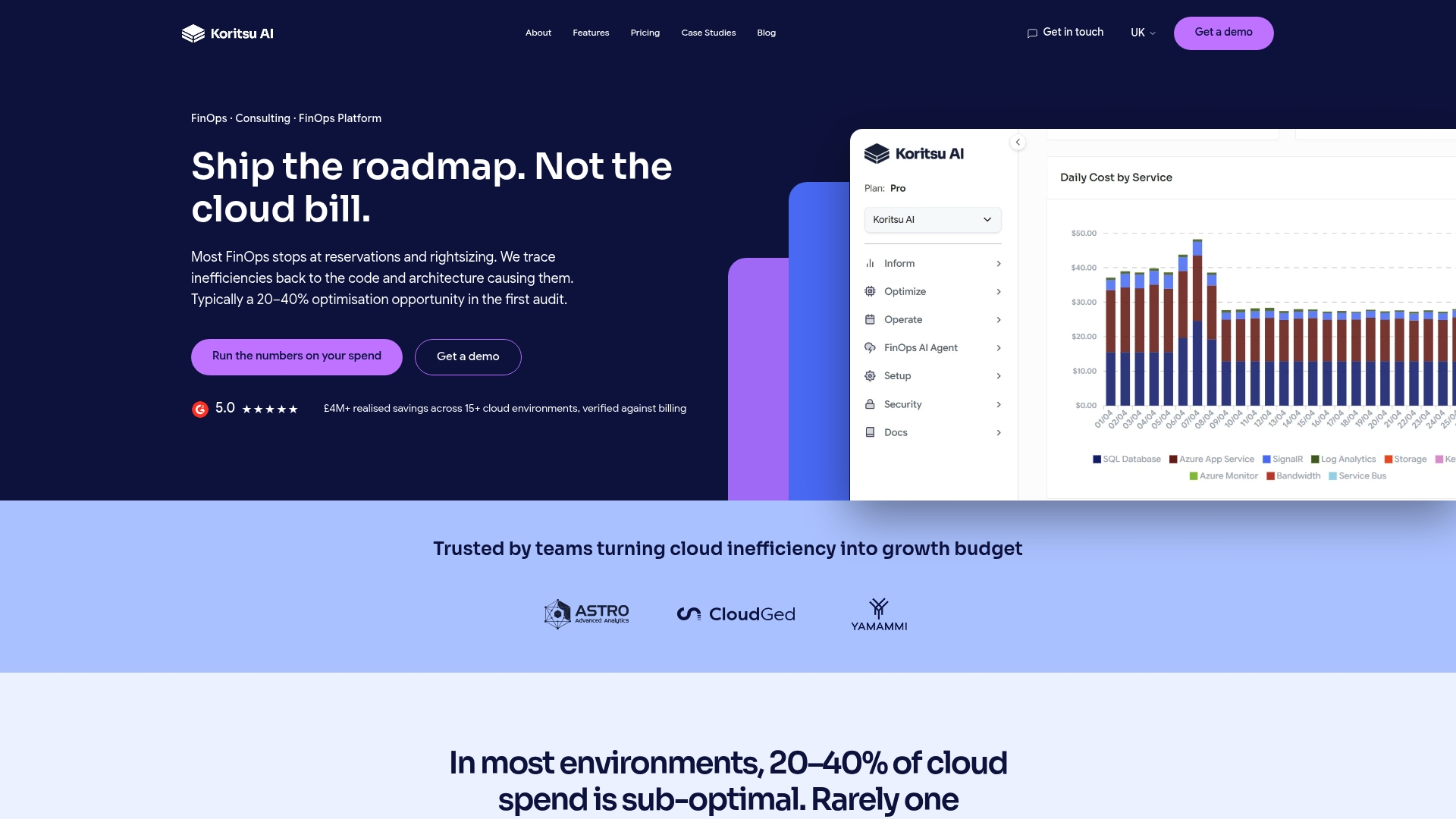
Most cloud cost problems are not visible until they are already expensive. Koritsu AI continuously analyses cloud spending across AWS, Google Cloud, and Azure, surfacing idle resources, overprovisioned instances, and tagging gaps that manual reviews miss. The AI agent Kori identifies exactly where money is being lost, and Koritsu AI's specialists help engineering teams act on those findings. Clients have achieved results such as a 52% reduction in cloud costs and a 96% cut in AWS Lambda spend. Koritsu AI charges only when it delivers savings. Start with a free assessment at koritsu.ai.
FAQ
What are cloud environment management best practices?
Cloud environment management best practices are the processes and policies that govern how organisations provision, monitor, secure, and optimise cloud resources. Core practices include Infrastructure as Code, Policy as Code, continuous rightsizing, mandatory tagging, and centralised governance through a Cloud Centre of Excellence.
How do I manage cloud resources to reduce costs?
Run automated rightsizing scans monthly or quarterly to identify idle or oversized resources, enforce mandatory tagging for cost attribution, and set automated budget alerts. Automated cleanup of non-production environments after a defined period, such as 30 days, removes a significant category of waste.
What is a cloud governance framework?
A cloud governance framework is a set of policies, standards, and controls that define how cloud resources are provisioned, secured, and managed across an organisation. It typically includes a Cloud Centre of Excellence, standardised landing zones, Policy as Code enforcement, and documented shared responsibility boundaries.
Why is Policy as Code important for cloud compliance?
Policy as Code automates compliance enforcement by blocking non-compliant deployments in real time at the pipeline level. Manual audits alone are insufficient because developers will bypass non-automated controls unless the platform prevents non-compliance by design.
How does rightsizing differ from a one-time cost review?
Rightsizing is a continuous operational discipline, not a one-time project. Workloads change constantly, so automated monthly or quarterly scans are required to match capacity to current demand and decommission resources that are no longer needed.