FinOps Inform · FinOps Framework
Cloud FinOps framework benefits: a practitioner's guide
Discover cloud FinOps framework benefits that can help your organization save 30-40% on cloud costs while enhancing performance. Learn more!

The cloud FinOps framework is defined as an operational model that unifies engineering, finance, and product teams around shared cloud cost ownership to maximise business value. Organisations implementing FinOps typically reduce cloud spending by 30 to 40% without degrading service performance. That figure is not a ceiling. It is a starting point for teams that treat cost management as a continuous discipline rather than a quarterly fire drill. The FinOps Foundation, Cloudaware, and Microsoft Cost Management each recognise the same core truth: cloud cost is not a technology problem. It is a process problem. This guide unpacks the top cloud FinOps framework benefits so you can build the case internally and act on it.
1. Measurable cost savings through waste elimination and rightsizing
The most direct advantage of a cloud FinOps framework is a reduction in cloud spend that shows up on the invoice within one to two budget cycles. Most organisations realise benefits within that window as roles, processes, and tooling mature together. The savings come from three specific levers: rightsizing over-provisioned compute, eliminating idle resources, and shifting to smarter pricing models such as reserved instances, savings plans, and spot instances.
The critical distinction is that FinOps embeds these optimisation activities into engineering workflows rather than treating them as ad-hoc projects. A team that reviews instance utilisation once per quarter will always lag behind actual spend. A team that has cost signals wired into its CI/CD pipeline catches waste before it compounds.
- Rightsizing: match compute, memory, and storage to actual workload demand using utilisation data, not estimates
- Reserved instances and savings plans: commit to predictable workloads on AWS, Azure, or Google Cloud to cut on-demand rates by 30 to 70%
- Spot and preemptible instances: run fault-tolerant batch workloads at a fraction of on-demand cost
- Idle resource termination: automate shutdown schedules for non-production environments outside working hours
- Storage tiering: move infrequently accessed data to lower-cost storage classes automatically
Pro Tip: Wire a cost-per-build metric into your CI/CD pipeline. When engineers see the cloud cost of each deployment alongside test results, rightsizing decisions happen at the point of change rather than weeks later in a finance review.
2. Improved financial visibility and forecasting accuracy

Poor forecasting is one of the most expensive problems in cloud financial management. Variance of 25% or more between forecast and actual spend is common in organisations without a FinOps practice. FinOps implementations reduce that variance to below 10%, which transforms budgeting from guesswork into a reliable planning input.
The mechanism is allocation. High-maturity FinOps implementations achieve a 90 to 95% allocation rate of cloud costs to specific teams, products, or cost centres. That level of precision means finance teams can hold engineering teams accountable to a budget line, and engineering teams can see exactly which services are driving their costs. The FinOps framework creates a unified operational model that ingests billing data from AWS, Azure, and Google Cloud into a single standardised model with metadata and daily deltas, removing the manual reconciliation that typically delays reporting by weeks.
| Metric | Without FinOps | With mature FinOps |
|---|---|---|
| Forecast variance | 25% or above | Below 10% |
| Cost allocation rate | 40 to 60% | 90 to 95% |
| Reporting lag | 2 to 4 weeks | Near real-time |
| Anomaly detection | Manual and reactive | Automated and proactive |
Pro Tip: Adopt a tagging standard before you buy any tooling. Without consistent tags across AWS, Azure, and Google Cloud resources, allocation models collapse into estimates. Start with five mandatory tags: team, environment, product, cost centre, and owner.
3. Shared accountability across engineering, finance, and product teams
The FinOps framework shifts cloud cost management from a centralised finance function into a shared responsibility distributed across every team that consumes cloud resources. FinOps frameworks embed cost accountability into team KPIs, which means engineers are measured partly on the efficiency of the infrastructure they build, not just the features they ship.
This cultural shift is where most of the long-term value lives. When a finance team owns the cloud bill in isolation, engineers have no incentive to write cost-efficient code. When engineers own their portion of the bill, the conversation changes. Architectural decisions, database choices, and deployment frequencies all get evaluated through a cost lens without requiring a finance approval gate.
"Successful FinOps implementation depends more on cultural change and shared accountability than on tools alone." — Cloudaware
The practical mechanism is cost signal routing. Actionable FinOps signals routed to real owners vastly improve cost responsiveness compared to generic monthly reporting. When an anomaly alert lands in the inbox of the engineer who deployed the workload rather than a central finance inbox, resolution happens in hours rather than weeks.
- Shared KPIs: tie engineering team performance metrics to cost-per-unit outcomes, not just raw spend
- Cost showback and chargeback: make each team's cloud consumption visible, whether or not you bill internally
- Anomaly routing: send cost alerts directly to the team or engineer responsible for the workload
- Regular cost reviews: embed a 30-minute cost review into sprint retrospectives rather than waiting for monthly finance reports
4. Governance and automated cost controls at scale
Manual governance does not scale. As cloud environments grow across multiple accounts, regions, and providers, the volume of cost decisions outpaces any centralised team's capacity to review them. The FinOps framework addresses this through policy-as-code governance, which automates cost controls via tagging rules, lifecycle schedules, and automatic shutdown policies.
The comparison between traditional and FinOps-governed environments is stark:
| Governance dimension | Traditional approach | FinOps automated controls |
|---|---|---|
| Tagging compliance | Manual audits, low coverage | Enforced at resource creation via policy |
| Idle resource management | Periodic manual review | Automated shutdown schedules |
| Budget breach response | Monthly finance review | Real-time alert with owner routing |
| Region and service restrictions | Spreadsheet-based approval | Infrastructure-as-code guardrails |
| Compliance alignment | Separate audit process | Embedded in cost governance layer |
Automated governance also reduces cloud sprawl, the accumulation of forgotten resources, orphaned snapshots, and unattached volumes that silently inflate the bill. When lifecycle policies are enforced by code rather than by process, sprawl is contained structurally rather than managed reactively. This is particularly relevant for enterprises running workloads across AWS, Azure, and Google Cloud simultaneously, where manual oversight across three billing models is practically impossible. You can read more about aligning cloud costs with business outcomes to understand how governance feeds directly into strategic planning.
5. Better unit economics and business value alignment
Mature FinOps practitioners move beyond raw invoice reduction and normalise costs by unit metrics such as cost per customer, cost per transaction, or cost per API call. This reframes the conversation from "how do we spend less?" to "how do we spend efficiently relative to the value we deliver?" That distinction matters enormously for product and engineering leadership.
A team that reduces cloud spend by 20% while growing revenue by 40% has improved its unit economics dramatically, even though the absolute bill is higher. Without unit cost metrics, that story is invisible in a standard finance report. With them, it becomes a competitive advantage that leadership can track and reward.
FinOps is not just about cutting costs but about maximising overall business value by balancing cost with performance and reliability. This framing is what separates a mature FinOps practice from a cost-cutting exercise. It also makes FinOps a strategic function rather than a finance overhead, which is the argument you need to make internally to secure the investment in tooling, headcount, and process change.
6. How to adopt the FinOps framework for maximum benefit
Implementing FinOps is not a tool purchase. It is an organisational change that requires sequenced steps to avoid the most common failure mode: treating FinOps as reactive reporting rather than a continuous operational discipline.
- Establish cost ownership first. Before selecting tools, define which team owns which cloud resources. Without clear ownership, allocation models are arbitrary and accountability is impossible.
- Implement a tagging standard. Apply mandatory tags across all resources in AWS, Azure, and Google Cloud. This is the foundation of every allocation, chargeback, and anomaly routing capability that follows.
- Build a unified cost model. Use tools such as Cloudaware or Microsoft Cost Management to ingest billing data from all providers into a single model with daily granularity. Avoid monthly snapshots; they hide the patterns that drive waste.
- Embed cost reviews into engineering workflows. Add cost metrics to sprint reviews, deployment dashboards, and architecture decision records. Cost should be a first-class engineering concern, not a finance afterthought.
- Start with showback before chargeback. Show teams their costs before you bill them internally. This builds trust and gives teams time to understand and act on their consumption before financial consequences apply.
- Automate governance progressively. Begin with tagging enforcement and idle resource shutdown. Add budget alerts with owner routing. Graduate to policy-as-code guardrails as the practice matures.
- Measure and iterate. Track forecast variance, allocation rate, and cost-per-unit metrics each sprint. The paradigm shift from rigid IT budgeting to dynamic, variable-cost models only succeeds when the measurement cadence matches the pace of cloud change.
If you are questioning whether your current approach qualifies as FinOps at all, the article FinOps isn't what you think it is is worth reading before you invest further in tooling.
Key takeaways
The cloud FinOps framework delivers measurable cost reductions, precise financial accountability, and shared ownership across engineering and finance by treating cloud cost as a continuous operational discipline rather than a periodic reporting exercise.
| Point | Details |
|---|---|
| Cost reduction potential | Organisations typically reduce cloud spend by 30 to 40% through rightsizing, waste elimination, and smarter pricing. |
| Allocation accuracy | Mature FinOps practices achieve 90 to 95% cost allocation, enabling genuine team-level accountability. |
| Forecasting improvement | Forecast variance drops from above 25% to below 10% with a structured allocation and tagging model in place. |
| Cultural change is primary | Tools accelerate FinOps, but shared accountability embedded in team KPIs is what sustains it. |
| Adoption timeline | Most organisations see tangible benefits within one to two budget cycles of structured FinOps adoption. |
Why culture beats tooling every time in FinOps
I have seen organisations spend six figures on cloud cost management platforms and still fail to reduce their bill. The tools were fine. The problem was that nobody had agreed on who owned what. Engineers assumed finance would handle it. Finance assumed engineering would flag issues. The bill kept growing.
The biggest hurdle in FinOps adoption is cultural friction, and the fix is not a better dashboard. It is empowering engineering teams with genuine cost ownership rather than imposing centralised controls that they will route around. When engineers see their cloud costs the same way they see their test coverage or deployment frequency, the behaviour changes without mandates.
What I find most underappreciated is the operational control loop framing. FinOps frameworks evolve from reactive reporting into real-time operational control loops embedded in daily engineering workflows and CI/CD pipelines. That is not a minor upgrade from monthly finance reviews. It is a fundamentally different operating model. Teams that reach this maturity level do not just spend less. They spend with precision, and they can defend every pound on the bill in terms of business value delivered.
The future of this discipline sits at the intersection of FinOps and AI-driven analysis. Platforms that surface anomalies, predict spend trajectories, and recommend architectural changes in real time are compressing the feedback loop further. The organisations that will win are those building the cultural foundation now, so they can absorb and act on those signals when they arrive.
See the FinOps framework benefits in your own environment
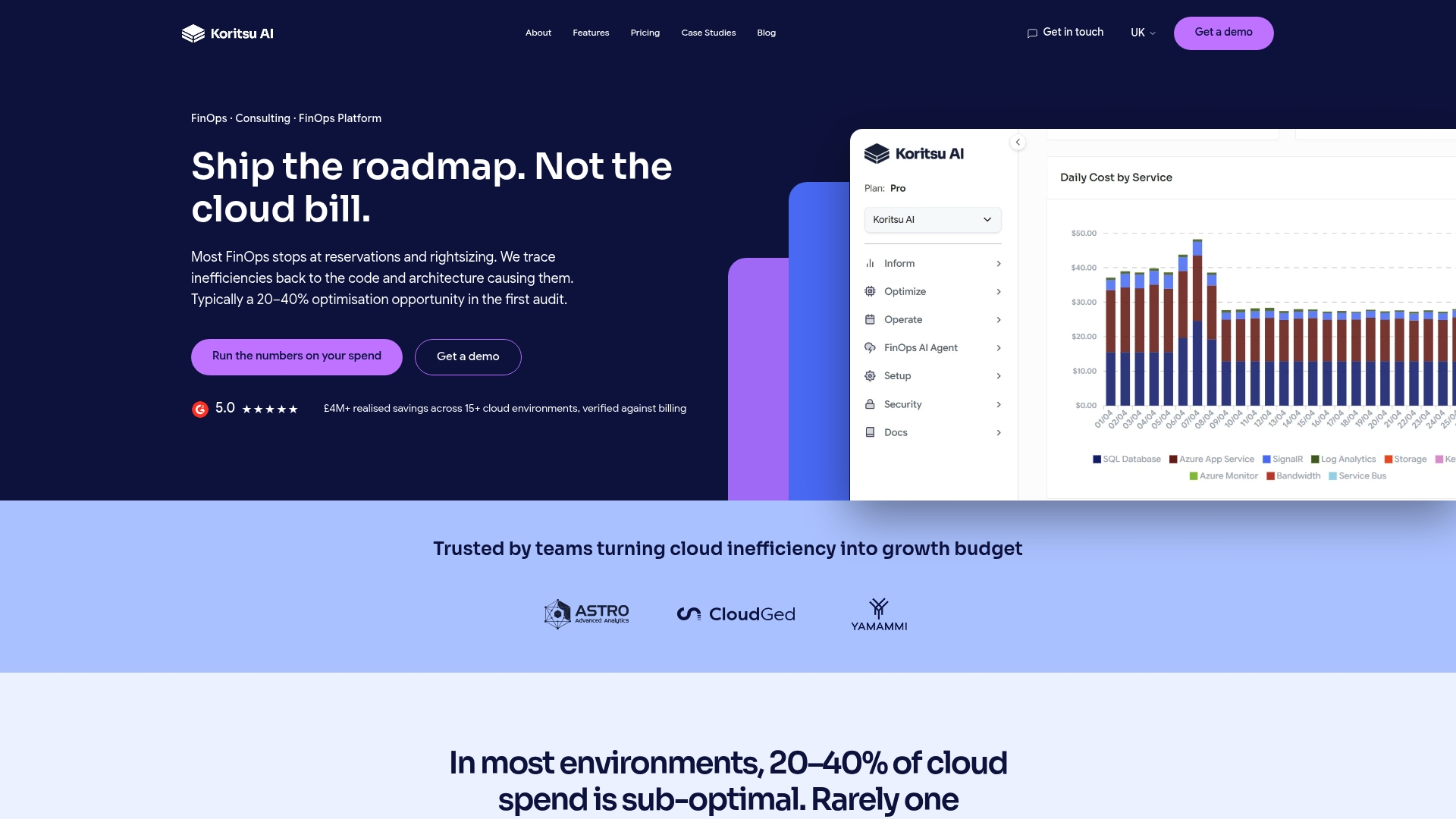
Koritsu AI combines an AI platform with hands-on engineering expertise to surface and fix the cloud inefficiencies that standard FinOps tooling misses. Kori, our AI agent, continuously analyses your AWS, Azure, or Google Cloud spend and identifies where money is being lost at the infrastructure and code level. Our specialists then work directly with your engineering teams to act on those findings. One UK bidding platform achieved a 52% reduction in cloud costs using this approach. You start with a free assessment, and we take a share of the savings we actually find. Explore our cloud cost optimisation services to see what is possible for your organisation.
FAQ
What are the main cloud FinOps framework benefits?
The primary benefits are a 30 to 40% reduction in cloud spend, improved forecast accuracy, and shared cost accountability across engineering and finance teams. These outcomes depend on establishing clear ownership, consistent tagging, and continuous cost reviews embedded in engineering workflows.
How long does it take to see results from implementing FinOps?
Most organisations see measurable benefits within one to two budget cycles after adopting FinOps, as roles, processes, and tooling reach operational maturity. Early wins from rightsizing and idle resource elimination often appear within the first 30 to 60 days.
What is the difference between FinOps and traditional cloud cost management?
Traditional cloud cost management is typically reactive, centralised, and reported monthly. FinOps is a continuous operational discipline that routes cost ownership to engineering teams, automates governance through policy-as-code, and embeds cost signals directly into delivery workflows.
Which tools support a cloud FinOps framework?
Cloudaware and Microsoft Cost Management are widely used platforms for unifying billing data across AWS, Azure, and Google Cloud into a single allocation model. The right tooling depends on your provider mix, team structure, and the maturity stage of your FinOps practice.
Why does cost allocation matter so much in FinOps?
Without accurate cost allocation, accountability is impossible. High-maturity FinOps implementations achieve 90 to 95% allocation of cloud costs to specific teams, which is the foundation for chargeback, anomaly routing, and meaningful budget conversations between engineering and finance.