FinOps Inform · FinOps Framework
Cloud FinOps programme launch: your 8-week guide
Discover how to effectively execute a cloud FinOps programme launch in just 8 weeks. Optimize costs and align your finance and engineering teams.

A cloud FinOps programme launch is the structured process by which engineering organisations move from reactive cloud billing to active, measurable cost governance. Done correctly, it cuts waste, aligns finance and engineering teams, and creates a repeatable system for managing cloud spend on AWS, Google Cloud, or Azure. The FinOps Foundation 2026 Framework defines this as a phased operating model covering visibility, optimisation, and governance. Tools like Google Cloud's Gemini Cloud Assist, the AWS FinOps Agent, and Noros now accelerate each phase with AI-driven analysis. This guide gives CTOs and engineering leaders a concrete plan to execute that launch in eight weeks.
What do you need before launching a cloud FinOps programme?
FinOps is fundamentally an organisational and cultural operating model, not a tooling problem. That distinction matters before you spend a day configuring dashboards. Without executive sponsorship and a named FinOps lead, even the best tooling produces reports that nobody acts on.
On the technical side, your baseline stack must include native cost data exports from each provider you run. For AWS, that means enabling the Cost and Usage Report (CUR). For Azure, you need Azure Cost Management exports. For Google Cloud, you need BigQuery billing exports feeding into Cloud cost reports. These are non-negotiable inputs. Without them, you have no reliable baseline to measure against.

Tagging is equally critical and frequently underestimated. Every resource must carry consistent metadata: team, environment, product, and cost centre at minimum. A mature enterprise FinOps stack combines these native tools with dashboards, rightsizing recommendations, reservation management, anomaly detection, and tagging enforcement. You do not need expensive third-party platforms to start. You need discipline and consistency.
| Tool | Provider | Primary function |
|---|---|---|
| AWS Cost and Usage Report | AWS | Granular spend data export |
| Azure Cost Management | Azure | Budget tracking and anomaly alerts |
| Google Cloud Billing Export | Google Cloud | BigQuery cost data for analysis |
| Gemini Cloud Assist | Google Cloud | AI-driven cost visibility and reporting |
| AWS FinOps Agent | AWS | Real-time anomaly detection and routing |
| Noros | Multi-cloud | Continuous cost syncing and KPI tracking |
Pro Tip: Set tagging policies as infrastructure-as-code from day one. Retrofitting tags across hundreds of resources after launch is one of the most time-consuming tasks a FinOps team faces.
How to execute the 8-week cloud FinOps launch roadmap
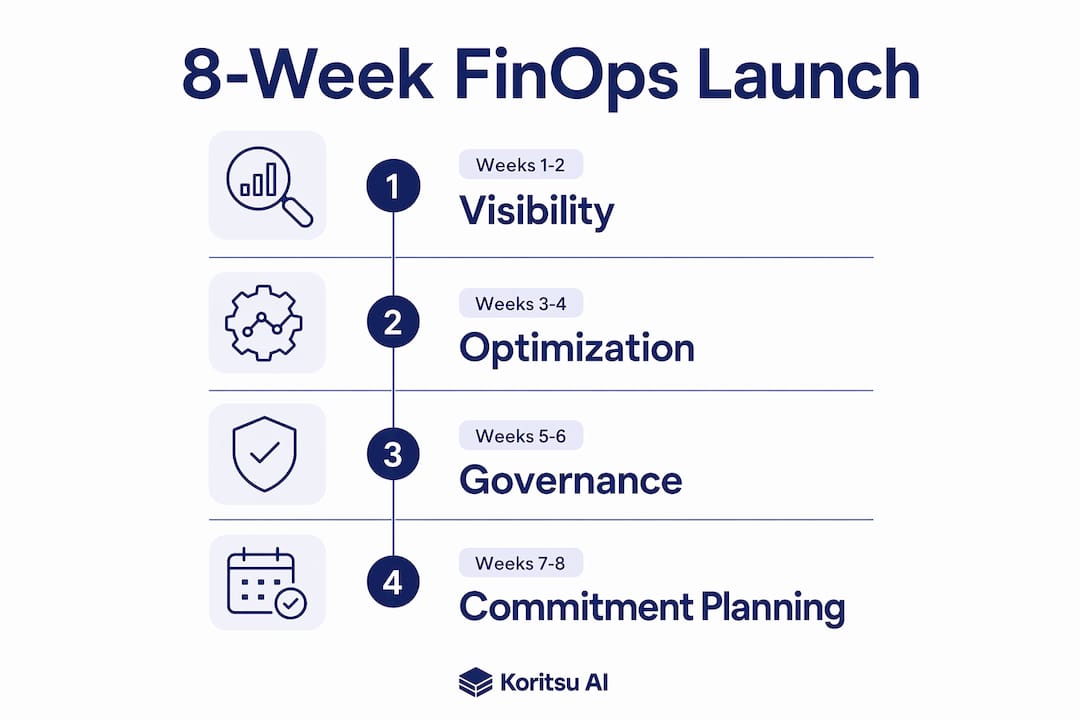
Effective FinOps launch roadmaps typically span eight weeks, with each phase building on the last. Skipping phases is the most common reason programmes stall after the first month.
-
Weeks 1–2: Visibility baseline. Enable cost data exports across all providers. Build a single dashboard that shows spend by team, service, and environment. Identify your top ten cost drivers. At this stage, you are not fixing anything. You are establishing the ground truth your team will use for every decision that follows.
-
Weeks 3–4: High-impact optimisation. Target rightsizing first. Oversized compute instances are almost always the fastest win. Then move to commitment planning. Stable workloads benefit from reserved capacity or committed-use discounts yielding 30–50% savings versus on-demand pricing. That is not a marginal improvement. For a team spending £200,000 per month on cloud, that is £60,000–£100,000 back per month.
-
Weeks 5–8: Governance and reporting. Build budget alerts, establish a weekly cost review cadence, and assign cost ownership to each engineering team. Create a reporting framework that surfaces anomalies before they compound. This phase is where FinOps becomes a habit rather than a project.
| Phase | Weeks | Key deliverable |
|---|---|---|
| Visibility baseline | 1–2 | Unified cost dashboard, top-10 cost drivers identified |
| Optimisation | 3–4 | Rightsizing complete, commitment plan in place |
| Governance | 5–8 | Budget alerts live, weekly review cadence established |
Common pitfalls during execution include treating week one as optional, skipping commitment planning because it feels complex, and failing to assign named owners to cost centres. Each of these delays the point at which your programme produces measurable results.
Pro Tip: Run a "cost spike" simulation in week two. Deliberately create an untagged resource and verify your alerting catches it. If it does not, fix the gap before you go live with governance.
What role do AI FinOps agents play in cloud financial management?
The industry is shifting from periodic manual reviews to continuous, event-driven AI governance that automates cost management and routes findings instantly. This is not a future trend. It is already available and deployed by engineering teams running mature FinOps practices.
AI-powered FinOps agents like the AWS FinOps Agent and Noros provide real-time anomaly detection, root cause analysis, and automated alert routing directly to the teams responsible for the spend. That last point is the one most organisations miss. Routing a cost alert to a central FinOps inbox is far less effective than routing it to the Slack channel of the team that owns the workload.
Noros continuously syncs cost data across providers, tracks KPIs, and surfaces anomalies proactively. It answers cost questions in real time and improves its recommendations as it learns your environment. Google Cloud's Gemini Cloud Assist takes a similar approach: integrating it drives 75% higher cost reporting adoption and reduces manual analysis time by 18%. Higher adoption means more engineers actually using cost data in their daily decisions.
FinOps agents integrate with DevOps tools like Slack and Jira to deliver near-real-time alerts and cost insights directly to engineers. This closes the loop between detection and action without requiring a central team to triage every finding.
Leading AI FinOps agents and their primary differentiators:
- AWS FinOps Agent: Native AWS integration, real-time anomaly detection, automated routing to responsible teams
- Noros: Multi-cloud continuous syncing, conversational cost queries, proactive KPI tracking
- Gemini Cloud Assist: Google Cloud native, AI-driven spend caps, measurably higher reporting adoption
Pro Tip: Connect your AI FinOps agent to your incident management workflow. A cost spike that triggers a Jira ticket alongside a Slack alert gets resolved in hours, not weeks.
What best practices and challenges should you expect after launch?
The hardest part of FinOps is shifting culture so engineers treat cloud cost as a key engineering metric, alongside latency and reliability. Most engineering teams are measured on delivery speed and system uptime. Cost is rarely in the performance review. That has to change for FinOps to stick.
Proving value early is the most reliable way to build that culture. Quick wins such as rightsizing and commitment adjustments in weeks 3–4 are essential for maintaining momentum. When a team sees a concrete cost reduction tied directly to their work, they engage. When they see only dashboards and reports, they disengage.
Continuous education matters as much as tooling. Cloud economics training for engineers does not need to be a formal course. A monthly 30-minute review where teams present their cost trends builds awareness faster than any workshop. Cross-team collaboration between finance, engineering, and product is equally necessary. FinOps breaks down when it lives only in one team's remit.
Common challenges to plan for:
- Tagging discipline erodes over time without automated enforcement
- Commitment planning requires confidence in workload stability, which new teams often lack
- Balancing delivery speed against cost awareness creates friction that needs active management
- Reporting fatigue sets in if dashboards are not tied to decisions and actions
"The cloud cost is not a technology problem. It is a process problem." This framing, widely cited in enterprise FinOps practice, captures why tooling alone never solves the challenge. The cultural and organisational shift is the work that determines whether your programme delivers lasting results.
Key takeaways
A successful cloud FinOps programme launch requires organisational alignment, native tooling, AI-driven agents, and a phased eight-week roadmap to move from cost visibility to sustained governance.
| Point | Details |
|---|---|
| Start with visibility | Enable AWS CUR, Azure Cost Management, and Google Cloud billing exports before touching optimisation. |
| Follow the eight-week roadmap | Phases covering visibility, optimisation, and governance produce measurable results within two months. |
| Use AI agents for continuous monitoring | Tools like the AWS FinOps Agent and Noros route anomalies to responsible teams in real time. |
| Treat culture as the hard problem | Engineers must measure cloud cost alongside latency and reliability for FinOps to become permanent. |
| Prove value early | Rightsizing and commitment discounts in weeks 3–4 deliver 30–50% savings on stable workloads. |
What I have learned from watching FinOps programmes succeed and fail
Most FinOps programmes I have seen fail do not fail because of tooling. They fail because the programme is treated as a finance initiative rather than an engineering one. When a FinOps lead sits in the finance team and sends monthly reports to engineering, nothing changes. When a FinOps lead sits in engineering and owns a weekly cost review with real consequences, things change fast.
The 2026 shift toward AI-driven cost governance is genuinely significant. The AWS FinOps Agent and Noros are not just faster dashboards. They change the feedback loop entirely. An engineer who receives a Slack alert about a cost anomaly in their service at 10am can fix it by noon. That same anomaly, surfaced in a monthly report, gets deprioritised indefinitely.
What I find most underappreciated is the scope expansion happening right now. FinOps programmes that launched to manage compute and storage costs are now being asked to govern AI and ML spend, which behaves very differently. GPU instance costs are volatile, training runs are unpredictable, and the teams running them often have no cost awareness at all. If your programme does not account for this, it will have a significant blind spot within twelve months.
Leadership engagement is the final variable. A CTO who asks about cloud cost efficiency in every engineering review creates a culture where cost matters. One who delegates it entirely to a FinOps team creates a culture where it does not. The benefits of AI-driven cloud analysis are real, but they only compound when leadership treats cost as a first-class engineering concern.
How Koritsu AI supports your cloud FinOps programme launch
Koritsu AI combines an AI platform with hands-on expert advice to help engineering teams find and fix cloud cost inefficiencies buried in how software and infrastructure were built. Kori, the AI agent, continuously analyses your cloud spend and surfaces where money is being lost. Specialists then help your team act on those findings.
One UK bidding platform achieved a 52% reduction in cloud costs working with Koritsu AI. The savings came from architectural inefficiencies, not from discount purchasing. Koritsu AI's engineering-grade FinOps services cover everything from initial assessment through to ongoing governance. Every engagement starts with a free assessment, and Koritsu AI charges only on the savings it actually delivers.
FAQ
What is a cloud FinOps programme?
A cloud FinOps programme is an operating model that gives engineering and finance teams shared ownership of cloud spend. It combines tooling, processes, and cultural practices to move from reactive billing to active cost governance.
How long does it take to launch a FinOps programme?
An effective launch takes eight weeks, covering visibility in weeks 1–2, optimisation in weeks 3–4, and governance in weeks 5–8. Organisations that follow this phased structure see measurable results within the first two months.
Which tools are needed to start implementing cloud FinOps?
The minimum stack includes AWS CUR, Azure Cost Management, and Google Cloud billing exports. AI-driven agents like the AWS FinOps Agent and Noros add real-time anomaly detection and automated routing once the baseline is established.
How much can you save with FinOps commitment planning?
Stable workloads moved to reserved capacity or committed-use discounts typically save 30–50% compared to on-demand pricing. The exact saving depends on workload stability and the commitment term selected.
Who should own the cloud FinOps programme?
The FinOps lead should sit within engineering, not finance. Cost ownership must be distributed to individual engineering teams, with a central FinOps function providing tooling, reporting, and governance support.