FinOps Inform · Cost Optimisation
Cloud spending audit checklist: a guide for CTOs
Discover the ultimate cloud spending audit checklist to identify waste, enforce governance, and optimize your cloud costs effectively.

A cloud spending audit checklist is a structured series of steps designed to identify waste, enforce governance, and align cloud costs with business outcomes. Most organisations running on AWS, Google Cloud, or Azure are spending more than they need to, and the excess is rarely obvious. It is buried in orphaned resources, untagged workloads, and architectural decisions made years ago. Cloud cost optimisation is not a one-time exercise. It requires continuous attention as workloads evolve, which is exactly why a repeatable checklist matters more than a one-off review.
1. What should a cloud spending audit checklist include?
A complete cloud expense review covers seven core controls. Each one targets a specific category of waste and feeds into a broader governance model.
-
Enforce mandatory resource tagging. Every cloud resource must carry metadata: owner, cost centre, and environment at minimum. Policy-as-code checks can block deployments that are missing required tags such as 'owner', 'env', and 'cost_center'. Without this, cost allocation becomes guesswork and accountability disappears.
-
Identify orphaned and underutilised resources. Unattached storage volumes, idle load balancers, and stopped instances with persistent disks all generate charges with zero business value. Run a weekly scan and set a deletion policy for resources idle beyond a defined threshold.
-
Rightsize compute instances and containers. Analysis of CPU, RAM, and network usage guides switching to cheaper instance types without degrading workloads. Test changes in a staging environment first, then promote to production with a rollback plan.
-
Review commitment utilisation. Reserved Instances and Savings Plans deliver meaningful discounts, but only when matched to actual usage patterns. Audit your coverage rate monthly and model whether additional commitments are justified by current and forecast demand.
-
Map data transfer and network costs. Mapping data flows identifies high-cost egress areas and opportunities for architectural changes such as collocating compute and storage or using edge cache services. Network costs are frequently the most overlooked line item in a cloud bill.
-
Set policy-as-code guardrails. Automated budget alerts, review gates, and tagging enforcement maintain cost discipline and prevent regressions. Embed these controls directly into your CI/CD pipeline so that cost governance is not a separate process.
-
Establish anomaly detection with runbooks. Incident-like handling of anomalies shortens time-to-action from days to hours. Assign on-call ownership for cost spikes the same way you would for a production outage.
Pro Tip: Treat a cost anomaly above a defined threshold as an incident. Page the responsible team, open a ticket, and close it only when the root cause is confirmed and resolved.
2. How do unit economics improve a cloud financial audit?
Raw monthly spend figures tell you very little on their own. The real signal comes from measuring cloud costs against business output, a practice known as unit economics.

Unit economics means calculating the cost per meaningful business event: cost per order processed, cost per API call served, cost per batch job completed. Tying spend directly to unit economics rather than gross monthly figures represents the highest level of FinOps maturity. It shifts the conversation from "our bill went up" to "our cost per transaction increased by 12%, which tells us something specific about our architecture."
This approach changes how you prioritise audit findings. A workload consuming £8,000 per month looks expensive in isolation. If it processes two million orders, the cost per order is £0.004, which may be entirely acceptable. A workload costing £1,200 per month that serves only a handful of internal users may be the real problem.
"FinOps maturity involves measuring cloud spend against business output metrics instead of absolute spend, enabling smarter decisions tied to profitability. The teams that get this right stop arguing about the bill and start making architecture decisions based on unit cost trajectories."
To build this capability, you need dashboards that join cloud billing data with application telemetry. FinOps practices recommend tagging resources by product or feature, then mapping those tags to business metrics in a reporting layer. Koritsu AI surfaces exactly this kind of unit economics insight through its continuous analysis platform, connecting spend data to the business metrics that actually matter to your board.
3. What ongoing governance processes sustain cloud cost optimisation?
A cloud budget optimisation checklist produces results only once. Sustained savings require a repeatable operational loop.
The FinOps loop runs in four stages: alert, triage, action, and verify. Each stage has a defined owner and a time limit. Without that structure, findings from an audit sit in a spreadsheet and nothing changes.
- Weekly anomaly review. Pull the previous week's cost data, compare it against the baseline, and flag any deviation above your threshold. Assign each flag to a team within 24 hours.
- Monthly forecasting session. Review commitment utilisation, forecast the next 90 days of spend, and model any planned infrastructure changes. A weekly review cadence with clear ownership drives lasting optimisation, but monthly planning sessions are where strategic decisions get made.
- Showback and chargeback. Publishing cost scorecards by team, namespace, or feature drives behavioural change aligned with business goals. Teams that see their own costs act differently from teams that receive a shared bill.
- Deployment gates. Embed tagging and budget checks into your deployment pipeline. A pull request that would create an untagged resource or breach a budget threshold should fail the gate automatically.
- Quarterly strategic review. Assess whether your commitment portfolio still matches your architecture direction. Evaluate whether your unit economics are improving or deteriorating relative to revenue growth.
Pro Tip: Assign a named FinOps champion in each engineering team. This person is not a finance analyst. They are an engineer who owns cost accountability for their service and attends the monthly forecasting session.
Building a cost-aware engineering culture is the difference between a governance framework that works and one that exists only on paper.
4. How to tailor the audit checklist to your organisation
Not every organisation needs the same depth of audit. The right scope depends on your cloud spend, your team structure, and the complexity of your environment.
A useful threshold for SMEs: consider a formal FinOps audit when cloud spending exceeds £2,000 per month or when growth is unexplained and rapid. Annual audits backed by a prioritised action plan can capture 80–90% of available savings for smaller organisations. For enterprises, the audit frequency and depth increase significantly.
| Dimension | SME (under £50k/month) | Enterprise (over £50k/month) |
|---|---|---|
| Audit frequency | Quarterly | Monthly or continuous |
| Tagging enforcement | Manual review with spot checks | Policy-as-code in CI/CD pipeline |
| Anomaly detection | Threshold alerts via billing console | AI-driven detection with runbooks |
| Commitment modelling | Annual Reserved Instance review | Continuous Savings Plan modelling |
| Unit economics | Basic cost-per-service tracking | Full product-level unit economics |
| Multi-cloud coverage | Single cloud focus | Unified billing layer across providers |
Multi-cloud environments add a layer of complexity that single-cloud audits do not face. Weekly reviews focus on change detection; monthly reviews focus on planning and accountability with a fixed agenda. Without that discipline, multi-cloud audits collapse under their own weight. Prioritise audit items by spend distribution: the top 20% of services by cost almost always account for the majority of waste.
Container orchestration environments, particularly those running Kubernetes, require namespace-level cost allocation in addition to standard resource tagging. Without it, you cannot attribute costs to individual teams or services within a shared cluster.
Key takeaways
A structured cloud spending audit checklist, applied continuously and tied to business unit economics, is the most reliable path to sustained cloud cost reduction.
| Point | Details |
|---|---|
| Tag every resource | Mandatory tagging with owner, cost centre, and environment is the foundation of all cost allocation. |
| Measure unit economics | Track cost per order, API call, or job rather than gross monthly spend to make meaningful decisions. |
| Run a FinOps loop | Weekly anomaly reviews and monthly forecasting sessions translate visibility into realisable savings. |
| Embed governance in pipelines | Policy-as-code gates prevent cost regressions before they reach production. |
| Scale audit depth to spend | SMEs benefit from quarterly audits; enterprises need continuous monitoring with AI-driven detection. |
What I have learned from cloud audits that go wrong
The most common failure I see is not a lack of tools. It is a lack of process ownership. Teams run an audit, produce a list of findings, and then the findings sit in a backlog while everyone waits for someone else to act. The cloud cost is not a technology problem. It is a process problem.
The second failure is chasing the wrong savings. A team spends three weeks rightsizing 40 small instances to save £200 per month, while a single misconfigured data transfer route costs £4,000 per month and nobody notices. Always audit by spend distribution first. Fix the big items before the small ones.
Quick wins matter for building momentum, but they should not define your strategy. Deleting orphaned resources and switching off idle environments gives you a fast result and earns trust with the finance team. Use that trust to fund the harder architectural work, which is where the real savings live. The cloud infrastructure ROI from structural changes consistently outperforms the ROI from surface-level cleanup.
The cultural barrier is real. Engineers do not naturally think about cost. They think about performance, reliability, and delivery speed. The answer is not to make them think like accountants. It is to give them cost visibility in the tools they already use, and to make cost a first-class metric alongside latency and error rate. When an engineer can see that their service costs £0.08 per API call and the target is £0.05, they will find a way to close the gap.
How Koritsu AI supports your cloud cost audit
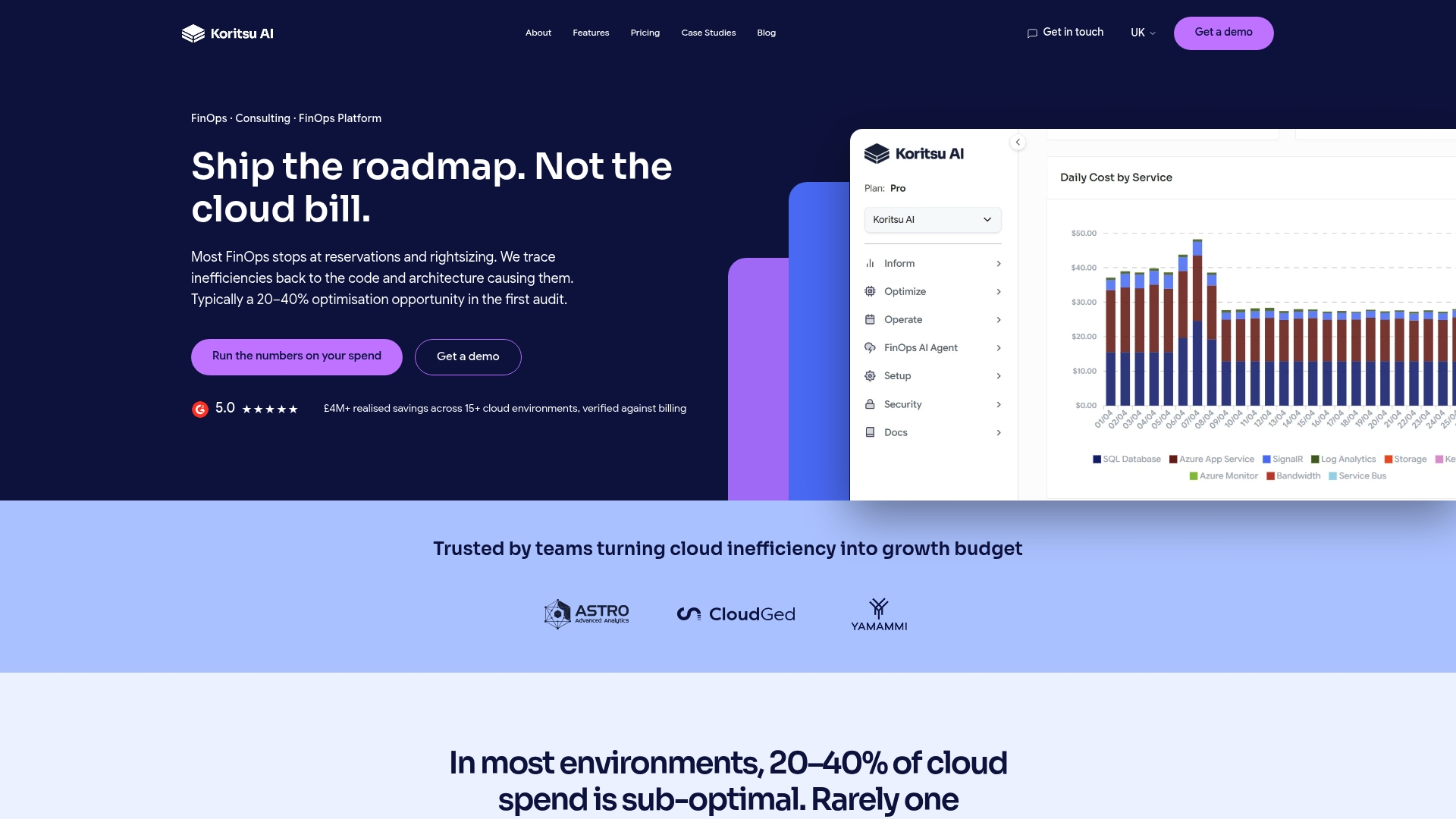
Koritsu AI combines a continuous analysis platform with hands-on expert advice to help CTOs and financial managers move from audit findings to confirmed savings. Kori, the AI agent, surfaces waste across AWS, Google Cloud, and Azure in real time, covering anomaly detection, unit economics dashboards, and policy enforcement. Specialists then work with your engineering teams to act on those findings. The model is straightforward: clients start with a free assessment, and Koritsu AI takes a share of the savings actually delivered. One UK bidding platform achieved a 52% cloud cost reduction using this approach. If your cloud bill is growing faster than your business, that is the right place to start.
FAQ
What is a cloud spending audit checklist?
A cloud spending audit checklist is a structured set of steps that identifies waste, enforces governance, and aligns cloud costs with business outcomes. It covers resource tagging, rightsizing, commitment utilisation, anomaly detection, and unit economics measurement.
How often should you conduct a cloud expense review?
SMEs should conduct a formal audit at least quarterly, while enterprises benefit from continuous monitoring with monthly planning sessions. The right cadence depends on spend volume and the rate of infrastructure change.
What is rightsizing in a cloud cost audit?
Rightsizing means selecting the smallest compute instance or container configuration that meets your workload's performance requirements. It is guided by analysis of CPU, RAM, and network usage metrics over a representative period.
How does FinOps improve cloud cost management?
FinOps is a financial management practice that creates shared accountability for cloud spend across engineering, finance, and product teams. A structured FinOps loop of alerts, triage, action, and verification translates cost visibility into realisable savings.
When should an SME start a formal cloud financial audit?
An SME should start a formal audit when monthly cloud spending exceeds £2,000 or when spend growth is unexplained. Annual audits with a prioritised action plan can capture 80–90% of available savings at that scale.