FinOps Inform · Cost Optimisation
Cloud spending governance framework: a guide for CTOs
Discover the cloud spending governance framework to control costs and boost accountability. Learn how to optimize your cloud expenditures effectively.

A cloud spending governance framework is a structured set of policies, processes, and tools that organisations use to monitor, control, and allocate cloud expenditures with accountability and precision. The industry term for this discipline is cloud financial governance, and it sits at the intersection of FinOps practice, infrastructure management, and financial accountability. Without it, cloud costs grow in ways that are difficult to explain, harder to reverse, and almost impossible to attribute to the right teams. The good news is that the problem is fixable. Automated policy-as-code governance integrated into infrastructure-as-code workflows can save enterprises between $627,000 and $958,250 annually by replacing manual reviews with continuous, automated enforcement. That figure alone makes the case for treating cloud financial governance as a board-level priority, not an engineering afterthought.
What does a cloud spending governance framework require?
The foundation of any cloud spending governance framework is clear ownership. Costs must be attributed to real entities, whether that is an application, a business unit, or a product team. Without that attribution, no one is accountable when a budget is breached.
Tagging policies are the mechanism that makes ownership real. Effective tagging attaches metadata such as team, project, and environment to every cloud resource. This enables accurate cost allocation, chargeback reporting, and the identification of orphaned or untagged resources that silently drain budgets.

Beyond ownership and tagging, you need the right tooling. No single tool covers every governance requirement. A layered approach combining native cloud tools with third-party FinOps platforms provides the broadest coverage across billing, cost normalisation, allocation, and anomaly detection. Native tools from AWS, Google Cloud, and Azure give you baseline billing data. Third-party platforms add normalisation, multi-cloud visibility, and policy automation on top.
Pro Tip: Set tagging enforcement at the provisioning stage, not retrospectively. Retroactive tagging campaigns rarely achieve full coverage and create significant manual overhead.
The table below summarises the core tool categories and what each one governs.
| Tool category | Governance function |
|---|---|
| Native cloud billing tools | Baseline cost visibility and raw usage data |
| Third-party FinOps platforms | Multi-cloud normalisation, allocation, and anomaly detection |
| Infrastructure-as-code systems | Policy-as-code enforcement at provisioning |
| Real-time monitoring tools | Continuous spend tracking and alerting |
| Tagging and metadata engines | Cost attribution, chargeback, and orphan detection |
Real-time monitoring is non-negotiable. Periodic monthly reviews are too slow to catch runaway costs before they compound. You need continuous visibility, with alerts that fire the moment spend deviates from expected patterns.
How do you design effective policies and processes?
Policy design is where most governance frameworks either succeed or fail. The process starts with defining budgets and forecasts that are tied to business objectives, not just historical spend. A budget that has no connection to product roadmaps or revenue targets is a number without meaning.
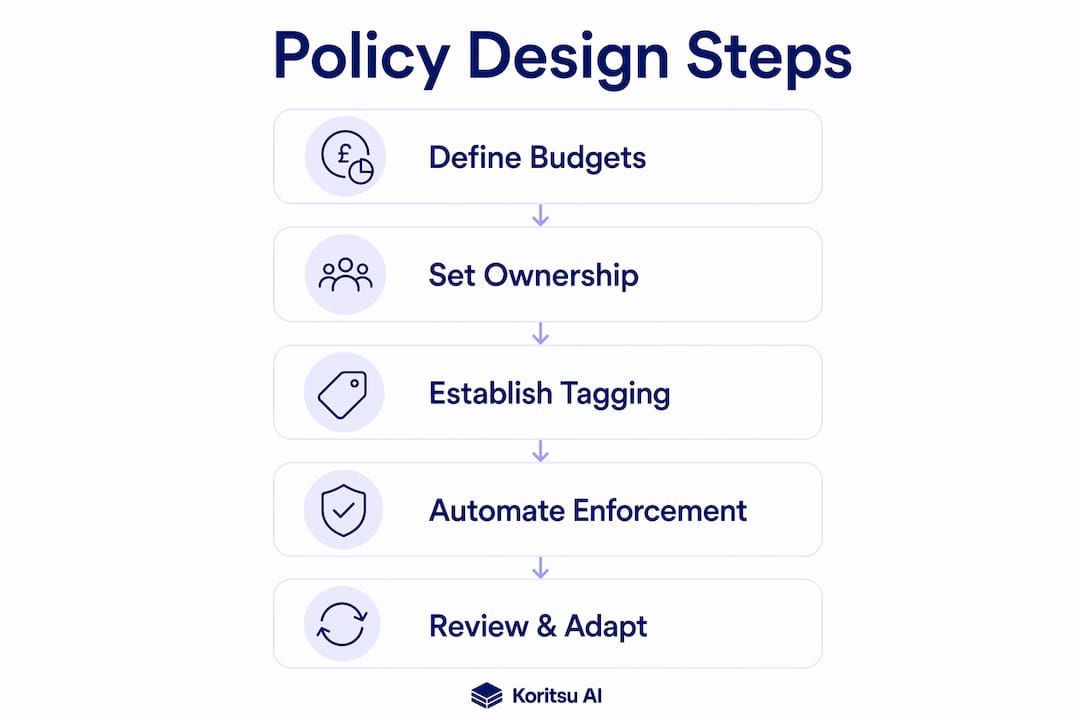
Once budgets exist, you need guardrails. Policy-as-code embeds those guardrails directly into infrastructure provisioning workflows. When an engineer provisions a resource that would breach a budget or violate a tagging rule, the system blocks or flags it before it is ever deployed. This is far more effective than reviewing spend after the fact.
The key design and implementation steps are:
- Define budget envelopes for each team, application, and environment, aligned with quarterly business planning.
- Encode spending rules as policy-as-code within your infrastructure-as-code pipeline, covering resource types, regions, and tagging requirements.
- Build approval workflows for provisioning requests that exceed defined thresholds or introduce new resource categories.
- Assign named owners to every cost centre, with clear accountability for anomalies and budget breaches.
- Define escalation paths so that a budget breach triggers an immediate notification to the cost owner, with a resolution deadline.
- Document a triage protocol requiring that anomalies are reviewed within 24 hours to prevent costs from compounding.
Governance frameworks that define budgets and escalation paths allow organisations to respond rapidly to cost anomalies. Speed matters here. A cost anomaly left unaddressed for a week can represent tens of thousands of pounds in wasted spend.
Pro Tip: Treat your policy-as-code rules as living documents. Review them quarterly alongside your infrastructure architecture, because new resource types and services regularly introduce gaps that existing rules do not cover.
Approval workflows deserve particular attention. Many enterprises skip them because they feel like friction. They are friction by design. An approval step forces a conversation between the engineer requesting a resource and the finance or platform team responsible for the budget. That conversation catches misalignments before they become cost incidents.
What operational practices maintain continuous cost visibility?
Operational governance is the ongoing work that keeps a framework functioning after it is built. The most important practice is continuous real-time spend monitoring. Cloud financial management works best when visibility, planning, and governance are integrated into one connected system, not fragmented across separate tools and teams.
Connecting cost metrics to unit economics is the practice that separates mature governance from basic cost tracking. Unit economics such as cost per customer or cost per transaction give finance leaders and CTOs a way to judge whether cloud spend is generating proportionate business value. A rising cloud bill is not necessarily a problem if revenue per customer is rising faster.
The core operational practices that sustain governance health are:
- Continuous anomaly triage. Review every spend anomaly within 24 hours. Assign it to a named owner and resolve or escalate within the same business day.
- Commitment and consumption reviews. Conduct monthly reviews of reserved instances, savings plans, and committed use discounts to ensure they still match actual consumption patterns.
- Automated tagging audits. Run weekly automated checks for untagged or incorrectly tagged resources and route them to the responsible team for correction.
- Idle resource cleanup. Automated remediation workflows should flag idle or underutilised resources for review, with automated shutdown for resources that meet defined criteria.
- Cross-team cost reviews. Hold monthly sessions between finance, engineering, and platform teams to review spend trends, forecast accuracy, and upcoming infrastructure changes.
FinOps practice formalises this cross-team model through three pillars: Inform, Optimise, and Operate. Each pillar maps directly to a governance activity. Inform covers visibility and reporting. Optimise covers rightsizing and commitment management. Operate covers the ongoing process discipline that keeps the framework running.
Pro Tip: Do not wait for a monthly finance review to surface cost anomalies. Set automated alerts at 80% of budget thresholds so teams have time to act before a breach occurs.
What are the most common mistakes in cloud spending governance?
The most damaging mistake is unclear ownership. When no one is accountable for a cost centre, no one acts when spend exceeds budget. This is not a technology problem. It is a process problem, and no tool resolves it without an ownership model underneath.
The second most common failure is overreliance on a single tool. Fragmented approaches lead to cost visibility without control and delayed responses to overspend. A native billing tool shows you what you spent. It does not enforce policies, attribute costs to teams, or trigger approval workflows. You need layers.
Other frequent pitfalls include:
- Ignoring policy-as-code. Manual governance reviews create overhead and miss violations. Automated enforcement at provisioning is the only approach that scales.
- Disconnecting costs from business outcomes. Reporting cloud spend without linking it to revenue, customers, or transactions makes it impossible to judge whether the spend is justified. Read more about aligning costs with outcomes to close this gap.
- Slow anomaly response. Budget breaches that are not addressed within 24 hours compound quickly. An unresolved anomaly in a high-throughput environment can double in cost within days.
- Treating governance as a one-time project. Cloud infrastructure changes constantly. Governance policies that are not reviewed regularly become outdated and ineffective within months.
The practical fix for most of these issues is the same: assign ownership first, automate enforcement second, and review continuously. Governance that depends on manual effort will always degrade over time.
Key takeaways
A cloud spending governance framework succeeds when ownership, automated enforcement, and real-time visibility operate together as a single connected system.
| Point | Details |
|---|---|
| Ownership is the foundation | Assign every cost centre to a named team or application before building any other governance layer. |
| Tagging enables attribution | Enforce tagging at provisioning to support accurate cost allocation and chargeback reporting. |
| Policy-as-code prevents overspend | Embedding spending rules into infrastructure-as-code stops violations before resources are deployed. |
| Anomaly triage must be same-day | Unresolved cost anomalies compound quickly; review and assign every alert within 24 hours. |
| Unit economics connect cost to value | Linking cloud spend to cost per customer or transaction tells you whether the spend is justified. |
Governance is a culture, not a configuration
I have worked with engineering and finance teams across a wide range of enterprise environments, and the pattern is consistent. The organisations that struggle with cloud costs are not short of tools. They are short of accountability. They have dashboards, alerts, and billing reports. What they lack is a shared understanding of who owns what and what happens when something goes wrong.
The frameworks that actually hold together treat governance as a cross-team discipline. Finance understands the infrastructure. Engineering understands the budget. Platform teams own the enforcement layer. When those three groups share accountability, anomalies get resolved quickly and policies stay current.
Automation matters enormously, but it is not a substitute for that culture. Policy-as-code is only as good as the policies behind it. If the policies were written once and never reviewed, they will drift out of alignment with the actual architecture within a year. The teams I have seen succeed treat their governance rules the same way they treat their application code: versioned, reviewed, and updated regularly.
Real-time visibility is the other non-negotiable. Monthly spend reviews are a post-mortem. By the time the report lands, the damage is done. The organisations that control their cloud costs well are the ones that know what they spent yesterday, not last month.
How Koritsu AI supports your governance framework
Building a cloud spending governance framework from scratch is a significant undertaking. Most enterprises already have the infrastructure. What they are missing is the continuous analysis layer that connects spend data to ownership, flags anomalies in real time, and surfaces the inefficiencies buried in how their software and infrastructure were built.
Koritsu AI combines an AI platform with hands-on expert advice to do exactly that. Kori, the AI agent, continuously analyses your cloud spend across AWS, Google Cloud, and Azure, surfacing where money is being lost and why. Koritsu's specialists then help your engineering teams act on those findings. You start with a free cloud cost assessment and pay only from the savings delivered. For enterprises serious about cloud financial governance, the Koritsu AI platform is the fastest path from visibility to control.
FAQ
What is a cloud spending governance framework?
A cloud spending governance framework is a structured combination of policies, processes, and tools that organisations use to monitor, control, and allocate cloud costs with clear accountability. It embeds financial discipline into infrastructure workflows rather than relying on periodic manual reviews.
How does policy-as-code improve cloud cost governance?
Policy-as-code encodes spending rules directly into infrastructure provisioning pipelines, blocking or flagging non-compliant resources before they are deployed. This approach can save enterprises between $627,000 and $958,250 annually by replacing manual enforcement with continuous automated controls.
Why is tagging so important in cloud financial governance?
Tagging attaches metadata such as team, project, and environment to every cloud resource, enabling accurate cost attribution, chargeback reporting, and the identification of orphaned resources. Without consistent tagging, cost allocation is guesswork and ownership accountability breaks down.
What is the FinOps framework and how does it relate to governance?
FinOps is a practice that combines finance, engineering, and business teams to embed financial accountability into daily cloud operations. Its three pillars, Inform, Optimise, and Operate, map directly to the visibility, efficiency, and process components of a cloud spending governance framework.
How quickly should cost anomalies be triaged?
Best practice requires anomaly triage within 24 hours of detection. Anomalies left unresolved compound rapidly, particularly in high-throughput environments, and a same-day response protocol is the standard recommended by cloud financial management practitioners.