FinOps Inform · Tool Comparison
Top 4 Doit.com alternatives for cloud cost optimisation 2026
Discover the top 4 doit.com alternatives to help you evaluate options for cloud cost optimisation and make informed decisions.
Controlling cloud cost growth without losing engineering flexibility is difficult with one-size-fits-all platforms. Existing tools force technical teams to adapt to rigid billing models or generic recommendations that do not match engineering reality. This comparison covers fees, technical scope, and AI-driven recommendations across four alternatives so you can match a platform to your environment with confidence.
Table of contents
Koritsu AI
At a glance
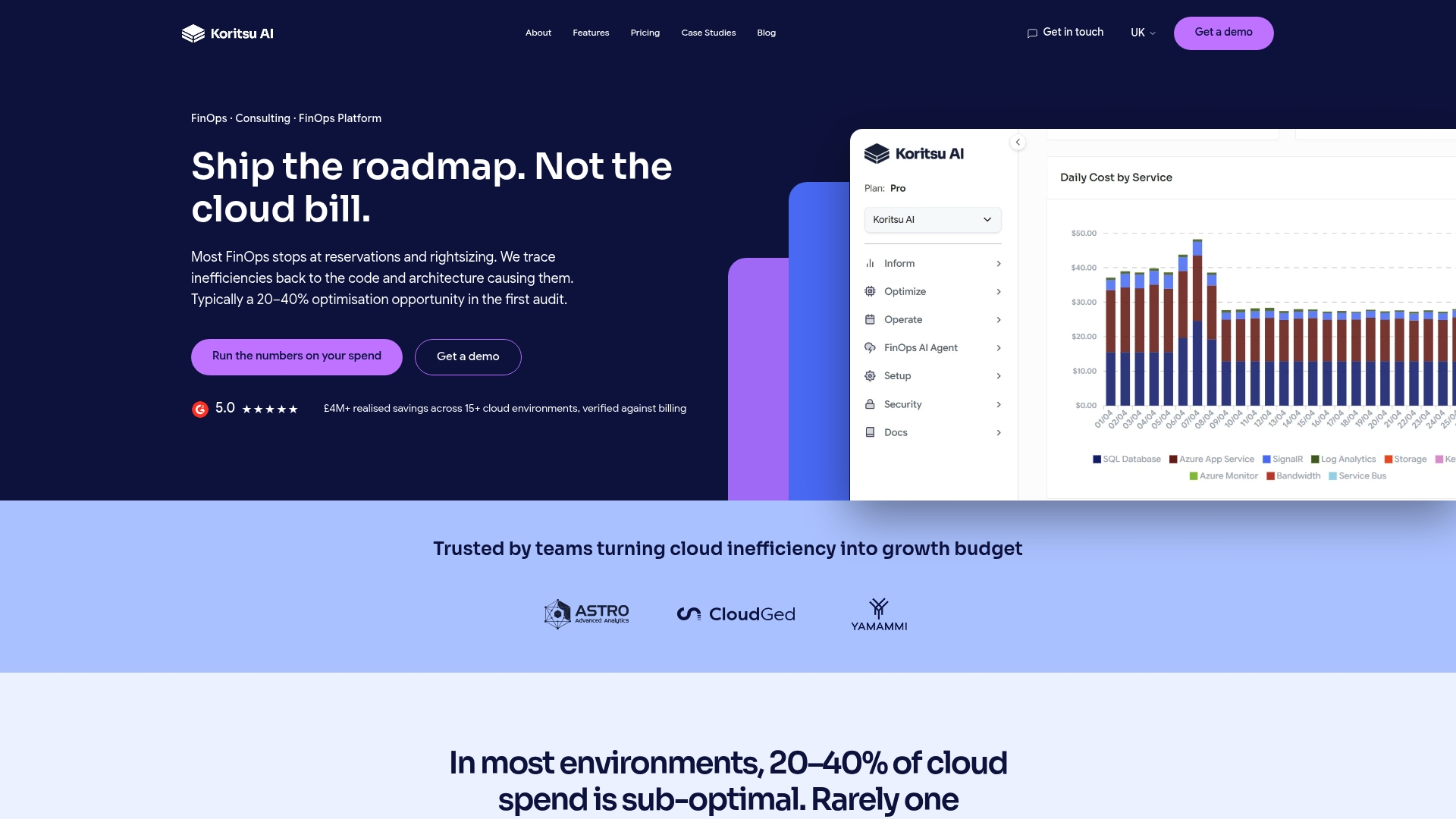
Koritsu AI reports typical savings of 20–40% verified against billing. The product pairs an AI agent, Kori, with specialist consultants to find inefficiencies buried in code, architecture, and billing. It targets teams spending over £8,000 per month on cloud infrastructure.
Core features
- AI cost analysis and anomaly detection that flags unusual spend and trends.
- Code and architecture review that identifies inefficient patterns, rightsizing opportunities, and architectural fixes.
- Prioritised recommendations with verification against actual bills to show real impact.
- Continuous monitoring and cost attribution by team, service, and feature for clearer chargebacks.
- Connects to cloud billing exports and infrastructure metrics for accurate, source data analysis.
Key differentiator
Koritsu combines engineering-grade reviews with continuous AI monitoring and direct, billing-verified savings attribution. The vendor ties fees to the savings it proves on customer bills, which shifts commercial risk away from buyers. That mix makes recommendations that are technical, testable, and financially accountable rather than purely advisory.
Pros
-
Deep engineering-level analysis. The team reviews code and architecture, not just invoice line items, so recommendations target root causes of waste.
-
Fast visibility from day one. The pre-built platform plugs into billing exports and shows initial anomalies quickly.
-
Aligned commercial model. The success fee model means the vendor earns only when verified savings appear on the bill.
-
Ongoing automated monitoring by Kori. The agent provides continuous alerts and keeps track of regressions after fixes.
-
Multi-cloud support. Analysis covers AWS, Azure, GCP and other providers so cross-cloud estates are comparable.
Cons
- Organisations without mature engineering or cloud operations teams may find implementation challenging because many recommendations require engineering changes.
Who it's for
Koritsu AI suits engineering, infrastructure, and FinOps teams in medium and large organisations spending over £8,000 per month on cloud services. It fits teams that can act on code and architectural recommendations and that need billing-verified cost reductions. It is less suitable where there is no internal capacity to implement technical fixes.
Unique value proposition
Koritsu begins with a free assessment and moves to a revenue share where the vendor takes a portion of verified savings on customer bills. That commercial structure forces the vendor to prioritise high-confidence changes and to prove outcomes on billing. For procurement and finance, this converts vendor advice into measurable, auditable reductions in spend.
Real world use case
A business spending £50,000 per month used Koritsu to surface over-provisioned instances, orphaned compute, and inefficient architecture. The team implemented the prioritised fixes and the savings appeared on subsequent bills. The vendor adjusted its fee against those verified reductions.
Pricing
Koritsu charges on a success fee basis tied to verified savings rather than a fixed licence. Engagements begin with a free assessment, then the vendor takes a share of the measured reductions on the bill. Pricing therefore depends on the scale of savings and the implementation required.
Website: https://koritsu.ai
Vantage
At a glance
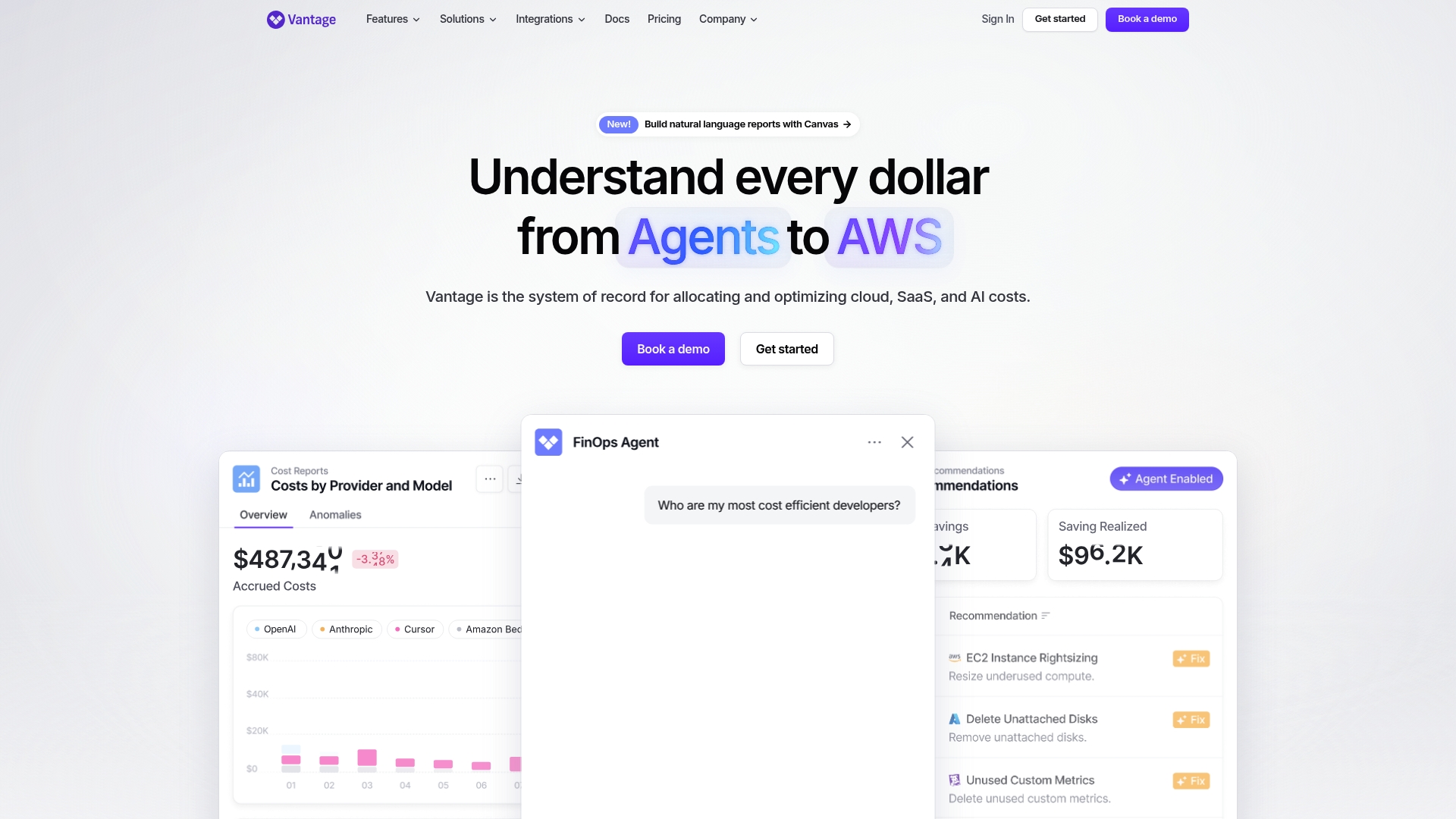
FinOps as Code support includes a Terraform provider and an MCP Server for AI integration. This lets teams apply versioned, code driven cost rules alongside their infrastructure as code. Vantage also offers a free tier and a Pro plan that the vendor lists from $30/month. That combination targets teams running Kubernetes and AI workloads who need governance and repeatable cost controls.
Core features
- Cost reporting and visualisation for multi cloud environments, with dashboards and exportable reports.
- Virtual tagging to attribute spend when native tags are missing or inconsistent.
- Automated savings recommendations, plus anomaly and budget alerts to spot overspend quickly.
- FinOps as Code primitives, Terraform provider, and MCP Server for AI workflows and integrations.
Key differentiator
Vantage pairs explicit AI workload support with native Kubernetes signals. That focus surfaces container inefficiencies and AI GPU waste that generic cost tools miss. The FinOps as Code tooling lets engineers enforce cost guards in CI pipelines. For teams running model training or large clusters, this product tailors recommendations to those resource patterns.
Pros
- Strong reporting and visualisation. The dashboards make it easy to slice spend by team, product, or cluster, which speeds decision making.
- Effective spend forecasting and optimisation tools. Forecasting ties to usage trends and helps budget owners plan for bursty AI costs.
- Smooth onboarding and professional services. The vendor advertises hands on support for initial setup and tagging strategies.
- Deep integrations with cloud providers and developer tools. That reduces manual data wrangling when reconciling bills.
- AI and Kubernetes support improve operational efficiency for containerised and ML workloads. Teams running GPU clusters will see targeted recommendations.
Cons
- Support responsiveness could be faster, according to the vendor limitations. That delays resolution for high priority incidents.
- Automation breadth is narrower than some rivals. Certain routine resource actions may still require manual steps.
- Scalability for heavily automated resource management looks less robust in specific large scale scenarios. Very large estates may hit limits in automated playbooks.
When it may not fit
Large organisations that require push button automation for millions of ephemeral resources may find the automation scope restrictive. Teams that expect SLA style response for every support ticket will want a higher support tier. If your workflow depends on extreme scale auto remediation, evaluate those limits before committing.
Notable integrations
- AWS
- Azure
- Google Cloud
- Kubernetes
- Datadog
- Snowflake
- OpenAI
- GitHub
Who it's for
Vantage suits engineering and finance teams that run Kubernetes clusters and AI workloads and need stronger cost governance. It targets organisations from startups to enterprises that want to apply policy as code to cloud spend. The product fits teams who prioritise visibility and forecast driven budgeting over full autonomous remediation.
Real world use case
A large technology firm used Vantage to gain granular visibility across multiple cloud providers. The team applied the Terraform provider to enforce tagging and budgets in CI. They then used Kubernetes signals and AI cost models to reduce GPU waste and keep AI training within budget.
Pricing
The vendor lists a free tier and a Pro plan starting at $30/month. Pricing then scales through tiered plans up to custom Enterprise agreements. Enterprise customers receive tailored support and deployment options.
Website: https://vantage.sh
Finout
At a glance
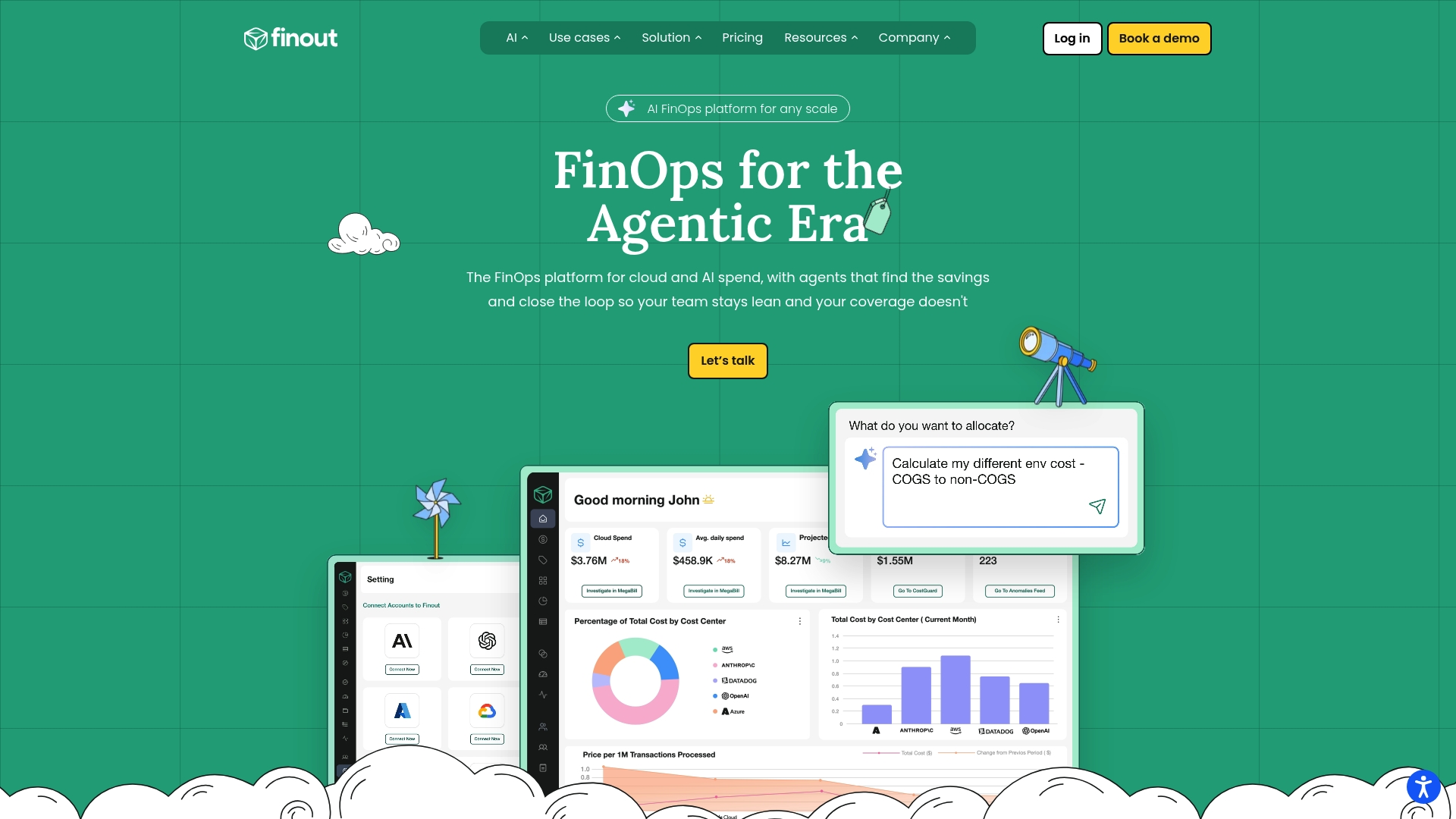
AI powered virtual tagging maps untagged cloud and AI spend to owners and business units automatically. That mapping reduces manual tagging work and clarifies cost ownership across complex estates. The vendor states Finout holds an honourable mention in Gartner's Magic Quadrant, which the company uses to support its enterprise positioning.
Core features
- AI-powered Virtual Tagging for automatic allocation of previously untagged spend to teams and projects.
- Real-time monitoring and attribution that shows cost flows as they occur across cloud and AI services.
- Anomaly detection and waste identification to flag spikes and idle resources quickly.
- Budget automation and forecasting tools to set budgets and receive alerts on overspend.
- Provider and service integrations spanning AWS, GCP, Azure, OpenAI, Snowflake, Kubernetes, Datadog, and Slack.
Key differentiator
The defining feature is the AI-powered virtual tagging capability. It automatically infers owners for untagged cost lines and attaches business context at scale. That reduces the manual tagging burden on engineering teams and speeds accurate cost attribution for chargebacks and budgeting.
Pros
-
Powerful cost attribution models deliver granular visibility into who spends what. This helps finance and engineering align on billing and accountability.
-
Real-time cost monitoring surfaces issues fast. Teams can act on anomalies before they become large bill impacts.
-
Detailed resource level insights support rightsizing and waste removal. That yields clear operational recommendations rather than vague guidance.
-
The product roadmap points to ongoing enhancements. The vendor emphasises continued support for AI workload visibility.
-
Integrations with major cloud providers and telemetry tools make ingesting billing and usage data straightforward for most large estates.
Cons
-
The platform has a noticeable learning curve for new users. Implementation teams need time to interpret attribution outputs.
-
Reporting and the UI feel less intuitive than some competing tools. Teams used to polished dashboards may require additional customisation.
-
Support responsiveness varies according to some users. Larger customers may need clearer support SLAs.
-
Forecasting features need more depth for complex multi cloud budgets.
When it may not fit
Finout is not the best fit for small teams with simple cloud bills. If your estate is limited to a single cloud account the overhead of virtual tagging may outweigh the benefits. Organisations that need very polished out of the box reporting or guaranteed fast vendor support should expect extra work or a different vendor.
Notable integrations
- Cloud providers: AWS, GCP, Azure.
- AI and data services: OpenAI, Snowflake, Kubernetes.
- Monitoring and collaboration: Datadog, Slack.
Who it's for
Large organisations and enterprises with complex cloud and AI estates will get the most from Finout. Teams that need fine grained attribution, chargeback capability, and integration across many services will find the product relevant. Smaller businesses with straightforward billing are unlikely to justify the implementation effort.
Real world use case
A multinational tech company used Finout to allocate cloud and AI costs across dozens of teams. The company mapped previously untagged spend to owners and stopped recurring waste. Real-time alerts caught anomalous runaway jobs within hours rather than days.
Pricing
Pricing was not specified in the scraped content and appears to follow an enterprise sales model. Expect pricing by quote with implementation and support tiers. Contact the vendor for a tailored estimate and licence details.
Website: https://finout.io
nOps
At a glance
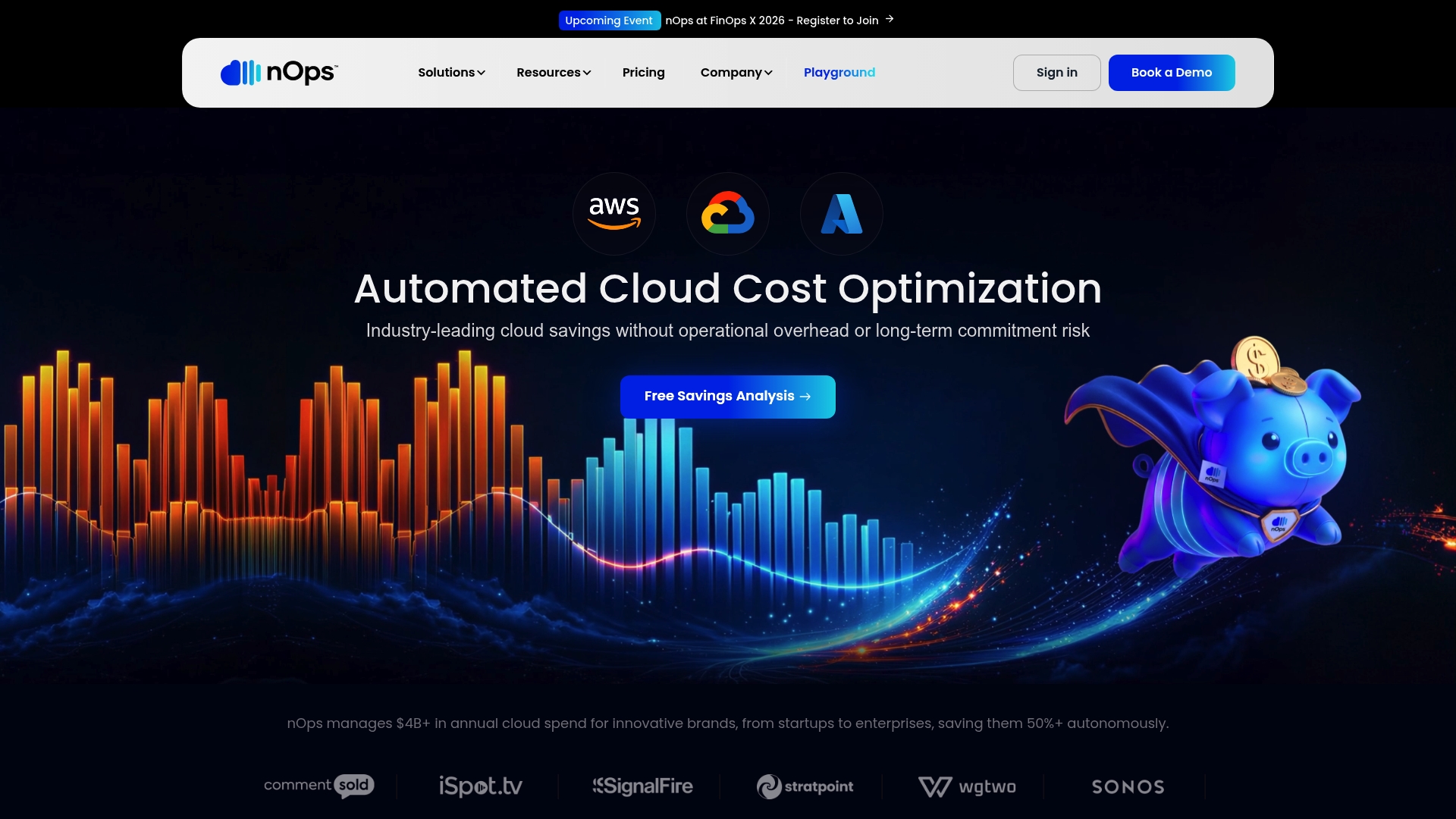
nOps reports it manages over $4 billion in annual cloud spend. That figure suggests the tool targets teams running significant multi cloud estates. According to the company, customers have seen cloud cost reductions of over 50%. The platform combines commitment management with continuous rebalancing to follow usage changes in near real time.
Core features
- Automated multicloud commitment optimisation for AWS, Azure, and GCP, including reservations and savings plans across accounts.
- Continuous rebalancing engine that adapts to hourly usage fluctuations and adjusts commitments to reduce wasted spend.
- Unified visibility across multicloud, Kubernetes, SaaS, and AI costs with tagging, allocation, and attribution.
- Real time dashboards with anomaly detection and forecasting to highlight unexpected spend.
- Cost reporting and AI powered insights to help Finance and FinOps teams assign costs and justify savings.
Key differentiator
The defining capability is the continuous hourly rebalancing engine that aims to maximise discounts without locking teams into rigid commitments. That mechanism rebalances purchases and returns capacity as usage shifts. This focus on hour by hour adjustment separates nOps from tools that only recommend monthly or quarterly buys.
Pros
- Intuitive interface makes dense billing data easier for engineers and finance teams to act on. The UI reduces the learning curve for multi account reporting.
- Automates purchase and management of reservations and savings plans, cutting manual workload for FinOps teams. This reduces the frequency of missed buying windows.
- Deep multicloud and SaaS visibility helps spot where third party services or Kubernetes clusters inflate bills. These views suit combined finance and engineering reviews.
- Supports large scale, multi account environments, so enterprise organisations can centralise commitment strategy. The platform claims the scale noted above.
- Real time anomaly detection surfaces sudden cost spikes, enabling faster investigation by on call engineers.
Cons
- Users outside the US report periodic latency and slow interactions with the UI. That performance gap can slow incident triage for distributed teams.
- Data heavy tables and exports can be cumbersome to filter and interpret at scale. Analysts may need additional ETL work.
- Reports and dashboards sometimes load slowly for large datasets, which reduces exploratory analysis speed.
When it may not fit
If your environment is primarily a small single cloud account, nOps may be overpowered and more costly than simpler tools. Teams with low tolerance for UX latency in non US regions will find the platform frustrating. If you require lightweight spreadsheet style exports without further processing, the platform can feel too data dense.
Who it's for
Cloud finance teams, FinOps managers, and cloud engineers managing multicloud environments who need automated commitment buying and clear cost allocation. The product fits teams that run many accounts or large Kubernetes clusters and want to reduce manual purchasing work. It suits organisations prepared to centralise commit strategy.
Real world use case
A company running multiple cloud accounts used nOps to automate hourly commitment optimisation and allocation across accounts. The team gained clearer cost attribution for Finance and reduced the time engineers spent checking purchase recommendations. The vendor states this type of deployment has led to the cost reduction figure noted above.
Pricing
nOps offers a Share of Saving model with a free analysis to surface opportunities. The vendor also supports a Fixed Fee option that scales with cloud spend. Pricing starts by aligning cost with realised savings or by a spend based retainer.
Website: https://nops.io
Comparison of alternatives
Selecting the right solution for cloud cost management is crucial for achieving financial efficiency and operational effectiveness.
Depth of cost analysis
Koritsu AI excels through its combination of technical recommendations and verifiable budgetary savings — providing insights grounded in engineering precision. By comparison, Vantage integrates cost rules into infrastructure as code, enabling FinOps practices tailored for Kubernetes. Meanwhile, Finout automates resource attribution through virtual tagging, making it highly effective for complex cost structures, albeit requiring expertise for implementation. Lastly, nOps emphasises real-time resource adjustments, optimising costs dynamically based on fluctuating needs.
Core applicability by use case
Koritsu AI is uniquely positioned for organisations managing complex system architectures with mature engineering practices, ensuring that proposed solutions demonstrate measurable impacts. Alternatively, for firms emphasising AI workloads and containerised application efficiency, Vantage leads with its Kubernetes-oriented functionality. Finout is best for enterprises managing intricate multi-cloud setups needing detailed cost attribution, and nOps provides real-time optimisation suited for large-scale deployments.
Best fit
- For advanced engineering teams aiming to uncover inefficiencies within code and architecture for billing-verified savings, Koritsu AI stands as the prime choice.
- For organisations focusing on Kubernetes and enforcing cost constraints as code, Vantage offers a tailored approach.
- For enterprises requiring granular cost attribution for budgetary clarity, Finout provides effective solutions through virtual tagging.
- For teams needing real-time enhancements to cost commitments and multi-cloud adjustments, nOps demonstrates impactful resource management.
Our pick
Koritsu AI offers a distinctive combination of engineering expertise and billing-verifiable savings, making it for teams with the capacity to implement technical recommendations for substantial financial results. However, organisations heavily centred around Kubernetes or multi-cloud real-time adjustments might find greater alignment with other discussed solutions.
Koritsu AI provides engineering-driven insights and billing-verified savings, making it a strong choice for sophisticated cloud cost analysis.
| Product | Key Focus | Best For | Pricing | Notable Limitation |
|---|---|---|---|---|
| Koritsu AI | Billing-verified savings with engineering-grade reviews | Teams spending £8,000+ per month on cloud | Success fee model | Requires engineering capacity for implementation |
| Vantage | FinOps support with Kubernetes and AI cost insights | Kubernetes and AI-focused organisations | From $30/month | Limited auto-remediation for very large environments |
| Finout | AI-powered virtual tagging for cost attribution | Complex cloud estates needing detailed tags | Not disclosed | Initial learning curve for cost attribution implementation |
| nOps | Hourly multicloud commitment optimisation | Enterprises with automated resource needs | Share of savings model | Performance latency for non-US distributed teams |
Discover how Koritsu AI outshines Doit.com alternatives for cloud cost optimisation
Managing cloud costs is rarely straightforward. The true savings are often hidden in inefficient code and architecture rather than simple billing line items. Koritsu AI specialises in uncovering these hidden inefficiencies by combining continuous AI-driven spend analysis with expert engineering advice. Unlike many doit.com alternatives, Koritsu AI backs its recommendations with verified billing savings and only charges when those savings materialise.
Take control of your cloud spend with Koritsu AI's free initial assessment. Visit Koritsu AI now to pinpoint inefficiencies in your cloud infrastructure and receive prioritised, actionable fixes that engineering teams can implement with confidence. Book your free assessment and see verified savings on your next bill.
FAQ
How does Koritsu AI support cost analysis for cloud infrastructure?
Koritsu AI provides AI cost analysis and anomaly detection that flags unusual spending and trends. The tool's capabilities are designed to target teams spending over £8,000 per month on cloud infrastructure, ensuring that significant savings can be identified effectively. Consider engaging with Koritsu AI for a detailed examination of your cloud costs.
What is the difference between Koritsu AI and Vantage in terms of reporting?
Vantage offers strong reporting and visualisation capabilities, making it easy to slice spend by team, product, or cluster. In contrast, Koritsu AI focuses on deep engineering-level analysis that not only covers billing anomalies but also addresses root causes of waste in coding and architecture. Both tools are effective, but Koritsu AI delivers a more technical approach when tackling inefficiencies.
Can I rely on Koritsu AI's continuous monitoring feature?
Yes, Koritsu AI features ongoing automated monitoring by its AI agent, Kori, which provides continuous alerts and tracks regressions after fixes. This ensures that organisations remain aware of cost fluctuations and can address issues in real time, allowing for proactive cost management.
What concerns should I have if my organisation lacks mature engineering capabilities and is considering Koritsu AI?
Organisations without mature engineering or cloud operations teams may find the implementation of Koritsu AI challenging, as many recommendations require technical changes. It's essential to assess internal resources before deciding to adopt this solution.
How does Koritsu AI ensure alignment with financial impact in its recommendations?
Koritsu AI ties its fees to proven savings on customer bills, which prioritises recommendations that are not purely advisory but technically accountable. This arrangement means your organisation can expect measurable cost reductions directly linked to the insights provided by the platform.