FinOps Inform · Cost Automation
Eliminate cloud waste automatically: a 2026 guide
Discover how to eliminate cloud waste automatically in 2026. Learn to save costs with effective strategies for managing cloud resources.

Automatic cloud waste elimination is defined as the continuous, policy-driven process of detecting and remediating idle, orphaned, and overprovisioned cloud resources without manual intervention. The industry term for this practice is automated cloud cost governance, and it sits at the heart of the FinOps discipline. Most engineering teams running workloads on AWS, Google Cloud, or Azure are haemorrhaging budget on resources nobody is using. The savings are rarely found in discount programmes. They are buried in unattached volumes, oversized instances, and forgotten snapshots. You can eliminate cloud waste automatically by combining policy-as-code tools, event-driven architectures, and rightsizing recommendations into a single, self-correcting system.
What tools and prerequisites do you need to eliminate cloud waste automatically?
Automation without visibility is guesswork. Before you write a single policy, you need a complete picture of what you are running and what it costs.
The three foundational prerequisites are:
- Cloud cost allocation. Every resource must be tagged with owner, environment, and cost centre. Accurate resource tagging is foundational for automated cost governance, enabling policy targeting and chargeback mechanisms. Without enforced tagging standards, automation effectiveness drops sharply.
- Resource inventory. Use native tools such as AWS Config, Azure Resource Graph, or Google Cloud Asset Inventory to maintain a live catalogue of all running resources. This is the data layer your policies will act on.
- Cost visibility. AWS Cost Explorer, Azure Cost Management, and Google Cloud Billing all surface spending trends. They tell you where to focus your first automation policies.
With visibility in place, the primary execution tool for most teams is Cloud Custodian. It is an open-source, policy-as-code engine that defines and enforces cost governance rules in YAML across AWS, Azure, and GCP. Deploying multiple policies can take a few hours, with continuous enforcement running via serverless functions that react to cloud events in real time. That speed matters because waste accumulates continuously, not just at month end.
The table below shows the core tool categories and their function in an automated waste removal pipeline.

| Tool category | Example tools | Primary function |
|---|---|---|
| Policy-as-code engine | Cloud Custodian | Define and enforce cost rules across clouds |
| Rightsizing adviser | AWS Compute Optimizer | Recommend instance size changes from usage data |
| Event broker | AWS EventBridge | Trigger automation on resource state changes |
| Serverless executor | AWS Lambda | Run remediation actions without standing servers |
| Cost visibility | AWS Cost Explorer, Azure Cost Management | Surface spending trends and anomalies |
Governance frameworks matter as much as tooling. FinOps principles require cross-team collaboration and shared accountability for cloud spend. Without that cultural layer, even the best automation gets overridden by engineers who do not understand why resources are being stopped.
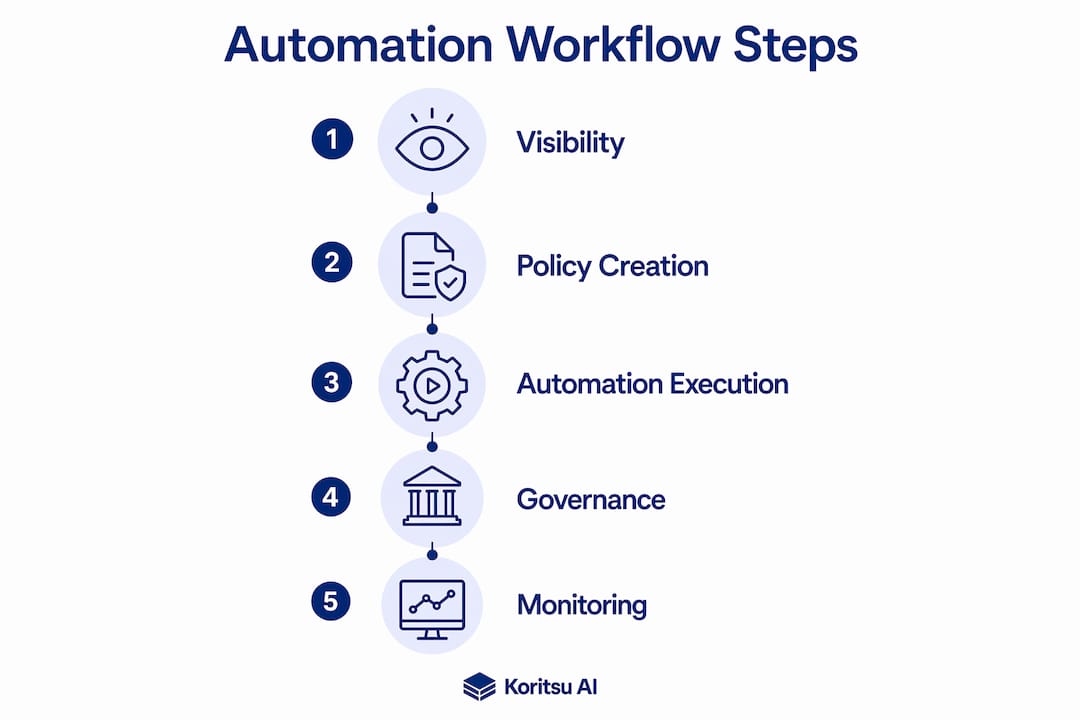
How do you set up automated workflows for common waste scenarios?
The highest-impact waste categories are well understood. The question is sequencing them correctly so you build confidence before touching production.
-
Start with off-hours scheduling. Off-hours scheduling is the highest ROI automation policy. It automatically stops dev and test resources outside business hours, delivering immediate cost reductions with low operational risk. A Cloud Custodian policy can tag resources at 6 PM and trigger a Lambda function via EventBridge to stop them. A matching start policy runs at 7 AM. This single workflow often cuts non-production spend by a material amount within the first week.
-
Clean up unattached volumes and orphaned snapshots. Idle resources such as unattached EBS volumes, unused Elastic IPs, and stale load balancers can constitute up to 70% of cloud compute costs in some organisations. A Cloud Custodian policy filters for volumes with no attachment for more than seven days, tags them for deletion, waits 48 hours for a human override, then deletes them automatically. The mark-for-deletion lifecycle gives teams a safety window without requiring manual reviews.
-
Automate rightsizing for compute instances. AWS Compute Optimizer analyses up to 93 days of utilisation data to produce rightsizing recommendations. Those recommendations can be fed into an EventBridge rule that triggers a Step Functions workflow during a maintenance window, resizing the instance without human involvement. This removes the manual bottleneck that stops most teams from acting on rightsizing at scale.
-
Enforce tag compliance automatically. Resources without required tags should be quarantined, not ignored. A policy that marks untagged resources and notifies the owning team via Slack or email creates accountability without manual audits. After a grace period, non-compliant resources can be stopped automatically.
-
Build a mark-for-deletion lifecycle for all policies. Every destructive action should follow a notify, wait, and act sequence. This pattern prevents accidental deletion while maintaining full automation.
Pro Tip: Start your automation programme with off-hours scheduling on a single non-production account. Measure the savings over two weeks, then use that number to justify expanding to all accounts. A concrete figure from your own environment is far more persuasive than any industry benchmark.
The example architecture for this pipeline is: Cloud Custodian policies running on a schedule or triggered by EventBridge, executing Lambda functions that call cloud APIs, logging every action to CloudTrail or Azure Monitor, and reporting results to a shared FinOps dashboard.
What are the common challenges in automating cloud waste management?
The technology is the easy part. The hard part is keeping automation running reliably without breaking things or alienating engineering teams.
The most common challenges are:
- False positives. A policy that stops a resource a developer is actively using destroys trust in the entire programme. Mitigate this by requiring tags that mark resources as exempt, and by running policies in dry-run mode for two weeks before enabling destructive actions.
- Lack of auditability. Every automated action must be logged with the policy name, the resource affected, the timestamp, and the reason. CloudTrail on AWS and Azure Activity Log provide this natively. Without audit trails, you cannot demonstrate compliance or debug unexpected deletions.
- Resistance from engineering teams. Automation that stops resources without warning feels hostile. Solve this with notification policies that alert owners 24 hours before any action, and with a clear opt-out tagging convention such as
custodian-exempt: true. - Policy drift. Cloud environments change faster than policies are updated. A policy written for a three-tier web application may not account for a new serverless architecture introduced six months later. Schedule quarterly policy reviews as a standing calendar item.
Effective cloud cost governance is not a technology problem. It is a process problem. The automation tools exist and work well. What fails is the organisational discipline to maintain tagging standards, review policies regularly, and hold teams accountable for the resources they provision.
Pro Tip: Use Cloud Custodian's --dryrun flag to generate a report of every resource a policy would affect before you enable live enforcement. Review that report with the relevant engineering team before going live. This single step prevents most false-positive incidents.
Monitoring automation effectiveness requires a feedback loop. Track the number of resources remediated per week, the cost avoided per policy, and the number of false-positive incidents. If a policy generates more than two false positives in a month, pause it and refine the filter criteria before re-enabling.
Which cloud waste removal strategies offer the best ROI at scale?
Prioritisation matters because not all waste is equal. The table below ranks common automation policies by typical ROI and deployment complexity.
| Policy type | Typical ROI | Deployment complexity | Risk level |
|---|---|---|---|
| Off-hours scheduling | Very high | Low | Low |
| Unattached volume cleanup | High | Low | Medium |
| Orphaned snapshot deletion | High | Low | Low |
| Rightsizing compute | Very high | Medium | Medium |
| Unused Elastic IP cleanup | Medium | Low | Low |
| Tag compliance enforcement | Medium | Medium | Low |
Scaling these policies across a multi-account environment requires a centralised approach. Cloud Custodian's c7n-org orchestrator applies consistent policies across all accounts in an AWS Organisation or Azure Management Group. Cross-account IAM roles allow a single policy engine to act on resources in dozens of accounts simultaneously. This is how enterprise teams move from managing waste in one account to governing it across hundreds.
The steps for scaling automation are:
- Establish a central policy repository in version control, treating policies as infrastructure-as-code.
- Use a CI/CD pipeline such as GitHub Actions or AWS CodePipeline to validate, test, and deploy policy changes automatically.
- Deploy c7n-org or an equivalent orchestrator with cross-account IAM roles.
- Centralise logs and cost metrics into a single FinOps dashboard for all accounts.
- Set up automated weekly reports showing cost avoided per policy and per account.
Event-driven automation combining serverless functions, event triggers, and cost policies allows real-time response to waste without human latency. This increases both cost savings and operational agility. Scheduled policies catch accumulated waste; event-driven policies catch it the moment it appears. The combination is more effective than either approach alone.
Rightsizing at scale benefits from the same CI/CD discipline. Rightsizing compute resources continuously using data-driven recommendations prevents the overprovisioning that accumulates when teams size for peak load and never revisit their choices. Feeding Compute Optimizer recommendations into a Step Functions workflow that runs during maintenance windows means rightsizing happens automatically, on a schedule, without an engineer needing to remember to do it.
Key takeaways
Automatic cloud waste elimination works because continuous, policy-driven automation catches idle and overprovisioned resources the moment they appear, removing the manual bottleneck that lets waste accumulate.
| Point | Details |
|---|---|
| Tagging is the foundation | Enforced, consistent resource tags are required before any automation policy can target the right resources. |
| Start with off-hours scheduling | This policy delivers the highest ROI at the lowest risk and builds team confidence in automation quickly. |
| Use mark-for-deletion lifecycles | Every destructive action should notify owners, wait for override, then act. This prevents accidental deletion. |
| Scale with c7n-org and CI/CD | Centralised policy repositories and cross-account IAM roles extend governance across hundreds of accounts. |
| Measure and iterate | Track cost avoided per policy weekly and refine filters when false-positive rates exceed acceptable thresholds. |
What I have learned from implementing cloud waste automation
The teams that succeed with cloud cost automation share one trait: they treat it as an ongoing process, not a project with an end date. I have seen organisations deploy Cloud Custodian, celebrate the first month's savings, and then let the policies go stale for six months. When they revisit, the waste has returned because the environment changed and the policies did not.
The most underrated step is the cultural one. FinOps practices require cross-team collaboration and shared accountability. Automation without that cultural layer gets switched off by the first engineer who finds their development environment stopped unexpectedly. The fix is not better tooling. It is better communication before you enable enforcement.
On tool selection: Cloud Custodian is the right choice for most teams because it is open-source, multi-cloud, and has a large community. AWS Compute Optimizer is the right choice for rightsizing on AWS because it uses 93 days of actual utilisation data, not guesswork. The combination of the two, connected by EventBridge and Lambda, covers the majority of waste scenarios without requiring a commercial platform. Where I would add a commercial layer is when you need a single pane of glass across AWS, Azure, and GCP, or when your team lacks the engineering capacity to maintain the open-source stack.
The uncomfortable truth is that most cloud waste is not a technical failure. It is a process failure. The cloud makes it trivially easy to provision resources and trivially easy to forget them. Automation does not fix the underlying behaviour. It compensates for it. The goal is to build systems that make waste impossible to ignore, not systems that silently clean up after teams who never learn to provision responsibly.
— Kori
How Koritsu AI supports automatic cloud waste elimination
Koritsu AI combines a continuously running AI platform with hands-on expert advice to find and fix cloud inefficiencies that automated policies alone miss.
Kori, Koritsu AI's AI agent, analyses cloud spending across AWS, Google Cloud, and Azure to surface where money is being lost at the code and infrastructure level. The platform integrates with existing FinOps workflows and complements policy-as-code tools by identifying structural inefficiencies buried in how applications were built, not just how resources are tagged. Koritsu AI's work with a UK bidding platform delivered a 52% reduction in cloud costs through a combination of automated analysis and expert-led remediation. Koritsu AI charges only on savings delivered, starting with a free assessment. Learn more at koritsu.ai.
FAQ
What is automatic cloud waste elimination?
Automatic cloud waste elimination is the continuous, policy-driven process of detecting and removing idle, orphaned, and overprovisioned cloud resources without manual intervention. It uses tools such as Cloud Custodian, AWS Compute Optimizer, and event-driven architectures to enforce cost governance in real time.
Which cloud waste automation policy delivers the fastest ROI?
Off-hours scheduling is the fastest ROI policy. It stops dev and test resources outside business hours, delivers immediate cost reductions, and carries low operational risk, making it the standard starting point for most automation programmes.
How do you prevent automation from deleting resources by mistake?
Use a mark-for-deletion lifecycle: notify the resource owner, wait 48 hours for a manual override, then delete. Running policies in dry-run mode for two weeks before enabling live enforcement also prevents most false-positive incidents.
How do you scale cloud waste automation across multiple accounts?
Use Cloud Custodian's c7n-org orchestrator with cross-account IAM roles to apply consistent policies across all accounts in an AWS Organisation or Azure Management Group. Store policies in version control and deploy changes through a CI/CD pipeline.
Does rightsizing require manual effort once automation is in place?
No. AWS Compute Optimizer analyses up to 93 days of utilisation data and produces rightsizing recommendations that can be executed automatically via EventBridge and Step Functions during maintenance windows, removing the need for manual review at scale.