FinOps Inform · Cost Optimisation
Load testing cloud cost impact: a guide for IT leaders
Discover the load testing cloud cost impact and learn how to control expenses while maximizing ROI to safeguard your infrastructure.

Load testing cloud cost impact is defined as the total financial effect that performance and stress testing activities have on a cloud infrastructure bill, spanning compute, data transfer, tooling, and engineering labour. For IT managers and engineering leaders running workloads on AWS, Google Cloud, or Azure, this cost is rarely trivial. A comprehensive load testing programme can cost between $5,000 and $50,000 per cycle, including cloud compute, tools, and engineering hours. The upside is equally significant: that same programme can deliver up to 40x ROI by preventing production outages that cost over $1 million per hour. Understanding where the money goes, and how to control it, is the difference between load testing as a budget drain and load testing as a risk management investment.
What drives the load testing cloud cost impact?
The total cost of cloud performance testing is not a single line item. It is the sum of several distinct cost categories, each of which can be controlled independently.
Compute costs are the most visible component. Every virtual user (VU) running a test consumes CPU and memory on a cloud instance. Azure Load Testing, for example, charges $0.15 per Virtual User Hour for the first 10,000 VUH per month, dropping to $0.06 thereafter. A test running 500 VUs for two hours costs $150 at that rate before any other charges apply. That figure scales quickly for high-concurrency or long-duration tests.

Tooling and licensing costs vary enormously depending on your choice of framework. Managed platforms like Azure Load Testing or k6 Cloud charge on a consumption basis. Open-source tools like Apache JMeter carry no licence fee, but that saving is largely illusory. Open-source load testing requires 40–120 engineering hours per cycle for orchestration, plugin management, and troubleshooting. At a fully loaded engineering rate, those hours frequently exceed what a managed licence would have cost.
Data transfer charges are the cost category most teams forget to budget for. Cross-availability-zone data transfer on AWS costs approximately $0.01 per GB, rising to $0.02 per GB or more for cross-region traffic. A multi-region load test generating several terabytes of synthetic traffic can add hundreds of pounds to a test budget before the team realises what happened.
The table below summarises the main cost components and their typical scale:
| Cost component | Typical scale | Key driver |
|---|---|---|
| Cloud compute (VU hours) | $0.06–$0.15 per VUH | Concurrency, duration, instance type |
| Engineering labour | 40–120 hours per cycle | Tool complexity, orchestration overhead |
| Data transfer (cross-region) | $0.01–$0.02+ per GB | Number of regions, traffic volume |
| Tooling licence | $0 to several thousand | Managed vs. open-source choice |
| Orphaned infrastructure | $3,000+ per incident | Lack of automated teardown |
How do different tools affect cloud load testing expenses?
The choice of load testing framework is one of the highest-leverage decisions you make for cost control. The difference between tools is not cosmetic. It is computational.
Modern cloud-native frameworks like k6 can reduce compute resource requirements by up to 75% compared to legacy tools like Apache JMeter. JMeter was built for a different era of infrastructure and requires 3–5 times more compute resources than modern alternatives to simulate the same user load. That gap translates directly into a larger cloud bill for every test run.
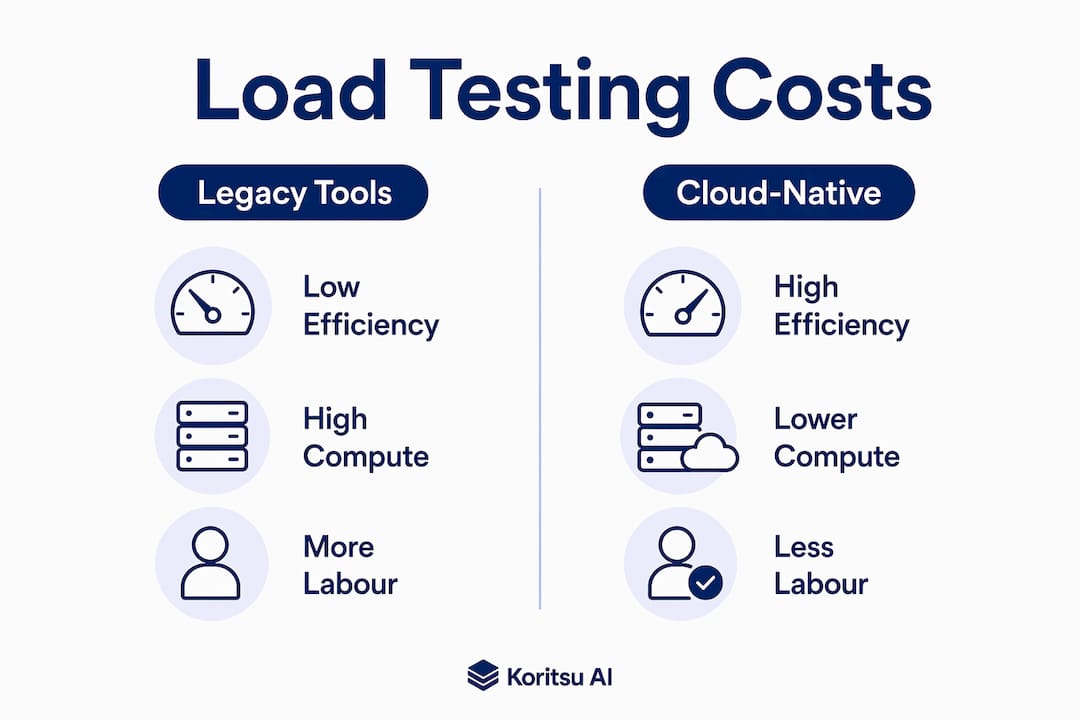
| Dimension | Apache JMeter | k6 / cloud-native tools |
|---|---|---|
| Compute efficiency | Low (JVM overhead) | High (Go-based, lightweight) |
| Licensing cost | Free | Consumption-based or SaaS fee |
| Engineering overhead | High (40–120 hrs/cycle) | Low (managed infrastructure) |
| Infrastructure management | Manual | Automated by platform |
| Multi-region support | Complex, costly | Built-in, simpler pricing |
The hidden cost of JMeter is not the licence. It is the engineering time spent keeping it running. Configuring distributed JMeter across AWS EC2 instances, managing plugins, and debugging failures consumes engineering capacity that has a real cost attached to it. Managed platforms absorb that overhead in exchange for a usage fee, and for most teams at scale, that trade is financially sound.
Pro Tip: Before committing to an open-source framework for cost reasons, calculate the fully loaded engineering cost of one test cycle. Multiply your senior engineer's hourly rate by the lower bound of 40 hours. If that figure exceeds the annual licence of a managed tool, the "free" option is the more expensive one.
What strategies reduce the financial impact of load testing on cloud costs?
Cost reduction in cloud performance testing follows a clear set of practices. None of them require sacrificing test quality.
-
Use Spot or Preemptible instances for load generation. AWS Spot Instances and Google Cloud Preemptible VMs can deliver 60–90% savings on compute costs compared to on-demand pricing. The requirement is a test framework that tolerates node termination gracefully. k6 and distributed frameworks built on Kubernetes handle this well. JMeter does not, without significant additional engineering.
-
Rightsize your load generator instances. Teams routinely over-provision load generators out of caution. Map your expected virtual user concurrency to the actual CPU and memory requirements of your chosen framework, then select the smallest instance type that meets those requirements. A cloud deployment cost checklist approach applied to test infrastructure yields the same savings it does in production.
-
Schedule tests during off-peak pricing windows. Some cloud providers offer lower spot pricing during low-demand periods. Running non-urgent load tests overnight or at weekends exploits these windows without affecting test validity.
-
Automate infrastructure teardown. A fleet of 20 on-demand instances left running over a weekend costs over $3,000 in avoidable spend. Automated teardown scripts, triggered at test completion, eliminate this risk entirely. Tag every test resource with a TTL label and enforce deletion via AWS Lambda or Azure Automation.
-
Replace always-on staging environments with digital twin or traffic replay models. Digital twin and traffic replay approaches reduce non-production infrastructure costs by around 50% by eliminating the need for a full-scale staging environment kept permanently warm for infrequent test cycles. Tools like Speedscale enable this pattern on Kubernetes-based architectures.
Pro Tip: Tag every cloud resource created during a load test with a dedicated cost allocation tag, such as "purpose: load-test". This makes post-test cost verification trivial and gives your finance team a clean audit trail without manual reconciliation.
How should IT managers plan and budget for cloud performance testing costs?
Budgeting for load testing is a process problem, not a technology problem. The teams that overspend are not using the wrong tools. They are failing to estimate, monitor, and verify costs with the same rigour they apply to production infrastructure.
Start with a pre-test cost estimate. Calculate expected VU hours by multiplying your planned virtual user count by test duration in hours. Apply the relevant pricing tier from your chosen platform. Add an estimate for data transfer based on expected traffic volume and region configuration. Document this estimate alongside the test plan so there is a baseline to compare against post-test.
Set cloud budget alerts before the test runs. AWS Budgets, Azure Cost Management, and Google Cloud Billing all support threshold-based notifications. A sensible approach is to set an alert at 80% of your estimated test budget and a hard stop at 120%. This catches runaway tests before they become a finance conversation.
- Pre-calculate VU hours and apply platform pricing tiers to produce a written cost estimate.
- Set budget alerts at 80% and 120% of the estimate in AWS Budgets, Azure Cost Management, or Google Cloud Billing.
- Document cost estimates in the test plan alongside performance acceptance criteria.
- Run a post-test cost verification within 24 hours and compare actuals against the estimate.
- Adjust test frequency and scale based on organisational risk tolerance, not habit.
The ROI framing matters here. Ecommerce outages cost over $1 million per hour, which means a $20,000 load testing programme that prevents a single two-hour outage pays for itself 100 times over. Presenting load testing budgets to finance leadership in this framing changes the conversation from cost control to risk management. That shift in framing is what gets programmes funded consistently. For a broader view of how cloud infrastructure investments translate into financial returns, the cloud infrastructure ROI examples from engineering-led organisations provide useful benchmarks.
Key takeaways
The most effective way to control load testing cloud cost impact is to treat it as a structured engineering process, not an ad hoc activity, combining rightsized infrastructure, automated teardown, and pre-test cost estimates.
| Point | Details |
|---|---|
| Cost components are multiple | Compute, data transfer, engineering labour, and orphaned infrastructure all contribute to total spend. |
| Tool choice drives efficiency | Cloud-native frameworks like k6 use up to 75% less compute than legacy tools like JMeter. |
| Spot instances cut compute bills | Using Spot or Preemptible instances saves 60–90% on load generator compute costs. |
| Automated teardown is non-negotiable | A fleet of 20 instances left running over a weekend costs over $3,000 in avoidable spend. |
| Budget framing changes outcomes | Presenting load testing as outage risk mitigation, not overhead, secures consistent funding. |
What I have learned about load testing costs that most articles miss
Most discussions of cloud load testing expenses focus on the obvious: VU hours, instance types, and tool licensing. Those are the easy parts. The costs that actually surprise engineering teams are the ones that sit outside the test itself.
Data egress is the most consistent offender. Teams design a multi-region test to simulate realistic global traffic, then discover that the cross-region data transfer charges have added a material sum to the bill. This is not a configuration error. It is a budgeting gap. The fix is simple: include data transfer in every pre-test estimate, not as an afterthought.
The second overlooked cost is engineering labour on open-source tooling. I have seen teams spend 80 hours per cycle keeping a JMeter cluster operational, then report that their load testing costs are low because they pay no licence fee. The labour cost is real. It just does not appear on the cloud bill. Integrating those hours into your CI/CD pipeline cost analysis gives you an honest picture of what performance testing actually costs the organisation.
The deeper issue is that load testing cost is a process problem. The organisations that manage it well have one thing in common: finance and engineering talk to each other before the test runs, not after the invoice arrives. That collaboration is not a cultural luxury. It is the mechanism that keeps load testing programmes funded and proportionate.
— Kori
How Koritsu AI helps you control cloud testing costs
Cloud performance testing costs are fixable. The inefficiencies are almost always structural: wrong instance types, missing teardown automation, no cost tagging, and no pre-test estimates.
Koritsu AI combines continuous cloud spend analysis with hands-on expert guidance to surface exactly these kinds of inefficiencies. Our AI agent, Kori, identifies where load testing and broader cloud activity is generating avoidable cost. Our specialists help engineering teams act on those findings. A UK bidding platform reduced its cloud costs by 52% working with Koritsu AI, with savings coming from precisely the structural issues that affect load testing budgets. Start with a free assessment at koritsu.ai and see where your spend is going before the next test cycle runs.
FAQ
What is the typical cost of a cloud load testing programme?
A comprehensive load testing programme typically costs between $5,000 and $50,000 per cycle, covering cloud compute, tooling, and engineering hours. The ROI can reach 40x when the programme prevents production outages.
How does tool choice affect cloud load testing expenses?
Cloud-native frameworks like k6 require up to 75% less compute than legacy tools like Apache JMeter. That efficiency gap translates directly into a lower cloud bill for every test run.
What are the most common hidden costs in cloud performance testing?
Data egress charges for cross-region load generators and engineering labour for open-source tool maintenance are the most frequently overlooked costs. Both must be included in pre-test budget estimates.
How can teams avoid orphaned infrastructure costs after load tests?
Automated teardown scripts, triggered at test completion and enforced via AWS Lambda or Azure Automation, eliminate the risk of idle instances accumulating charges. Resource tagging with a TTL label supports this process.
Is load testing cost justified for smaller engineering teams?
Load testing is justified at any scale where a production outage would cost more than the test programme. Given that outages can exceed $1 million per hour, even a modest $5,000 programme represents sound risk management.