FinOps Inform · Tools
Top 5 nops.io Alternatives for Cloud Cost Management 2026
Discover the top 5 nops.io alternatives for cloud cost management to help you choose the best solution for your needs.
Managing cloud costs across multiple providers becomes unpredictable when spend visibility breaks down by team and AI service usage. Many cloud cost optimisation tools tie essential features to high-priced enterprise tiers, require lengthy setups, or only support one provider, leaving multi-cloud and AI workloads poorly covered. This comparison lines up pricing models, automation levels, and multi-cloud coverage across five cloud cost optimisation platforms so you can choose one that matches your engineering footprint and spend management needs.
Koritsu AI
At a Glance
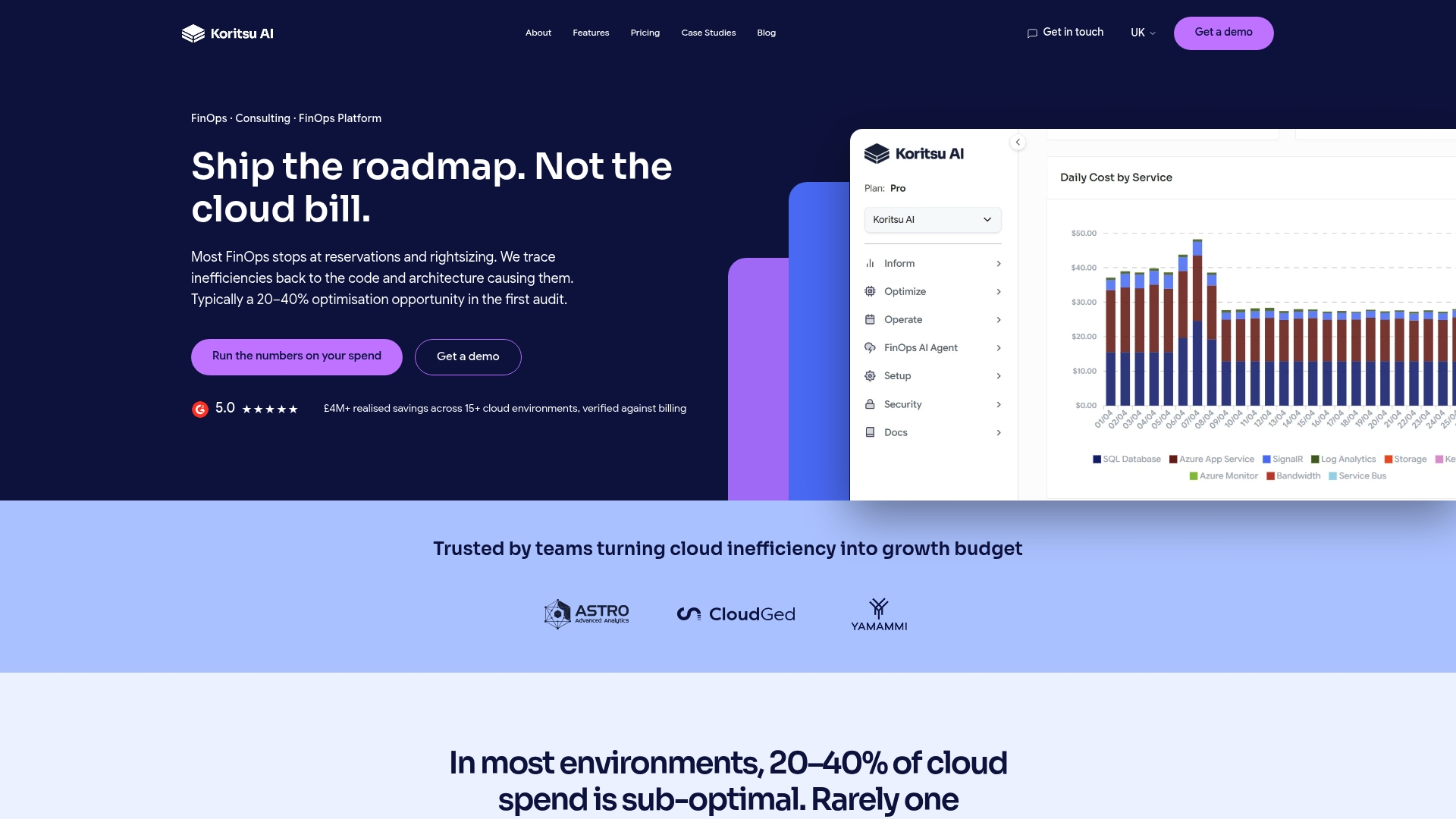
Koritsu bills a success fee model where two months of realisable savings are invoiced only after those savings are verified against billing data. The platform couples an AI agent named Kori with hands-on engineering specialists to find and fix hidden cloud waste.
Core Features
- AI-powered FinOps analysis and monitoring that continuously examines spend and flags anomalies.
- Detailed cost breakdowns by resource, service, and sub-costs to show where money flows and why.
- Code and architecture review that surfaces structural inefficiencies rather than only tag-level waste.
- Automated anomaly detection and alerts for sudden cost regressions.
- Guided recommendations for rightsizing and architectural improvements, plus specialist support to ship fixes.
Key Differentiator
Koritsu pairs engineering-depth reviews with continuous AI monitoring and verifies savings against the actual bill. That mix means findings are framed as engineering work items that your team can implement, rather than alerts left to procurement or finance to interpret.
Pros
-
Deep engineering focus. The review process inspects code and architecture so you address root causes, not just oversized instances or idle resources.
-
Savings verified on billing data. Koritsu aligns measurement with finance by checking optimisations directly against exported invoices and charge details.
-
Continuous guardrails via Kori. The AI agent watches for regressions so a one-off optimisation does not drift back to higher spend.
-
No upfront cost to start. You begin with a free assessment and pay only from realised, verified savings, which lowers procurement friction for trials.
-
Multi-cloud support. The platform works across AWS, Google Cloud, Azure and other FOCUS billing providers, allowing consolidated optimisation across providers.
Cons
- Requires engineering capacity. You need active cloud environments and teams willing to implement architectural changes for the savings to materialise.
Who It’s For
If you lead engineering, infrastructure or finance in a medium to large organisation running active cloud workloads, Koritsu fits situations where the hidden inefficiencies are structural. It is less useful for small teams without the bandwidth to action architectural fixes.
Unique Value Proposition
Starts with a free assessment and charges only when savings are realised. That commercial structure shifts vendor risk to the provider and makes a pilot operationally simple for finance and engineering to sign off.
Real World Use Case
Koritsu’s marketing materials describe a customer that, according to the vendor, identified 20–40% excess spend in an AWS estate after an architecture and code review. The engagement then converted findings into engineering tasks, engineers shipped fixes, and savings were confirmed on the bill before any fee was charged.
Pricing
Koritsu uses a success fee model: two months of realisable savings billed after verification. After the initial engagement there are tiered monthly plans available for ongoing monitoring and support.
Website: https://koritsu.ai
Economize
At a Glance
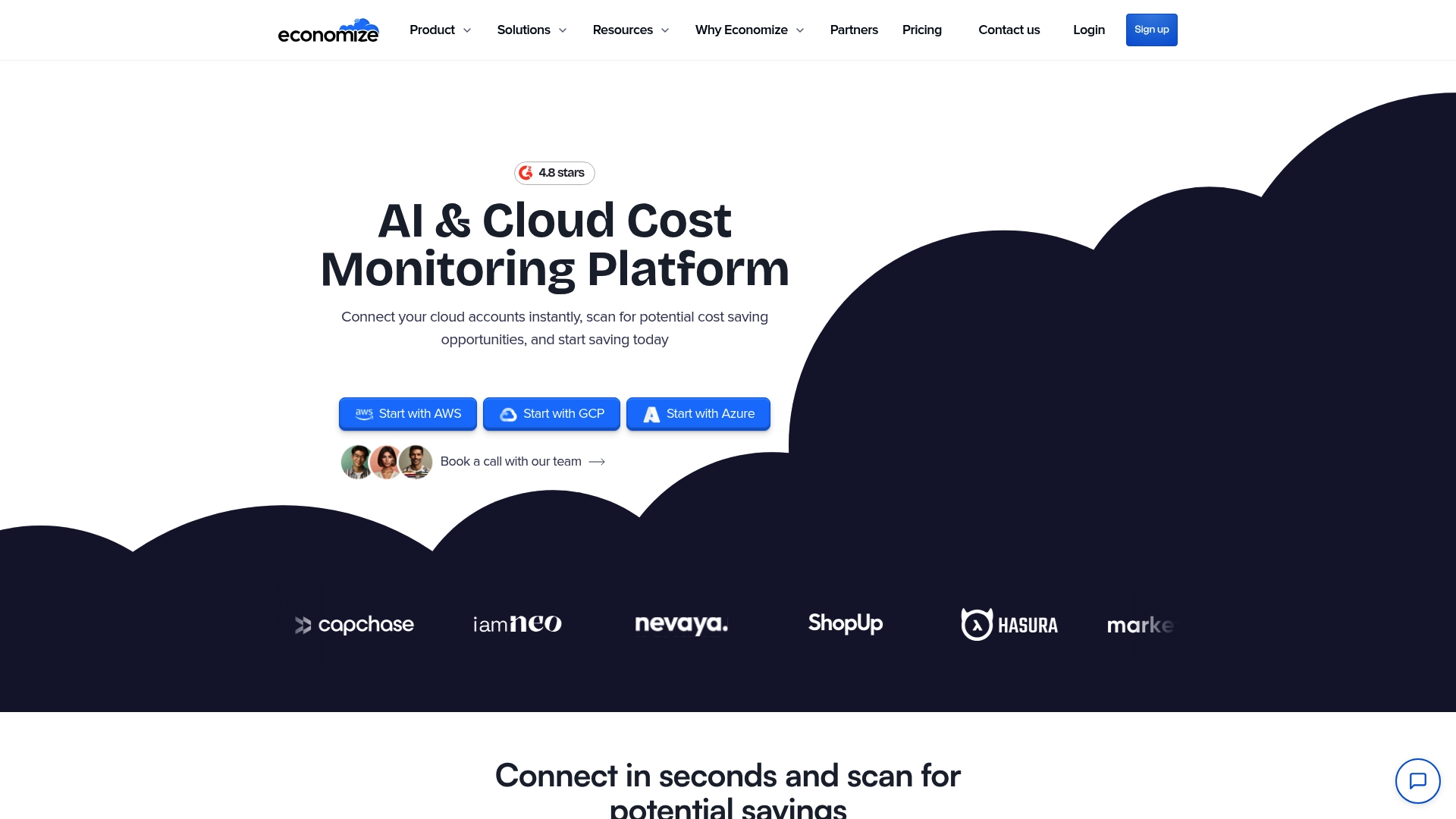
A Professional tier starts at $249/month while Enterprise begins at $2,499/month scaled to cloud spend, a clear signal this product targets mid sized and larger organisations. The vendor describes an agentless, multi cloud service that combines AI driven recommendations with real time monitoring across AWS, GCP and Azure.
Core Features
Economize delivers detailed cost reports, real time expense monitoring and AI driven optimisation suggestions. It includes anomaly detection with root cause analysis and a unified multi cloud asset overview to help you spot waste across providers.
The platform uses agentless account connections and role based access controls so teams can start without installing agents on resources.
Key Differentiator
What sets Economize apart is the combination of agentless account scanning with continuous AI driven recommendations and native collaboration hooks. That approach reduces setup friction while feeding alerts and reports into existing team workflows.
Economize pairs cost signals with integration endpoints so FinOps teams get notices where they already work rather than in a siloed dashboard.
Pros
- Smooth cloud account onboarding reduces project overhead and gets teams reporting in hours rather than days.
- Proactive support during onboarding and ongoing customer service helps when cloud billing surprises appear.
- Detailed visualisations such as cost breakdowns and pie charts make it easier to present spend to non technical stakeholders.
- Weekly reports and anomaly alerts keep FinOps managers informed without requiring constant dashboard checks.
- Integrates with common collaboration tools so notifications can be routed to your existing channels.
Cons
- The vendor’s public Trustpilot entry shows a single review rated 3.7, which leaves independent confidence relatively low.
- Public facing material provides limited detail on advanced enterprise controls, so procurement teams will need deeper technical conversations before buying.
- The product appears oriented to mid sized and large organisations which can make it overfeatured for small startups or solo practitioners.
When It May Not Fit
If you are a very small startup or an individual engineer looking for a lightweight free tool, Economize’s pricing bands and enterprise focus may be more than you need. Teams requiring very granular on prem or niche provider support should validate coverage before committing.
If you want a quick, out of the box invoice parser with no integration work, this may be heavier than necessary.
Notable Integrations
- Slack
- Microsoft Teams
- Google Chat
- SAML SSO
These integrations allow alerts, weekly summaries and single sign on to land in existing tools rather than creating new inboxes.
Who It’s For
Cloud platform teams, FinOps managers and CTOs at medium to large organisations who run multi cloud estates and need continuous cost governance. If your team must align engineering, finance and product on spend signals, Economize is built for that cross functional workflow.
Real World Use Case
The vendor’s marketing describes a SaaS customer that reduced AWS spending by 30% after applying Economize recommendations. That case illustrates how continuous anomaly alerts and right sizing suggestions feed budgeting cycles and reduce surprise bills.
Pricing
- Free tier available for evaluation.
- Professional at $249/month for teams that need regular monitoring and recommendations.
- Enterprise starting at $2,499/month scaled to cloud spend with advanced controls and support.
Website: https://economize.cloud
Yasu
At a Glance
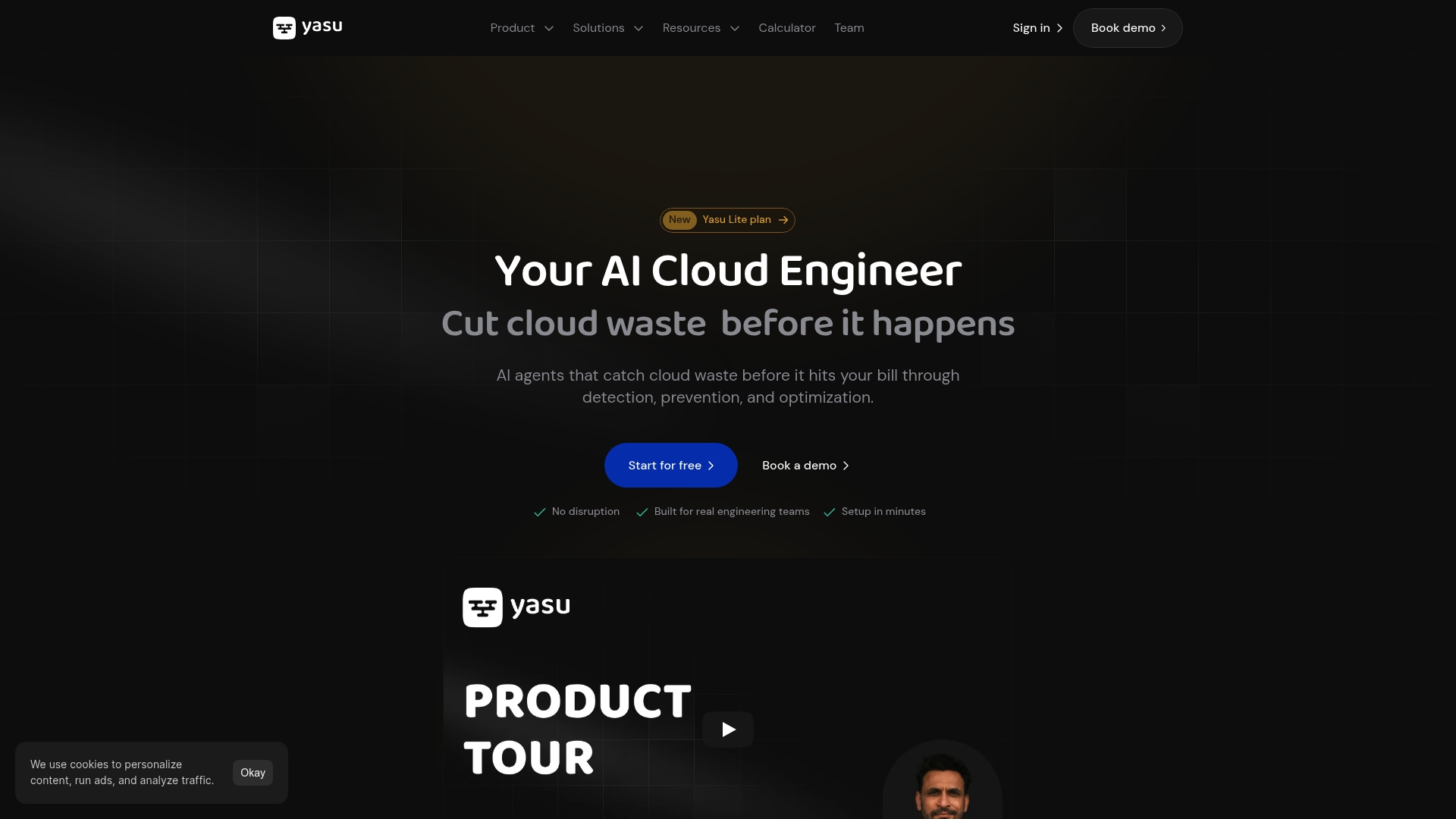
Yasu’s marketing materials claim it can cut cloud spend by around 30% on average without adding headcount. That savings figure is vendor reported and sets expectations for engineering and FinOps teams assessing autonomous optimisation tools.
Yasu combines continuous analysis with automated remediation so cost reduction happens inside existing workflows rather than as a separate reporting exercise.
Core Features
- The vendor states connections to AWS, GCP, Azure, GitHub and Slack can be live in under 3 minutes, which supports fast onboarding.
- AI-powered agents run continuous cost analysis, detect waste, and recommend or apply fixes automatically.
- Automated fixes are wired into CI CD pipelines to prevent waste before it reaches production.
- Real time visibility and alerting across multiple providers with natural language querying via Slack or Teams.
Key Differentiator
Yasu positions itself as an autonomous cloud engineer that both finds waste and implements fixes in real time inside your existing pipelines. That operating model reduces the need for new headcount and shifts optimisation from a periodic task to an always-on process.
Because actions can be automated within CI CD, teams see fewer repetitive pull requests for trivial rightsizing and more focus on architecture work.
Pros
- Rapid setup. The quick connector claims enable a fast trial where teams can validate initial findings without lengthy onboarding.
- Continuous automation reduces manual toil so engineers spend less time opening tickets for low value changes.
- Natural language queries in chat lower the barrier for stakeholders to ask cost questions without dashboard training.
- Multi cloud support helps teams that run across AWS, GCP and Azure avoid tool fragmentation.
- Reports and financial outputs aim to fit FinOps workflows rather than require people to rework export formats.
Cons
- The long term reliability and precision of AI recommendations is not transparent in available materials. That limitation is common with agent driven tooling.
- Some engineering teams will resist automated fixes; guard rails and approval workflows are often required to build trust.
- Pricing is not publicly listed which forces procurement cycles to start with a sales conversation rather than self-service evaluation.
When It May Not Fit
If your organisation requires full manual control over every infrastructure change then Yasu’s autonomous actions will feel intrusive. Teams with highly custom platforms or strict change control may prefer a tool that offers recommendations only.
If your environment is extremely complex the vendor warns that savings and accuracy will vary with architecture and usage patterns.
Notable Integrations
- GitHub for PR cost comments and automated fixes
- GitLab for CI CD integration
- Slack for alerts and natural language queries
- Teams for chat based queries and stakeholder access
Who It’s For
Cloud engineering teams, FinOps practitioners and finance managers responsible for cloud spend who want live, embedded cost control rather than periodic reports. It suits teams ready to accept automated remediation with appropriate governance.
Real World Use Case
The vendor cites a rapidly scaling SaaS company that used Yasu to identify oversized resources and misconfigurations and reports a 35% monthly saving on AWS. That case study is vendor supplied and illustrates how automated fixes combine with observability to produce month over month reductions.
Pricing
Yasu does not publish standard pricing. The available information implies customised or tiered plans that are quoted after a discovery conversation. Expect vendor engagement to obtain a price estimate for your scale and cloud footprint.
Website: https://yasu.cloud
OpsNow FinOps Plus
At a Glance
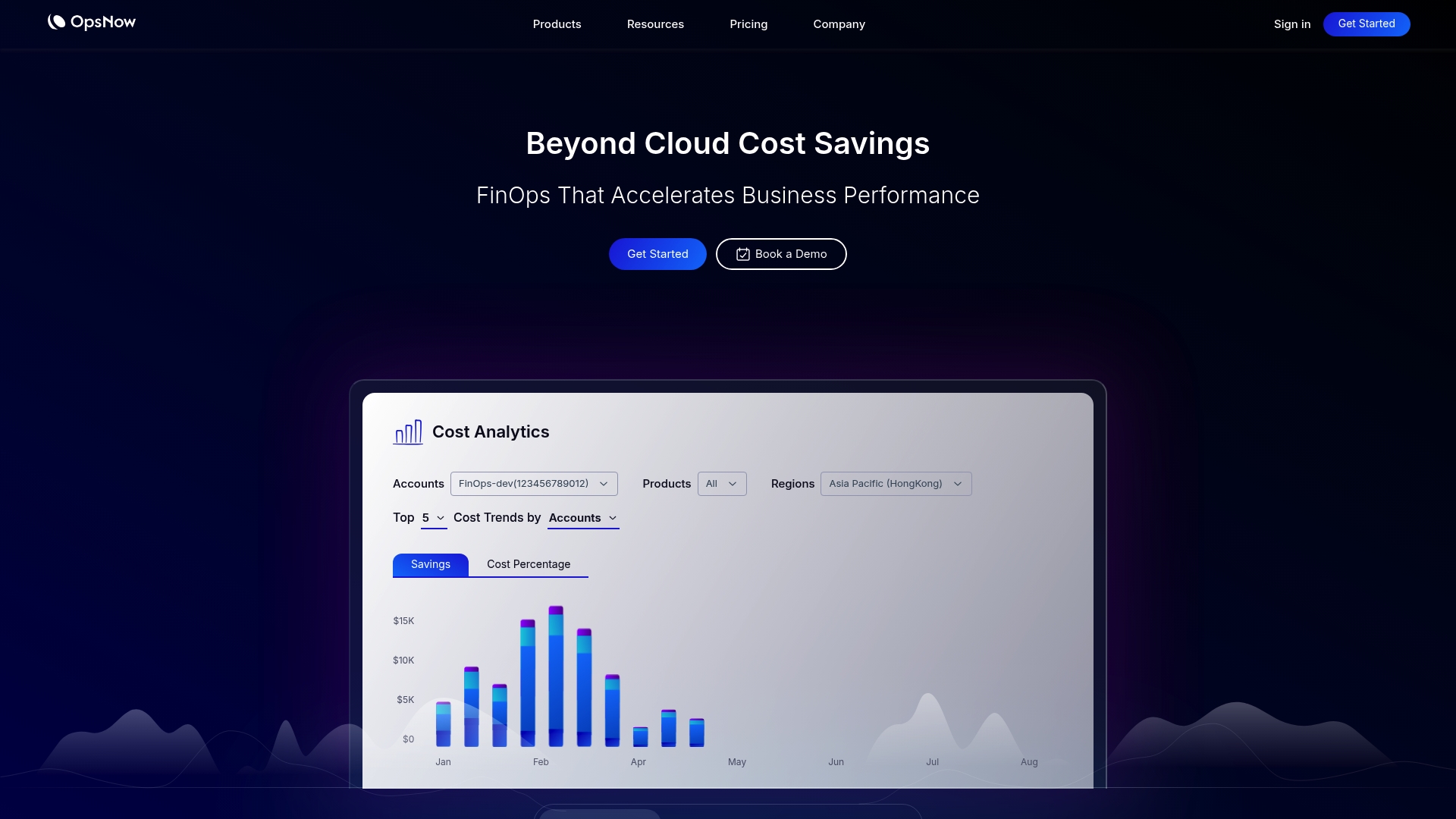
OpsNow’s marketing materials state it is certified by the FinOps Foundation, a concrete credential that will matter to governance teams. The vendor also pitches AI-driven forecasting and automated savings across AWS, Azure and GCP, all surfaced in a single dashboard.
Core Features
- Cost analytics and anomaly detection: cross-cloud visibility with alerts for unexpected spend patterns.
- Real time resource monitoring and rightsizing recommendations: suggestions to cut idle or oversized instances and reclaim capacity.
- Tag based cost attribution and chargeback capability: lets finance map cloud spend to business units and projects.
- Policy driven governance: enforce compliance rules and automatic remediations for non compliant resources.
- AI powered forecasting, budgeting and optimisation insights: predictive budgets and automated optimisation suggestions for planning.
Key Differentiator
OpsNow sets itself apart by combining automated optimisation with governance at enterprise scale. Its selling point is the marriage of AI recommendations and policy enforcement so finance and engineering can act from the same interface rather than trading CSVs and tickets.
Pros
-
Centralised visibility across multiple cloud accounts reduces the time teams spend hunting for cost drivers. Teams stop toggling between vendor consoles to assemble a single view.
-
Workflows cover planning, delivery and troubleshooting, which shortens the handoff between finance and engineering during cost reviews.
-
The GUI surfaces live logs and resource usage in one place, making incident triage faster when spikes appear during business hours.
-
Strong multi cloud analytics gives granular resource and cost breakdowns, useful when you need to reallocate spend across regions or teams.
-
Support is reported as generally good during business hours, so engineering-led remediation often happens within the same workday.
Cons
-
Support is not available 24/7, which is a real limitation for globally distributed teams operating outside core business hours.
-
Most public evidence of customer experience appears on comparison pages rather than detailed independent reviews, so third party validation is limited.
-
The platform’s feature list is broad; that breadth can mean a steeper initial setup and governance design phase for entrenched estates.
When It May Not Fit
If you run a small cloud estate or prefer a single cloud provider workflow, the enterprise orientation here may bring unnecessary complexity. Also, if your operations require round the clock vendor support, the stated support window will be a constraint.
Who It’s For
Large organisations and central cloud teams that need unified cost control, governance and collaborative workflows across multiple cloud providers. Best for groups that can invest time in policy design and want a single pane for finance and engineering.
Real World Use Case
A multinational firm used OpsNow to unify AWS, Azure and GCP spend into one set of dashboards, applied policy driven rules to non compliant resources and used the AI suggestions to rightsise persistent instances. The result was faster cross team decisions and clearer chargeback reports.
Pricing
The vendor directs visitors to its website for plan details and pricing tiers. Prospective buyers should request a tailored quote that reflects their account volumes and required governance features.
Website: https://opsnow.io
CloudYali
At a Glance
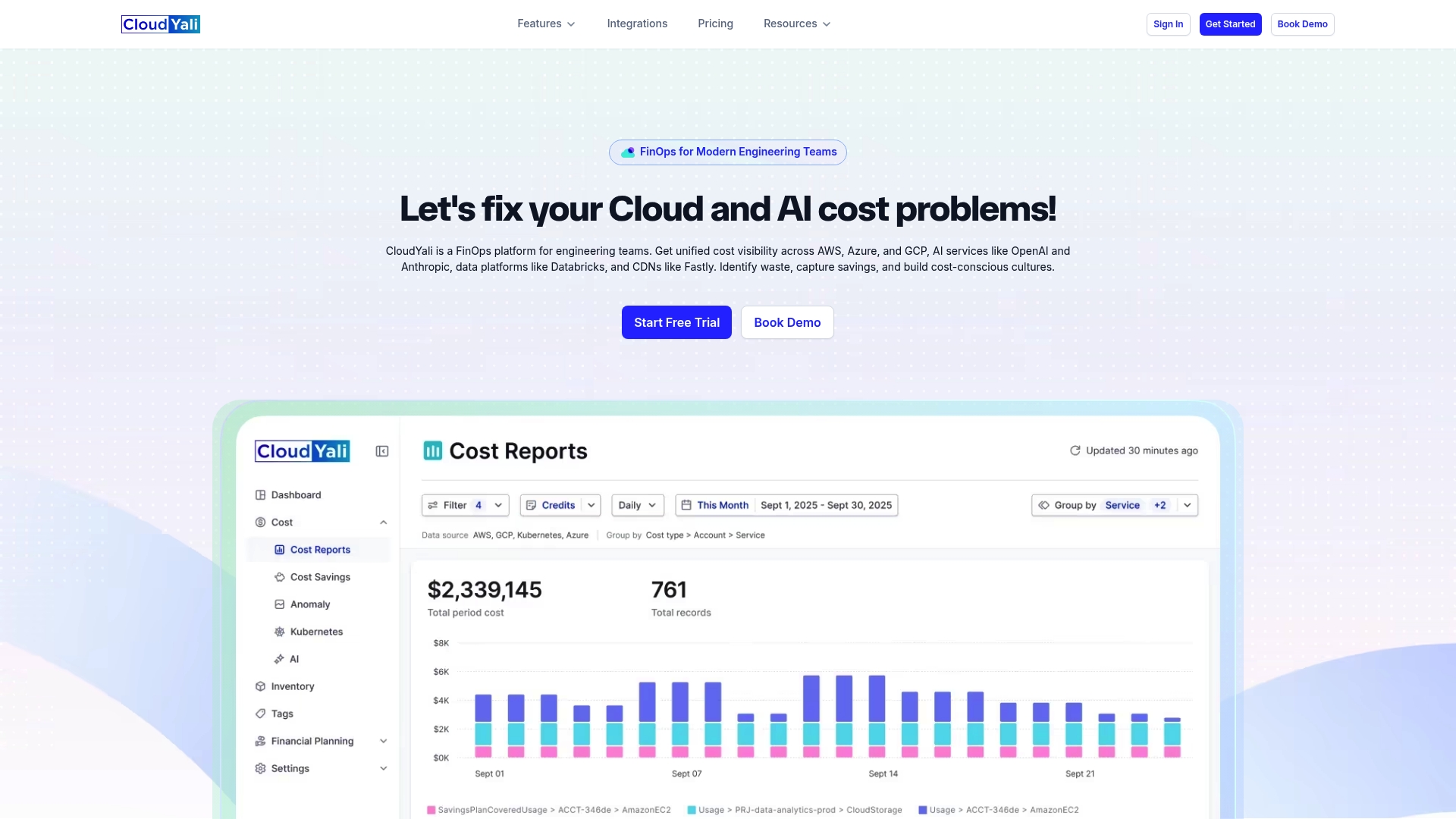
AI cost tracking for LLM and generative services such as OpenAI and Amazon Bedrock is highlighted among CloudYali’s capabilities, making AI spend visible alongside traditional cloud bills.
The vendor advertises a straightforward flat fee pricing approach for teams of varying sizes, a positioning worth verifying against actual contracts and support tiers.
Core Features
- Cost visibility with granular insights across services and teams, intended to surface who is spending what and where.
- Automated recommendations for rightsizing and waste elimination that teams can discuss and validate in community threads.
- Asset discovery and tracking across multiple cloud providers to keep a canonical inventory of resources.
- Budget setting with proactive alerts to stop overruns and tag governance tools to enforce consistent allocation.
- Unified coverage for AWS, Azure and GCP plus explicit tracking for AI services and integrations with collaboration tools.
Key Differentiator
CloudYali’s central claim is unified visibility across multi-cloud environments and AI services paired with automated recommendations. That combination frames the community as a place where engineers and FinOps practitioners compare decisions and share rule sets rather than a simple Q and A forum.
Compared with Koritsu AI, CloudYali leans into cross-provider cost observability and community discussion of automated suggestions, which means it serves a slightly different set of workflows and peer conversations.
Pros
-
Transparency across providers lets members correlate spend patterns across AWS, Azure and GCP without juggling separate threads or spreadsheets.
-
Automated recommendations provide concrete items to test in engineering sprints, shortening the path from discussion to measurable savings.
-
Tag governance content and templates help teams standardise allocation, so community contributors can share tag policies that have been piloted in production.
-
The platform’s focus on AI service tracking addresses an emerging cost vector; members can compare prompts, model choices and billing quirks.
-
Flexible plans are advertised for startups through to large organisations, which lowers the entry barrier for small teams wanting peer support.
Cons
-
TrustRadius reporting indicates insufficient public reviews, so community claims about reliability or ease of use are hard to corroborate independently.
-
Limited publicly available user sentiment makes it difficult to gauge long term support quality and moderator responsiveness from outside the platform.
-
Pricing detail opacity remains a concern; advertised flat fees do not replace the need to see exact inclusions for guardrails and SLAs.
When It May Not Fit
If your procurement process relies on independent third party reviews or published case studies, CloudYali is a weaker fit because public user feedback appears sparse. Also avoid it if you need mature community moderation signals before committing.
Who It’s For
DevOps, FinOps and cloud engineering teams wrestling with multi-cloud bills and the new cost patterns from LLM usage. It suits teams that prefer peer-shared playbooks and community-tested governance templates over isolated vendor support.
Real World Use Case
A SaaS startup uses CloudYali to monitor AWS and GCP spending, identify waste and run the vendor’s automated savings recommendations. The team logs recommended actions in a shared thread, tests rightsizing changes during a sprint and records reduced spend in their budget dashboard.
Website: https://cloudyali.io
Comparative Analysis
Introduction
Choosing the right cloud cost optimisation tool depends on balancing detailed accountability with workflow fit. The following comparison highlights the particular strengths and trade-offs among leading solutions.
Setup Efficiency
Yasu offers standout advantages in onboarding speed, actively supporting integrations with major provider ecosystems like AWS, GCP, and Azure within minutes. Their tools embed within existing CI/CD pipelines, creating immediate operational value. However, this efficiency is partially diminished without proactive human oversight to qualify automation outputs. For highly dynamic teams requiring a smooth start, Yasu shines.
Savings Verification vs Trade-offs
Economize and OpsNow FinOps Plus cater broadly to medium-to-large setups with features streamlining governance and analysis. By contrast, Koritsu AI is differentiated by its verification of realised savings directly against billing data. This ensures optimisations lead to tangible fiscal benefits, though this rigorous process necessitates viable engineering bandwidth. Organisations desiring granular accuracy should evaluate Koritsu’s approach.
Feature Breadth and Community Support
Of the solutions, CloudYali is unique in its integration of AI-centric cost tracking with a community-driven forum for practice-sharing. Meanwhile, while other select tools like Economize incorporate standardised monitoring, CloudYali excels in providing public explorations of optimisation initiatives. Teams working on generative AI or seeking peer-reviewed strategies might find CloudYali a valuable resource.
Best Fit
- Koritsu AI: Engineering-focused teams with active cloud setups seeking savings proven by financially verifiable means
- Yasu: Teams with needs for immediate implementation without complex setup or additional headcount dependency
- Economize: Organisations prioritising extensive reporting capabilities and frequent cost oversight
- CloudYali: Users focused on AI expenditure alongside multi-cloud spend or in need of a collaborative tool
- OpsNow FinOps Plus: Enterprises demanding extensive and rigorous cross-cloud cost governance solutions
Our Pick
Among these capable tools, Koritsu AI uniquely blends engineering-root audits with finance-focused measurement, presenting a framework for maximised savings verification. While larger teams with limited desire for engineering adjustments might opt for alternatives, for solutions targeting waste through accountability and well-validated fiscal strategies, Koritsu AI is the strongest companion.
Cloud Cost Optimisation Software Comparison
Selecting the right cloud cost optimisation software involves evaluating the features and strategies offered by each platform to address cloud spending efficiently.
| Product | Core Feature | Best For | Pricing | Notable Limitation |
|---|---|---|---|---|
| Koritsu AI | AI-based FinOps with engineering support | Medium to large organisations | Success fee based on savings | Requires engineering capacity for implementation |
| Economize | Detailed cost reporting and alerts | Mid to large enterprises | Free tier, $249/month (Pro) | Limited information on advanced controls |
| Yasu | Autonomous cost analysis and actions | Teams focusing on automation | Not disclosed | Automated changes may feel intrusive |
| OpsNow FinOps Plus | AI-driven governance and forecast | Enterprises needing unified cost control | Not disclosed | Governance setup requires initial investment |
| CloudYali | Cost tracking for multi-cloud and AI | DevOps and FinOps teams seeking community insights | Flat fee advertised | Sparse independent reviews from users |
Discover a Smarter Way to Cut Cloud Costs with Koritsu AI
Managing cloud spend can feel overwhelming when hidden inefficiencies lurk deep within your architecture rather than in obvious pricing options. Koritsu AI is designed specifically to tackle these structural waste challenges by pairing continuous AI analysis with hands-on engineering expertise. This approach offers real savings verified directly against your billing data — not just alerts.
Why choose Koritsu AI over other nops.io alternatives?
- No upfront fees — pay only from actual savings found
- Deep code and architectural reviews to fix root causes
- Continuous monitoring to prevent cost regressions
FAQ
How does Koritsu AI verify savings against billing data?
Koritsu AI verifies savings by invoicing two months of realisable savings only after those savings are confirmed against billing data. The platform ensures that financial metrics are aligned by checking optimisations directly against exported invoices. This systematic verification provides confidence to finance teams in optimising cloud costs.
What is the difference between Koritsu AI and Economize?
Economize excels with its agentless account connections and rapid onboarding, which enables teams to report in hours rather than days. In contrast, Koritsu AI offers deep engineering reviews by inspecting code and architecture to address root inefficiencies, making it more suited for organisations needing comprehensive structural optimisations. Consider your team’s readiness to implement complex changes when making your choice.
Which platform offers a success fee model like Koritsu AI?
Koritsu AI adopts a unique success fee model where invoices are based on verified savings, providing a lower-risk entry for organisations. This approach differentiates it from many competitors, making it easier for teams to start with a trial without upfront costs. This can appeal to teams hesitant to commit to a subscription without seeing initial results.
Can I use Economize if I am a small team?
Economize may not be the best fit for very small teams, as its Professional tier starts at $249 a month and aims at medium to large organisations. For those with limited engineering capacity, starting with Koritsu AI, which offers a free assessment, can allow for a lower-commitment introduction to cost optimisation.
Does Koritsu AI provide automated anomaly detection?
Yes, Koritsu AI includes automated anomaly detection to monitor spend and flag regressions. This feature helps maintain consistent cost control and prevents overspending, allowing organisations to stay proactive about their cloud budgets. Continuous monitoring is critical for effective cloud financial management and optimisation.