FinOps Inform · Tool Comparison
Top 3 omu.ac.jp Alternatives 2026
Discover 3 omu.ac.jp alternatives for academic resources. Compare options to find the best fit for your educational needs.

Identifying cloud cost optimisation software that delivers verified savings without high upfront risk is challenging for organisations, research groups, and IT departments. Many competitors provide dashboards and projected savings, but rarely validate results against actual billing or offer a success fee model. This comparison covers pricing, savings verification, and engineering integration so you can match an alternative to your real procurement and accounting needs.
Table of Contents
Koritsu AI
At a Glance
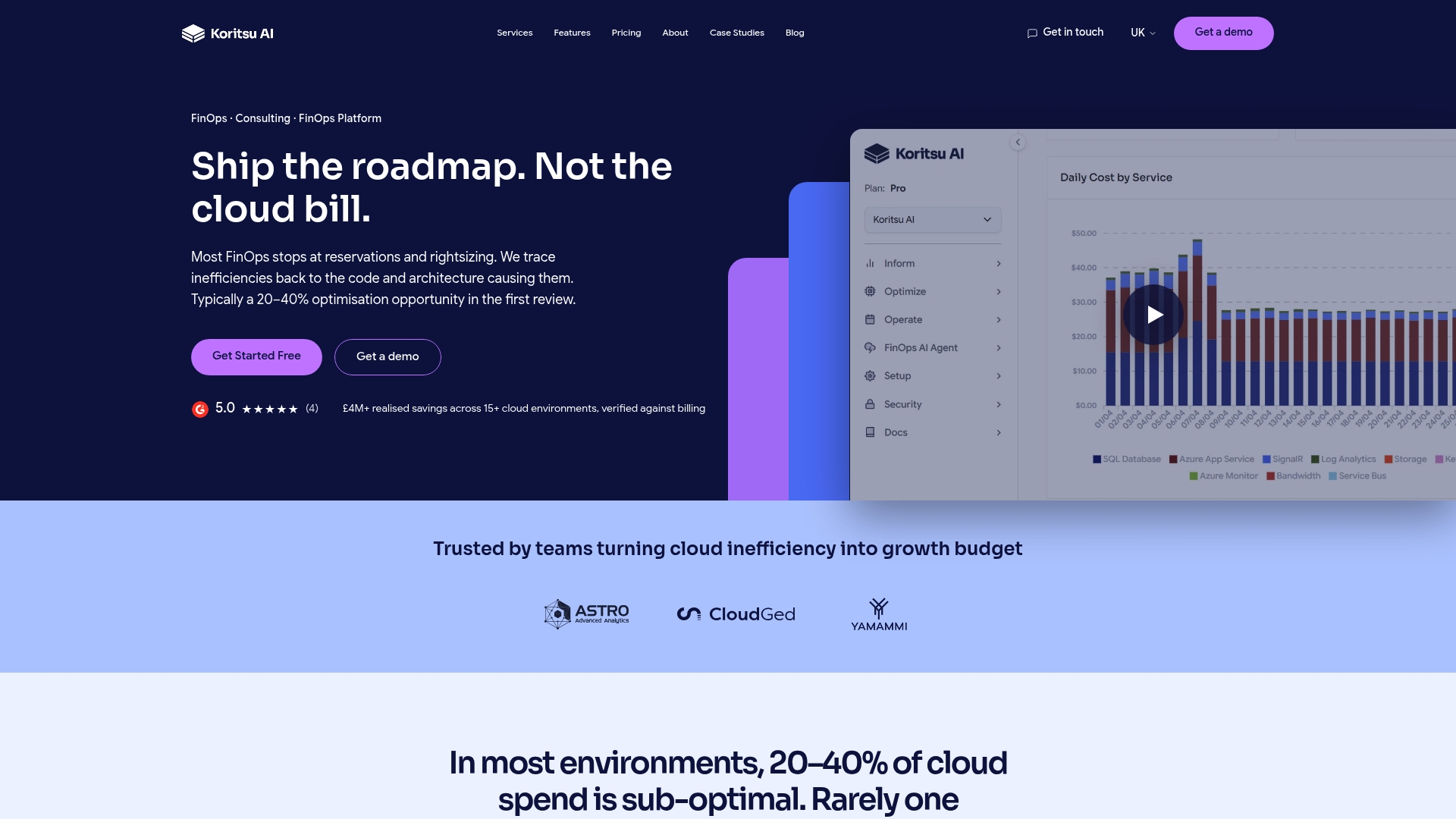
According to the company, Koritsu AI typically finds 20–40% savings in cloud spend for engineering-heavy environments. The platform pairs an AI agent called Kori with expert consultants to verify savings against billing data. Clients begin with a free assessment and move to a success fee model once savings are realised.
Core Features
Koritsu AI performs AI-powered cost analysis and anomaly detection while delivering a resource level spend breakdown by service, resource, and architecture. The service includes engineering and architecture deep dives to identify root causes of waste and produces automated, prioritised recommendations for rightsizing and policy controls. Continuous monitoring with Kori keeps alerts and regressions visible after initial fixes.
Key Differentiator
Koritsu's single strongest claim is its verification of savings against actual billing combined with engineering level analysis. That combination means recommendations are tested against invoices rather than inferred from tags alone. The team then helps engineering groups implement fixes so identified savings translate into real cost reductions.
Pros
Koritsu specialises in engineering level analysis that goes beyond surface metrics, so you get concrete changes to code and architecture rather than dashboards alone. Verification against billing data gives a clear audit trail for finance teams and reduces disputes about projected savings. The pricing model removes upfront fees and aligns incentives, and continuous monitoring helps keep savings persistent across multi cloud environments.
Cons
- Requires close collaboration with engineering teams to implement recommendations, which may slow adoption for less resourced groups.
Who It's For
Research groups, university IT departments, and labs that run substantial cloud workloads and have engineering capacity will see the most value. The platform suits teams responsible for cloud architecture, cost control, and unit economics rather than individual students running small projects. Koritsu fits where technical fixes can be deployed and billing data is available.
Unique Value Proposition
No upfront fees and a success fee model change the financial risk for institutions testing cost optimisation. This pricing lets an IT or research group trial a free assessment and pay only once verified savings appear on invoices. That structure helps finance teams accept external help while shifting implementation risk to the vendor.
Real World Use Case
According to the company, a global financial services group used Koritsu's resource level analysis to find a Lambda function with excessive memory allocation. Rightsizing and redesign reportedly cut that function's cost by over 96%, with the savings verified directly against billing exports. The example shows how a single code or configuration change can produce large, verifiable savings for high‑usage workloads.
Pricing
Koritsu begins with a free assessment, then moves to a success fee arrangement so the vendor shares upside with the client. After savings are realised, clients can adopt an ongoing subscription for continuous monitoring and support if they choose. The vendor states there are no upfront charges for the initial engagement.
Website: https://koritsu.ai
nOps
At a Glance
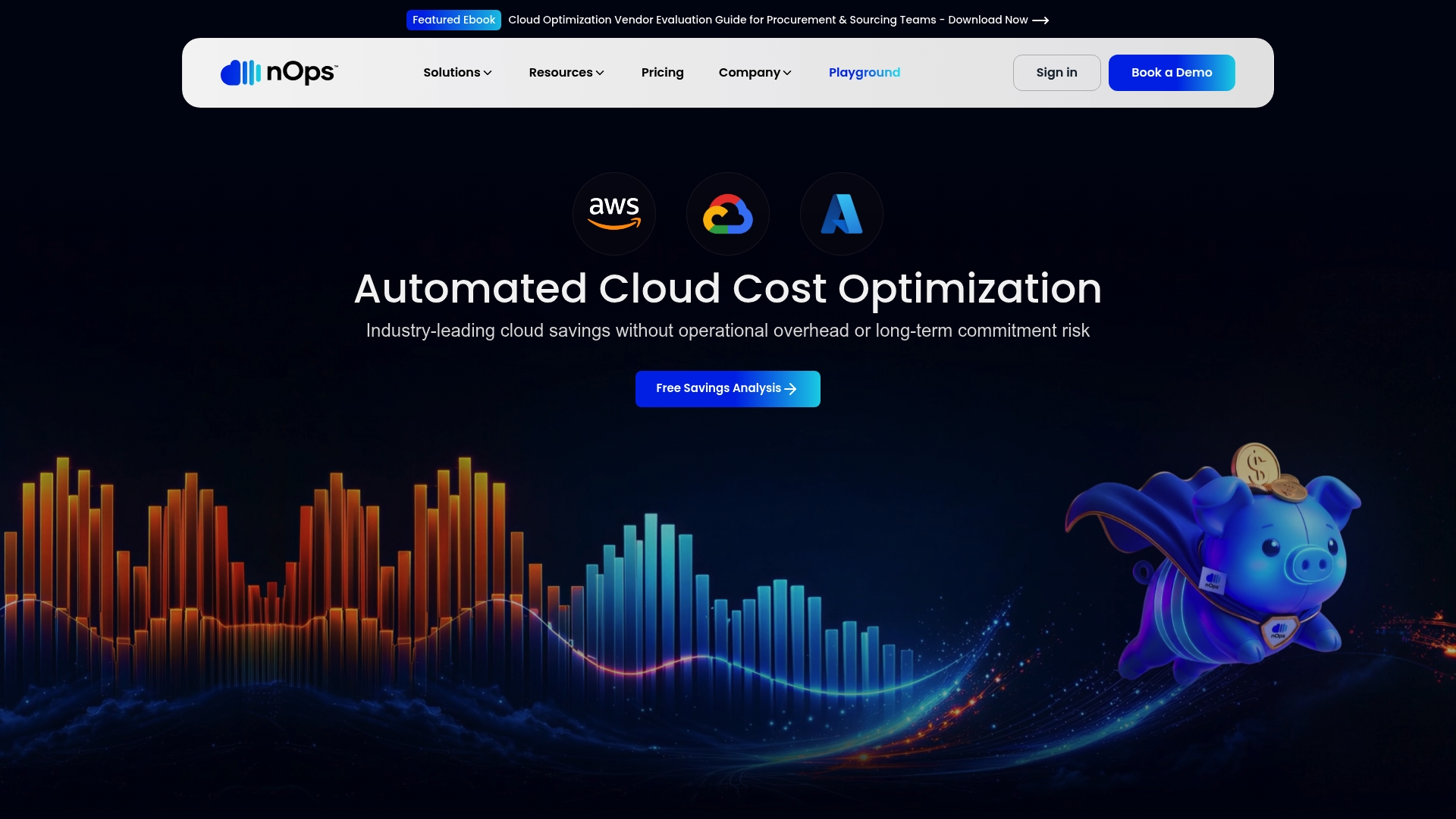
nOps reports managing over $4 billion in annual cloud spend. The vendor advertises savings of 50%+ on cloud costs without long term commitments. The platform targets automated cost optimisation and continuous commitment rebalancing across AWS, Google Cloud, and Microsoft Azure.
Core Features
The platform delivers unified cost visibility and allocation across multiple cloud providers, with dashboards for anomaly detection and forecasting. It pairs AI driven recommendations with real time commitment rebalancing to reduce waste while avoiding long lock in periods. Teams can also pull optimisation suggestions into collaboration tools and reporting workflows.
Key Differentiator
nOps centres on AI powered continuous rebalancing of commitments across multi cloud environments. That mechanism adjusts reservations and commitments automatically so engineering teams do not need to manage long term contracts manually. The emphasis on ongoing rebalancing separates it from tools that only provide one off buying advice.
Pros
Automates complex commitment management and reduces manual effort for teams that manage large cloud estates. The multi cloud visibility brings AWS, Google Cloud, and Microsoft Azure billing into one place, which simplifies allocation and reporting for FinOps teams. Integrations with collaboration and monitoring tools let recommendations reach engineers through existing workflows, while the continuous rebalancing model reduces the risk of being locked into unsuitable commitments.
Cons
- Automated recommendations require manual validation in very complex environments, according to third party reviews.
- Customisation of optimisation strategies can feel limited for teams needing bespoke policy rules.
- There is a learning curve for teams new to FinOps practices and to commitment rebalancing concepts.
When It May Not Fit
Small organisations or teams with minimal cloud spend will not see enough upside to justify the service model. Environments with unusual billing models or heavy use of bespoke licensing may require manual checks for every recommendation. If your primary requirement is granular, rule by rule policy control, this platform may feel constraining.
Notable Integrations
nOps integrates with major cloud providers and common ops tools. Primary integrations include AWS, Google Cloud, and Microsoft Azure, and it links into Slack and Jira for notifications and workflow. Observability and data tools such as Datadog and Snowflake are supported for richer cost analysis.
Who It's For
Organisations with substantial cloud spend and dedicated FinOps or platform teams will benefit most. The product suits medium to large businesses running multi cloud infrastructure that need continuous optimisation rather than occasional audits. It also fits teams that prefer a pay for performance pricing mix alongside a fixed fee option.
Real World Use Case
A SaaS company running multiple cloud accounts used nOps to automate commitment adjustments and reduce AWS spend while freeing engineers from manual cost tasks. The marketing materials include a single case claiming a 50% reduction; that savings figure above is the vendor reported example rather than an independently verified result.
Pricing
nOps uses a Share of Savings model where you pay a percentage of realised savings and a fixed fee that scales with cloud spend. The vendor also offers a free 30 minute savings analysis to scope potential gains before any engagement. Contract details and exact percentages are not publicly listed.
Website: https://nops.io
Vantage
At a Glance
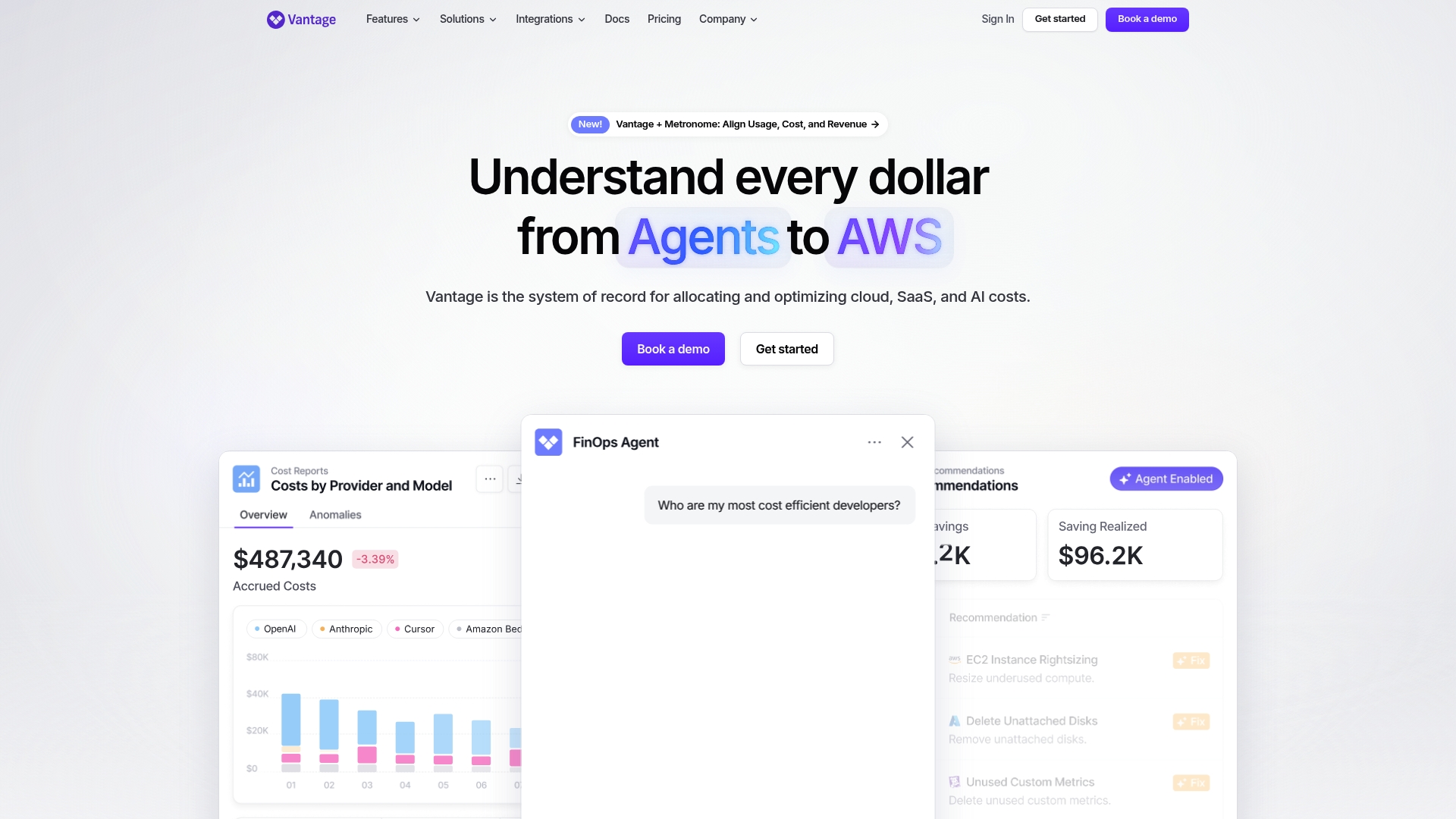
Vantage advertises AI enabled chat with LLMs to query cost data across AWS, Azure, and Google Cloud in real time. The platform couples that capability with automated savings plan actions and Terraform links to make optimisation repeatable. It targets organisations with mission critical cloud spend and growing FinOps needs.
Core Features
Vantage combines cost recommendations and anomaly detection with virtual tagging to improve cost attribution and reporting. The product includes Kubernetes efficiency tools and rightsizing workflows alongside automated savings plan autopilot functionality. Terraform integration and connectors to monitoring and developer tools let teams automate FinOps tasks from commit to deployment.
Key Differentiator
Vantage stands out for its focus on AI enabled interactions paired with deep multi cloud integration and automation. That mix lets engineering and finance teams ask questions in chat, then drive changes through Terraform or automated savings plans. The result is a platform built to turn analysis into repeatable actions.
Pros
Deep connections to cloud and observability platforms let you see cost drivers where they arise. The AI enabled chat speeds routine finance queries and reduces the friction of technical discussions. Granular virtual tagging and rightsizing tools improve cost attribution and make chargeback more accurate. Flexible plan options aim to suit growing teams as cloud spend increases.
Cons
- Pricing transparency for some tiers is limited; enterprise costs often require direct contact and negotiation.
- The breadth of features increases setup complexity for smaller teams with minimal cloud estate.
- New users face a learning curve because the platform exposes many knobs and configuration options.
When It May Not Fit
Small teams with simple single provider accounts will find the platform more complex than necessary. Organisations that need clear public pricing for procurement may prefer vendors with fixed published rates. If you want a lightweight cost dashboard with few automation features, Vantage is likely more platform than you need.
Notable Integrations
Vantage integrates with major cloud providers and common developer and monitoring tools. The list includes AWS, Azure, Google Cloud, Kubernetes, Datadog, Snowflake, OpenAI, and Terraform. Those connectors support both deep analysis and automation across infrastructure and data platforms.
Who It's For
Teams running sizeable multi cloud environments that require automated FinOps workflows and conversational cost analysis will benefit most. The product suits organisations that want to let engineers drive cost changes through code and automation. It is less suited to very small projects or teams wanting minimal operational overhead.
Real World Use Case
A company uses Vantage to consolidate billing across AWS, Azure, and Google Cloud and to apply virtual tags for granular cost allocation. Teams ask the platform questions in chat and use Terraform links to enact recommended rightsizing and savings plans. That workflow shortens the time from insight to action and improves governance.
Pricing
Vantage offers a free starting tier and tiered paid plans labelled Pro, Business, and Enterprise. The vendor lists those tiers publicly, but enterprise pricing is available by direct enquiry. Organisations with large cloud spend should expect to discuss scope before receiving firm pricing.
Website: https://vantage.sh
Comparison of alternatives
When selecting a cloud cost optimisation tool, institutions must weigh features such as savings verification, cloud integration, and automation capabilities. Each featured platform excels in specific areas, making them uniquely suited to different usage contexts.
Savings verification and precision
Koritsu AI demonstrates a clear advantage in verifying savings against actual billing data. This feature ensures institutions have confidence in the efficiency advancements made. In contrast, although Vantage and nOps offer automation tools, their savings estimations rely on predictive algorithms rather than precise invoice matching. For teams where financial accuracy and auditable cost reduction are priorities, Koritsu AI is the stronger fit.
Multi-cloud integration and automation
Vantage excels at providing multi-cloud integration, supported by tools facilitating automated optimisation actions. For example, its Terraform integration allows teams to implement changes programmatically. In comparison, nOps offers strong commitment management functionality that automatically adjusts reservations, targeting those managing extensive cloud estates. While Koritsu AI provides broad compatibility, it places greater emphasis on individual project verification than wholesale multi-cloud coordination.
Best fit
- Institutions prioritising precise savings verification alongside financial auditability will gain the greatest value from Koritsu AI.
- Organisations focusing on the automation of commitment management in extensive cloud environments should consider nOps.
- Teams requiring deep multi-cloud integration with AI-driven tools for effective resource allocation will benefit from the features of Vantage.
Our pick
For institutions relying on savings verification and engineering insights, Koritsu AI emerges as the foremost choice. Its ability to deliver on verified savings through detailed engineering collaboration makes it a valuable partner. However, organisations with strong needs for automated commitment management or multi-cloud deployment may find other tools better suited to their operational strategies.
Choosing the right cloud cost optimisation platform involves considering the specific features and benefits each option provides, tailored to your organisation's needs.
| Product | Core Features | Key Differentiator | Best For | Pricing | Notable Limitation |
|---|---|---|---|---|---|
| Koritsu AI | AI cost analysis, anomaly detection, insights by service/architecture | Verifies savings against billing data | Research and IT teams with engineering capacity | No upfront fee; success-based | Requires collaboration with engineering teams for recommendation implementation |
| nOps | Unified cost views, automated commitment rebalancing | Continuous AI-driven commitment rebalancing | Medium to large organisations with substantial multi-cloud deployments | Price not published | Customisation options for strategies may feel limited for bespoke needs |
| Vantage | AI for cost queries, virtual tagging, automation integration | Real-time AI-enabled chat for cost management | Mid-to-large infrastructures requiring multi-cloud automation | Price not published | Setup complexity could challenge smaller teams |
How Can Koritsu AI Address Your Cloud Cost Challenges Identified Among omu.ac.jp Alternatives
Cloud cost inefficiencies often stem from how infrastructure and software are built, rather than from obvious discounts or pricing schemes. Koritsu AI targets those hidden inefficiencies by combining continuous AI analysis with expert engineering support. This approach highlights where waste happens and helps your teams apply concrete fixes that directly reduce your AWS, Google Cloud, or Azure spend.
Benefits of Koritsu AI include:
- Verified savings against actual billing records
- No upfront fees, only payment from realised savings
- Continuous monitoring by the AI agent, Kori, for lasting cost control
If your research group, university IT department, or lab fits the profile that requires engineering-level cost optimisation, consider starting with a free assessment at Koritsu AI to identify precise savings. See how you could lower your cloud spend with data-backed recommendations and hands-on support.
FAQ
How does Koritsu AI help identify cloud cost savings?
Koritsu AI finds 20–40% savings in cloud spend specifically for engineering-heavy environments. It uses an AI agent named Kori alongside expert consultants to verify these savings against billing data. This means clients can rely on concrete recommendations to optimise spending effectively.
What is the difference between nOps and Koritsu AI?
nOps excels in automated commitment management across multi-cloud environments, allowing for real-time adjustments without long-term commitments. Koritsu AI, on the other hand, focuses on engineering-level analysis and verification against actual billing, making it the preferred option for clients looking for concrete cost reductions in cloud spend.
Which platform offers a no upfront fee model for cost optimisation?
Koritsu AI operates a no upfront fee model with a success fee arrangement, meaning clients only pay once verified savings are realised. This structure shifts the financial risk to the vendor, encouraging organisations to trial the service without initial costs.
Can I use Koritsu AI if my team lacks engineering capacity?
Using Koritsu AI may be challenging for teams with limited engineering resources, as it requires close collaboration with engineering teams to implement recommendations. This means that organisations will need sufficient technical capacity to realise and maintain the identified savings.
How does continuous monitoring work with Koritsu AI?
Continuous monitoring with Kori allows for ongoing alerts and visibility of regressions after initial fixes are implemented. This ensures that clients can maintain their cloud cost savings over time, adapting to changing usage patterns or new services.