FinOps Inform
Bill First, 99.5% Gate: Savings Verification for Engineers & Finance
Bill first playbook for engineers and finance: the artefacts, a 99.5% three-way validation gate, and a 3-5 day cadence to publish auditable, bill...

A credible savings verification process delivers bill-validated realised savings, expressed as absolute and relative figures, backed by a reproducible calculation that traces from provider billing data to a signed validation report. If your process cannot show its working from raw invoice through to final number, and someone from finance and engineering hasn't signed it, it is a forecast, not a verified saving.
TL;DR:
- The verification process must trace from raw invoices to signed reports, using three-way validation to detect discrepancies caused by timing or rounding issues.
- Baseline and scope need to be set and signed off before data collection, as savings measured against on-demand prices can be misleading without clear documentation.
- Reproducible scripts, signed validation reports, and timestamped raw exports are essential for auditability and defending savings claims during reviews.
- Continuous monitoring with automation and AI can detect anomalies early, preventing months of unnecessary spend from delayed discovery.
- Failure to clearly separate existing commitments from new savings or to record provenance can undermine audit reliability and inflate actual savings.
What is the savings verification process, step by step?
Verifying cloud savings is a sequence, not a single reconciliation at month end. Skip a step and the number you present will not survive a finance review or a contract dispute.
- Fix the baseline and scope before touching a spreadsheet. Decide whether you're measuring against public on-demand pricing, your contracted rates, or the effective billed rate you were paying last month. Savings measured against on-demand can look dramatically better than savings measured against your existing negotiated rates, so state the baseline in writing and get sign-off before you start.
- Pull raw billing exports and commitment data, and preserve provenance. That means Cost and Usage Reports (CUR), reservation and Savings Plans records, and a note of exactly which query or script generated each extract.
- Run three-way validation and clear your accuracy gate. Cross-check the runbook output against a FOCUS-normalised dataset and the provider's own API before anyone treats the number as final.
- Separate incremental savings from savings tied to commitments you already had. A discount you negotiated last year isn't a new saving this quarter, even though it shows up in the same invoice line.
- Publish the signed validation report with reproducible artefacts attached. No sign-off, no published number.
Pro Tip: Timestamp every raw export the moment you pull it. Billing data corrects retroactively more often than teams expect, and a validation report dated against a stale CUR file is the fastest way to lose an audit argument.
Which data sources make a savings verification procedure auditable?
The inputs decide whether your report is defensible or just plausible. Auditors don't accept dashboards; they accept data with a traceable origin.
- Cost and Usage Reports (CUR) or equivalent billing CSV exports, pulled directly from the provider console, not copied from a third-party tool's cache.
The methodology that ties these together is three-way validation: run your calculation through a defined runbook, normalise it against the FOCUS specification via an MCP-style validation layer, and reconcile both against the provider's own billing API.
When the three sources disagree by more than the gate allows, the usual culprits are timing skew between billing cycles, tax lines being included in one export but not another, rounding at the currency-conversion step, or an amortisation mismatch. Document which one caused the variance directly in the report. An unexplained gap is worse than a small one that's been annotated.
Which metrics prove realised savings to finance?
Finance and audit teams need a compact set of numbers, not a dashboard tour. The primary outputs should be:
- Realised net savings in absolute currency terms, calculated against the agreed baseline.
- Incremental savings as a percentage of the effective billed baseline, not the list price.
- Unit-cost trend over time, such as cost per transaction or per compute hour, ideally tied to a service-level objective so a cost reduction can be checked against performance rather than assumed to be free.
Supporting KPIs give the primary numbers context: percentage of spend that's allocatable to a specific team or service, tag coverage, mean time to resolve a cost anomaly, and the validation accuracy percentage itself from the three-way check. Every published figure should carry a short sensitivity note, stating the assumptions behind it (which usage pattern, which exchange rate, which billing period) so a reviewer can see exactly where the number would move if an assumption changed.
Who signs off, and on what schedule?
Verification has to run on a fixed cadence, or savings claims drift further from the bill with every month that passes. The rhythm that works in practice: month-end close closes the books, a validation run follows within three to five days, and the report only publishes once it clears the accuracy gate.
- Data owner pulls and timestamps the raw billing export and commitment data.
- FinOps reviewer runs the three-way validation and checks the variance rows against the accuracy gate.
- Engineering approver confirms the technical changes behind the claimed saving actually shipped and match the change tickets.
- Finance approver signs the report, converting a technical calculation into a number the business can rely on.
The artefacts that come out the other end are what make the whole exercise auditable later: the raw billing export, a validation-report.json file listing pass/fail status and every variance row, the reproducible scripts or notebooks used to generate the numbers, and the change tickets linked to each optimisation. Good cost allocation practice, with metadata and hierarchy mapped cleanly, typically lets mature FinOps teams allocate 80 to 90% of spend, which is what makes the sign-off chain fast rather than a forensic exercise every month. Running this as a tight weekly loop, rather than a quarterly scramble, is what turns anomalies into resolved, verified savings with clear owners instead of disputed line items.
How automation and an AI agent speed up verification
Manual reconciliation doesn't scale past a handful of accounts. Once you're running production workloads across multiple AWS, Azure, or GCP accounts, someone has to automate the ingestion, the ownership mapping, and the validation run, or the process simply won't happen every month.
- Ingest billing and telemetry automatically, rather than exporting CSVs by hand.
- Auto-map every resource to an owner or team, so allocation coverage doesn't depend on someone remembering to tag things correctly.
- Run the validation pipeline on schedule, generating a signed report without a human chasing three different consoles.
- Surface anomalies and likely-to-realise opportunities, cutting the time between "spend spiked" and "root cause identified."
This is the gap an AI-driven platform and agent are built to close. Kori runs continuous monitoring rather than a monthly snapshot, which is how it once flagged a $7,500-a-month billing surprise during an account migration before it compounded into a quarter's worth of wasted spend. Pro Tip: If your current process only checks savings once a month, an anomaly that appears on day three can cost you three weeks of unnecessary spend before anyone notices. Continuous monitoring closes that gap.
Checklist: the mistakes that undermine a verification report

Most failed audits trace back to a handful of avoidable errors: an undefined baseline, amortised and unamortised costs blended in the same total, or a script nobody can rerun because its provenance was never recorded, so using forecast usage based call automation for procurement can help prevent these issues.
Start small, verify one workload before scaling the process across an estate. Require tag completeness before you calculate allocation percentages, not after. Keep one reproducible notebook per verification cycle rather than a folder of one-off scripts nobody can trace back three months later.
How Koritsu AI supports a bill-first verification process
Building this process from scratch, and running it reliably every month, is where most FinOps teams stall. Koritsu AI is built around exactly this workflow: continuous monitoring through Kori, engineering-grade root cause analysis, and a verification approach that stays anchored to the actual bill rather than a vendor's projected savings.
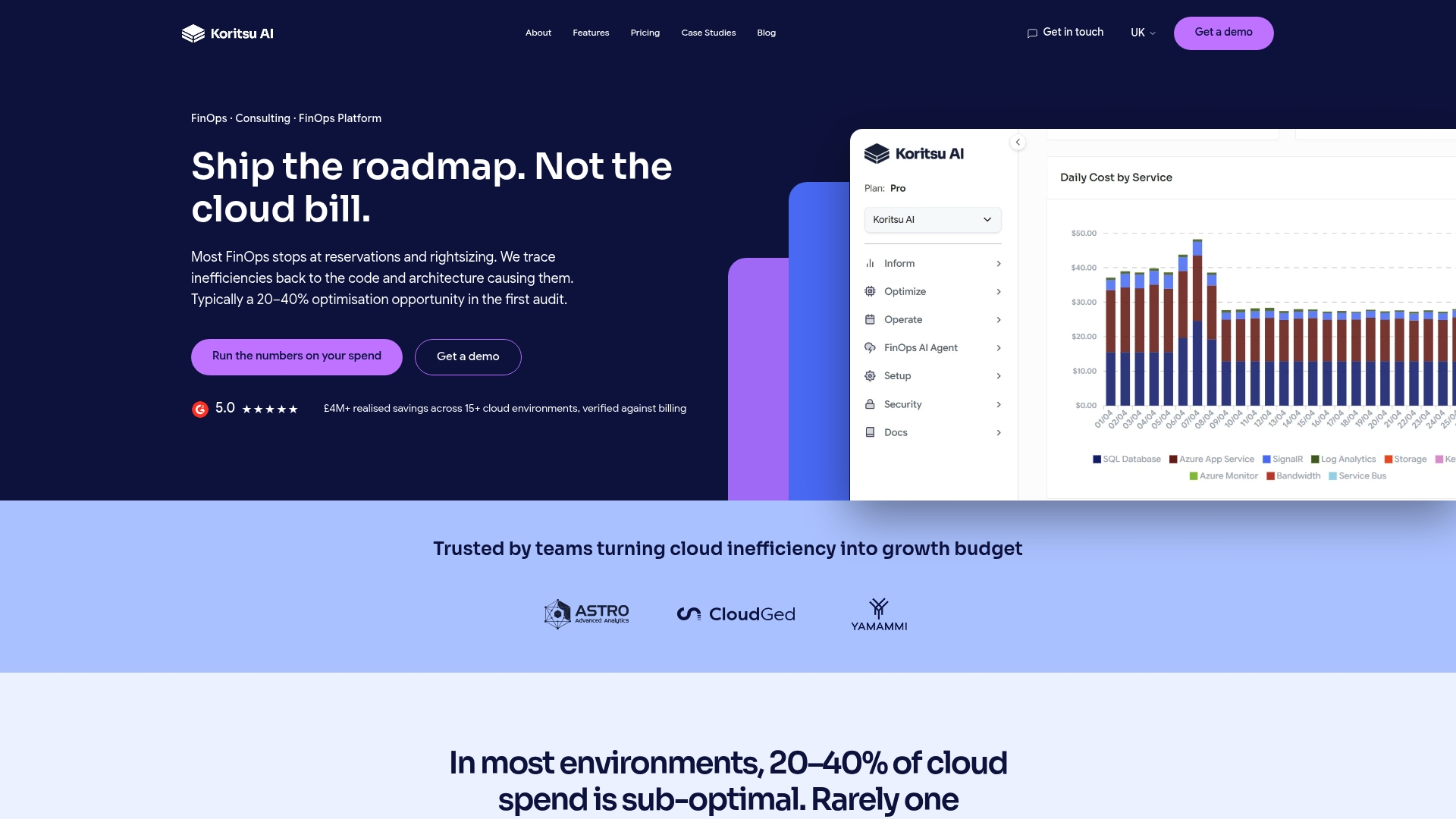
The starting point for most teams is the Savings Opportunity Report, a free assessment that surfaces where spend is being wasted and gives you a reproducible baseline to work from. From there, Koritsu AI's FinOps as a Service plans, Monitor, Advisor, Embedded and Premium, extend continuous monitoring and validation into an ongoing subscription once the initial savings have been verified. Engagements start on a success fee, so you pay based on savings actually validated against your bill, not a projected number on a sales deck. If you're running production workloads across AWS, Azure, or GCP and need a verification process that would survive a finance review, request a Savings Opportunity Report and see what it finds.
Sources
FAQ
What documents count as proof in a savings verification process?
The minimum set is a raw billing export, a signed validation report showing pass/fail status against your accuracy gate, and the reproducible script or notebook used to calculate the number. Without all three, a saving claim can't be independently checked, which is why reproducible, billing-anchored calculations rank as the strongest evidence available.
How often should savings verification run?
Monthly, timed to start within three to five days of month-end close so the numbers reflect a finalised bill rather than a projection. Running it as a recurring weekly loop for anomaly triage, alongside the monthly formal verification, keeps small issues from compounding into large disputed line items.
What's the difference between existing and incremental savings?
Existing savings come from commitments or negotiated rates you already had in place before an optimisation project started. Incremental savings are the new reduction created by the current engagement, and the two must be reported separately or the total will overstate what the current work actually achieved.
Does Koritsu AI charge for the verification process itself?
Koritsu AI's initial engagements run on a success fee, a share of the savings actually verified against your bill, with no upfront cost. Ongoing monitoring and verification support is available through the FinOps as a Service subscription plans once the initial savings are confirmed.
What accuracy threshold should a validation gate use?
A commonly used gate is 99.5% agreement between the runbook calculation, the FOCUS/MCP-normalised dataset, and the provider's billing API. If the three sources fall below that threshold, the report should not publish until the variance is investigated and documented.