FinOps Inform · Tool Comparison
Top 3 tanoshiijapanese.com Alternatives 2026
Explore 3 tanoshiijapanese.com alternatives to decide the best resources for Japanese language learning and cultural insights.

Managing cloud costs across multiple providers without clear savings or actionable insights wastes budget and time for engineering and finance teams. Many tools only offer surface-level recommendations or limit functionality when teams exceed certain spend levels. This comparison details pricing, fit, and depth of cost analysis so you can match a cloud cost optimisation platform to your team's budget, provider scope, and reporting needs.
Table of Contents
Koritsu AI
At a Glance
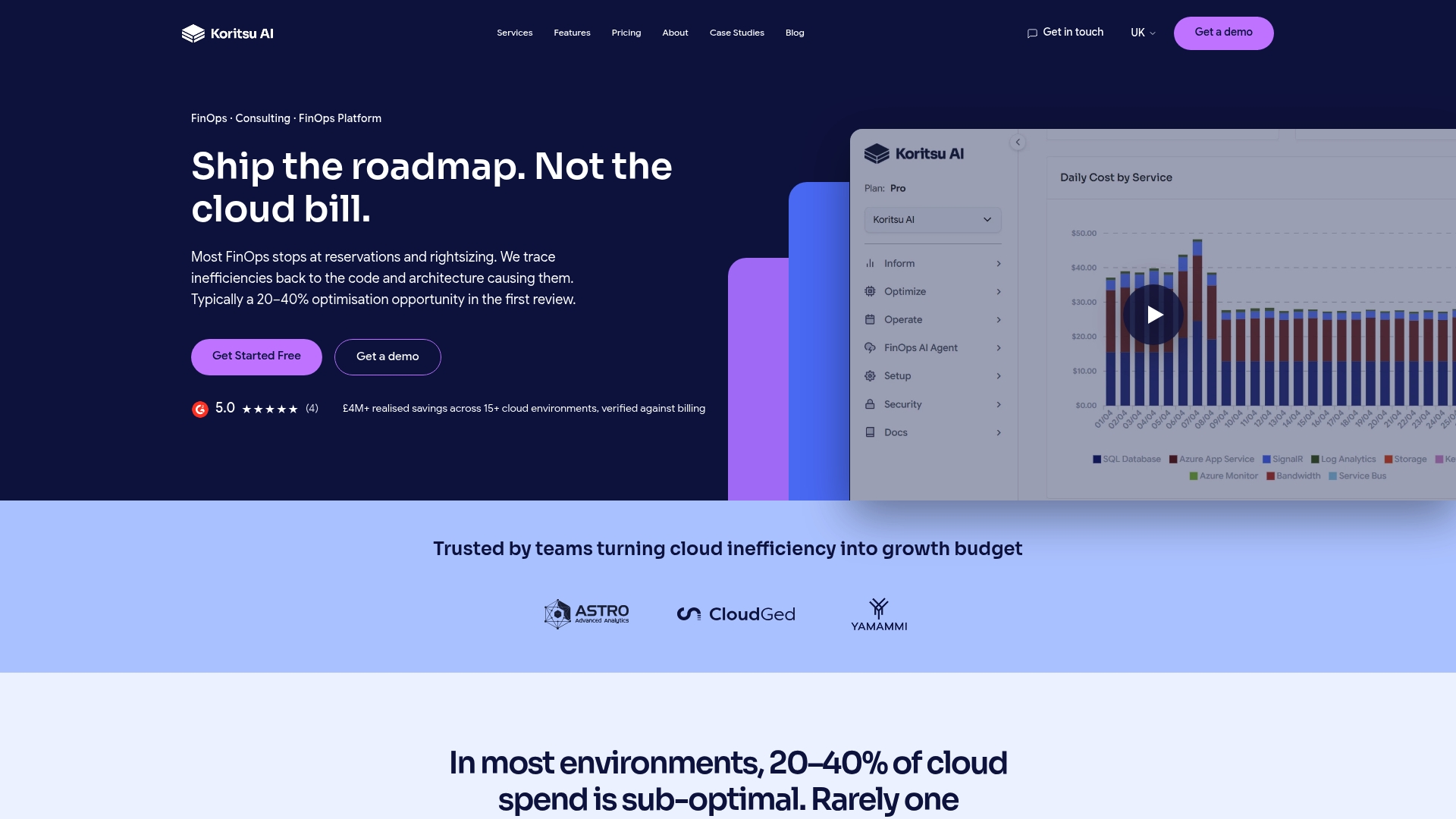
Koritsu AI's marketing materials state it finds 20–40% savings by analysing code and architecture to expose structural cost inefficiencies. The service pairs an AI agent named Kori with specialist engineers and verifies recommendations against billing data. Clients start with a free assessment and move to a success fee model billed from realised savings.
Core Features
The platform runs Kori, an automated AI agent, for continuous cost anomaly detection and alerting across AWS, GCP, and Azure. It performs resource level cost analysis that links spend to root causes, and supplies concrete recommendations for architectural change. Continuous monitoring and automated reporting prevent regressions, and keep engineering teams informed.
Key Differentiator
Koritsu AI goes beyond surface tuning by analysing code and architecture at engineering depth to reveal structural inefficiencies. That engineering analysis connects recommended fixes directly to billing line items for verification. The combination of AI detection and hands on engineering support aims to turn findings into implemented savings rather than a list of suggestions.
Pros
Deep analysis identifies root causes in application and infra design, not only excess instance sizes or unused volumes. The automated agent continuously monitors environments so teams get early alerts rather than waiting for monthly surprises. The success fee model aligns costs and incentives, and the platform claims full multi cloud visibility from day one, which speeds analysis across accounts.
Cons
- Requires read only billing and infrastructure access, which might be a barrier for some organisations.
Who It's For
Cloud engineering, FinOps, and infrastructure teams in medium to large organisations using AWS, GCP, or Azure will get the most from Koritsu AI. Teams that can dedicate engineers to act on recommendations will extract the greatest value. Those running many legacy or mid migration accounts may face exclusion from analysis.
Unique Value Proposition
Success fee only pricing means clients pay two months of verified savings billed against the actual bill rather than an upfront licence. That model shifts commercial risk to the vendor and forces prioritisation of fixes that produce measurable reductions. For teams with constrained FinOps budgets, this converts exploratory engagements into a pay for performance arrangement.
Real World Use Case
The vendor advertises a case where Koritsu produced a 30% reduction in AWS spend by changing architecture and rightsizing, verified against billing data. In practice, engineering teams used the platform to identify inefficient autoscaling rules and orphaned data stores. The result was implemented changes and measurable lower bills over subsequent months.
Pricing
Koritsu AI operates on a success fee model. The stated arrangement is two months of verified savings, billed against the actual bill, with no upfront fee for the initial assessment.
Website: https://koritsu.ai
Economize
At a Glance
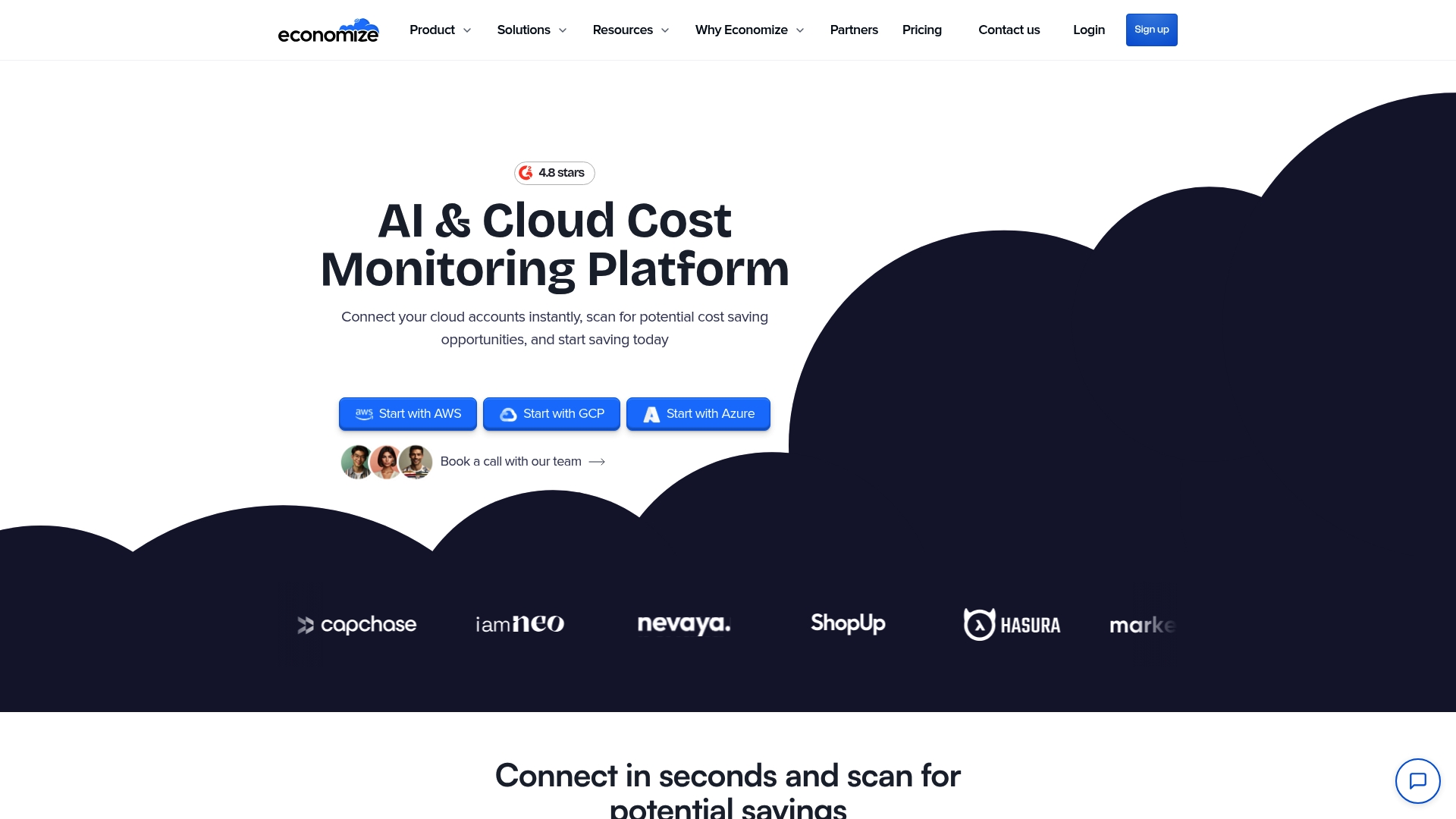
Economize reports a 4.8-star rating from over 1,400 reviews. The platform connects AWS, GCP, and Azure accounts without agents and runs continuous scans for savings and anomalies. Its dashboard highlights cost spikes in real time and points to rightsizing suggestions.
Core Features
Economize links cloud accounts instantly and agentlessly across the three major providers, then scans account metadata and billing records for optimisation opportunities. The platform combines real-time cost monitoring and alerting with detailed reports on resource usage and trends. A recommendations engine suggests rightsizing steps and simple remediation actions.
Key Differentiator
The main distinction is agentless multi cloud support paired with real-time detection and an AI recommendations engine. That combination reduces rollout friction for teams that cannot install agents across many accounts. The approach is useful when you need quick visibility across several providers and want prescriptive next steps.
Pros
Account setup is quick and generally friction free because Economize does not require agents for AWS, GCP, or Azure integrations. Reporting is detailed and geared toward engineers and finance teams, so you get clear resource usage breakdowns and cost drivers. Real-time alerts limit surprise bills and the recommendations engine focuses on rightsizing. The vendor advertises SOC II compliance, which will matter to security-conscious organisations.
Cons
- Pricing for higher tiers can be costly for very large organisations, and enterprise buying often needs a custom quote.
- The AWS billing interface remains complex for some teams, and Economize cannot fully eliminate upstream billing quirks.
- The platform is limited for organisations with cloud spend above $1M per month and needs bespoke work at that scale.
When It May Not Fit
If your cloud spend regularly exceeds $1M per month, Economize requires a custom engagement and may not be the best out-of-the-box fit. Small teams that need advanced rightsizing on the free tier will find those features limited. Organisations seeking deep provider-specific optimisation beyond rightsizing should budget for professional services.
Notable Integrations
- Slack
- Teams
- Discord
- Google Chat
- Azure Active Directory (SAML SSO)
Who It's For
Teams that need quick cross‑provider visibility and prefer agentless deployment will get the most value. It suits finance and engineering groups that want near real-time alerts and clear rightsizing recommendations. The product scales from startups to larger organisations that do not exceed the stated spend ceiling.
Real World Use Case
A technology company connects its AWS, GCP, and Azure accounts and enables alerting across all environments. Economize surfaces an unexpected cost spike from an idle cluster and sends a rightsizing recommendation. The engineering team acts on the recommendation and the finance team sees a measurable drop in the next billing cycle.
Pricing
Plans start with a Free tier and move to Professional at $249/month. Enterprise begins at $2,499/month and the vendor offers custom quotes for very large organisations. Higher tiers include expanded feature sets and enterprise support.
Website: https://economize.cloud
Costimize
At a Glance
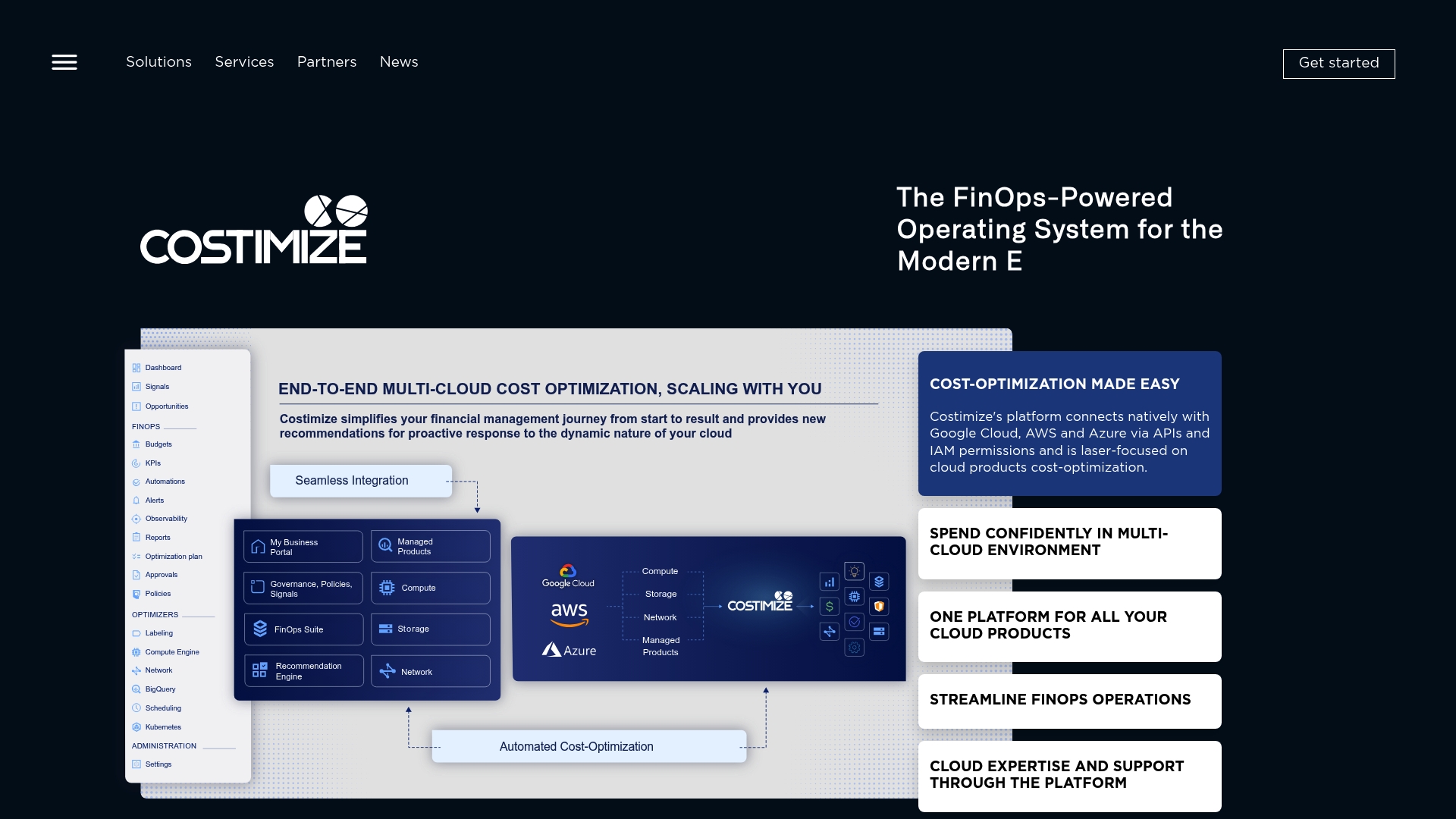
Costimize connects natively with Google Cloud, AWS, and Azure via APIs and IAM permissions. It analyses cloud spend in real time and generates automated optimisation recommendations across providers. Governance controls, budget KPIs, and ESG reporting sit alongside those financial insights.
Core Features
The product ingests billing and usage data from each major provider and presents a unified spend view for multi cloud estates. Automated recommendations identify rightsizing opportunities, idle resources, and inefficient product choices while continuous reporting supports budget management and KPIs. Policy and compliance tools let teams enforce limits and track governance across accounts and subscriptions.
Key Differentiator
The single strongest aspect is the mix of native multi cloud integration with real time optimisation and governance tools. That pairing lets engineering and finance teams act on recommendations without switching systems. Costimize emphasises FinOps practices and partner channels as part of its operational model.
Pros
Deep provider connections give direct visibility into where costs originate across Google Cloud, AWS, and Azure. Governance and policy features reduce manual reconciliation by enforcing rules and centralising compliance reporting. Built in budgeting and KPI workflows support structured decision making for both engineering and finance teams. The platform also brings an ESG perspective to cost work, which helps organisations report environmental and financial outcomes together.
Cons
- Limited public detail on scalability and customisation options makes it hard to judge fit for very large estates.
- Pricing is not published. The vendor refers to tiered fixed pricing without clear thresholds or examples.
- Initial setup and integration may be complex for organisations new to cloud cost management and IAM configuration.
When It May Not Fit
If your procurement team requires a public price list to model budgets, this solution will not meet that need. If you operate on a single cloud provider, the multi cloud focus adds minimal value. Teams that need detailed proof of scalability and customisation before purchasing should seek additional vendor evidence first.
Notable Integrations
- Google Cloud connects via API and IAM for billing and usage ingestion.
- AWS connects via API and IAM for cost and usage analysis.
- Azure connects via API and IAM for consolidated reporting and governance.
Who It's For
Organisations running workloads across multiple cloud providers and seeking to adopt FinOps practices will find Costimize relevant. Enterprise teams that need governance, automated budgeting, and consolidated billing visibility will get the most value. Smaller teams or single provider estates are less likely to benefit from the multi cloud emphasis.
Real World Use Case
A multinational consolidated billing across three clouds and used Costimize to detect idle resources and oversized instances. The platform enforced policies to block unconstrained deployments and produced centralised reports for finance and engineering. That reduced manual reconciliation and helped teams prioritise remediation work by financial impact.
Pricing
Pricing is not publicly listed. The vendor describes a tiered fixed pricing model without disclosed thresholds. Organisations must request a quote to obtain firm figures and deployment options.
Website: https://costimize.io
Comparison of alternatives
Each competitor in this analysis addresses cloud cost optimisation through a unique approach and specialised features, yet one provider distinctly excels in creating savings by deeply analysing cloud architecture at the code level.
Deployment and accessibility
Economize offers an agentless connection setup compatible with AWS, GCP, and Azure, making it extremely user-friendly to implement without requiring additional access configurations. This characteristic means teams can quickly begin identifying cost optimisations, providing rapid value in contexts requiring immediate performance.
Governance and sustainability
Costimize stands out with its advanced governance tools and ESG reporting capabilities. For organisations that place a premium on environmental sustainability alongside financial metrics, the platform's integration of these elements supports broader operational goals by facilitating compliance visibility across cloud estates.
Best fit
- Medium or large organisations needing architectural-level analysis and verifiable, engineering-backed cloud cost savings will benefit most from Koritsu AI.
- Teams requiring immediate deployment without extensive configurations will find Economize appealing due to its agentless connectivity feature.
- Organisations focused on governance and environmental reporting can rely on Costimize's integrated ESG functionality as a primary differentiator.
- Small organisations and budget-conscious teams might appreciate Economize's available free plan for exploring its capabilities before significant commitment.
- Very large organisations exceeding $1M in monthly cloud spend may prioritise bespoke solutions, for which Economize offers tailored arrangements.
Our pick
Koritsu AI represents the most effective solution for organisations prioritising in-depth architectural optimisation combined with a performance-supported pricing framework. Its strength lies in addressing cloud inefficiencies at the structural level, verified through implemented changes. However, simpler needs like agentless installations or ESG-focused compliance may lead some to consider the alternatives.
Evaluating cloud cost optimisation platforms requires understanding their key capabilities and identifying which aligns best with your organisational needs.
| Product | Core Feature | Key Differentiator | Best for | Pricing | Notable Limitation |
|---|---|---|---|---|---|
| Koritsu AI | AI-led continuous cost analysis | Depth in architectural insights | Medium to large organisations using AWS, GCP, or Azure | Success fee model from realised savings | Requires read-only billing and infrastructure access |
| Economize | Agentless multi-cloud cost oversight | Real-time alerts and rightsizing engine | Finance and engineering teams seeking agentless deployment | Free tier, Professional $249/month, Enterprise $2,499/month | Limited for organisations with cloud spend exceeding $1M/month |
| Costimize | Integrated governance and ESG reporting | FinOps and budgeting support | Organisations requiring native multi-cloud billing visibility | Price not published | Unclear scalability details for large-scale implementations |
Are You Struggling to Find Reliable tanoshiijapanese.com Alternatives for Cloud Cost Control?
Many organisations find that managing multi cloud expenses involves hidden inefficiencies buried deep in software and infrastructure design. Koritsu AI uncovers these overlooked areas by combining an AI platform named Kori with expert engineering support. This approach reveals structural cost issues often missed by basic rightsizing tools, helping cloud engineering, FinOps, and infrastructure teams achieve genuine savings.
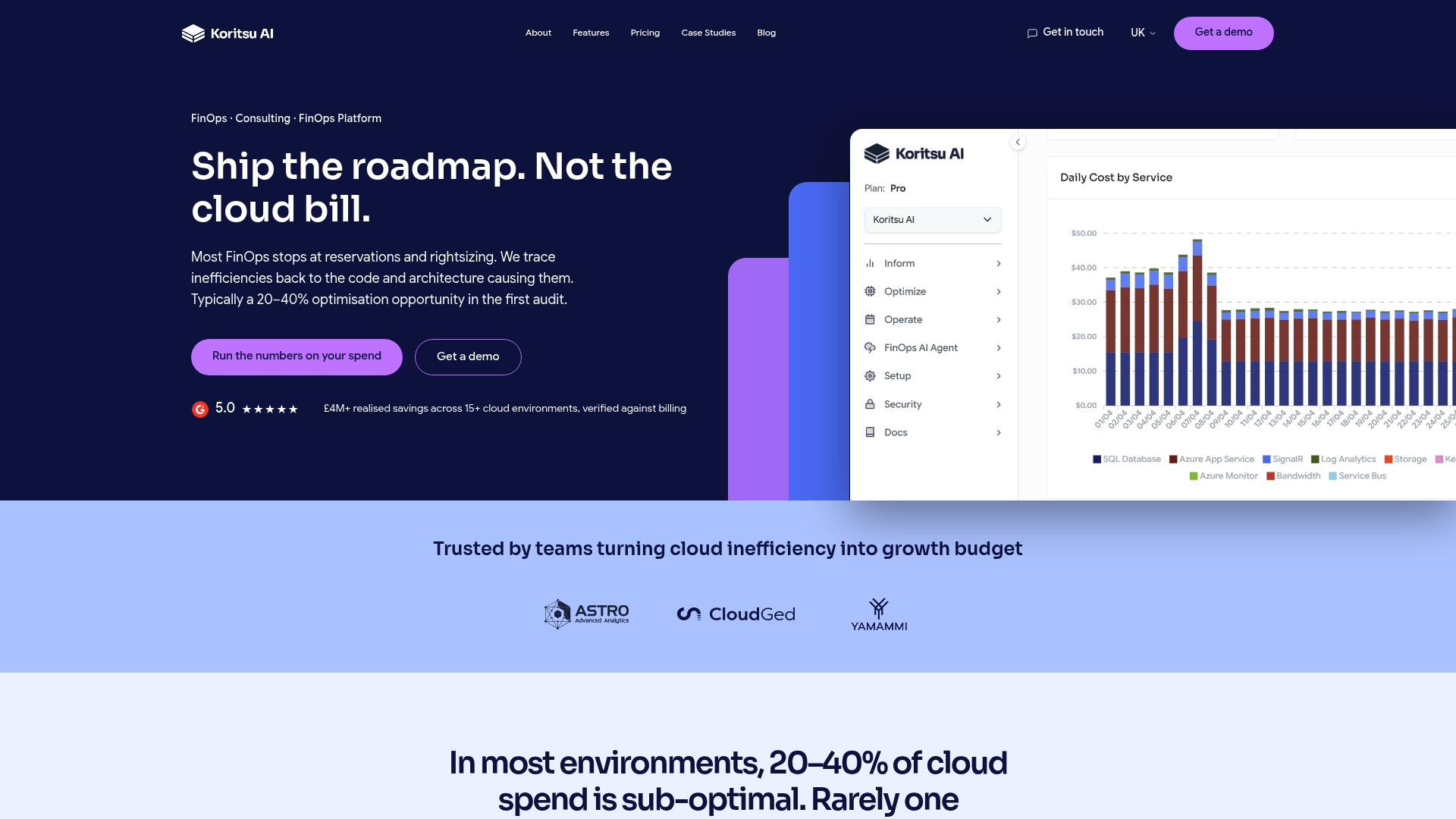
If you need a proven partner to reveal where money is lost and support your teams in fixing it, visit Koritsu AI. Start with a free assessment and move onto a success fee model that charges only from realised savings.
FAQ
How does Koritsu AI find cost savings compared to other tools?
Koritsu AI identifies savings by analysing code and architecture to uncover structural cost inefficiencies. Its automated AI agent, Kori, combined with specialist engineers, enhances the depth of analysis, aiming for 20–40% savings. Users can start with a free assessment to see potential cost reductions.
What is the difference between Economize and Koritsu AI?
Economize offers agentless, real-time cost monitoring and recommendations across multiple cloud providers, which aids rapid deployment and visibility. In contrast, Koritsu AI focuses on deep architectural analysis and hands-on engineering support for sustainable cost savings after addressing root causes. Organisations that need immediate visibility may prefer Economize, while those seeking deeper analysis might benefit from Koritsu AI.
Which platform provides continuous monitoring of costs in real time?
Economize provides continuous monitoring and alerts for cost spikes in real-time, linking cloud accounts without the need for agents. This feature makes it easier for teams to manage costs effectively as they receive immediate notifications for any anomalies that occur.
Does Koritsu AI require billing access to operate?
Yes, Koritsu AI requires read-only access to billing and infrastructure for its analysis. This access allows the platform to deliver precise recommendations based on actual cost data. Prospective users should ensure they can grant this access before engaging with the platform.
How does pricing differ between Koritsu AI and its competitors?
Koritsu AI operates on a success fee model, only charging for two months of verified savings once cost reductions are realised. This payment model aligns incentives and assesses risk differently compared to other platforms, such as Economize, which has subscription plans starting from $249 per month.