FinOps Inform · Cost Optimisation
The role of CI/CD in cloud spending: 2026 guide
Discover the role of CI/CD in cloud spending and learn how effective governance can optimize your infrastructure costs. Read the 2026 guide!

CI/CD pipelines are defined as the primary control plane for cloud spending, not merely a delivery mechanism. The role of CI/CD in cloud spending is to govern when, how, and at what cost infrastructure is provisioned during every build, test, and deployment cycle. Companies spend 15–20% of their development budget on CI/CD infrastructure alone. That figure means your pipeline is one of the largest, most controllable cost levers in your entire engineering operation. The FinOps Foundation frames this shift explicitly: treat CI/CD as a cloud spend control plane, embedding cost governance directly into engineering workflows rather than reviewing bills after the fact. Koritsu AI applies exactly this model, surfacing pipeline inefficiencies before they compound into budget overruns.
What drives cloud costs in CI/CD pipelines?
Cloud expenditure in CI/CD pipelines breaks down into four primary categories: compute time, storage, data transfer, and orchestration platform charges. Each category carries its own waste pattern, and most teams underestimate at least two of them.
Compute time is the most visible cost. Every build job spins up a runner, consumes CPU and memory, and bills by the minute. The less obvious problem is idle runners: machines that stay warm between jobs, accumulating charges without doing useful work. Redundant builds compound this further. When every commit to every branch triggers a full pipeline, you pay for builds that will never reach production.

Storage costs grow quietly. Artefact retention policies are rarely set with cost in mind. Teams default to keeping build artefacts for 90 days or longer, which means hundreds of gigabytes of binaries sitting in object storage. Container image layers, test reports, and log archives all add up. Data transfer charges appear when those artefacts move between regions or out to external registries.
The most underestimated cost is developer wait time. For 100 engineers running 20-minute pipelines, daily wait time cost can reach £5,900 against just £38 in direct compute charges. That is two orders of magnitude difference. Slow pipelines do not just frustrate engineers; they destroy throughput and carry a real financial cost that never appears on a cloud bill.
Common inefficiencies that drive costs higher include:
- Redundant builds triggered on every branch push, including draft pull requests
- Excessive artefact retention periods with no automated cleanup policy
- Idle self-hosted runners left running outside business hours
- Missing dependency caching, causing full dependency downloads on every run
- Over-provisioned runner sizes for lightweight jobs such as linting or unit tests
Enterprise CI/CD infrastructure bills regularly exceed £16,000 per month. At that scale, even a 20% reduction in waste represents a meaningful saving. The cost is not a technology problem. It is a process problem.
How does embedding cost governance into CI/CD pipelines improve cloud spending control?
Cost governance embedded in CI/CD pipelines means that budget rules are enforced at the point of code change, not discovered during a monthly finance review. The FinOps term for this is "shifting left on cost," and it changes the economics of cloud expenditure management fundamentally.
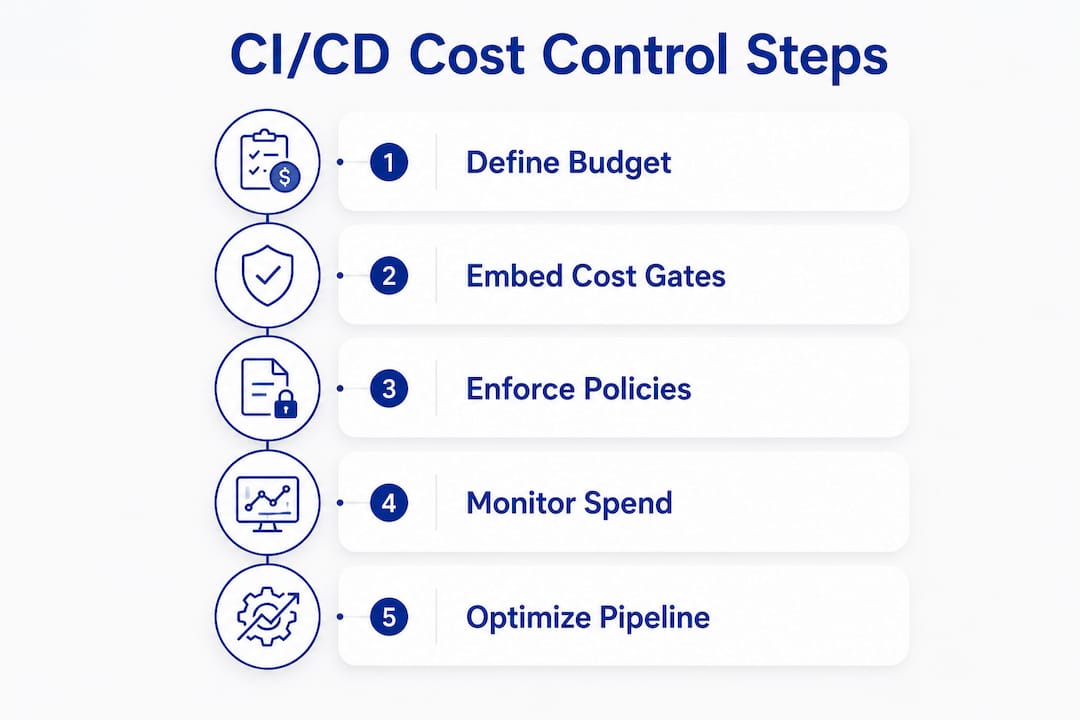
The most direct mechanism is the cost gate. A cost gate is a pipeline step that runs a cost estimation tool against the proposed infrastructure change and blocks a merge if the projected monthly increase exceeds a preset threshold, such as £400 per month. The developer sees the rejection immediately, with a clear explanation of which resource is driving the increase. This prevents "broken economics" from reaching production in the same way a failing test prevents broken code from shipping.
Policy-as-code enforces tagging and configuration standards automatically. Every resource provisioned through the pipeline must carry the required cost allocation tags: team, environment, service, and owner. Without tags, the pipeline fails. This sounds strict, but it solves the single biggest obstacle to cloud cost attribution: untagged resources that cannot be assigned to a team or product.
Budget-as-code takes this further. Budgets and tag requirements versioned alongside software changes mean that every budget increase goes through a pull request, a code review, and an approval process. Finance and engineering review the same artefact. There is no separate spreadsheet, no manual process, and no surprise at month end.
The practical enforcement stages work as follows:
- Visibility only: cost estimates appear as pull request comments, no blocking
- Warning stage: pipeline posts a warning when estimated costs exceed a threshold
- Soft enforcement: pipeline fails but can be overridden with a documented justification
- Hard enforcement: pipeline fails with no override; change must be rearchitected
Pro Tip: Start with visibility only for the first four weeks. Engineers need to calibrate their intuition about what things cost before enforcement feels fair rather than arbitrary.
The trade-off between enforcement strictness and delivery speed is real. Overly aggressive cost gates slow down teams and breed resentment. The goal is not to block every change; it is to make cost visible at the moment of decision. Integrating cost estimates into pull requests gives developers immediate feedback without requiring a separate tool or workflow.
What practical strategies reduce CI/CD cloud costs without sacrificing speed?
Reducing the impact of CI/CD on cloud costs does not require a platform migration or a lengthy procurement process. Most savings come from configuration changes that take days, not months.
-
Switch to self-hosted runners on spot instances. Running self-hosted runners on spot instances and ARM64 processors cuts CI/CD costs by 70–90% compared to managed runners. ARM64 instances on AWS Graviton or equivalent offer better price-to-performance for most build workloads. The engineering overhead of managing your own runner fleet is real, but the savings justify it at scale.
-
Implement dependency caching aggressively. Proper caching reduces build times and billed minutes by up to 90%. Cache npm, Maven, pip, and Gradle dependencies between runs. Cache Docker layers. Cache test results for unchanged modules. Every cache hit is a compute minute you do not pay for.
-
Schedule non-production environments to shut down. Staging and QA environments that run 24 hours a day waste roughly 65% of their compute budget on nights and weekends. Automated shutdown schedules, triggered by the CI/CD pipeline itself, recover that spend immediately.
-
Limit unnecessary workflow triggers. Configure pipelines to skip full runs on documentation-only changes, draft pull requests, and commits that do not touch application code. Path filters in GitHub Actions and GitLab CI reduce pipeline runs significantly without any impact on quality.
-
Rightsize runners for the job type. A linting job does not need the same runner as an integration test suite. Map job profiles to instance sizes. Use the cloud deployment cost checklist to audit your current runner configuration against actual resource consumption.
-
Set artefact retention policies. Default retention periods are almost always too long. Set build artefacts to expire after 7 days for feature branches and 30 days for main. Container images in your registry should follow a tag-based retention policy that keeps only the last five production releases.
| Strategy | Typical saving | Complexity |
|---|---|---|
| Spot instance runners | 70–90% on compute | Medium |
| Dependency caching | Up to 90% on build minutes | Low |
| Environment scheduling | ~65% on non-prod compute | Low |
| Workflow trigger filtering | 20–40% on total runs | Low |
| Runner rightsizing | 15–30% on compute | Medium |
Pro Tip: Caching and trigger filtering are the fastest wins. Implement both before touching your runner infrastructure. You will likely halve your pipeline bill before spending a single hour on spot instance configuration.
How do you measure the impact of CI/CD on cloud cost and delivery efficiency?
Measurement is where most teams fall short. They track deployment frequency and lead time from the DORA metrics framework, but they rarely connect those metrics to cost. The result is a pipeline that ships fast and burns money simultaneously.
The metrics that matter for cost efficiency in CI/CD are:
- Compute cost per deployment: total pipeline spend divided by deployments in a period
- Developer wait time: aggregate time engineers spend blocked on pipeline results
- Pipeline duration: median and 95th percentile build times by pipeline type
- Cache hit rate: percentage of builds that successfully reuse cached dependencies
- Artefact storage growth rate: week-on-week change in storage consumption
Developer wait time deserves particular attention. The cost of pipeline delays dwarfs direct compute charges by two orders of magnitude for most engineering teams. A 20-minute pipeline for 100 engineers is not a minor inconvenience. It is a structural productivity tax that compounds every working day.
DORA metrics provide the delivery side of the equation. Lead time for changes, deployment frequency, change failure rate, and mean time to restore all reflect how well your pipeline serves the business. The goal is to reduce cost per deployment while maintaining or improving DORA scores. These two objectives are not in conflict. Faster, more efficient pipelines achieve both.
Dashboards integrated directly with your CI/CD platform give teams real-time cost awareness. When engineers can see the cost impact of their pipeline changes as they make them, behaviour shifts. Cost becomes a first-class engineering metric alongside uptime and test coverage. The FinOps framework provides the organisational model for making this shift stick across teams.
Key takeaways
CI/CD pipelines are the most controllable cost lever in cloud expenditure management, and embedding cost governance directly into them prevents waste before it reaches production.
| Point | Details |
|---|---|
| CI/CD drives significant cloud spend | Companies spend 15–20% of development budgets on CI/CD infrastructure, with enterprise bills exceeding £16,000 per month. |
| Developer wait time is the hidden cost | Wait time costs can exceed direct compute charges by two orders of magnitude, making pipeline speed a financial priority. |
| Cost gates prevent budget overruns | Blocking merges that exceed preset monthly cost thresholds stops waste at the point of code change, not after deployment. |
| Spot instances and caching deliver the fastest savings | Self-hosted runners on spot instances and aggressive dependency caching can cut pipeline costs by 70–90%. |
| Measure cost per deployment, not just DORA metrics | Tracking compute cost per deployment alongside lead time and deployment frequency connects engineering performance to budget outcomes. |
Why I think most teams are solving this problem backwards
Most engineering teams I have worked with treat cloud cost as a finance problem. They wait for the monthly bill, run a cost allocation report, and then try to work out which team owns which spike. By that point, the waste has already happened and the engineer who caused it has moved on to three other features.
The uncomfortable truth is that cloud cost is an engineering design problem. It is created at the point of code change, not at the point of billing. Treating it as a finance problem means you are always reacting. Treating it as an engineering problem means you can prevent it.
The cultural shift required is not small. Engineers are measured on shipping features and keeping systems up. Cost has historically been invisible to them. Introducing cost gates and pull request cost estimates can feel like friction, and it will generate pushback. The key is to start with visibility, not enforcement. Show engineers what their changes cost before you tell them they cannot merge. Alert fatigue is real; if every pull request generates a cost warning, engineers will ignore them. Calibrate thresholds carefully.
The synergy between FinOps maturity and DevOps maturity is genuine. Teams that have invested in infrastructure-as-code, automated testing, and deployment pipelines are already 80% of the way to cost governance. They just need to add cost as a signal. The cloud spending governance framework that Koritsu AI recommends builds directly on existing DevOps practices rather than replacing them.
Start small. Pick one pipeline, add a cost estimation step, and post the results as pull request comments for a month. The conversations that follow will tell you exactly where to focus next.
How Koritsu AI helps teams control cloud costs in CI/CD
Cloud cost problems buried in CI/CD pipelines are exactly what Koritsu AI is built to find. Most of the waste is not obvious from a billing dashboard. It lives in runner configurations, artefact retention settings, and untagged resources that no one owns.
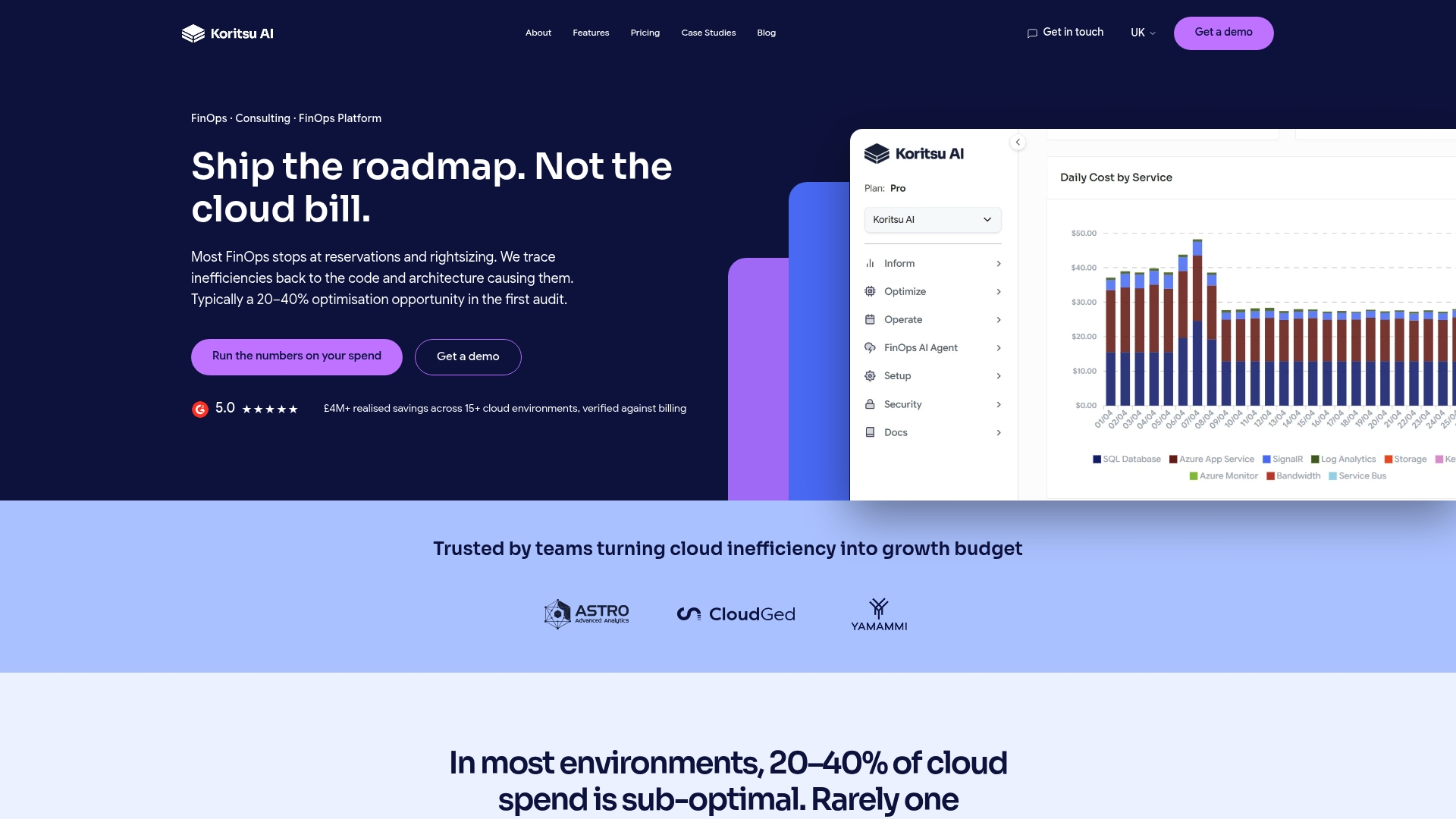
Koritsu AI combines an AI platform that continuously analyses your cloud spend with hands-on specialist advice. Kori, the AI agent, surfaces where money is being lost inside your pipelines. The specialists help your team act on it. The UK bidding platform case study shows what this looks like in practice: a 52% reduction in cloud costs by fixing the inefficiencies built into how the software and infrastructure were constructed. Start with a free cloud cost assessment and pay only from the savings Koritsu AI actually finds.
FAQ
What is the role of CI/CD in cloud spending?
CI/CD pipelines directly control when and how cloud infrastructure is provisioned, making them one of the largest drivers of cloud expenditure. Embedding cost governance into pipelines treats cloud spend as an engineering metric rather than a finance afterthought.
How much do CI/CD pipelines typically cost per month?
Enterprise CI/CD infrastructure spend regularly exceeds £16,000 per month, representing 15–20% of total development budgets. Costs vary significantly based on runner type, build frequency, and artefact retention policies.
What is a cost gate in a CI/CD pipeline?
A cost gate is a pipeline step that estimates the monthly cost impact of an infrastructure change and blocks the merge if it exceeds a preset threshold. This prevents unexpected cost increases from reaching production in the same way a failing test prevents broken code from shipping.
How does caching reduce CI/CD cloud costs?
Proper dependency caching reduces build times and billed compute minutes by up to 90% by reusing previously downloaded packages and compiled artefacts. Every cache hit eliminates a compute charge without affecting build quality or reliability.
What metrics should I track to measure CI/CD cost efficiency?
Track compute cost per deployment, developer wait time, pipeline duration, and cache hit rate alongside DORA metrics such as deployment frequency and lead time. Connecting delivery performance to cost per deployment gives you a complete picture of pipeline efficiency.