FinOps Inform · Tool Comparison
Top AI-driven cloud optimisation tools for UK enterprises (2026)
Discover the top AI-driven cloud optimisation tools for UK enterprises. Reduce costs and optimize cloud performance effectively with proven solutions.

For UK enterprises, the strongest starting point is Koritsu AI, which combines continuous AI analysis with hands-on FinOps execution on a success-fee model, a verified 52% cost reduction for a UK bidding platform being the clearest proof point. Alongside it, two platform classes are worth trialling in parallel: an enterprise FinOps governance platform (Apptio Cloudability or Tanzu CloudHealth) if chargeback and multi-account reporting are the primary need, and an autonomous Kubernetes optimisation tool (CAST AI or Kubecost) if container workload cost is the dominant problem.
Typical verified savings across the market are often reported to be substantial for general cloud spend, with Kubernetes-specific automation sometimes reaching up to 70–80% in specialised cases where automation is combined with health-aware rules. Most organisations typically reach first credible savings within a few weeks of a focused pilot.
Trial selection checklist
- Multi-cloud visibility and allocation: trial Koritsu AI, CloudZero, or Vantage
- Autonomous Kubernetes cost reduction: trial CAST AI or Kubecost
- AI/GPU and LLM workload cost control: trial WrangleAI or Datadog Cloud Cost Management
- Enterprise governance and chargeback: trial Apptio Cloudability or Tanzu CloudHealth
- Managed commitment purchasing: trial ProsperOps or Archera
- Provider-native tooling only: trial AWS Cost Explorer, Trusted Advisor, and Compute Optimizer
| Platform class | Primary use case | Automation level | Typical time to first savings |
|---|---|---|---|
| Koritsu AI | AI analysis + FinOps execution | High (AI + human) | 4–8 weeks |
| Enterprise FinOps governance | Chargeback, showback, multi-account | Visibility to moderate | 6–12 weeks |
| Autonomous Kubernetes | Cluster-level cost reduction | High (autonomous) | 2–6 weeks |
| AI/GPU workload visibility | LLM and inference spend control | Visibility-focused | 4–8 weeks |
| Managed commitment | Reserved instance and savings plan purchasing | Managed service | 4–8 weeks |
| Provider-native | AWS/Azure/GCP native recommendations | Low to moderate | 6–12 weeks |
How do these tools compare across the dimensions that matter most?
The table below covers the 30 platforms on the evaluation dimensions most decisive for enterprise procurement. Consolidated duplicates (Kubecost/IBM Kubecost, Apptio Cloudability/IBM Cloudability, CloudHealth/Tanzu CloudHealth, AWS Cost Explorer + Trusted Advisor + Compute Optimizer) are treated as single entries.
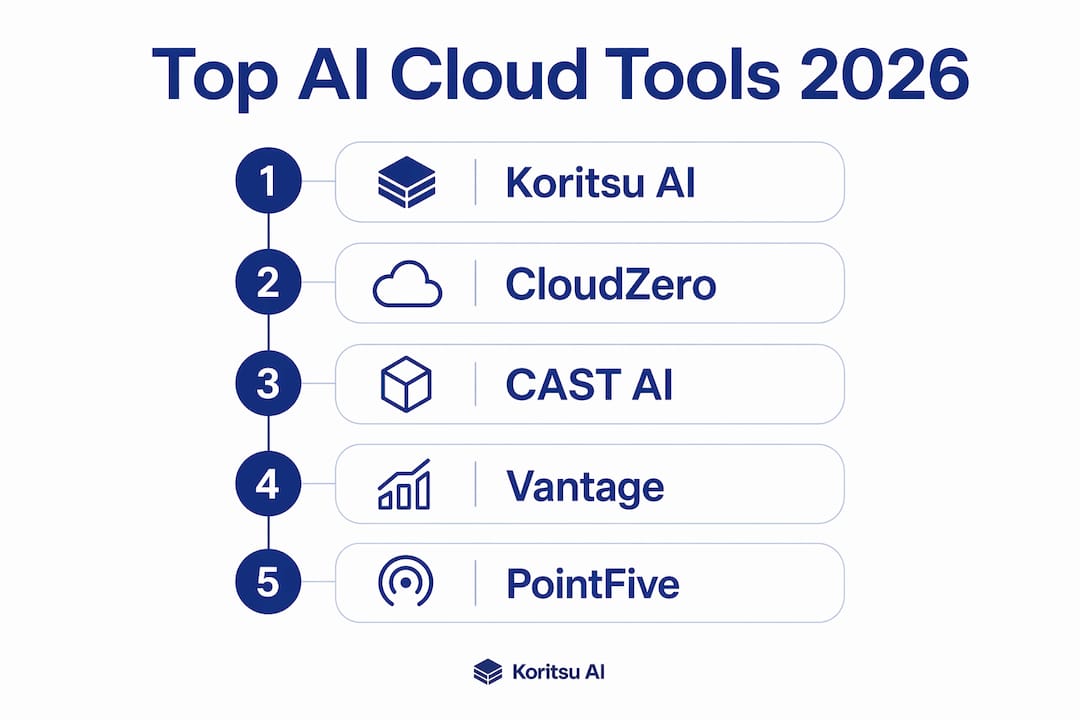
| Tool | Best for | Automation level | Cloud coverage | Kubernetes | AI/GPU workload | Pricing model | Enterprise controls | Deployment |
|---|---|---|---|---|---|---|---|---|
| Koritsu AI | UK enterprises: AI + FinOps execution | High (AI + human) | AWS, Azure, GCP | Yes | Yes | Success fee + SaaS subscription | SSO, RBAC, multi-account | SaaS + managed |
| CloudZero | Product-level cost allocation | Visibility | Multi-cloud | Partial | Partial | % of spend | SSO, RBAC | SaaS |
| CAST AI | Autonomous K8s optimisation | Autonomous | AWS, Azure, GCP | Deep | No | % of savings | RBAC, multi-account | Agent-based SaaS |
| Vantage | Developer-friendly multi-cloud | Visibility | Multi-cloud | Partial | Partial | Flat fee / % of spend | SSO, RBAC | SaaS |
| PointFive | Commitment and rightsizing | Moderate | Multi-cloud | Partial | No | % of savings | SSO, RBAC | SaaS |
| Finout | Engineering allocation and observability | Visibility | Multi-cloud | Partial | Partial | Flat fee | SSO, RBAC | API-first SaaS |
| Apptio Cloudability | Enterprise governance and chargeback | Moderate | Multi-cloud | Partial | No | Flat fee / % of spend | SSO, RBAC, org-level | SaaS |
| Datadog Cloud Cost Mgmt | Observability-integrated cost | Visibility | Multi-cloud | Yes | Yes | Per-host / usage | SSO, RBAC | SaaS (agent) |
| Kubecost | Per-pod K8s cost attribution | Visibility to moderate | AWS, Azure, GCP | Deep | No | Open source / per-node | RBAC, multi-account | Agent-based |
| ProsperOps | Managed commitment purchasing | Managed | AWS | No | No | % of savings | Multi-account | Managed service |
| Spot by NetApp | Spot instance orchestration | Autonomous | AWS, Azure, GCP | Partial | No | % of savings | SSO, RBAC | SaaS + agent |
| Costimizer | Low-touch automated savings | High (automated) | Multi-cloud | Partial | No | % of savings | RBAC | SaaS |
| Harness | Cost governance in CI/CD | Moderate | Multi-cloud | Yes | No | Per-developer / flat | SSO, RBAC | SaaS |
| Cloudcheckr | Cost, security and compliance | Moderate | Multi-cloud | Partial | No | Flat fee | SSO, RBAC, org-level | SaaS |
| Zesty | Serverless and compute rightsizing | Autonomous | AWS | No | No | % of savings | RBAC | SaaS + agent |
| AWS Cost Explorer + Trusted Advisor + Compute Optimizer | Provider-native recommendations | Low to moderate | AWS | Partial | Partial | Free / pay-per-use | Native AWS controls | Native |
| WrangleAI | LLM and AI/GPU spend control | Visibility | Multi-cloud | No | Deep | Flat fee | SSO, RBAC | SaaS |
| nOps | Operational governance + cost | Moderate | AWS | Partial | No | % of savings | SSO, RBAC | SaaS |
| IBM Turbonomic | Hybrid cloud workload placement | High (automated) | Multi-cloud + on-prem | Yes | Partial | Flat fee / per-node | SSO, RBAC, org-level | SaaS + agent |
| Densify | Performance-led rightsizing | Moderate | Multi-cloud | Partial | No | Flat fee | SSO, RBAC | SaaS |
| Archera | SKU and commitment optimisation | Moderate | AWS, Azure | No | No | % of savings | RBAC | SaaS |
| ScaleOps | Enterprise governance at scale | Moderate | Multi-cloud | Yes | No | Flat fee | SSO, RBAC, org-level | SaaS |
| Tanzu CloudHealth (Broadcom) | Chargeback and multi-account governance | Moderate | Multi-cloud | Partial | No | Flat fee | SSO, RBAC, org-level | SaaS |
| Anodot | Anomaly detection and cost alerting | Visibility | Multi-cloud | No | Partial | Flat fee | SSO, RBAC | SaaS |
| Flexera | Licence, asset and cloud cost management | Visibility to moderate | Multi-cloud | No | No | Flat fee | SSO, RBAC, org-level | SaaS |
Reading the table for your buyer scenario
- Finance-led procurement: prioritise the Enterprise controls and Pricing model columns. Governance platforms (Apptio Cloudability, Tanzu CloudHealth, Flexera) score highest here.
- SRE-led procurement: the Automation level and Kubernetes columns are decisive. CAST AI, IBM Turbonomic, and Koritsu AI lead.
- Platform team procurement: Vantage, Finout, and Harness offer the strongest developer workflow integration.
UK readiness note: ask every shortlisted vendor for SOC 2 Type II and ISO 27001 certificates, data residency confirmation (EU/UK data processing), and at least one UK enterprise reference before advancing to contract.
Vendor profiles: features, limits, pricing signals and UK relevance
Koritsu AI combines a continuous AI analytics platform with hands-on FinOps execution. The AI agent, Kori, surfaces inefficiencies buried in architecture and infrastructure decisions, not just purchasing discounts. Specialists then help engineering teams act on those signals. The success-fee model means you pay only from verified savings, which removes the upfront risk typical of SaaS subscriptions. A UK bidding platform achieved a 52% reduction in cloud spend. Deployment is SaaS plus managed engagement; enterprise controls include SSO, RBAC, and multi-account billing. Best for UK enterprises that want AI-driven analysis combined with engineering execution and contract terms aligned to realised outcomes.

CloudZero maps cloud spend to products, features, and engineering teams, making it the strongest option for organisations that need to answer "what does this feature cost to run?" It requires disciplined tagging and billing API integration to reach full accuracy. Pricing is typically a percentage of monitored spend. Best for product-led organisations with mature tagging practices.
CAST AI operates autonomously at the Kubernetes cluster level, continuously adjusting node selection, workload placement, and scheduling to reduce compute costs. It acts without manual approval once policies are set, which is powerful but requires careful policy configuration before enabling in production. Pricing is a percentage of savings delivered. Best for Kubernetes-native teams comfortable with autonomous cluster management.

Vantage provides clean, developer-friendly cost dashboards across AWS, Azure, and GCP, with strong support for unit economics and per-resource cost reporting. It sits firmly in the visibility category rather than automated remediation. Flat-fee pricing tiers make budgeting predictable. Best for platform teams that want multi-cloud cost visibility without agent complexity.
PointFive focuses on rightsizing recommendations and reserved instance or savings plan commitment management. It is particularly strong for organisations with predictable, stable workloads where purchasing strategy drives the largest savings. Best for finance teams managing commitment portfolios.
Finout takes an API-first approach to cost allocation, integrating with billing APIs and observability tools to produce engineering-metric-aligned cost reports. It suits teams that want cost data surfaced inside existing dashboards rather than a separate portal. Best for engineering-led organisations with strong observability tooling already in place.
Apptio Cloudability (now part of IBM) is a mature enterprise FinOps platform with sophisticated showback, chargeback, and multi-account reporting. It handles complex organisational hierarchies well. Pricing tends to be flat-fee at enterprise scale. Best for large enterprises with formal FinOps programmes and finance-driven chargeback requirements.
Datadog Cloud Cost Management integrates cost data directly into the Datadog observability platform, correlating spend with performance metrics and traces. If your organisation already runs Datadog for monitoring, the integration removes a separate vendor relationship. Best for Datadog-standardised organisations that want cost and performance in one pane.
Kubecost (including IBM Kubecost) provides per-pod and per-namespace cost attribution for Kubernetes workloads, with an open-source tier that many teams use for initial visibility. The enterprise version adds RBAC, multi-cluster support, and SLA-backed support. Pricing is per-node for the enterprise edition. Best for Kubernetes-heavy environments that need granular cost attribution without full autonomous remediation.
ProsperOps operates as a managed service that continuously optimises AWS savings plan and reserved instance purchasing on your behalf. It requires no engineering effort once connected to billing APIs. Pricing is a percentage of savings delivered. Best for AWS-centric teams that want commitment optimisation without dedicating engineering time to it.
Spot by NetApp automates workload placement across spot and on-demand instances, using predictive algorithms to minimise interruption risk. It suits stateless or fault-tolerant workloads. Pricing is a percentage of savings. Best for compute-heavy workloads that can tolerate spot instance interruptions.
Costimizer claims continuous, automated cost optimisation with minimal operator involvement. It suits organisations that want a low-touch, set-and-monitor approach. Best for teams with limited FinOps headcount seeking automated savings across their cloud estate.
Harness embeds cost governance into CI/CD pipelines, surfacing cost impact at the point of deployment rather than after the fact. This makes it particularly valuable for organisations that want engineers to see cost consequences during delivery. Best for DevOps-mature organisations that want cost controls in the delivery lifecycle.
Cloudcheckr covers cost, security, and compliance in a single platform, which reduces the number of tools a cloud operations team needs to manage. Best for enterprises that need a unified view across cost and security posture.
Zesty focuses on automated rightsizing for serverless and flexible compute, adjusting resource allocation based on actual utilisation patterns. Best for teams running significant serverless workloads on AWS.
AWS Cost Explorer + Trusted Advisor + Compute Optimizer provide predictive scaling and recommendations natively within AWS, with no additional vendor relationship or agent to manage. The trade-off is limited cross-cloud visibility and less sophisticated allocation modelling. Best for AWS-only organisations that prefer provider-native tooling and want to avoid third-party agents.
WrangleAI specialises in visibility and governance for LLM inference and training spend, a gap most general cloud cost tools do not address well. As AI/GPU workloads grow as a proportion of cloud bills, this becomes a meaningful differentiator. Best for organisations with significant LLM or AI model training spend.
nOps combines cost insights with operational governance, particularly strong for AWS environments. It offers prescriptive recommendations and integrates with AWS billing APIs. Pricing is a percentage of savings. Best for platform engineering teams on AWS that want governance alongside cost controls.
IBM Turbonomic uses AI-driven workload placement to balance performance and cost across hybrid cloud and on-premises environments. It is one of the few platforms that explicitly models performance risk alongside cost, making it suitable for enterprises with strict SLA requirements. Best for hybrid cloud environments where performance-aware optimisation is non-negotiable.
Densify analyses historical workload behaviour to produce rightsizing recommendations that preserve performance characteristics. It is particularly careful about not recommending changes that would degrade application performance. Best for organisations with complex, performance-sensitive workloads.
Archera focuses on cloud purchasing optimisation, helping teams select the right SKU and commitment type for their workload patterns. Best for teams whose primary savings opportunity lies in purchasing decisions rather than architectural change.
ScaleOps targets large enterprises needing governance and optimisation at organisational scale, with strong multi-account and policy controls. Best for enterprises managing dozens of accounts across business units.
Tanzu CloudHealth (Broadcom) is a mature FinOps and governance platform with strong chargeback and multi-account reporting capabilities, now under Broadcom ownership. Best for enterprises with existing VMware or Broadcom relationships and complex governance requirements.
Anodot applies anomaly detection to cloud cost data, surfacing unexpected spend spikes in near real time. It is not a full FinOps platform but excels at alerting. Best for organisations that prioritise early warning on cost anomalies over full allocation modelling.
Flexera combines cloud cost management with software licence and asset management, which is valuable for enterprises where licence costs and cloud costs are intertwined. Best for enterprises with complex software licence estates alongside cloud spend.
How do you choose the right platform for your enterprise?
The decision is rarely about which tool has the most features. It is about which platform fits your current maturity, your primary cost driver, and your procurement constraints.
Ordered evaluation criteria
- Security and compliance: SOC 2 Type II and ISO 27001 are the baseline for UK enterprise procurement. Confirm data residency and UK/EU data processing agreements before shortlisting.
- Automation safety: understand exactly what the tool will change autonomously and what requires human approval. Reliability-first optimisation simulates fixes against health signals before applying them in production.
- Integration with your billing APIs and tagging: without disciplined tagging and billing API integration, allocation accuracy degrades and savings claims become unreliable.
- Observability linkage: cost tools that connect to your existing observability stack (Datadog, Grafana, Prometheus) produce more trustworthy recommendations.
- Enterprise controls: SSO, RBAC, multi-account billing, and org-level allocation are non-negotiable for enterprises with multiple teams or business units.
- Commercial model alignment: success-fee or percentage-of-savings models reduce upfront risk. Flat-fee SaaS requires a clearer business case before signing.
- UK readiness: ask for UK enterprise references, confirm support SLAs in GMT/BST, and verify that contract terms comply with UK data protection requirements.
Questions to ask vendors during RFP or demo
- What changes does the platform make autonomously, and what requires explicit approval?
- How does the tool simulate a recommendation before applying it to production?
- What is the rollback procedure if an automated change degrades performance?
- How does the platform integrate with our cloud billing APIs and existing tagging taxonomy?
- Can you provide a UK enterprise reference we can speak with directly?
- What is your SOC 2 Type II and ISO 27001 status, and where is our data processed?
- How do you verify and report savings against our actual cloud bills?
Red flags that should stop a shortlisting
- No enterprise controls (no SSO, no RBAC, no multi-account support)
- No UK or European references
- Opaque pricing with no clear savings verification methodology
- Autonomous remediation with no simulation or rollback capability
- Savings claims that cannot be reconciled against cloud provider billing data
Expected timeline to verified savings
A realistic pilot follows a structured path: a 1–2 week discovery and assessment, a 4–8 week focused pilot on a single business unit or namespace, and a 4–12 week verified savings period before wider roll-out. Observable, documented milestones tied to verified billing data are the single most important contract negotiation lever for UK enterprise buyers.
UK procurement tips
- Negotiate a pilot clause before committing to a full contract. Most vendors will agree to a scoped pilot if you frame it as a prerequisite for wider roll-out.
- Request that savings verification references your actual cloud provider billing data, not the vendor's internal calculation.
- Include a data residency clause specifying UK or EU processing in any contract.
- Ask for SLA commitments on support response times in UK business hours.
How we evaluated these tools
The evaluation behind this shortlist used a structured scoring approach across seven dimensions, weighted to reflect enterprise procurement priorities.
Scoring dimensions and weightings
- Security and compliance (SOC 2, ISO 27001, data residency): highest weight, as this is a hard gate for UK enterprise procurement
- Automation safety (simulation, health-signal validation, rollback): high weight, reflecting the operational risk of autonomous changes in production
- Multi-cloud coverage and billing integration: high weight for organisations running across AWS, Azure, and GCP
- Kubernetes and container optimisation capability: high weight for engineering teams with significant container workloads
- Enterprise controls (SSO, RBAC, multi-account, org-level allocation): high weight for large organisations
- Pricing transparency and commercial model: medium weight, with preference for verifiable savings-aligned models
- UK readiness (local references, UK data processing, GMT/BST support): medium weight, reflecting the article's target market
Data sources
Vendor documentation, published case studies, and Koritsu AI's own engagement experience informed the profiles. Verified savings claims were treated conservatively: only figures reconcilable against cloud provider billing data were accepted. Vendor marketing claims about percentage savings were noted but not used as primary evidence without corroboration. Storage and compute cost trajectories were included in TCO modelling guidance to ensure procurement comparisons reflect total cost rather than compute alone.
Limitations and how to adapt the weighting
This evaluation reflects a UK enterprise buyer with mixed cloud workloads. If your primary driver is Kubernetes cost reduction, weight the Kubernetes capability dimension higher and deprioritise multi-cloud breadth. If your primary driver is licence and asset management, weight the Flexera-style asset-awareness dimension higher. The types of cloud compute inefficiency in your environment should directly shape which dimensions matter most in your own scoring.
What actually separates the best platforms in 2026?
The capability that matters most in 2026 is not the breadth of a dashboard. It is autonomous safety: the ability to act on cost opportunities without creating reliability incidents.
Most cloud cost tools can identify that a workload is overprovisioned. Fewer can safely act on that finding. The leading platforms now simulate fixes against health signals before applying changes in production, decoupling cost reduction from reliability risk. For enterprise SREs, this is the line between a tool they will trust and one they will block.
Koritsu AI's approach reflects this directly. The AI agent, Kori, continuously analyses cloud spending and surfaces architectural inefficiencies. Specialists then work with engineering teams to act on those signals, with changes validated before they reach production. The 52% cost reduction achieved for a UK bidding platform came from this combination: AI-identified root causes, engineering-led execution, and verified savings tied to actual billing data.
A concrete example: when Koritsu AI identifies a rightsizing opportunity on a production service, the recommendation is first modelled against historical utilisation data and current health metrics. The change is then tested in a non-production environment before any production adjustment is proposed. Only after that simulation passes does the recommendation move to the engineering team for approval and execution. This is not a fully autonomous flow, and that is deliberate. For enterprise workloads, human approval at the execution stage is a feature, not a limitation.
Pro Tip: When scoping a pilot, restrict automated remediation to non-production namespaces or a single, low-risk business unit for the first four weeks. This lets you validate savings claims against real billing data without exposing production workloads to autonomous changes before you have calibrated the tool's behaviour.
The benefits of AI-driven cloud analysis for CTOs extend beyond cost reduction. When engineering teams can see which architectural decisions are driving spend, they make better decisions in future sprints. That feedback loop is what separates a one-time cost reduction from a repeatable savings capability.
Key takeaways
The clearest finding from this evaluation: the top AI-driven cloud optimisation tools separate themselves not by dashboard breadth but by how safely and verifiably they act on the opportunities they surface.
| Point | Details |
|---|---|
| Trial Koritsu AI first | UK enterprises get AI analysis, hands-on FinOps execution, and a success-fee model tied to verified savings. |
| Autonomous safety is the decisive capability | Platforms that simulate fixes against health signals before production changes reduce reliability risk materially. |
| Pilot scope matters | Restrict the first 4–8 weeks to a single business unit or namespace to produce credible, auditable savings data. |
| Verified savings beat headline percentages | Insist that savings claims reconcile against cloud provider billing data, not vendor-internal calculations. |
| Koritsu AI's success-fee model | Aligns vendor incentives with your outcomes; the 52% UK case study is the clearest available proof point. |
The gap between what these tools promise and what actually lands
Most procurement teams focus on the wrong question. They ask "which tool saves the most?" when they should ask "which tool can we actually operationalise safely, and how do we verify what it saves?"
The headline savings percentages you see in vendor marketing are almost always real, but they are scoped to the conditions that produced them: a specific workload type, a specific cloud configuration, a specific level of tagging maturity. When those conditions do not match your environment, the savings do not transfer. The procurement mistake we see most often is signing a contract based on a competitor's case study rather than a pilot scoped to your own workloads.
The honest warning: autonomous remediation tools can create reliability incidents if deployed without proper policy configuration and health-signal validation. The platforms that have invested in simulation and rollback capabilities are the ones worth trusting with production workloads. The ones that cannot clearly explain their safety model should not be given autonomous access to your infrastructure, regardless of the savings claim.
What clients consistently underestimate is the internal change management required. The tool is rarely the bottleneck. Getting engineering and finance to agree on an allocation model, a tagging taxonomy, and a savings verification methodology is where most pilots stall. The platforms that provide hands-on support for that process, rather than leaving it to the buyer, are the ones that deliver verified savings within the pilot window.
Start with a free assessment from Koritsu AI
Most cloud cost tools ask you to commit before you know what you will save. Koritsu AI works the other way: the engagement starts with a free assessment that identifies where your cloud spend is leaking and what the realistic savings opportunity looks like across your AWS, Azure, or GCP estate.
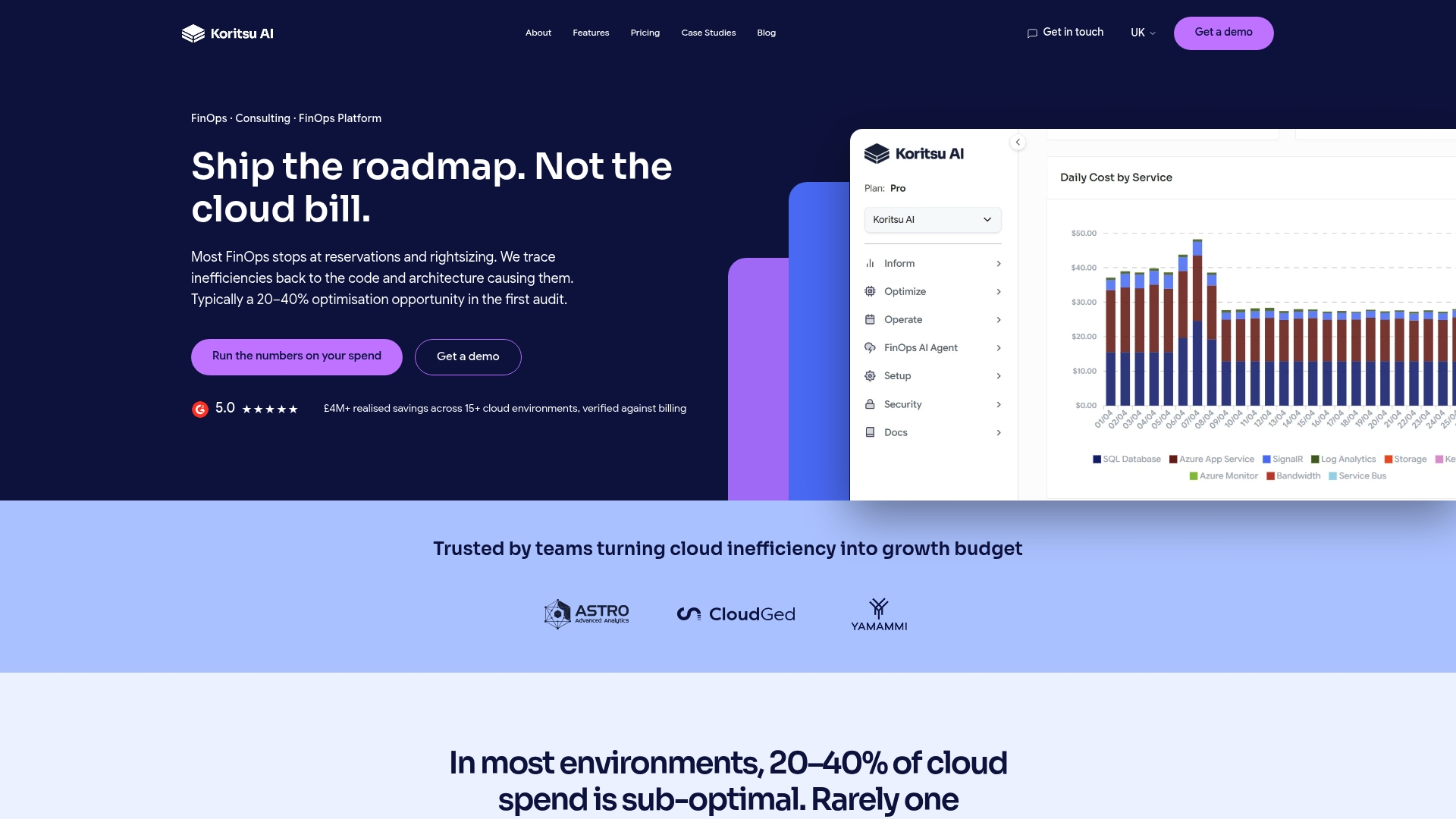
From there, the initial pilot runs for 4–8 weeks on a scoped business unit or namespace, with savings verified against your actual cloud billing data. The success-fee model means Koritsu AI's revenue is tied directly to what you save, not to what you spend on the platform. The UK bidding platform case study is the clearest available evidence of what that model produces in practice. To request a free assessment or discuss a pilot scope, visit koritsu.ai.
Useful sources for further reading
The sources below support the claims in this article and provide starting points for vendor due diligence.
- Koritsu AI UK case study: 52% cloud cost reduction. Primary evidence for Koritsu AI's verified savings claim; request equivalent evidence from any vendor you shortlist.
- Komodor: cloud native cost and performance optimisation. Independent technical reference on reliability-first optimisation and pre-deployment simulation.
- AWS Application Auto Scaling. Primary source for AWS-native predictive scaling capabilities; useful for evaluating provider-native tooling trade-offs.
- vuhp/cloud-cost-cli on GitHub. Open-source CLI tool for privacy-first, local AI-explained cost analysis; relevant for teams that cannot send billing data to third-party APIs.
- Koritsu AI blog: cloud environment management best practices. Guidance on tagging, observability, and allocation as prerequisites for accurate optimisation.
- Koritsu AI blog: cloud architecture cost review. Practical framework for structuring vendor proofs and pilot milestones.
- Koritsu AI blog: why cloud environments over-scale. Root-cause analysis for overprovisioning; useful for scoping pilots and identifying red flags in vendor claims.
Note on source types: the Koritsu AI blog posts are vendor material and should be read as such. The Komodor and AWS sources are independent technical references. When a vendor provides a URL as evidence during procurement, ask whether it is vendor-produced or independently verified, and request access to the underlying billing data where possible.