FinOps Inform · Cost Optimisation
What is cloud resource overprovisioning?
Discover what is cloud resource overprovisioning and learn how avoiding it can save your organization 30–40% in cloud spending.

Cloud resource overprovisioning is the practice of allocating more computing capacity than a workload actually requires, and it is one of the most common and costly mistakes in cloud computing resource management. Organisations running on AWS, Google Cloud, or Azure routinely provision virtual machines, storage volumes, and network bandwidth at sizes built for worst-case scenarios that rarely materialise. The result is 30–40% of cloud spend wasted on unused capacity every year. That figure represents real budget that engineering teams could redirect to product development, reliability, or growth. Understanding overprovisioning in cloud services is the first step to fixing it.
What does overprovisioning look like in cloud environments?
Overprovisioning in cloud services is rarely the result of careless engineering. It is usually a rational response to uncertainty. Teams provision generously because they lack reliable utilisation data, fear performance degradation during traffic spikes, or inherit infrastructure-as-code templates sized for peak demand that never arrived. The problem is that cloud billing does not reward caution. You pay for what you allocate, not what you use.
The most common types of overprovisioned cloud resources fall into four categories:
- Virtual machines (VMs) and compute instances. Teams select instance types based on peak projections. Average utilisation then sits at a fraction of capacity for the majority of the month.
- Containers and Kubernetes nodes. CPU and memory requests are set conservatively at the pod level, causing node-level waste to accumulate across clusters.
- Block storage volumes. Block storage billing charges for the full allocated volume, not actual usage. A 2 TB disk provisioned for a 200 GB workload costs ten times what it should.
- Network bandwidth and data transfer. Reserved bandwidth tiers and over-allocated load balancer capacity add cost without adding performance.
- Databases and managed services. RDS instances and managed caches are frequently sized for launch-day traffic that never scaled as projected.
The pattern across all these resource types is the same. A buffer intended to protect performance becomes a permanent fixture in the architecture. Without active measurement, that buffer never shrinks.
How can cloud professionals identify and measure overprovisioning?

Detection is a data problem. You cannot right-size what you have not measured, and a single snapshot of utilisation tells you almost nothing. Workloads have daily, weekly, and seasonal rhythms. A batch job that runs at 3 AM looks idle at noon. A web application that spikes on Mondays looks fine on Fridays.
A reliable detection framework follows these steps:
- Collect baseline metrics across all resource dimensions. CPU, memory, storage I/O, and network I/O must all be captured. Automated alerting frameworks require data collected over 30 or more days to account for workload variation.
- Apply utilisation thresholds to flag candidates. AWS Compute Optimizer flags EC2 instances where peak CPU stays below 5% and network I/O remains under 5 MB per day over a 14-day window. These are strong signals of idle or severely underutilised resources.
- Segment by workload type. A development environment running at 3% CPU is a waste. A production database running at 3% CPU during off-peak hours may be correctly sized for its burst profile. Context determines whether low utilisation is a problem.
- Prioritise by potential saving. Not every overprovisioned resource is worth the remediation effort. Rank candidates by estimated monthly waste and address the highest-value items first.
- Validate with workload owners. Engineering teams closest to the application know whether a resource is genuinely idle or serving a latency-sensitive function that does not show up in average utilisation figures.
Pro Tip: Set up continuous monitoring rather than running quarterly audits. Workloads change constantly. A resource that was correctly sized in January may be overprovisioned by March after a feature deprecation or traffic shift.
Ignoring low utilisation metrics is one of the most common detection mistakes engineering teams make. The instinct is to focus on resources that are too small. The cost impact of resources that are too large is just as significant.
What are the financial and environmental impacts of overprovisioning?
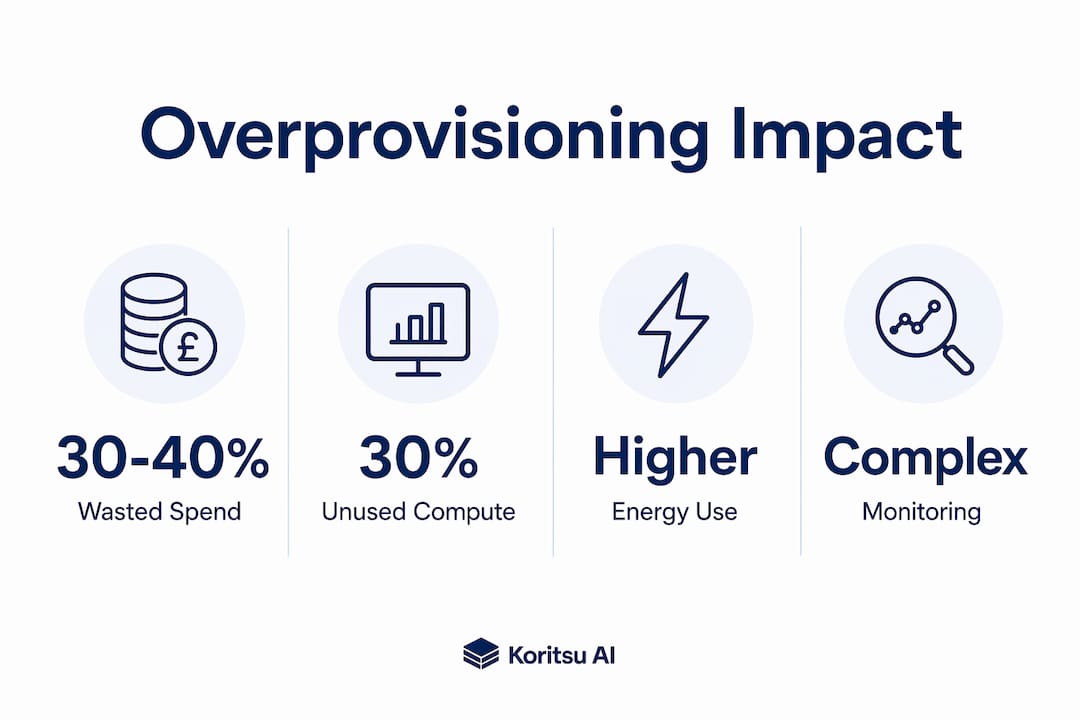
The financial case against overprovisioning is direct. Organisations waste 30–40% of their cloud expenditure on unused capacity. For a business spending £500,000 per year on cloud infrastructure, that is between £150,000 and £200,000 leaving the business without delivering any value.
| Impact area | Effect of overprovisioning |
|---|---|
| Compute costs | Paying for CPU and memory that workloads never consume |
| Storage costs | Billed for full allocated volume regardless of actual usage |
| Operational overhead | Larger environments require more monitoring, patching, and management |
| Carbon footprint | Idle resources waste energy and raise an organisation’s environmental impact |
| Budget planning | Inflated baselines make it harder to forecast accurately or justify new investment |
The environmental dimension is increasingly relevant to engineering and procurement decisions. Data centres consume substantial electricity. Running idle compute at scale contributes to carbon emissions that organisations are under growing pressure to report and reduce. Overprovisioning is not just a financial inefficiency. It is an environmental one.
The operational impact is subtler but equally damaging. Overprovisioned environments are harder to monitor. When everything is large, anomalies are harder to spot. A genuine performance problem can hide inside a resource that looks fine on paper because it has so much headroom.
What practical strategies reduce overprovisioning and optimise cloud costs?
Reducing overprovisioned cloud services requires a combination of technical changes and process discipline. No single technique solves the problem permanently because workloads evolve continuously.
The core strategies are:
- Rightsizing. Rightsizing means selecting the instance type, storage tier, and service configuration that matches actual workload demand. Effective rightsizing targets average CPU utilisation between 40–70%, leaving headroom for traffic bursts without paying for permanent excess capacity. This range balances performance reliability with cost efficiency.
- Scheduling and environment shutdown. Development, staging, and test environments do not need to run 24 hours a day. Automated scheduling that shuts down non-production resources outside working hours can cut those environment costs by more than half.
- Thin provisioning for storage. Rather than allocating fixed block storage volumes upfront, thin provisioning allocates capacity on demand as data is written. This approach directly addresses the billing inefficiency where storage is charged at full allocation regardless of use.
- Automation and continuous optimisation. Manual rightsizing is unsustainable at scale. Organisations with hundreds or thousands of resources cannot rely on periodic manual reviews. Automated tools that continuously analyse utilisation and surface recommendations are the only way to keep pace with infrastructure change. You can read more about this in the guide to eliminating cloud waste automatically.
- FinOps frameworks. FinOps is the practice of bringing financial accountability to cloud spending by aligning engineering, finance, and business teams around shared cost metrics. Adopting a FinOps framework creates the governance structure that makes rightsizing decisions stick rather than reverting when teams face delivery pressure.
Pro Tip: Rightsizing decisions made without input from finance teams often get reversed. Engineers optimise for performance. Finance teams optimise for cost. Bringing both perspectives into the review process produces changes that survive the next planning cycle.
Continuous optimisation consistently outperforms one-off rightsizing efforts. Workloads change. A resource correctly sized today may be overprovisioned in three months after a code refactor or a shift in user behaviour. Treating optimisation as an ongoing process rather than a project is the difference between sustained savings and a one-time reduction.
How do organisations govern cloud resources to prevent overprovisioning?
Governance is what prevents overprovisioning from returning after an initial clean-up. Technical fixes without process change produce temporary results. The infrastructure drifts back to its old state within months.
Effective governance combines several practices:
- Regular review cadences. Monthly or quarterly rightsizing reviews, prioritised by potential saving and performance risk, keep the environment aligned with actual workload needs.
- Cloud provider recommendations. AWS Compute Optimizer, Google Cloud Recommender, and Azure Advisor all surface rightsizing opportunities based on observed utilisation. These recommendations are a starting point, not a final answer, but ignoring them is leaving money on the table.
- Tagging and allocation policies. Resources without clear ownership are never optimised. Mandatory tagging policies that assign every resource to a team, product, and cost centre create the accountability that drives action.
- Cross-functional stakeholder involvement. Cloud cost is not a technology problem. It is a process problem. Bringing finance, product, and engineering into a shared review process ensures that cost decisions are made with full business context.
- AI-driven predictive management. AI tools that model workload patterns and forecast future demand can flag overprovisioning before it accumulates. Koritsu AI’s platform continuously analyses cloud spending across AWS, Google Cloud, and Azure, surfacing inefficiencies that manual reviews miss and helping engineering teams act on them before costs compound. You can explore the causes and fixes behind cloud over-scaling to understand where governance gaps typically originate.
Key takeaways
Cloud resource overprovisioning wastes 30–40% of cloud spend annually, and the most effective way to address it is through continuous rightsizing, automated monitoring, and FinOps governance rather than periodic manual reviews.
| Point | Details |
|---|---|
| Definition | Overprovisioning means allocating more cloud capacity than workloads actually need, generating direct cost waste. |
| Detection threshold | Flag resources where peak CPU stays below 5% over 14 days as strong candidates for downsizing or termination. |
| Rightsizing target | Aim for average CPU utilisation between 40–70% to balance performance headroom with cost efficiency. |
| Automation is necessary | Manual rightsizing cannot scale; continuous automated analysis is required to keep pace with workload change. |
| Governance sustains savings | Tagging policies, regular reviews, and cross-functional ownership prevent overprovisioning from returning after optimisation. |
The uncomfortable truth about cloud waste I keep seeing
Most organisations I work with already know they are overprovisioned. The utilisation dashboards are there. The data is there. What is missing is the organisational will to act on it.
The technical fix for overprovisioning is not complicated. Rightsizing a VM takes minutes. The hard part is the conversation between the engineer who provisioned it and the manager who approved the original size. Nobody wants to be the person who downsized a resource that then caused a production incident. So the resource stays large, the bill stays high, and the waste compounds quietly.
The teams that actually fix this problem do two things differently. They separate the performance conversation from the cost conversation, and they use data to make both objective. When you can show that a resource has not exceeded 4% CPU in 45 days, the discussion changes. It is no longer about trust or risk tolerance. It is about evidence.
The second thing they do is treat optimisation as a permanent function, not a project. One-off rightsizing efforts produce a spike in savings followed by a slow drift back to the original state. The teams that sustain savings build it into their sprint cycles, their architecture reviews, and their on-call runbooks. That is where the real compounding value comes from.
AI-driven tools are making this easier. Predictive models that flag emerging overprovisioning before it accumulates are changing the economics of cloud management. But the technology only works if the process and culture are already aligned. Start there.
— Kori
How Koritsu AI helps engineering teams cut cloud waste
Most cloud cost problems are not visible from a billing dashboard. They are buried in how infrastructure was built and how it has drifted since.
Koritsu AI combines an AI platform that continuously analyses cloud spending with hands-on expert advice to surface and fix those inefficiencies. Kori, Koritsu AI’s AI agent, identifies where money is being lost across AWS, Google Cloud, and Azure. Koritsu AI’s specialists then help engineering teams act on those findings. The model is straightforward: clients start with a free assessment, and Koritsu AI takes a share of the savings it actually delivers. One UK bidding platform achieved a 52% reduction in cloud costs working with Koritsu AI. Explore the Koritsu AI platform to see what your infrastructure is actually costing you.
FAQ
What is cloud resource overprovisioning?
Cloud resource overprovisioning is the allocation of more computing capacity, such as CPU, memory, or storage, than a workload actually requires. It results in paying for unused resources and is estimated to account for 30–40% of wasted cloud expenditure annually.
What are the most common types of overprovisioned cloud resources?
The most commonly overprovisioned resources are virtual machines, Kubernetes nodes, block storage volumes, database instances, and reserved network bandwidth. Block storage is particularly prone to waste because billing is based on allocated volume rather than actual usage.
How do you detect overprovisioning in cloud environments?
Detection relies on collecting CPU, memory, storage, and network I/O metrics over at least 30 days. Resources where peak CPU stays below 5% and network I/O remains under 5 MB per day over a 14-day period are strong candidates for downsizing or termination.
What is rightsizing and how does it reduce cloud costs?
Rightsizing is the process of matching instance types and service configurations to actual workload demand. Effective rightsizing targets average CPU utilisation between 40–70%, which eliminates excess capacity while preserving headroom for traffic bursts.
How do FinOps frameworks help prevent overprovisioning?
FinOps frameworks align engineering, finance, and business teams around shared cloud cost metrics and governance policies. This cross-functional accountability ensures that rightsizing decisions are validated, documented, and maintained rather than reversed under delivery pressure.