FinOps Inform · Cost Optimisation
What is peak load cloud cost? A guide for IT teams
Discover what is peak load cloud cost and learn how to optimize expenses while boosting performance with this essential guide for IT teams.

Peak load cloud cost is the expense incurred when cloud infrastructure is provisioned to handle the highest expected demand spike rather than average usage. The result is that organisations pay for capacity that sits largely idle during normal operations. For IT managers and financial decision-makers, understanding peak load cloud costs is the first step towards bringing cloud infrastructure expenses under control. This guide explains the cost drivers, compares pricing models across AWS, Azure, and Google Cloud, and sets out practical strategies to reduce waste without compromising performance.
What is peak load cloud cost and why does it matter?
Peak load cloud cost is defined as the charge generated by provisioning compute, storage, and network resources at levels sufficient to absorb the highest anticipated traffic or processing burst. The industry term for managing this challenge is FinOps, which embeds financial accountability into engineering decisions. Most organisations do not pay for average demand. They pay for the worst case, and that gap between peak provisioning and typical usage is where budget leaks.
The financial consequences are significant. Cloud cost management programmes that address idle resources and overprovisioning consistently deliver 30–40% savings. That figure reflects how much capacity the average organisation is carrying unnecessarily.
Peak load costs affect every layer of the stack. Compute instances, database throughput, network egress, and logging pipelines all scale to meet the peak. When the spike passes, the costs do not automatically fall away unless autoscaling or architectural controls are in place.

What drives peak load cloud costs?
The primary driver is provisioning behaviour. Engineers routinely add a 50% safety buffer on top of the expected peak load. The logic is sound: no one wants a production outage during a traffic surge. The financial consequence, however, is that this buffer sits idle for 80–90% of normal operating hours. That is not a technology failure. It is a process failure.
Several factors compound the base provisioning cost:
- Overprovisioning at instance level. Teams select instance sizes based on peak projections, not measured utilisation data.
- Retained peak capacity. After a high-traffic event, teams delay scaling down out of caution, extending the cost window unnecessarily.
- Autoscaling misconfiguration. Scale-out policies trigger correctly, but scale-in policies are set too conservatively or not set at all.
- Multi-region redundancy. Disaster recovery replicas are provisioned at peak size rather than at a reduced standby configuration.
Pro Tip: Run a utilisation report across your compute fleet before your next budget review. Any instance averaging below 40% CPU over 90 days is a rightsizing candidate, and the savings are often immediate.
The financial risk of ignoring these drivers compounds over time. A team that provisions for a Black Friday spike in November and does not scale back until January has paid three months of peak rates for baseline traffic. That pattern repeats across every seasonal or campaign-driven workload in the organisation.
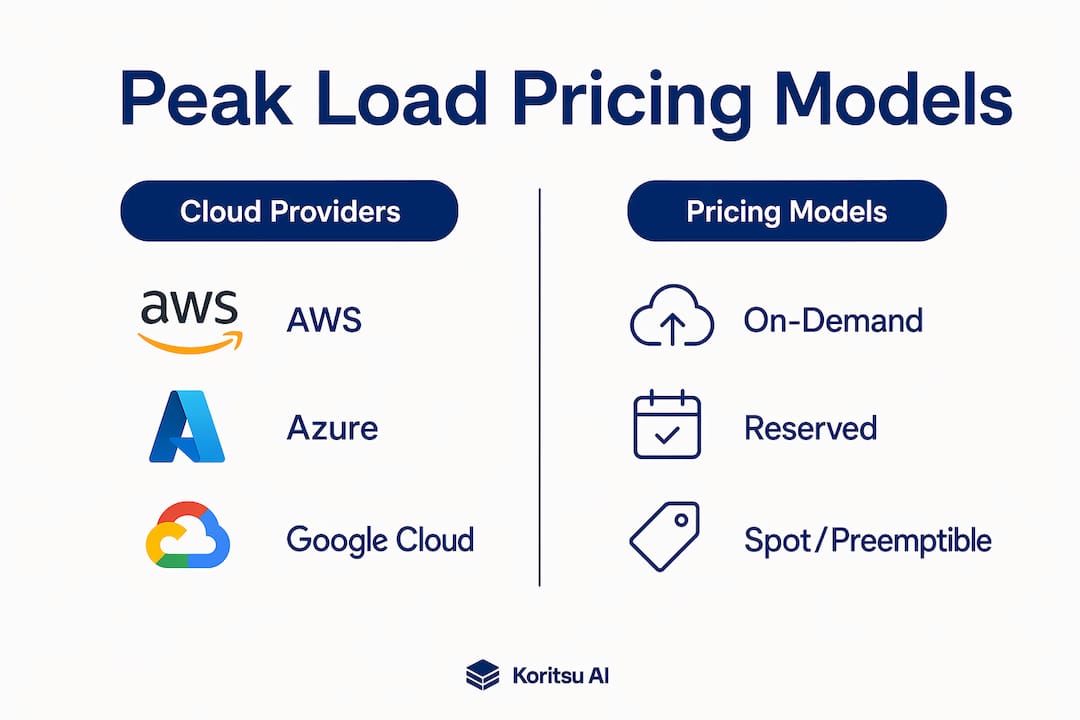
How do peak cloud pricing models work across AWS, Azure, and Google Cloud?
Cloud providers offer three primary pricing structures, each suited to a different part of the demand curve. Understanding which model fits which workload is the core of any cloud service pricing strategy.
| Pricing model | Typical discount | Best suited for | Key consideration |
|---|---|---|---|
| On-demand | None (list price) | Unpredictable peak bursts | Highest unit cost; no commitment |
| Reserved instances / savings plans | 30–60% off on-demand | Stable baseline workloads | 1 or 3-year commitment required |
| Spot / preemptible instances | 50–91% off on-demand | Batch jobs, fault-tolerant workloads | Can be interrupted with short notice |
On-demand pricing is the default and the most expensive. It is the correct choice for genuine, unpredictable peak bursts where the duration is short and the cost is acceptable. Relying on on-demand for baseline traffic is where organisations lose the most money.
Reserved instances and savings plans on AWS, Azure Reserved VM Instances, and Google Cloud committed use discounts all deliver 30–60% savings for workloads with predictable, steady consumption. The commitment is financial, not technical. The underlying infrastructure remains flexible. The savings are real and immediate once the reservation is active.
Spot instances on AWS, preemptible VMs on Google Cloud, and Azure Spot VMs offer the deepest discounts, reaching 91% in some configurations. The trade-off is interruption risk. For a detailed breakdown of when spot capacity makes sense architecturally, the spot instance guide for architects covers the decision framework thoroughly.
The practical approach is to layer these models. Commit reserved capacity for the baseline, use autoscaling on-demand for moderate surges, and route interruption-tolerant workloads to spot capacity. That layered structure is the foundation of a sound peak cloud pricing model.
What hidden factors inflate peak load cloud costs?
The compute bill is visible. The downstream costs are not, and they are often where the real waste accumulates. Database IOPS provisioning, network egress charges, and log verbosity all scale linearly with peak activity. When compute doubles during a traffic spike, these costs frequently double alongside it, yet they rarely appear in the initial cost model.
The "Black Friday Hangover" is a well-documented pattern in cloud cost management. Teams scale up aggressively for a high-traffic event, then delay scaling back because the risk of under-provisioning feels greater than the cost of over-provisioning. The result is weeks or months of inflated spend after the event has passed.
Three hidden cost areas deserve specific attention:
- Database IOPS. Provisioned IOPS on Amazon RDS, Azure SQL Database, or Google Cloud Spanner are often set at peak levels and never reviewed. Reducing provisioned IOPS to match actual throughput patterns produces direct savings.
- Network egress. Data transfer costs between availability zones, regions, and to the public internet scale with traffic volume. Peak events generate egress spikes that persist in the bill long after the traffic subsides.
- Log verbosity. Debug-level logging left active in production sends log volume to services like Amazon CloudWatch or Google Cloud Logging at peak rates. The storage and ingestion costs are non-trivial at scale.
Pro Tip: Treat your cloud bill as three separate budgets: compute, data services, and network. Most teams only scrutinise compute. The other two categories frequently contain 20–30% of total spend with no corresponding business value.
How to reduce peak load cloud costs: practical strategies
Reducing peak load cloud costs requires a combination of architectural decisions, operational habits, and tooling. No single action solves the problem. The following approach addresses each layer systematically.
-
Separate baseline from elastic capacity. A hybrid architecture pattern routes steady baseline traffic to reserved or committed instances and directs burst traffic to on-demand or spot capacity. This prevents the organisation from paying peak rates for traffic that is entirely predictable.
-
Implement quarterly rightsizing reviews. Analyse CPU, memory, and storage utilisation over the preceding 90 days. Any instance running below 40% average CPU utilisation is a candidate for downsizing. This practice alone accounts for a significant share of the 30–40% savings organisations achieve through systematic cloud cost management.
-
Configure autoscaling with aggressive scale-in policies. Most teams configure scale-out correctly and neglect scale-in. Set scale-in cooldown periods to the minimum your application can tolerate. Test scale-in behaviour explicitly. The cost of a brief performance dip during scale-in testing is far lower than months of unnecessary capacity.
-
Audit downstream services alongside compute. Review provisioned IOPS, log retention policies, and cross-region data transfer configurations at the same time as compute rightsizing. These costs are linked to peak activity and respond to the same review cycle.
-
Combine native tools with a FinOps platform. AWS Cost Explorer, Azure Cost Management, and Google Cloud Billing provide good per-service visibility. Combining native tools with third-party FinOps platforms gives finance and IT teams normalised multi-cloud attribution. That shared view is what makes financial accountability possible across engineering teams.
For teams undertaking a broader review, the cloud architecture cost review guide provides a structured framework for 2026 environments.
Key takeaways
Peak load cloud cost is the single largest source of avoidable cloud infrastructure expense for most organisations, and it is fixable through a combination of architectural discipline, pricing model selection, and regular operational review.
| Point | Details |
|---|---|
| Define peak load cost clearly | It is the charge for provisioning at maximum expected demand, not average usage. |
| Safety buffers create idle waste | Engineers adding a 50% buffer means capacity sits unused 80–90% of the time. |
| Layer pricing models | Combine reserved, on-demand, and spot instances to match cost to actual demand patterns. |
| Hidden costs scale with peaks | Database IOPS, network egress, and log verbosity all rise with peak activity and must be audited. |
| Rightsizing drives the biggest savings | Quarterly reviews targeting instances below 40% CPU utilisation deliver 30–40% cost reductions. |
Peak load costs are a process problem, not a technology problem
I have reviewed cloud bills across dozens of organisations, and the pattern is consistent. The technology works exactly as designed. AWS, Azure, and Google Cloud provision what you ask for and charge accordingly. The problem is that what teams ask for is shaped by fear of outages, not by utilisation data.
The cultural shift required is straightforward to describe and genuinely difficult to execute. Engineering teams need to feel safe scaling down. That safety comes from good monitoring, tested autoscaling policies, and a shared understanding between finance and IT about what the cost of over-provisioning actually is. Without that shared understanding, every team defaults to the safe choice, which is more capacity.
The organisations that manage peak load costs well have one thing in common. They treat the cloud bill as a product metric, not an accounting line. When the cost of a feature or a service is visible to the team building it, behaviour changes. Quarterly rightsizing reviews become normal. Autoscaling configurations get tested. Reserved instance commitments get made with confidence rather than avoided out of uncertainty.
The FinOps cultural shift from "what was spent" to "why it was spent" is what separates organisations that control their cloud costs from those that simply report them after the fact.
How Koritsu AI approaches peak load cost reduction
Koritsu AI combines an AI platform with hands-on engineering expertise to find and fix the inefficiencies that drive peak load cloud costs. Kori, Koritsu's AI agent, continuously analyses cloud spending across AWS, Azure, and Google Cloud to surface where money is being lost, including idle capacity, overprovisioned instances, and downstream cost drivers that standard billing tools miss.
The results are measurable. A UK bidding platform achieved a 52% reduction in cloud costs through Koritsu's engineering-grade optimisation programme. Koritsu's FinOps consultancy services work directly with engineering teams to implement the architectural and operational changes that produce lasting savings. The engagement starts with a free assessment, and Koritsu charges only on the savings it delivers.
FAQ
What is peak load cloud cost in simple terms?
Peak load cloud cost is the expense of provisioning cloud resources to handle the highest expected traffic or processing demand. Organisations pay for this peak capacity even when actual usage is far lower, which creates significant idle waste.
How does peak load cloud cost differ from average cloud cost?
Average cloud cost reflects typical daily consumption. Peak load cloud cost reflects the maximum provisioned capacity, which is often 50% or more above average usage due to safety buffers engineers add to prevent outages.
Which pricing model best reduces peak load cloud costs?
A layered approach works best. Reserved instances cover predictable baseline loads at 30–60% below on-demand rates. Spot instances handle burst or batch workloads at up to 91% discount. On-demand covers genuine, unpredictable spikes.
How often should organisations review peak load provisioning?
Quarterly rightsizing reviews are industry best practice. Reviewing CPU, memory, and storage utilisation over 90-day windows identifies overprovisioned instances and allows teams to downsize without performance risk.
Are hidden costs beyond compute significant in peak load scenarios?
Database IOPS, network egress, and log ingestion all scale linearly with peak activity. These downstream costs are frequently overlooked and can represent a substantial share of total cloud infrastructure expenses during and after peak events.