FinOps Inform · Cost Allocation
What is shared responsibility cloud billing?
Discover what shared responsibility cloud billing is and how it helps organizations optimize cost allocation and accountability in cloud usage.

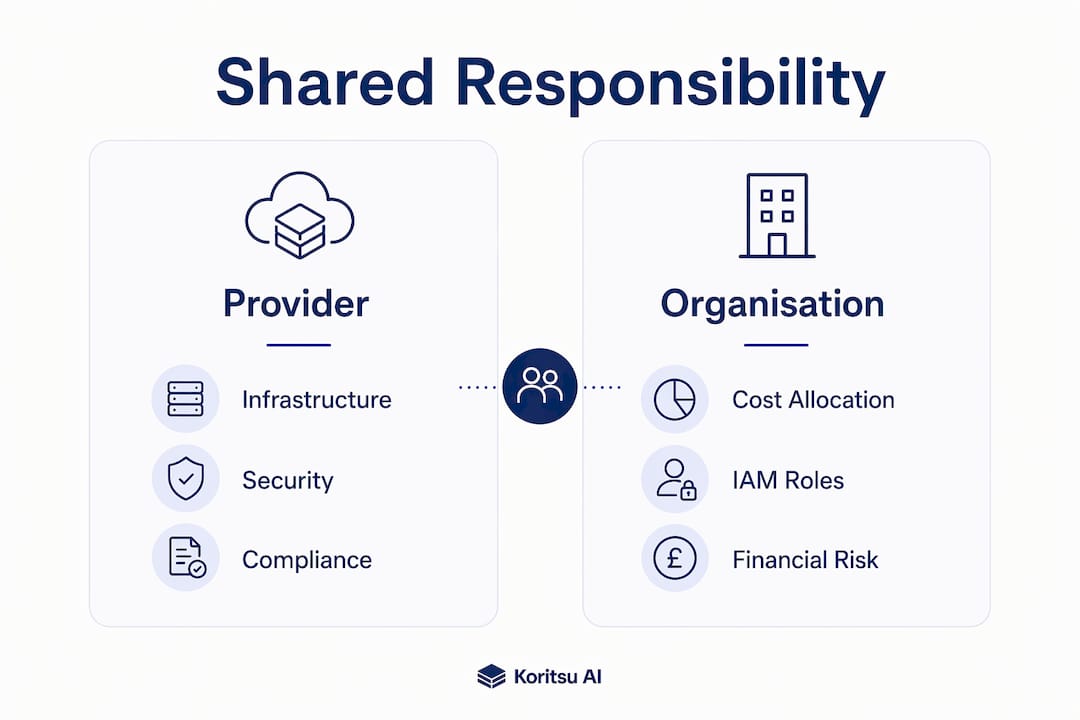
Shared responsibility cloud billing is the practice where an organisation pays its cloud provider directly, then distributes internal cost allocation, governance, and accountability across teams using tools like IAM roles and FinOps frameworks. The term borrows from the security shared responsibility model, but the industry standard phrase for the financial discipline is cloud financial accountability. Both terms describe the same core challenge: one bill arrives from AWS, Google Cloud, or Azure, and your organisation must decide who owns which portion of it. Getting that internal distribution right is where most teams fail, and where most cloud inefficiency originates.
What is shared responsibility cloud billing and how does it work?
Cloud financial accountability is defined as a technical and behavioural discipline with a continuous feedback loop involving telemetry, cost models, policy enforcement, and collaboration across finance, engineering, and security teams. The organisation is always the payer to the cloud provider. The shared responsibility sits entirely within the organisation itself.
Think of it this way: Google Cloud Billing or AWS Cost Explorer shows you one consolidated number. That number means nothing until you break it down by team, product, environment, or cost centre. Organisations typically follow a seven-step accountability process: instrumentation, ingestion, attribution, policy and governance, visualisation, remediation, and review. Each step requires input from both engineering and finance. Neither team can complete the loop alone.

The practical result is that cloud cost is not a technology problem. It is a process problem. Finance teams can report spend but cannot fix inefficient infrastructure. Engineering teams can build efficiently but rarely see the financial impact of their decisions without structured visibility. Shared responsibility cloud billing closes that gap by making cost data visible, attributable, and actionable for both sides.
How does internal cost allocation work across teams?
Effective cost allocation transforms a single consolidated bill into a granular breakdown that attributes spending to specific owners. Two primary models govern how organisations do this internally.
Showback provides visibility only. Teams see what they spent, but no money actually moves between departments. Showback is the starting point for most organisations because it changes behaviour without requiring finance system integration. Even simple showback reports increase accountability and encourage better engineering decisions.
Chargeback goes further. Costs are formally billed back to business units, appearing in departmental budgets. This model creates genuine financial ownership but requires mature tagging, agreed allocation keys, and finance system integration. Without those foundations, chargeback creates disputes rather than accountability.
Tagging is the technical backbone of both models. Every cloud resource should carry tags for team, environment (production, staging, development), and cost centre. In multi-account setups on AWS or multi-project setups on Google Cloud, consistent tagging lets you attribute costs at the resource level rather than estimating at the account level.
The problem is that tagging alone never covers everything. Shared or unallocated costs such as support fees, shared networking, and platform services require allocation models like amortisation or proportional splitting. Practitioners apply transparent allocation keys and formulas to distribute these overhead costs fairly across consuming teams.
AWS recommends moving beyond simple account-level billing using tools like AWS Billing Conductor for consistent internal pricing and allocation models. Shared platform costs often require multiple layers of allocation, covering both platform owner and consumer chargebacks.
Pro Tip: Run a monthly tagging coverage report. Any resource without a cost centre tag should be flagged for the owning team within 48 hours. Untagged resources are the primary source of unallocated spend.
How do IAM roles govern cloud billing permissions?
Billing access control uses IAM roles to separate who can view costs from who can modify billing accounts or link projects. Permissions to billing are distinct from resource permissions, and least privilege must be maintained to avoid errors and misuse. This distinction matters because an engineer who can deploy infrastructure should not automatically have the ability to change billing account settings.
Typical billing roles and their responsibilities break down as follows:
- Billing Account Admin: Full control over a billing account, including linking and unlinking projects. Reserved for a small number of finance leads or cloud platform owners.
- Billing Account Viewer: Read-only access to cost data and invoices. Appropriate for finance analysts, business unit leads, and cost reporting teams.
- Billing Account Costs Manager: Can manage budgets and view spend but cannot change account settings or payment methods. Useful for engineering leads who need budget visibility.
- Project Billing Manager: Can link or unlink a specific project to a billing account without broader billing account access. Useful for DevOps teams managing project lifecycles.
- Tagging Manager: Can create and manage resource tags without payment or billing account access. Appropriate for platform engineering teams responsible for tagging governance.
The principle of least privilege applies directly here. Finance teams typically need Viewer roles. Engineering leads might receive tagging management rights without payment capabilities. Proper permission assignment limits risk and improves cost ownership without increasing operational control risks.
Segregation of duties between finance and engineering is not bureaucracy. It is the mechanism that prevents accidental billing account changes, unauthorised project linking, and cost data manipulation. In large organisations, billing role assignments should be reviewed quarterly alongside access reviews for other critical systems.
How do SaaS, PaaS, and IaaS affect shared billing responsibility?
The cloud service model your organisation uses directly determines how much financial risk and management effort stays with you. Higher-level cloud services like SaaS shift more operational and security burdens to the provider, while IaaS places more on the customer, and this shift affects cost responsibilities significantly.
| Service model | Provider manages | Organisation manages | Financial risk retained by organisation |
|---|---|---|---|
| SaaS | Infrastructure, platform, application | Data, access, licences | Data breach costs, licence overprovisioning, vendor lock-in |
| PaaS | Infrastructure, runtime, middleware | Applications, data, integrations | Compute scaling costs, integration failures, data egress |
| IaaS | Physical hardware, networking, virtualisation | OS, runtime, applications, data | Full compute, storage, and networking cost management |
SaaS reduces infrastructure management effort significantly. The trade-off is that organisations retain financial risk for data breaches, loss of access, and licence overprovisioning. A company running 500 unused SaaS seats is paying for a service the provider delivers perfectly. The inefficiency is entirely internal.
IaaS gives the most control and the most exposure. Every rightsizing decision, every idle instance, and every over-provisioned storage volume is your cost to manage. The shared responsibility model in cloud billing is most demanding at the IaaS layer because the organisation owns the full cost management lifecycle.
PaaS sits in between. Managed services like Google Cloud Run or AWS Lambda reduce the labour cost of infrastructure management but introduce complexity around scaling behaviour and data egress charges. Contract management and architectural decisions become the primary cost levers.
Pro Tip: When evaluating a move from IaaS to PaaS or SaaS, model the total cost of ownership including egress fees, integration costs, and licence management overhead. The headline compute saving is rarely the full picture.
What are the best practices for FinOps collaboration in cloud billing?
FinOps is the operational framework that makes shared cloud billing responsibility work in practice. Successful organisations integrate tagging, telemetry, and governance with finance and engineering in a feedback loop to manage cloud spend effectively. The loop only functions when both teams contribute continuously, not just at month-end reporting.
The following numbered practices reflect how mature FinOps teams structure their collaboration:
- Establish cost visibility before accountability. Deploy tagging policies and activate cost allocation reports in AWS Cost Explorer, Google Cloud Billing, or Azure Cost Management before assigning chargebacks. Teams cannot own costs they cannot see.
- Run showback before chargeback. Introduce showback reports for at least one quarter before moving to formal chargeback. This gives engineering teams time to understand their spend patterns and fix obvious inefficiencies without financial penalty.
- Define allocation keys for shared costs. Agree on formulas for distributing shared platform costs, support fees, and network charges. Document these keys and review them when the platform architecture changes.
- Automate policy enforcement. Use infrastructure-as-code tools and cloud-native policy engines to enforce tagging at resource creation. Reactive tagging campaigns are expensive and incomplete.
- Build remediation workflows. Cost visibility without remediation is reporting, not management. Connect cost anomalies to engineering workflows so that autoscaling adjustments, rightsizing recommendations, and idle resource terminations happen within agreed SLAs.
- Review the model regularly. Without formalised cost accountability, cloud spend accumulates in shared accounts unnoticed. Monthly reviews of allocation coverage, tagging health, and chargeback accuracy prevent the model from drifting.
A common pitfall is over-reliance on tagging as the sole allocation mechanism. Tags break. Resources get created without them. The FinOps School framework treats tagging as one input into a broader cost model, not the entire model. Allocation formulas, telemetry data, and architectural cost attribution fill the gaps that tags leave behind.
Pro Tip: Assign a named FinOps champion in each engineering squad. This person owns tagging compliance and attends the monthly cost review. Distributed ownership scales better than a central FinOps team trying to police every account.
Key takeaways
Shared responsibility cloud billing succeeds when organisations combine structured cost allocation, least-privilege IAM governance, and a continuous FinOps feedback loop between finance and engineering teams.
| Point | Details |
|---|---|
| Internal attribution is the core challenge | The cloud provider sends one bill; the organisation must distribute it accurately across teams and cost centres. |
| Showback before chargeback | Introduce visibility-only reporting first to change engineering behaviour before formal billing begins. |
| IAM roles enforce billing governance | Separate Billing Account Admin, Viewer, and Tagging Manager roles to maintain least privilege and segregation of duties. |
| Service model affects financial risk | IaaS retains full cost management with the organisation; SaaS shifts operations to the provider but retains licence and data risk. |
| Tagging alone is insufficient | Shared costs like support fees and network charges require allocation formulas, not just resource tags. |
The uncomfortable truth about cloud billing accountability
Most organisations I work with treat cloud billing as a finance problem. They assign a cost analyst, pull monthly reports from AWS or Google Cloud, and send spreadsheets to engineering leads. Nothing changes. The spend grows. The spreadsheets get bigger.
The uncomfortable truth is that cloud financial accountability fails when it is treated as purely finance-driven. Finance teams can report spend accurately. They cannot fix an oversized RDS instance or a misconfigured autoscaling group. That requires engineering involvement, and engineering teams only engage consistently when cost data is embedded in their workflows, not sent to them in a monthly email.
What I have seen work is treating the FinOps feedback loop as a product, not a process. The cloud FinOps framework works best when it has an owner, a backlog, and a regular cadence, just like any other engineering product. Cost anomalies become tickets. Rightsizing recommendations have acceptance criteria. Tagging coverage has a target metric.
The other misconception worth addressing is that moving to SaaS or PaaS removes your billing responsibility. It does not. It changes the nature of the responsibility. You trade infrastructure cost management for licence governance, vendor contract management, and data egress monitoring. The discipline required is different, but the accountability does not disappear.
The organisations that get this right are not necessarily the ones with the biggest FinOps teams. They are the ones where finance and engineering have a shared language around cost, a shared view of the data, and a shared commitment to acting on it. Building that culture is harder than buying a tool. It is also the only thing that actually works.
— Kori
How Koritsu AI supports cloud billing accountability
Cloud billing accountability requires more than dashboards. It requires continuous analysis, clear attribution, and engineering teams that act on what they see.
Koritsu AI combines an AI platform with hands-on expert advice to surface exactly where your cloud spend is going and why. Kori, our AI agent, analyses your AWS, Google Cloud, or Azure environment continuously, identifying misallocated costs, untagged resources, and architectural inefficiencies that standard billing reports miss. Our specialists then work with your engineering teams to fix them. You can see the kind of results this produces in our UK bidding platform case study, where a client achieved a 52% reduction in cloud costs. Koritsu AI charges only on savings delivered. Start with a free cloud cost assessment to see what your shared billing model is actually costing you.
FAQ
What is shared responsibility cloud billing?
Shared responsibility cloud billing is the practice where an organisation pays the cloud provider directly but distributes internal cost allocation, governance, and accountability across teams. The shared responsibility sits within the organisation, not between the organisation and the provider.
What is the difference between showback and chargeback?
Showback provides cost visibility to teams without moving money between departments. Chargeback formally bills costs back to business units, requiring mature tagging and finance system integration to work accurately.
Which IAM roles are used for cloud billing governance?
Common billing IAM roles include Billing Account Admin, Billing Account Viewer, Billing Account Costs Manager, and Project Billing Manager. Each role carries distinct permissions, and least privilege should be maintained to separate finance and engineering access.
Does using SaaS remove cloud billing responsibility from the organisation?
No. SaaS shifts infrastructure management to the provider but the organisation retains financial risk for data breaches, licence overprovisioning, and vendor lock-in. The nature of the responsibility changes; it does not disappear.
Why is tagging alone insufficient for cloud cost allocation?
Tags cannot be applied to shared costs like support fees, network charges, and platform services. These require allocation formulas and proportional splitting models to distribute overhead costs fairly across consuming teams.