FinOps Inform · Async Processing
Why async processing reduces cloud bills: 2026 guide
Discover why async processing reduces cloud bills. Learn how decoupling tasks cuts costs on compute time, idle capacity, and concurrency.

Why async processing reduces cloud bills: the core mechanisms
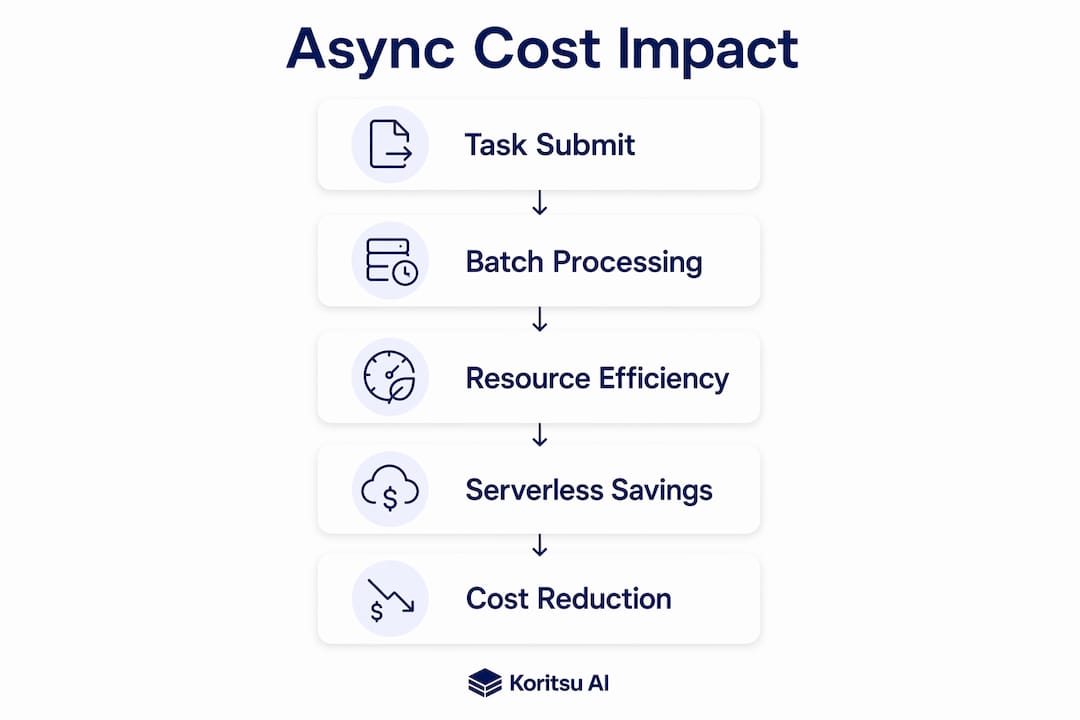
Asynchronous processing reduces cloud bills by decoupling when work is submitted from when it actually runs. Instead of holding compute resources open while waiting for a response, async systems queue tasks and execute them when capacity is cheapest. The result is a direct cut to three of the biggest billing components: compute time, idle capacity charges, and concurrency costs.
Batch async processing of non-real-time workloads typically cuts LLM inference token costs by 50% compared to synchronous processing, with savings reaching up to 70% when larger batches are used. That figure comes from a structural pricing difference: real-time API calls include the cost of idle headroom that providers maintain to guarantee millisecond responsiveness. Async calls do not need that guarantee, so providers route them through spare capacity at a lower rate.
The cloud billing components most affected by this shift are:
- Compute time: async jobs run during off-peak windows, often on spare capacity priced below on-demand rates
- Idle capacity: synchronous architectures overprovision to handle peak load; async smooths demand and removes that buffer
- Concurrency charges: blocking threads during I/O waits drives up concurrency counts; non-blocking async execution handles the same load with fewer threads
- Data transfer: batching requests reduces the number of API round trips, cutting per-call transfer overhead
Serverless functions on platforms like AWS Lambda compound these savings further. With a pay-per-request model and no idle charge, serverless async event processing hides cold start latencies behind queue buffering, so you pay only for actual compute time. The architectural discipline that async demands, queuing, batching, state tracking, also tends to simplify reliability and debugging, which reduces the operational overhead that quietly inflates cloud bills over time.
How async task systems are actually built
Understanding why async processing cuts costs requires understanding what the architecture looks like in practice. The core components are a queue, a batch submission layer, and a pool of workers that consume jobs independently of the caller.
In a typical async pipeline on AWS, work flows like this:
- A producer submits tasks to a durable queue such as AWS SQS
- A batch API layer accumulates requests up to a defined limit (batch APIs accept up to 100,000 requests per job) before submission
- Workers pull from the queue on a schedule, processing during off-peak windows
- A state store such as DynamoDB tracks job lifecycle: submitted, processing, complete, failed
- Retry logic handles partial failures without re-running the entire batch
The decoupling between submission and consumption is what hides latency from end users and removes the need for synchronous blocking. A web server handling document classification does not wait for the classifier to respond; it writes to the queue and returns immediately. The classifier runs when resources are available.
| Component | Synchronous approach | Async approach |
|---|---|---|
| Task submission | Caller blocks until complete | Caller writes to queue and returns |
| Resource allocation | Held open for duration of call | Allocated only during execution |
| Cold start impact | Adds directly to user-facing latency | Absorbed by queue buffer |
| Failure handling | Caller retries immediately | Durable queue retries on schedule |
| Cost model | Per-second compute, idle included | Per-request, no idle charge |
Scheduling windows matter enormously for cost. Batch APIs operate on a completion window that allows providers to route your jobs through spare capacity during off-peak hours. In practice, most batches complete well before the maximum allowed duration. The provider is not deliberately holding jobs; they simply cannot guarantee faster without charging the real-time premium.
Pro Tip: Design your pipeline so batch submission happens as early as possible and result consumption happens as late as the business allows. A nightly report read at 9AM can submit at midnight, giving the provider nine hours of scheduling slack and maximising the chance of hitting the cheapest capacity windows.
Durable state tracking is not optional. Teams that skip it end up with orphaned jobs: the batch completes, but no process retrieves the results. Robust async pipelines are built around stateful job lifecycle management, not single request-response calls. Every item submitted must be reconciled against what comes back, with retries for failures and a clear completion signal before the job is marked done.
How async processing cuts your infrastructure costs
The resource efficiency argument for async processing comes down to one principle: synchronous systems pay for time they are not using. A thread blocked on a network call or database query holds compute allocation while doing no useful work. At scale, that idle time accumulates into a measurable fraction of your monthly bill.

Non-blocking I/O and event loops in runtimes like Node.js allow a single-threaded system to handle thousands of concurrent operations without spawning additional threads. The practical effect is that you handle the same request volume with fewer instances, which directly reduces your compute spend. This is not a theoretical gain; it is the reason async-first architectures consistently require less horizontal scaling than their synchronous equivalents.
| Cost metric | Synchronous | Asynchronous |
|---|---|---|
| Compute time | Full duration, blocking | Execution time only |
| Idle capacity charge | Provisioned for peak load | Near zero with serverless |
| Token cost (LLM inference) | Full real-time rate | 50–70% reduction via batch API |
| Cold start cost | Paid on every synchronous call | Invisible behind queue buffer |
| Concurrency charge | High, threads held during I/O | Low, threads released immediately |
Serverless functions amplify this further. AWS Lambda charges based on usage only, without idle time charges. For async event processing triggered by SQS or Kinesis, cold starts are invisible to end users because the queue absorbs the latency. You pay only for the work actually done.
Workload categorisation is the practical lever here. Distinguishing workloads that can tolerate hour-long latencies from those requiring sub-second responses is the first step toward restructuring for cost efficiency. Document classification, report generation, content moderation, and bulk analytics all tolerate delays of 1–24 hours. Running them synchronously is a choice that costs money, not a technical requirement.
Pro Tip: When auditing your workloads, ask one question for each: “Is a human watching a spinner right now?” If the answer is no, the workload is an async candidate. Most engineering teams find that the majority of their API spend falls into this category once they look honestly.
Batching also enforces architectural discipline that pays dividends beyond cost. Forced to queue and batch, teams naturally build idempotency, audit trails, and retry logic. Real-time systems often skip these patterns because the API responds quickly enough that failures feel manageable. Async systems make correctness a structural requirement rather than an afterthought.
What can go wrong with async processing
Async processing does not reduce costs automatically. Implemented carelessly, it introduces failure modes that can erase the savings and add operational complexity on top.
The most common pitfalls are:
- Silent batch failures: a batch job completes but individual items fail without alerting anyone; results are missing and no one notices until downstream systems produce incorrect output
- Orphaned jobs: the batch finishes but no polling or webhook handler retrieves results; the work is done but the output is lost
- Retry storms: aggressive retry logic without exponential backoff floods the queue, driving up request counts and potentially hitting rate limits across the entire system
- Missing spend circuit breakers: one documented case saw an agent loop run unchecked for 11 days, growing API spend from £127 per week to £47,000 per week because no budget limit was set on the async job submission step
- Oversized batch submissions: batch APIs accept up to 100,000 requests per job; submitting 150,000 requests silently splits across multiple batches, doubling coordination complexity without warning
The tradeoff is real. Async systems are more complex to debug than synchronous ones because the submission and execution steps are separated in time. A failure in a synchronous call surfaces immediately; a failure in an async pipeline may not surface until hours later, by which point the context for diagnosing it has partially evaporated.
Idempotency is non-negotiable. Every job processor must handle duplicate submissions without producing duplicate results, because retries are guaranteed to happen. Durable queues such as AWS SQS provide at-least-once delivery, which means your workers will occasionally process the same message twice. Without idempotent processing, that produces data corruption rather than a harmless duplicate.
Monitoring async workloads requires explicit instrumentation. Unlike synchronous APIs, where a slow response time is immediately visible in latency metrics, async pipelines can accumulate backlogs silently. Budget controls, queue depth alerts, and job completion rate dashboards are not optional extras. They are the mechanism by which you catch runaway costs before they compound. Cloud observability tooling integrated with your async infrastructure gives you the visibility to act before a retry loop becomes a billing crisis.
How Koritsu AI approaches async cost optimisation
Most cloud cost problems are not purchasing problems. They are architecture problems. Teams default to synchronous APIs because that is how the first integration was built, and every subsequent workload gets bolted onto the same pattern out of habit. The result is that a large share of cloud spend goes to real-time capacity that most workloads never actually need.
The 50% baseline savings from batch APIs compounds quickly across a large workload, and the operational simplicity of not needing to engineer around synchronous failures compounds even faster. Real-time should be the expensive special case, justified when the UX genuinely demands it and avoided everywhere else.
Koritsu AI’s platform, driven by its AI agent Kori, continuously analyses cloud spending to surface exactly this kind of structural inefficiency. Kori identifies workloads running on synchronous paths that have no real-time requirement, quantifies the cost of that misclassification, and gives engineering teams a prioritised list of async migration candidates. The analysis covers compute time, concurrency charges, idle capacity, and API token costs across AWS, Google Cloud, and Azure.
The approach combines platform analytics with hands-on expert advice. Koritsu’s specialists work with engineering teams to design the queue infrastructure, state tracking, and retry logic that make async migrations reliable rather than fragile. The goal is not to hand over a report; it is to get the savings into production.
Pro Tip: Start with one high-volume, low-urgency workload. Document classification, nightly analytics, or bulk content enrichment are ideal first candidates. Prove the pattern on a small batch, measure the cost reduction, and then expand. The infrastructure you build for the first migration serves every subsequent one.

Koritsu AI’s pricing reflects this commitment. Clients start with a free assessment, and Koritsu takes a share of the savings actually delivered. There is no upfront fee and no subscription until the savings are proven. For teams that have identified async as a cost lever but lack the bandwidth to implement it safely, that model removes the risk from the decision.
The UK bidding platform case study demonstrates a significant reduction in cloud costs achieved through a combination of async refactoring, rightsizing, and architectural changes that Koritsu identified and helped implement. The async component was not the only lever, but it was the one that unlocked the largest single reduction in compute spend.
If your team is spending on real-time APIs for workloads that could tolerate a two-hour delay, that spend is recoverable. Koritsu AI’s cloud cost optimisation services are built to find it and help you get it back.
Cost savings across IaaS, PaaS, and FaaS: concrete examples
The mechanics of async cost reduction play out differently depending on which cloud service model you are using. The principle is the same across all three, but the billing levers and the magnitude of savings vary.
Infrastructure as a Service (IaaS)
On IaaS platforms such as AWS EC2, you pay for instances by the hour regardless of whether they are doing useful work. Synchronous workloads that block threads during I/O waits leave CPU and memory allocated but idle. Shifting those workloads to async batch jobs running on spot or preemptible instances cuts costs in two ways: the instances run only when there is work to do, and spot pricing is substantially cheaper than on-demand for interruptible batch jobs. Document processing pipelines, bulk data transformation, and overnight analytics runs are natural fits. The async architecture makes them interruptible by design, which is exactly what spot instances require.
Platform as a Service (PaaS)
PaaS environments such as AWS Elastic Beanstalk or Google App Engine typically charge for the compute tier you provision, not just the requests you serve. Synchronous applications that hold connections open during slow external calls drive up the required tier. Async worker processes decouple request handling from processing, allowing the web tier to stay lean while a separate worker pool handles the heavy lifting. The practical saving is a smaller web tier running at higher utilisation, rather than an oversized tier sitting at 20% CPU waiting for database responses. For teams running report generation or content moderation inside a PaaS environment, moving those tasks to an async worker queue often reduces the required compute tier by one or two levels.
Functions as a Service (FaaS)
FaaS is where async processing delivers its most direct cost advantage. AWS Lambda charges per request and per millisecond of execution, with no idle charge whatsoever. For async event-driven workloads triggered by SQS, Kinesis, or S3 events, this billing model is nearly perfect: you pay only for the compute that runs, cold starts are absorbed by the queue, and the function scales to zero between bursts. A company processing API requests via synchronous real-time calls versus batch async can see significant daily and annual cost differences. The break-even on the infrastructure investment typically occurs within a few months of volume. For application refactoring teams weighing the engineering cost of migration, that payback period is the number that makes the decision straightforward.
Key takeaways
Async processing cuts cloud bills by removing the cost of real-time capacity from workloads that never needed it in the first place.
| Point | Details |
|---|---|
| Batch async saves 50–70% on compute | Batch APIs cut token costs by around 50% compared to synchronous pricing, with savings reaching up to 70% with larger batches routed through spare capacity. |
| Idle capacity is the hidden cost | Synchronous APIs price in headroom for peak load; async smooths demand and removes that overhead entirely. |
| FaaS amplifies the saving | AWS Lambda charges per request with no idle cost; cold starts are invisible behind queue buffering in async event processing. |
| Silent failures erase savings | Missing retry logic, idempotency, and spend circuit breakers can turn async cost savings into runaway billing incidents. |
| Workload categorisation unlocks the gains | Identifying which workloads tolerate 1–24 hour latency is the first and most valuable step in any async migration. |