FinOps Inform · Cost Optimisation
Why cloud commitments go unused: the real causes
Discover why cloud commitments go unused and learn how to optimize your cloud budget. Avoid wasting money on unused capacity today!

Cloud commitment underutilisation is defined as the condition where prepaid cloud capacity goes uncharged against actual workloads, creating fixed costs with no corresponding business value. This happens because commitment-based pricing transfers utilisation risk entirely to the customer. Savings Plans and Reserved Instances lock organisations into paying full committed rates regardless of whether usage changes. The result is that businesses across AWS, Google Cloud, and Azure routinely pay for capacity they never consume. Understanding why cloud commitments go unused is the first step toward fixing a problem that quietly drains cloud budgets at scale.
Why cloud commitments go unused: the root cause
The fundamental problem is a misalignment between how commitments are priced and how workloads actually behave. Cloud providers design Savings Plans and Reserved Instances to reward predictability. Workloads, however, are rarely predictable over a one to three year horizon.
Commitment lock-in risk can span up to 36 months with unchanged charges despite significant workload shifts. That is a long time for any engineering team to guarantee stable demand. Most organisations cannot do it reliably, and the gap between committed spend and actual usage becomes waste.
The industry term for this broader problem is cloud waste, and unused commitments are one of its most expensive forms. Commitment pricing does not reduce inefficiencies like overprovisioning. It prepays those inefficiencies as fixed costs, making them unavoidable after purchase. That distinction matters enormously for how you approach the problem.

What operational factors cause cloud agreements to fail?
Several specific technical and business conditions drive underutilised cloud resources. Recognising them in your own environment is the starting point for any corrective action.
- Architectural changes. Migrating workloads to containers or Kubernetes invalidates commitments tied to specific instance types. A Reserved Instance purchased for EC2 compute becomes worthless when the same workload moves to a managed container service.
- Overprovisioning for peak demand. Typical workloads operate at 60% or more below peak CPU capacity, leaving prepaid compute sitting idle the majority of the time. Teams provision for the worst case and pay for it permanently.
- Poor workload visibility. The majority of organisations lack mature cost visibility, which means commitment purchases are based on incomplete data. Buying capacity you cannot accurately measure is a reliable path to waste.
- Rapid growth or business pivots. Commitments bought on current usage can misalign with future requirements in dynamic environments. A team that doubles in size, changes product direction, or acquires a new system will find its prior commitments obsolete.
- Prepaying inefficiency rather than eliminating it. Commitments do not fix the underlying cloud compute inefficiencies that drive excess spend. They simply lock in the cost of those inefficiencies for the duration of the term.
The common thread across all five causes is that commitments were purchased before the organisation understood its actual consumption patterns. That sequencing error is the root of most cloud spending inefficiencies.
How do cloud providers' pricing models encourage unused commitments?
Cloud providers are not passive participants in this problem. Their business model actively shapes the conditions that lead to unused commitments.
- Capital investment requires predictable revenue. Cloud providers make multi-billion-pound investments in data centres and physical infrastructure. Commitments generate guaranteed cash flow regardless of volatile consumer usage patterns. That predictability is valuable to the provider, not the customer.
- Discounted rates incentivise upfront purchase. Savings Plans and Reserved Instances offer meaningful discounts, sometimes 30-70% off on-demand rates. Those discounts are real. The catch is that the discount is conditional on paying whether you use the capacity or not.
- Utilisation risk shifts entirely to the customer. On-demand pricing charges only for what you consume. Commitment pricing charges for what you promised. The provider collects revenue either way. The customer absorbs the loss when usage drops.
- Capacity is reserved regardless of actual demand. Providers maintain infrastructure to serve committed customers at peak. They bill at the committed rate even when the customer's actual workload is a fraction of that capacity.
- Long contract terms amplify the risk. One and three year terms are standard. Business requirements change faster than that in most organisations. The longer the term, the greater the chance that the commitment becomes misaligned with reality.
Understanding this incentive structure does not mean avoiding commitments entirely. It means approaching them as a financial instrument with real risk, not simply a discount programme. Aligning cloud costs with business outcomes requires treating commitment decisions with the same rigour as any capital expenditure.
What practical steps reduce unused cloud commitments?
The correct sequence is optimise first, commit second. Purchasing commitments before addressing waste locks in the cost of that waste for the full contract term.
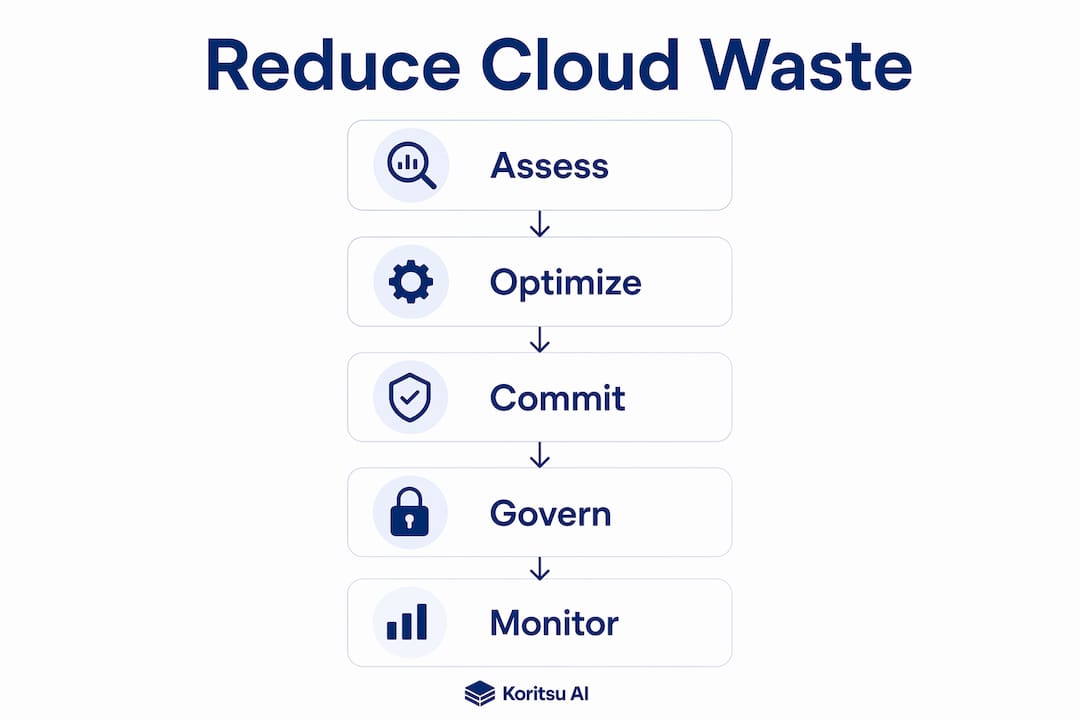
Pro Tip: Run a rightsizing analysis across all active workloads before purchasing any commitment. Committing to oversized instances multiplies the cost of overprovisioning across the entire contract term.
Start with workload visibility. You cannot commit intelligently to capacity you cannot measure. Invest in cost analytics that show actual utilisation at the service, instance, and team level before any commitment decision is made.
- Rightsize before committing. Reduce instance sizes to match actual consumption. A workload running at 20% CPU utilisation on a large instance should be moved to a smaller one before any Reserved Instance is purchased against it.
- Decommission idle resources. Idle compute, unused storage volumes, and orphaned load balancers all inflate the baseline you might commit against. Remove them first.
- Commit only to stable, predictable workloads. Stable workloads like production databases are appropriate candidates for commitment pricing. Variable or experimental workloads are not.
- Align commitment levels with true baseline demand. Commit to the floor of your usage, not the ceiling. On-demand pricing covers spikes. Commitments should cover only what you are certain to consume every day of the term.
- Monitor continuously and adjust. Usage patterns shift. Commitment coverage should be reviewed quarterly at minimum. Many cloud platforms allow partial modification of commitments; use that flexibility before waste accumulates.
Avoiding common reserved instance mistakes requires treating commitment management as an ongoing process, not a one-time purchase decision. The organisations that get this right treat their commitment portfolio the way a finance team treats a bond portfolio: with regular review, rebalancing, and clear criteria for entry and exit.
How does cloud financial governance prevent commitment waste?
Cloud cost optimisation is not a technology problem. It is a process problem. Governance is what turns good intentions into consistent outcomes.
Strong governance enforces lifecycle management of cloud resources and commitments. Without it, commitments accumulate across teams, renewal decisions get made by default rather than by analysis, and waste compounds over time. FinOps practices including regular reviews and cross-team collaboration improve forecasting accuracy and resource alignment.
The table below shows the difference between organisations with weak and strong commitment governance:
| Governance area | Weak governance | Strong governance |
|---|---|---|
| Commitment review cadence | Ad hoc or never | Quarterly, with documented criteria |
| Forecasting input | Engineering estimates only | Finance, engineering, and product aligned |
| Idle resource management | Reactive, after billing surprises | Proactive, with automated alerts |
| Commitment approval process | Individual team discretion | Central review with spend thresholds |
| Cost visibility | Aggregate billing only | Per-service, per-team granularity |
The practical steps that support strong governance include:
- Establishing a FinOps function or assigning clear ownership of cloud cost decisions.
- Setting commitment approval thresholds that require cross-functional sign-off above a defined spend level.
- Integrating cost analytics into engineering workflows so that spend data is visible to the teams making architectural decisions.
- Running regular cloud infrastructure ROI reviews to validate that committed spend is delivering expected returns.
Governance frameworks reduce the risk of prepaid waste by making commitment decisions deliberate rather than reactive. The goal is a culture where no commitment is purchased without a clear utilisation forecast and a defined review date.
Key takeaways
Unused cloud commitments are a process failure, not a pricing failure. The fix requires operational discipline, workload visibility, and governance before any commitment is purchased.
| Point | Details |
|---|---|
| Commitments transfer risk to you | Savings Plans and Reserved Instances charge full rates regardless of actual usage changes. |
| Optimise before committing | Rightsize and remove idle resources before purchasing any commitment to avoid locking in waste. |
| Stable workloads only | Commit only to predictable, steady workloads like production databases, not variable or experimental ones. |
| Governance prevents accumulation | Quarterly reviews and cross-team forecasting stop commitment waste from compounding over time. |
| Visibility is the prerequisite | Without granular cost analytics, commitment decisions are guesswork that reliably produces unused spend. |
Kori's take: the uncomfortable truth about cloud commitments
The most common mistake I see is organisations treating commitments as the primary cost reduction strategy. They buy a Savings Plan, see the discount percentage, and assume the problem is solved. It is not.
Commitments are a financial instrument. They work when applied to a clean, well-understood baseline of consumption. Applied to an inefficient, overprovisioned environment, they do not reduce costs. They lock in the cost of the mess for one to three years.
The organisations that genuinely reduce cloud spend do it in the right order. They fix the architecture first. They rightsize the workloads. They remove the idle resources. Then, and only then, do they commit to the stable baseline that remains. That sequence is not intuitive when a provider is offering you a 40% discount upfront. But the discount is only valuable if you are committing to capacity you will actually use.
The other thing I would say is that this is a leadership problem as much as a technical one. Engineering teams cannot fix commitment waste alone if finance is approving multi-year commitments without utilisation data. The cloud total cost of ownership conversation has to happen at the leadership level, with real numbers, before any commitment is signed.
Technology helps. Continuous monitoring surfaces the data you need. But the decision to act on that data requires people and process, not just a platform.
— Kori
How Koritsu AI helps you stop paying for unused cloud capacity
Cloud commitment waste is fixable. The starting point is knowing exactly where your money is going.
Koritsu AI combines an AI platform with hands-on expert advice to surface exactly where cloud spend is being lost. Kori, the AI agent, continuously analyses your AWS, Google Cloud, or Azure environment to identify underutilised commitments, oversized instances, and idle resources. Koritsu AI specialists then help your engineering teams act on those findings. The cloud cost optimisation platform is built for both technical and business audiences, so finance and engineering can work from the same data. Koritsu AI charges only on savings delivered, starting with a free assessment. See what a UK bidding platform saved by addressing commitment waste directly.
FAQ
What are cloud commitments and why do they go unused?
Cloud commitments are prepaid agreements, such as Savings Plans and Reserved Instances, that offer discounted rates in exchange for guaranteed spend over one to three years. They go unused when workloads change, shrink, or shift architecturally, leaving prepaid capacity with no matching consumption.
What is commitment lock-in risk?
Commitment lock-in risk is the financial exposure created when an organisation is contractually obligated to pay for cloud capacity it no longer needs. Lock-in periods can span up to 36 months, during which charges continue regardless of actual usage.
How does overprovisioning contribute to unused cloud spend?
Overprovisioning creates a gap between committed capacity and real demand. Workloads typically operate well below peak CPU capacity, meaning prepaid compute sits idle for the majority of the billing period.
Which workloads are suitable for cloud commitment pricing?
Stable, predictable workloads with consistent demand, such as production databases and core application servers, are the most appropriate candidates. Variable, experimental, or rapidly scaling workloads carry too much uncertainty for fixed-term commitments.
What is FinOps and how does it reduce commitment waste?
FinOps is a cloud financial management practice that brings finance, engineering, and product teams together to manage cloud spend with shared accountability. Regular FinOps review cycles improve forecasting accuracy and prevent commitments from accumulating beyond actual utilisation.