FinOps Inform · Cost Optimisation
Why cloud environments over-scaled: causes and fixes
Discover why cloud environments over-scaled and learn effective fixes. Stop wasting budget and optimize your cloud infrastructure today!

Cloud over-scaling is defined as the persistent allocation of compute, storage, and network resources that significantly exceeds actual workload demand. It is the leading cause of wasted cloud spend across AWS, Google Cloud, and Azure deployments. Understanding why cloud environments over-scaled is not an academic exercise. It is the first step toward recovering real money from your infrastructure budget. The root causes sit in three places: architectural decisions made during migration, operational habits that compound over time, and misaligned cost ownership between engineering and finance teams.
Why cloud environments over-scaled: the architectural root causes
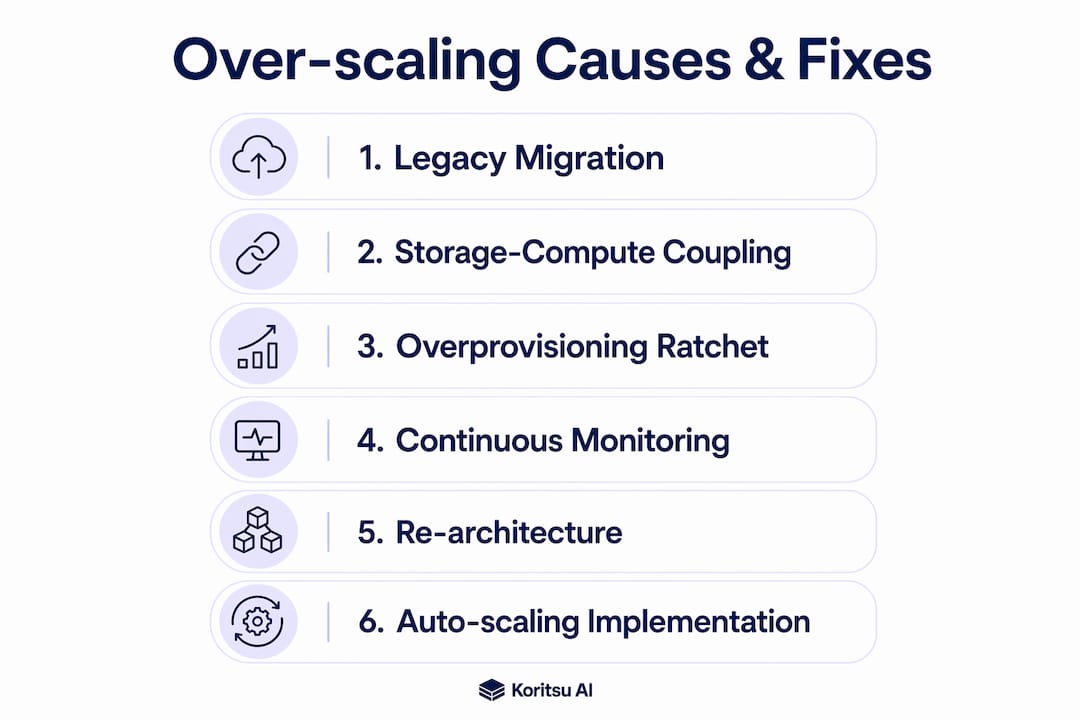
Legacy migration is the single biggest driver of structural over-scaling. When organisations move on-premises workloads to the cloud without re-architecting them, they replicate fixed capacity models onto elastic pricing. Lift-and-shift migration means paying cloud prices without exploiting cloud elasticity. The result is a workload that behaves like a physical server but costs like a cloud service.
The second architectural trap is the coupling of storage performance to compute size. To achieve higher IOPS on many cloud platforms, you must provision a larger virtual machine. A single high-IOPS database workload forces you into a larger VM tier and a premium storage class, inflating your base cost well beyond what rightsizing alone can fix. Architectural change is the only real remedy.

Elastic cloud economics only deliver savings when workloads are designed to exploit scaling and ephemeral resource use. Most migrated workloads are not. They carry fixed memory allocations, static instance types, and always-on services that were sensible on-premises but are wasteful in the cloud.
The compounding effect is architectural debt. Each design decision that adds a small cost premium multiplies across services and regions. Stale resources, multi-AZ deployments beyond actual redundancy requirements, and convenience-driven configuration choices accumulate into bills that grow quarter after quarter without any corresponding growth in usage.
- Legacy workloads migrated without re-architecting carry fixed capacity assumptions into elastic environments.
- Storage throughput requirements force oversized compute instances, creating unavoidable cost coupling.
- Architectural debt compounds silently across services, regions, and deployment configurations.
- Reserved instance purchases made for one architecture become waste when the architecture changes.
Pro Tip: During infrastructure reviews, flag any service where the instance size is driven by storage or IOPS requirements rather than CPU or memory demand. That coupling is a reliable signal of architectural debt and a strong candidate for re-architecting.
How operational behaviour drives persistent overprovisioning
Teams overprovision as an insurance policy. Conservative CPU, memory, and storage allocation protects against performance incidents, but those allocations are rarely revisited once set. The initial buffer becomes the permanent baseline. Over months, the gap between allocated resources and actual utilisation widens without anyone noticing.
Four operational patterns sustain this cycle:
- Provisioning defaults set during initial deployment are never updated as traffic patterns mature and stabilise.
- Dynamic environment changes, such as new feature releases or traffic shifts, trigger upward scaling that is never reversed when demand normalises.
- Cost ownership gaps between engineering and finance mean cloud resource decisions are treated as technical choices rather than financial ones, removing the incentive to optimise.
- Multi-tenant environments amplify the problem. An overprovisioned service in a shared cluster forces larger node sizes, which raises costs for every workload sharing that infrastructure.
The overprovisioning ratchet is the most insidious pattern. Resources scale up in response to a real or perceived performance risk, but scaling down requires deliberate action that no one is accountable for. Without a named owner for cloud cost at the team level, the ratchet only turns in one direction.
Cloud resource management must be treated as a continuous process, not a one-time configuration task. Cross-team ownership, regular utilisation reviews, and clear accountability are the operational controls that break the ratchet cycle.
What does over-scaling actually cost?
The financial impact of over-scaled cloud environments falls across four layers. Compute is the most visible: idle or underused virtual machines running at full price. Storage is less obvious but equally damaging, particularly when premium tiers are provisioned for throughput that the workload never actually demands. Licensing costs scale with instance size on many platforms, so an oversized VM carries a larger software licence fee on top of the compute charge. Support tiers tied to total spend also inflate as the bill grows.
| Cost layer | How over-scaling inflates it |
|---|---|
| Compute | Idle or underused instances running at full on-demand rates |
| Storage | Premium tiers provisioned for IOPS headroom that is never used |
| Licensing | Software licences priced per vCPU or instance size scale with oversized VMs |
| Support | Vendor support tiers calculated as a percentage of total cloud spend |
Scaling to meet performance SLAs creates a particularly damaging cycle. A performance degradation event triggers additional provisioning. That provisioning raises the cost baseline. The higher baseline makes future cuts feel risky, so the next performance event triggers another round of provisioning. The bill grows continuously without any architectural improvement.
Pro Tip: Map your cloud spend by cost layer before any optimisation exercise. Teams that conflate compute and storage costs miss the licence and support multipliers, which can account for a significant share of the total bill on oversized deployments.
Building for hypothetical scale before actual demand exists adds a further layer of waste. Teams provision for a traffic peak that may never arrive, then pay for the observability tooling, extra services, and compute headroom needed to support that phantom scale. The cost of solving a nonexistent problem is real and recurring.
What strategies reduce over-scaling in cloud environments?
Preventing cloud over-scaling requires action at the architectural, operational, and governance levels simultaneously. No single fix addresses all three root causes.
Re-architect before you right-size
Rightsizing a workload that is architecturally coupled to an oversized instance type delivers limited savings. The cloud architecture cost review must come first. Identify workloads where storage or IOPS requirements are driving instance size, then evaluate whether decoupling storage from compute through managed database services or object storage changes the cost profile. Re-architecting is more effort than rightsizing, but it removes the structural constraint that makes rightsizing ineffective.
Implement traffic-pattern-driven auto-scaling
Intelligent auto-scaling sets policies that trigger before full capacity is reached, maintaining a baseline for predictable peaks while scaling fast for unpredictable spikes. This approach limits idle resources without risking downtime. The key is using actual traffic pattern data, not conservative estimates, to set scaling thresholds. Teams that set thresholds based on worst-case assumptions recreate the overprovisioning problem inside their auto-scaling configuration.
Establish cross-functional cost governance
- Assign named cost owners at the team level, not just at the organisational level.
- Require engineering teams to review cloud spend per service monthly alongside their performance metrics.
- Set budget alerts at the service level, not just the account level, so overprovisioning is visible before it compounds.
- Align reserved instance purchases with current architecture, not the architecture that existed when the reservation was made.
- Conduct quarterly utilisation audits covering CPU, memory, storage, and network, with a defined process for acting on findings.
Use continuous monitoring, not periodic reviews
Periodic reviews catch waste after it has already compounded. Continuous monitoring surfaces anomalies in real time. The types of cloud compute inefficiencies that drive the largest bills, such as oversized instances and stale configurations, are often invisible in monthly cost reports but clear in daily utilisation data. Pair monitoring with a defined remediation process so findings translate into changes rather than reports.
Key takeaways
Cloud over-scaling is a structural and operational problem, not a purchasing problem. Fixing it requires re-architecting legacy workloads, establishing cross-team cost ownership, and replacing periodic reviews with continuous monitoring.
| Point | Details |
|---|---|
| Architecture drives the baseline | Lift-and-shift migration and storage-compute coupling create costs that rightsizing alone cannot fix. |
| Operational habits compound waste | Conservative provisioning defaults and absent cost ownership turn temporary buffers into permanent baselines. |
| Cost impact spans four layers | Compute, storage, licensing, and support costs all inflate together when instances are oversized. |
| Auto-scaling needs real data | Scaling policies built on worst-case estimates recreate overprovisioning inside the auto-scaler. |
| Governance breaks the ratchet | Named cost owners and service-level budget alerts are the controls that stop one-directional resource growth. |
Cloud cost is a process problem, not a technology problem
The pattern I see most often is this: an engineering team makes a sensible decision under pressure, that decision becomes the default, and the default compounds for two years before anyone questions it. By the time finance flags the bill, the architectural and operational causes are buried under layers of configuration that nobody wants to touch.
The uncomfortable truth about cloud over-scaling is that the cloud providers are not incentivised to fix it for you. Elastic pricing is a genuine advantage, but only if your workloads are designed to exploit it. Most are not, and the gap between what organisations pay and what they need to pay is structural, not accidental.
I have seen teams spend months on reserved instance negotiations while ignoring the fact that their instances are twice the size they need to be. The discount on an oversized instance is still more expensive than the full price of a correctly sized one. FinOps practices and AI-driven monitoring are changing this. Continuous analysis makes the waste visible in real time, and cross-functional governance gives teams the accountability structure to act on it. The organisations that treat cloud cost as a shared business metric, rather than an engineering line item, are the ones that break the overprovisioning cycle for good.
How Koritsu AI can help you recover wasted cloud spend
Most of the waste in over-scaled cloud environments is not in your pricing agreements. It is buried in how your infrastructure was built and how your teams provision resources. Koritsu AI combines continuous AI-driven spend analysis with hands-on expert guidance to surface exactly where money is being lost and help your engineering teams fix it. Kori, our AI agent, analyses your AWS, Google Cloud, or Azure environment and identifies the architectural and operational patterns driving your bill. A UK bidding platform used this approach to achieve a 52% reduction in cloud costs. Start with a free cloud cost assessment and pay only from the savings we find.
FAQ
What is cloud over-scaling?
Cloud over-scaling is the allocation of compute, storage, or network resources that persistently exceeds actual workload demand. It results in recurring expenditure on idle or underused capacity.
Why do cloud environments over-scale after migration?
Lift-and-shift migration replicates fixed capacity models from on-premises infrastructure onto elastic cloud pricing. Workloads retain static allocations and do not exploit the elasticity that makes cloud economics favourable.
How does storage performance cause overprovisioning?
Many cloud architectures tie storage throughput to VM size. Achieving higher IOPS requires provisioning a larger instance, forcing teams to pay for unused compute capacity to meet storage performance requirements.
What is the overprovisioning ratchet effect?
The ratchet effect occurs when resources scale up in response to a performance risk but are never scaled back down. Without named cost ownership at the team level, downward scaling requires deliberate action that no one is accountable for.
How can teams prevent cloud over-scaling?
Re-architect workloads to decouple storage from compute, set auto-scaling policies based on actual traffic patterns, assign named cost owners at the service level, and conduct continuous utilisation monitoring rather than periodic reviews.