FinOps Inform · Cost Allocation
Align cloud costs with business outcomes in 2026
Discover how to align cloud costs with business outcomes in 2026. Learn strategies to optimize spending and enhance accountability for better results.

Cloud spending without a clear connection to business results is one of the most common and costly problems facing finance executives today. If you are trying to align cloud costs with business outcomes but your monthly AWS, Azure, or Google Cloud bill reads like an abstract catalogue of compute hours and data transfer fees, you are not alone. Only 22% of organisations have a formal process for mapping IT spend to business outcomes in a way their boards understand. That gap does not just frustrate finance teams. It causes slower delivery, eroded customer experience, and budgets that spiral without accountability.
Key takeaways
| Point | Details |
|---|---|
| Lay the groundwork first | Accurate tagging, shared KPIs, and executive sponsorship must be in place before optimisation can work. |
| Map costs to outcomes explicitly | Link every significant cloud workload to a specific business goal using a structured allocation framework. |
| Close the execution gap | Delays between recommendations and action cost tens of thousands on large cloud bills. Automate wherever possible. |
| Measure in business terms | Track revenue impact, margin contribution, and customer metrics, not just uptime or CPU utilisation. |
| Treat alignment as ongoing | Cloud cost and business outcome alignment is a continuous discipline, not a one-time project. |
Aligning cloud costs with business outcomes: the foundations
Before you can meaningfully align cloud costs with business outcomes, you need certain capabilities in place. Skipping this step is why most cost management strategies fail to stick. The work becomes a series of disconnected one-off fixes rather than a systemic discipline.
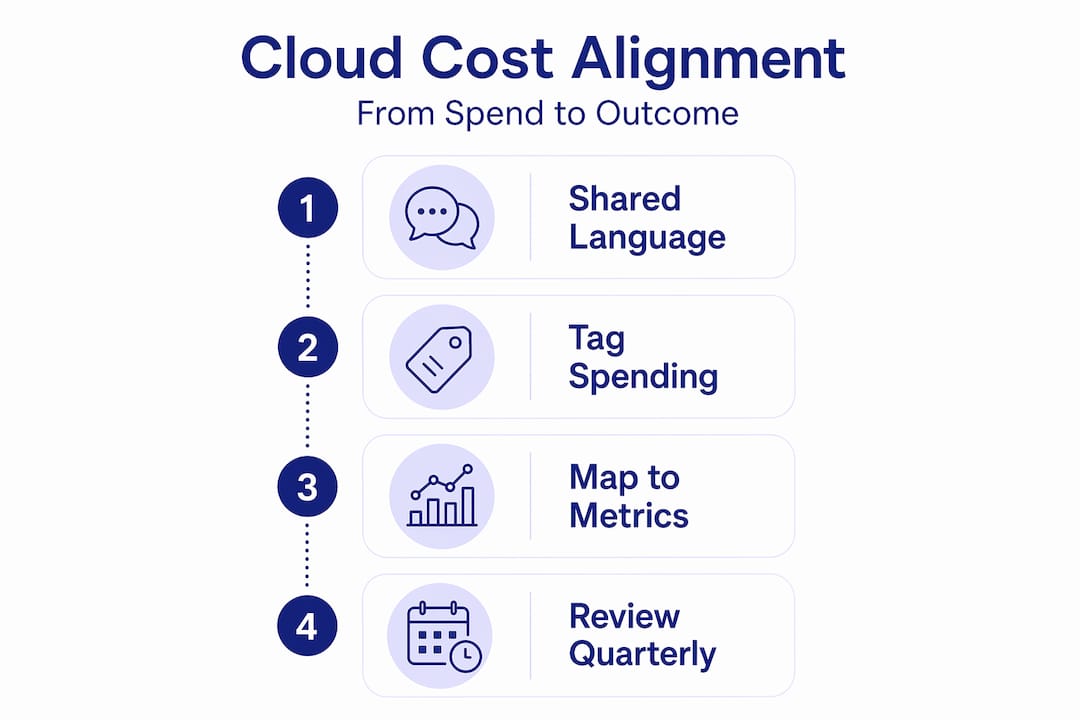
The starting point is a shared language between finance and IT. Both teams must agree on what constitutes a meaningful business outcome, whether that is revenue per transaction, customer acquisition cost, gross margin by product line, or time to market for new features. Without that shared vocabulary, IT teams optimise for uptime and performance whilst finance teams chase budget variances. Neither conversation advances the business.
Alongside shared language, you need accurate cost allocation data. That means tagging cloud resources consistently, by product, team, environment, and business unit, so that operational hygiene tasks like correctly labelled resources actually surface where money is going. Untagged resources are invisible in any allocation model, and invisible spend cannot be governed.
Three other foundations matter before you begin:
- Executive sponsorship: Cloud financial planning cannot be owned solely by IT. Finance leadership must have visibility into cloud billing data and a seat in governance decisions.
- Billing transparency: Obtain detailed cost and usage reports, not just summary invoices. You need granular data to correlate spend with workloads and outcomes.
- Understanding of commitment models: Know your baseline usage patterns well enough to consider reserved instances, savings plans, or flexible commitment structures. Insured flex commitments can deliver 30 to 60% discounts with cashback on unused capacity, but only if you understand your usage well enough to commit confidently.
Pro Tip: Start a simple tagging audit before anything else. Pull your last three months of cloud spend and calculate what percentage is allocated to an identifiable business unit or product. If that figure is below 80%, fixing tagging alone will transform your financial planning visibility.
How to map cloud spend to specific goals
With the foundations in place, the next task is building the explicit connection between cloud expenditure and organisational targets. This is where cloud financial planning moves from theory to practise.
Follow this process in sequence:
- Define business outcomes in measurable terms. Do not start with technology. Start with the question: what does success look like for this part of the business? Examples include reducing customer churn by 15%, processing 20% more transactions at the same margin, or launching a new product in a given market by a specific date.
- Translate outcomes into technical capabilities. Work with engineering and product teams to identify which cloud workloads and services directly enable each outcome. A product team trying to improve checkout conversion rate needs fast, reliable compute. A data team improving pricing decisions needs cost-effective analytics infrastructure. Each outcome maps to a set of cloud resources.
- Apply a cost allocation framework. Group and tag resources by the business function or product they serve. Use a structure that mirrors your P&L, not your AWS account hierarchy. Linking spending to features and business units is far more useful to a finance executive than a breakdown by EC2 instance type.
- Build dashboards that surface cost versus outcome together. Do not show cloud spend in isolation. Show it alongside the business performance metrics it supports. If your logistics platform costs £80,000 per month to run and processes 4 million deliveries, your cost per delivery is the metric that matters.
- Run regular cross-functional reviews. Finance, IT, and business unit leaders should review these dashboards together on a monthly cadence. Decisions about scaling up or cutting back should be made with both cost and business impact on the table.
The table below illustrates how this mapping works in practise across different business functions:
| Business outcome | Related cloud workload | Cost allocation tag | Key metric |
|---|---|---|---|
| Reduce checkout latency | API gateway, compute clusters | Product: checkout | Cost per 1,000 transactions |
| Improve data science productivity | Analytics and ML pipelines | Team: data science | Cost per model trained |
| Support customer growth | CRM integration, databases | Product: customer platform | Cost per active customer |
| Accelerate release velocity | CI/CD pipelines, test environments | Team: engineering | Cost per deployment |
Success metrics must be defined in business terms before technical decisions are made. Teams that measure model accuracy or uptime as proxies for business value are measuring the wrong thing.

Execution tactics that preserve performance
Understanding the framework is one thing. Acting on it is another. 70% of digital transformation projects fail due to misalignment between planning and business strategy, and cloud cost programmes are no different. The execution phase is where most organisations lose ground.
Start with operational hygiene. It is unglamorous work, but it delivers. One company cut its AWS bill by 60% through configuration fixes and commitment discounts alone, without any architectural changes. EC2 costs fell 57%, RDS by 42%, and data transfer by 58%. The savings were not in exotic engineering. They were in tagging, rightsizing, and correcting reserved instance usage.
Key execution priorities include:
- Rightsize resources continuously. Oversized instances are the most common source of waste. Match instance types to actual workload requirements, not to what was provisioned two years ago.
- Audit data transfer costs. Zero egress fee strategies are worth examining here. Data transfer between availability zones and to the internet is frequently one of the most overlooked cost drivers.
- Retire legacy infrastructure. Every organisation running cloud has forgotten workloads. Dev environments left running, test databases that never get switched off, and old snapshots accumulate quietly. These are pure waste with no associated business outcome.
- Adopt commitment discounts at the right time. Once you understand your baseline usage, reserved instances and savings plans deliver material savings with manageable risk.
The most overlooked execution problem, however, is the gap between knowing what to do and actually doing it. Delays between recommendations and purchase decisions cost tens of thousands of pounds on multi-million-pound cloud bills. Reducing the time between a cost recommendation and its implementation, from weeks to hours, is itself a major source of savings.
Pro Tip: Automate commitment purchases wherever your provider allows it. Manual approval workflows introduce delays that add up to significant unnecessary on-demand spend across a year.
The table below compares reactive and proactive approaches to optimising cloud expenditures:
| Approach | How it works | Typical outcome |
|---|---|---|
| Reactive cost reviews | Monthly or quarterly audits after bills arrive | Savings identified late, often not acted on |
| Proactive hygiene plus commitments | Continuous tagging, rightsizing, and commitment management | 40 to 60% cost reduction with no performance impact |
| AI-driven continuous monitoring | Automated analysis with fast execution cycles | Maximum savings realisation with minimal manual effort |
Sustaining alignment over time
Getting costs aligned to business outcomes once is not the goal. Sustaining that alignment as your business evolves is. Cloud environments change constantly. New services get provisioned, teams change priorities, and business objectives shift. Without a governance structure that keeps pace, costs drift and the alignment you built erodes.
Here is a practical approach to maintaining it:
- Establish shared KPIs between finance, IT, and business units. These should be reviewed and updated at each budget planning cycle. Business outcome alignment is an ongoing structural discipline, not a one-time project.
- Integrate cloud cost reviews into business performance reviews. Cloud spending should appear alongside revenue, margin, and customer metrics in regular business reviews. Not in a separate IT meeting.
- Set cost-per-outcome thresholds. Define what acceptable cloud cost looks like for each product or service. If cost per transaction rises above a threshold without a corresponding improvement in business performance, that triggers an investigation.
- Use AI-driven platforms to maintain continuous visibility. Leaders who focus on labour cost savings miss broader value that shows first in performance and decision improvements. Automation and AI tools that continuously analyse cloud spending keep you responsive without requiring manual effort at every cycle.
- Build accountability into team culture. Every cloud resource should have an owner who can answer the question: what business outcome does this serve? If no one can answer that question, the resource is a candidate for termination.
Pro Tip: At each quarterly business review, ask every team lead to justify their top three cloud cost lines in business outcome terms. You will find waste immediately, and you will change how engineers think about the infrastructure they provision.
My perspective: this is a process problem, not a technical one
I have seen organisations spend months on cloud cost optimisation programmes that produce detailed reports, long lists of recommendations, and very little actual change. The reason is almost always the same. They treat it as a technical problem.
The engineers know what needs fixing. The tools surface the inefficiencies clearly enough. What breaks down is the process around acting on that information. Finance and IT sit in separate rooms, measure success in different languages, and report to different executives. Cloud costs are reviewed in arrears, not in time to change anything.
What I have found actually works is starting with the business outcome conversation before touching a single cost report. When a CFO and a VP of Engineering agree on what success looks like for a given product, the cloud cost discussion becomes concrete and shared. Suddenly, rightsizing a database is not an IT task. It is a margin improvement decision.
The other uncomfortable truth is that most organisations are not short of cost-saving recommendations. They are short of the organisational velocity to act on them. Closing the execution gap, the time between identifying a saving and implementing it, is where the real money is. That requires process changes, governance structures, and sometimes external pressure to make happen.
If you are a finance executive reading this, your job is not to understand the technical details of reserved instances. Your job is to create the conditions where the right people act quickly on the right information. That is a leadership and process challenge. The technology to support it already exists.
How Koritsu helps you close the gap
Most cloud cost programmes stall because the gap between analysis and action is too wide. Koritsu exists to close that gap. The Koritsu AI platform continuously analyses your cloud spending across AWS, Azure, and Google Cloud, surfacing inefficiencies in the places most tools miss: how your software and infrastructure were built, not just what commitment tier you are on. One UK bidding platform achieved a 52% reduction in cloud costs by working with Koritsu, without compromising on performance or delivery timelines. Koritsu's model is straightforward: a free assessment to start, then payment only on savings delivered. If you are ready to see where your cloud budget is going and what it is actually returning, start your free assessment today.
FAQ
What does it mean to align cloud costs with business outcomes?
It means connecting every significant cloud expenditure to a measurable business result, such as revenue, customer acquisition cost, or delivery margin, so that spending decisions are evaluated by the business value they generate rather than the compute resources they consume.
Why do most cloud cost programmes fail to deliver lasting results?
Only 22% of organisations have a formal process for mapping IT spend to business outcomes. Without shared KPIs between finance and IT, recommendations rarely translate into action and costs drift back within months.
How quickly can cloud costs be reduced without harming business performance?
Significant reductions are achievable faster than most executives expect. One organisation reduced its AWS bill by 60% through configuration and commitment changes alone, with no architectural rework required.
What metrics should we use to measure cloud ROI?
Start with business performance metrics tied to each workload: cost per transaction, cost per active customer, or cost per deployment. Measuring cloud ROI purely in uptime or system performance misses what the board actually cares about.
How often should we review cloud costs against business outcomes?
Monthly reviews at the workload level, combined with quarterly integration into wider business performance reviews, create the cadence needed to keep cloud financial planning aligned with evolving business priorities.