FinOps Inform · Cost Optimisation
How to reduce cloud infrastructure costs in 2026
Discover how to reduce cloud infrastructure costs in 2026 with visibility, right-sizing, automated storage, and governance that make savings sustainable.

Cloud bills rarely spiral because of one reckless decision. They grow steadily, quarter by quarter, driven by provisioning habits, missing ownership, and architecture choices that made sense at launch but were never revisited. If you are an IT manager or financial decision-maker watching your AWS, Azure, or Google Cloud spend climb without a clear explanation, you are not alone. The good news is that the path to meaningfully reduce cloud infrastructure costs is well understood. The techniques are proven. What most organisations lack is a structured approach to apply them consistently.
Key takeaways
| Point | Details |
|---|---|
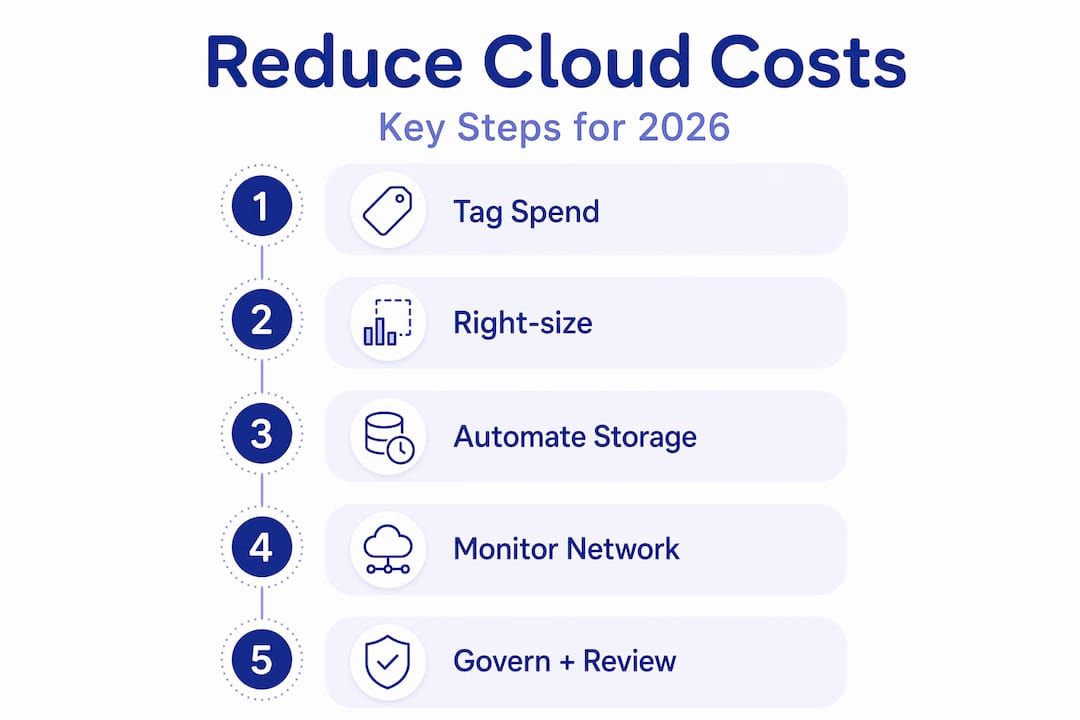
| Visibility comes first | Achieve at least 90% cost allocation through tagging before attempting any optimisation work. |
| Right-size before committing | Analyse actual utilisation and resize resources before purchasing Reserved Instances or Savings Plans. |
| Automate storage lifecycle | Use automated tiering and Terraform-enforced policies to cut storage costs without ongoing manual effort. |
| Governance sustains savings | Embed cost ownership into CI/CD pipelines and team KPIs to prevent costs from drifting upward again. |
| Unit economics guide decisions | Measure cost per user or per API request to connect engineering choices directly to financial outcomes. |
Reducing cloud infrastructure costs: start with visibility
You cannot optimise what you cannot see. This sounds obvious, yet it is the step most organisations skip or rush, and it is the reason so many cost reduction efforts stall after the first month.
The FinOps operating model structures this work into three phases: Inform, Optimise, and Operate. The Inform phase is not a formality. It is where you establish the data foundation that makes every subsequent decision reliable. That means consolidating billing data across all cloud providers into a single source, normalising it, and then attributing every pound of spend to a team, product, or workload.
The practical mechanism for attribution is tagging. Without consistent tags, cost data becomes an undifferentiated mass that nobody owns and nobody acts on. The target is allocating 90% or more of your total spend to named owners. Anything below that threshold means significant portions of your bill are invisible to the people responsible for them.
Here is what commonly blocks teams at this stage:
- Resources deployed without tags, particularly in early-stage or experimental environments that were never cleaned up
- Inconsistent tag naming conventions across teams, making aggregation unreliable
- Shared services and platform costs that require a sensible allocation model rather than direct tagging
- Missing ownership on 40% or more of resources, which paralyses any attempt to assign accountability
Pro Tip: Treat tagging and cost allocation as a prerequisite workstream, not a cleanup task. Assign it a dedicated owner and set a hard deadline. Every week without complete attribution is a week where optimisation decisions rest on incomplete data.
Once attribution is in place, anomaly detection becomes meaningful. Without it, you are sending alerts to nobody. With it, a sudden spike in data transfer costs lands in the right team's inbox within hours, not at the end of the month when the invoice arrives.
Right-sizing compute and commitment discounts
Compute typically represents the largest single line item on any cloud bill. It is also where the most significant savings live, and where the most expensive mistakes get made.
The most common mistake is purchasing commitment discounts before rightsizing. Over-committing to Reserved Instances without first analysing actual utilisation locks in waste for one or three years. You pay for capacity you do not use at a discounted rate, which feels efficient until you realise the discount is on wasted spend.
Rightsizing means examining actual CPU, memory, and network utilisation over a meaningful period, typically 30 to 90 days, and selecting the instance type that matches real demand rather than anticipated peak load. Most teams overprovision by a significant margin at launch and never revisit those choices.

| Commitment type | Best suited for | Flexibility | Max saving |
|---|---|---|---|
| AWS Compute Savings Plans | Stable workloads across EC2, Lambda, Fargate | High (cross-instance family) | Up to 66% |
| AWS Reserved Instances | Predictable single-instance workloads | Low (instance-specific) | Up to 72% |
| On-Demand | Variable or short-lived workloads | Full | None |
| Spot Instances | Fault-tolerant dev/test or batch jobs | None (interruptible) | Up to 90% |
AWS Savings Plans can reduce costs by up to 66% off On-Demand pricing when applied to correctly sized workloads. A real-world example bears this out: one engineering team reduced a $50k monthly AWS bill to $20k within a few weeks by combining rightsizing with commitment discounts, achieving reductions of 57% on EC2, 42% on RDS, and 58% on data transfer.
Commitment models also require periodic reassessment. After changes in architecture or the introduction of autoscaling, your baseline usage profile changes. Commitments purchased against a previous architecture can quickly become misfits. Build a quarterly review of utilisation coverage into your operating rhythm.
Pro Tip: Use Spot Instances for development, testing, and any batch processing workloads that can tolerate interruption. The cost savings are substantial, and the discipline of building interruption-tolerant workloads pays dividends in resilience as well.
Automated storage optimisation and lifecycle management
Storage costs accumulate quietly. They rarely trigger the same alarm as a runaway EC2 instance, but across a large environment they add up to a meaningful portion of the bill. The good news is that storage is one of the most automatable cost categories.
Here is a practical approach to reduce storage costs across cloud applications:
- Audit unattached volumes. EBS volumes that are no longer attached to instances continue to incur charges. Run a monthly automated scan to identify and delete them after appropriate approval workflows.
- Implement lifecycle policies. Set expiration and transition rules on object storage buckets. Data that has not been accessed in 90 days rarely needs to live in a hot tier.
- Use automated tiering where available. Azure's smart tier automatically moves objects across hot, cool, and cold tiers based on actual access patterns. Objects transition to cool after 30 days of inactivity and to cold after 90, then promote instantly when accessed again. This eliminates the need for manually maintained lifecycle rules that inevitably go stale.
- Enforce storage class selection via infrastructure-as-code. Terraform-based policies can codify storage class choices at provisioning time, quarterly trigger reviews of storage class assignments, and automate cleanup of orphaned resources. Without code enforcement, storage decisions drift based on whoever provisions next.
- Set cost alerts on storage buckets. Unusual growth in a bucket, particularly one associated with logging or backups, can silently double storage costs in a matter of weeks.
| Storage optimisation action | Effort to implement | Estimated impact |
|---|---|---|
| Delete unattached EBS volumes | Low | Immediate cost removal |
| Enable S3 lifecycle transitions | Low | 30 to 70% reduction on cold data |
| Implement Azure smart tier | Very low | Continuous automated savings |
| Enforce Terraform storage policies | Medium | Prevents future drift and overspend |
| Set bucket-level cost alerts | Low | Early detection of anomalies |
Automated classification and transition is genuinely the key insight here. Manually maintained lifecycle rules degrade over time as data usage patterns change and the engineers who wrote them move on. Automation removes that dependency entirely.
Network costs and idle resources
Data transfer fees are the hidden tax on cloud architectures. They do not appear in the same line as your compute or storage, they accumulate in ways that are difficult to predict, and they are frequently the last place anyone looks when trying to cut cloud service expenses.
The most impactful actions in this category are:
- Eliminate unnecessary cross-region transfers. Data moving between AWS regions or from cloud to on-premises incurs egress charges that compound at scale. Audit your architecture for transfers that could be eliminated by co-locating services or replicating data closer to consumers.
- Deploy CDN caching for repeated external traffic. Static assets, API responses that do not change frequently, and media files should be served from a CDN rather than repeatedly egressing from origin infrastructure. The cost difference on high-traffic workloads is substantial.
- Identify and decommission idle resources. Load balancers with no registered targets, NAT gateways in unused VPCs, and IP addresses that are allocated but unattached all cost money every hour. A focused idle resource sweep typically finds more waste than teams expect. One case study at Koritsu AI found that a backup configuration issue was responsible for 15% of an Azure bill.
- Enforce policy guardrails against misconfiguration. Services deployed without VPC endpoints force traffic through public internet paths, incurring egress fees that a private endpoint would eliminate entirely. Policy-as-code can block these configurations before they reach production.
- Review third-party SaaS integrations. Data pushed from cloud infrastructure to external analytics, monitoring, or logging platforms generates egress charges that are easy to overlook. Audit the volume and frequency of these transfers regularly.
The pattern here is consistent. Network costs are a process problem as much as a technical one. The architecture choices that created them were made under different constraints and were never reviewed. Scheduled reviews, combined with policy enforcement, are what keep them from accumulating.
Governance, tooling, and cost culture
Technical fixes deliver one-time savings. Governance is what prevents costs from drifting back up six months later. This is the part of cloud cost management that most organisations underinvest in, and it is why so many cost reduction projects show impressive results at first review and then quietly reverse.
FinOps as a cultural and operational framework turns cost management from a periodic finance exercise into a continuous engineering control loop. The practical mechanics include automated tagging enforcement in CI/CD pipelines, shared cost KPIs across engineering and finance teams, and anomaly alerts routed to the teams that own the resources generating the cost.
Unit economics metrics are particularly effective at connecting engineering decisions to financial outcomes. Measuring cost per active user, cost per API request, or cost per feature deployed creates accountability that aggregate bill reviews do not. When an engineer can see that a new feature costs three times as much per request as the one it replaced, they make different architectural choices.
Forecasting and anomaly detection complete the picture. Without forecasting, budget conversations happen after the fact. Without anomaly detection, surprise bills arrive at month end when the damage is already done. Koritsu AI's approach to avoiding surprise bills through continuous anomaly detection is one of the most direct ways to protect budget predictability.
Pro Tip: Tie cost KPIs to deployment frequency and feature output, not just to absolute spend. A team that deploys twice as often while holding costs flat is performing well. A team that reduces spend by cutting delivery is not. Context matters.
My honest take on why cost reduction efforts fail
I have seen a lot of organisations attempt to reduce cloud spending and produce disappointing results. The technical interventions are rarely the problem. Rightsizing, commitment discounts, storage tiering, all of these work. The failure is almost always in the setup that precedes them.
Teams buy Savings Plans before they have rightsized. They set up cost dashboards that nobody owns. They run a cleanup sprint, reduce the bill by 15%, and declare victory. Then architecture decisions made over the following two quarters quietly undo the savings without anyone noticing because the tagging is incomplete and nobody is watching.
What I have found actually works is treating FinOps as a process redesign, not a tooling exercise. The tools matter, but they are downstream of ownership. Until an engineer can point to a line in the bill and say "that is mine, and I know what changed," you do not have a cost management programme. You have a cost monitoring programme. Those are very different things.
The other lesson: automation is not optional at scale. Manual lifecycle tuning, manual tag audits, manual cleanup sprints. These degrade. The teams who sustain savings over years are the ones who encode cost behaviour into their deployment pipelines and infrastructure code, so that good defaults are the path of least resistance.
How Koritsu AI can help
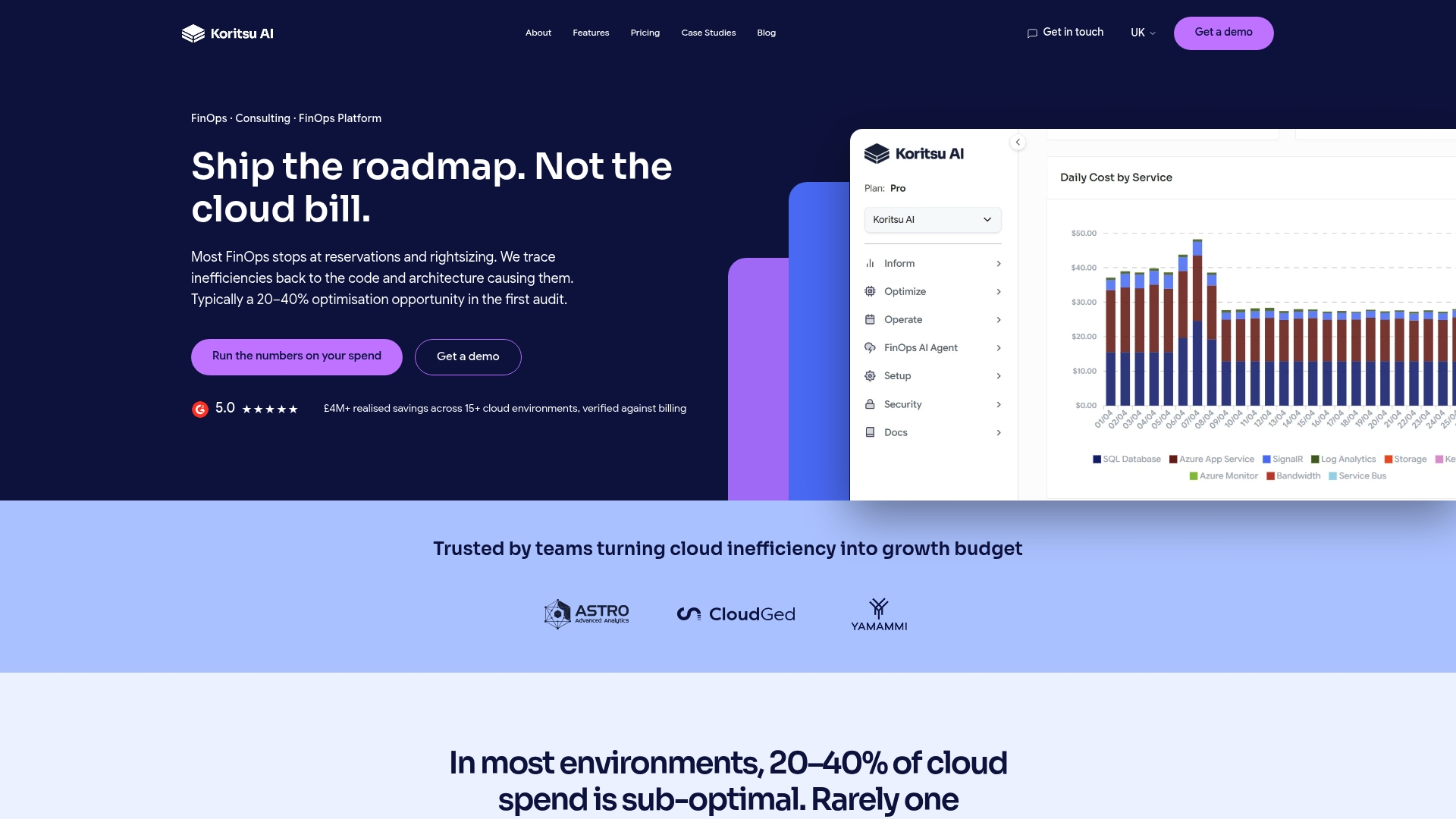
If the gap between knowing what to do and actually doing it consistently sounds familiar, that is exactly the problem Koritsu AI was built to close. Koritsu AI combines a continuous AI analysis platform with hands-on specialist support to find and fix the inefficiencies buried in how your infrastructure was built. Kori, our AI agent, surfaces where money is being lost across AWS, Azure, and Google Cloud. Our specialists help engineering teams act on those findings in a way that sticks. A UK bidding platform achieved a 52% cost reduction using Koritsu's platform, without a wholesale architecture rebuild. We only charge when we deliver. You start with a free assessment, and we take a share of the savings we actually find.
Start with a free assessmentFAQ
What does FinOps mean in practice for IT teams?
FinOps is an operating model that structures cloud cost management into three phases: Inform, Optimise, and Operate. In practice, it means establishing ownership, tagging, and visibility before attempting any cost reduction work.
Should I buy Reserved Instances before or after rightsizing?
Always rightsize first. Purchasing commitments before rightsizing locks in waste at a discounted rate, which reduces your bill but does not eliminate the underlying inefficiency.
How much can rightsizing and commitment discounts realistically save?
Real-world results vary, but one documented case study shows a 60% reduction on a $50k monthly bill achieved within weeks through combined rightsizing and commitment discounts across EC2, RDS, and data transfer.
What is the fastest way to reduce storage costs?
Deleting unattached volumes and enabling automated lifecycle transitions on object storage deliver immediate results with minimal effort. Azure's smart tier automated tiering is particularly low-effort and continuously optimises costs without manual intervention.
Why do cloud cost savings often reverse after the initial effort?
Savings reverse when the underlying governance is absent. Without tagging, ownership, anomaly detection, and cost controls embedded in deployment pipelines, new spend accumulates unchecked. Treating cost management as a continuous operating practice rather than a one-off project is what sustains results.