FinOps Inform · Cost Optimisation
Platform engineering's role in cost: 2026 CTO guide
Discover the role of platform engineering in cost management. Learn how it can cut expenses, boost ROI, and transform your budget strategy.

Platform engineering is defined as the practice of building and maintaining internal developer platforms that embed cost governance, automation, and infrastructure controls directly into engineering workflows. The role of platform engineering in cost management has shifted from a technical nicety to a financial imperative. Mature platform teams reduce cloud and operational costs by 20–30% and deliver 224% ROI with a six-month payback period. That is not a marginal improvement. It is a structural change in how your organisation spends on infrastructure. This guide covers the mechanisms, the data, and the trade-offs you need to understand before your next budget conversation.
How does platform engineering embed cost awareness into developer workflows?
Cost-aware platform engineering is not about restricting developers. It is about making the cost-efficient path the easiest path. Platform teams act as cost enablers by embedding FinOps guardrails directly into the tools developers already use, rather than adding a separate approval layer that slows delivery.
The mechanisms that drive this are specific and repeatable:
- FinOps guardrails in CI/CD pipelines. Cost policies are enforced at deployment time, not discovered weeks later in a billing report. Embedding FinOps guardrails within automated pipelines allows cost optimisation to occur at the point of deployment, removing manual bottlenecks entirely.
- Self-service provisioning with cost limits. Developers request infrastructure through internal platforms like Backstage or custom portals. Each request carries pre-set cost thresholds and approval workflows for anything that exceeds them.
- Automated resource optimisation. Cloud cost optimisation practices including automated rightsizing, spot instance utilisation, and idle resource termination reduce waste without requiring manual intervention from individual engineers.
- Real-time cost dashboards. Tools like Kubecost, OpenCost, and AWS Cost Explorer, when surfaced inside developer portals, give engineers immediate feedback on the cost implications of their configuration choices.
The cultural shift here is significant. When a developer can see that their staging environment is costing £800 per month and a configuration change would halve that, they act. Cost becomes a quality signal, not a finance department concern. You can read more about this framing in Koritsu AI's breakdown of what FinOps actually means in practice.
Pro Tip: Frame cost visibility as a feature of your internal developer platform, not a constraint. Engineers who can see the cost of their choices in real time make better decisions without needing to be told to.
What measurable ROI do mature platform teams deliver?
The financial case for platform engineering is well-evidenced. 224% ROI with a six-month payback period is the headline figure from mature implementations. The detail behind that number matters as much as the number itself.
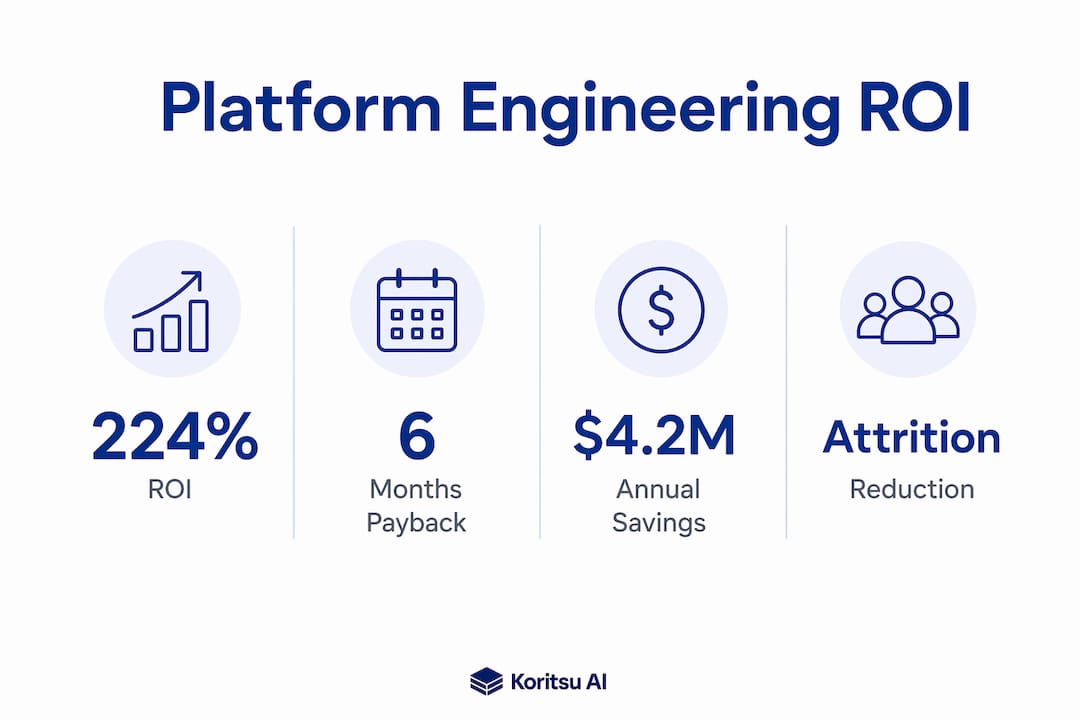
Organisations with well-structured platform teams report saving approximately $4.2 million per year in combined cloud and operational costs, alongside recovering around 12,000 engineering hours annually that were previously lost to manual infrastructure tasks. Those hours translate directly into delivery capacity. Faster delivery means faster revenue, and that is the argument that lands with a CFO.
The build-versus-buy decision also carries significant financial weight. Consider the comparison below:
| Cost Category | DIY Platform Build | Managed SaaS Platform |
|---|---|---|
| First-year total cost | $380,000–$650,000 | ~$84,000 annually |
| Engineering headcount | 3–6 engineers | Minimal internal resource |
| Time to value | 12–18 months | Weeks |
| Ongoing maintenance | High | Handled by vendor |
The DIY route is not inherently wrong, but the cost structure demands honest accounting. Many organisations underestimate the ongoing maintenance burden and the opportunity cost of engineers building internal tooling rather than shipping product.
Platform engineering also reduces attrition-related costs by improving the developer experience. Replacing a senior engineer costs between 50% and 200% of their annual salary. A platform that removes toil and frustration pays for itself in retention alone, before you count a single pound of cloud savings.
Pro Tip: When building the business case for your platform team, include attrition cost avoidance as a line item. It is often larger than the cloud savings figure and resonates immediately with finance leaders.
For more detailed cloud infrastructure ROI examples, Koritsu AI has compiled case data specifically for engineering leaders making this argument internally.
How do platform teams use kubernetes-native visibility to control spend?
Kubernetes-native cost visibility is the practice of attributing cloud spend down to the pod, namespace, and workload level, then linking that spend to the team or service that owns it. This is where the role of platform teams in cost awareness becomes genuinely operational rather than theoretical.

Without this granularity, shared platform costs become a black box. Finance sees a large AWS or Google Cloud bill. Engineering sees a complex cluster. Neither side can act with confidence. Effective cost allocation links spend to workload ownership, scaling policies, and deployment behaviour to produce signals that are useful in sprint planning, not just quarterly reviews.
Mature cost allocation programmes share four characteristics:
- Ownership is assigned at the namespace or label level, so every workload has an accountable team.
- Scaling policies are reviewed alongside cost data, so teams understand the financial consequence of their autoscaling configuration.
- Cost signals appear in the same tools engineers use for planning, such as Jira or Linear, rather than in a separate FinOps portal that nobody opens.
- Anomaly detection is automated, so a cost spike triggers an alert before it compounds across a billing cycle.
The challenge with shared platform infrastructure is attribution. A service mesh, a logging stack, or a shared ingress controller benefits multiple teams but is owned by none. Platform teams must define a fair allocation model, whether proportional by usage, flat rate per team, or weighted by workload criticality. There is no universally correct answer, but the absence of any model is always the wrong answer.
Linking cost allocation directly to workload ownership enables engineering teams to incorporate financial considerations into sprint planning effectively. That is the practical definition of cost optimisation through platform engineering: financial data flowing into technical decisions at the right moment.
Pro Tip: Align your cloud spend reporting cadence with your sprint cycle. Weekly cost data reviewed in sprint retrospectives creates a feedback loop that monthly billing reports never can.
You can explore specific techniques for tracking cost per feature in Koritsu AI's guide for engineering teams.
What are the risks in cost-aware platform engineering?
The impact of platform engineering on expenses is real, but the risks of poorly implemented cost governance are equally real. The most significant risk is architectural fragility. When cost governance dominates decision-making, architectural resilience may degrade. A team that eliminates redundancy to save money may find that redundancy was load-bearing.
The risks worth managing actively are:
- Reliability trade-offs. Removing multi-region failover or reducing replica counts to cut costs can create single points of failure. Cost awareness must sit alongside reliability targets, not above them.
- Developer autonomy erosion. Cost policing, where every infrastructure request requires finance approval, kills velocity. The goal is guardrails, not gates.
- Measurement gaps. 30% of organisations still lack clear metrics for platform ROI, which leaves platform teams vulnerable to budget cuts when CFOs demand quantifiable business impact. This figure has improved from 45% in 2024, but the gap remains material.
- Misaligned incentives. If platform teams are measured only on cost reduction, they will optimise for cost at the expense of developer experience. Measure platform impact across cost, delivery speed, incident frequency, and engineer satisfaction simultaneously.
The solution is to treat cost awareness as a first-class citizen in platform design, not the only citizen. Platform investment should be framed to CFOs by business impact metrics like attrition reduction and accelerated delivery, rather than technical KPIs alone. That framing protects the platform team's budget and keeps the incentive structure healthy.
Cost-effective platform engineering practices require this balance. The organisations that get it right are the ones where the platform team has a seat at the architecture review table, not just the finance review.
Key takeaways
Platform engineering delivers measurable cost reduction when cost governance, Kubernetes-native visibility, and FinOps automation are embedded directly into developer workflows rather than managed as separate processes.
| Point | Details |
|---|---|
| Proven ROI exists | Mature platform teams deliver 224% ROI with a six-month payback period. |
| Cost awareness belongs in workflows | FinOps guardrails in CI/CD pipelines make cost-efficient choices the default, not the exception. |
| Allocation granularity matters | Kubernetes-native cost tracking at pod and namespace level connects spend to accountable teams. |
| Reliability must not be sacrificed | Cost governance that overrides architectural resilience creates fragility; balance both explicitly. |
| Measure beyond cloud savings | Include attrition reduction and delivery acceleration when making the business case to finance. |
What I have learned from watching platform teams get this wrong
The most common mistake I see is treating cost reduction as the primary output of a platform team. It is not. Cost reduction is a consequence of building a well-governed, well-instrumented platform. Teams that chase the cost number directly tend to make decisions that look good in a billing dashboard and terrible six months later when an incident exposes the resilience they quietly removed.
The second mistake is the communication gap between engineering and finance. Platform teams speak in infrastructure terms. CFOs speak in business terms. The translation layer is missing in most organisations. Framing platform engineering ROI in terms of attrition avoided, features shipped faster, and incidents resolved more quickly lands far better than a chart showing reduced EC2 spend.
What actually works is embedding cost as a cultural norm rather than a compliance requirement. When engineers see cost data in the same tools they use for performance and reliability, they start treating it the same way. They investigate spikes. They right-size proactively. They ask whether a new service needs to be always-on or whether it can be event-driven. That behaviour change is worth more than any automated rightsizing tool.
The organisations I have seen get this right share one trait: their platform team has a clear mandate that includes both developer experience and financial efficiency. Neither is subordinate to the other. That balance is harder to maintain than it sounds, but it is the only configuration that produces durable results.
— Kori
How Koritsu AI supports cost-conscious platform engineering
Koritsu AI combines a continuously running AI platform with hands-on expert advice to surface where cloud spend is being lost and help your engineering team act on it. The AI agent, Kori, analyses your AWS, Google Cloud, or Azure environment and identifies inefficiencies buried in how your infrastructure was built, not just in your discount coverage. Clients start with a free assessment, and Koritsu AI only charges when savings are found. The UK bidding platform case study demonstrates over 52% cloud cost reduction through this approach. If you want to see what is possible in your environment, start your free assessment today.
Start with a free assessmentFAQ
What is the role of platform engineering in cost management?
Platform engineering reduces cloud and operational costs by embedding FinOps guardrails, automated rightsizing, and real-time cost visibility directly into developer workflows. Mature platform teams achieve 20–30% cost reduction and 224% ROI with a six-month payback period.
How do platform teams make developers cost-aware?
Platform teams surface cost data inside the tools developers already use, such as CI/CD pipelines and internal portals, so engineers see the financial impact of their configuration choices at the point of deployment rather than in a monthly billing report.
What is kubernetes-native cost visibility?
Kubernetes-native cost visibility is the attribution of cloud spend down to the pod, namespace, and workload level, linking each cost to the team that owns it. Tools like Kubecost and OpenCost enable this granularity and feed cost signals into sprint planning.
What are the risks of cost-focused platform governance?
The primary risk is architectural fragility: removing redundancy or reducing replicas to cut costs can create single points of failure. Cost governance must be balanced with reliability targets and developer autonomy to avoid suboptimal trade-offs.
How should CTOs justify platform engineering investment to a CFO?
Frame the business case around attrition reduction, delivery acceleration, and incident resolution speed rather than technical KPIs alone. Including avoided attrition costs, which can reach 200% of an engineer's salary per departure, typically produces a more compelling financial argument than cloud savings figures in isolation.