FinOps Inform · Cost Allocation
What is cloud cost by team? A 2026 guide
Discover what is cloud cost by team in our 2026 guide. Learn to manage budgets effectively and reduce waste in your organization.

Your monthly AWS or Azure invoice tells you what you spent. It does not tell you who spent it, why, or where the waste is. For IT finance managers and team leaders, understanding what is cloud cost by team is the difference between managing a budget and managing a bill. Organisations waste 30 to 40% of cloud spend on unused or underutilised resources, and most of that waste persists precisely because no specific team owns it. This guide explains how cloud cost attribution works, where most organisations go wrong, and what it takes to fix it.
Key takeaways
| Point | Details |
|---|---|
| Cost attribution requires tagging | Without mandatory resource tagging, cloud costs cannot be reliably assigned to teams or departments. |
| Showback before chargeback | Start with visibility dashboards before transferring financial responsibility to avoid friction. |
| Cost is an engineering problem | Embedding cost signals in developer workflows produces faster, more durable savings than monthly finance reports. |
| Automation closes execution gaps | Automated commitment purchasing and scheduled shutdowns remove the manual delays that allow waste to compound. |
| Measure and sustain | Establish KPIs, feedback loops, and regular reviews to maintain gains as cloud environments grow. |
What cloud cost by team really means
Cloud cost by team, sometimes called team cloud expenses breakdown or cloud cost attribution, refers to the practice of tracking and assigning cloud infrastructure spending to the specific teams or departments responsible for generating it. This is not a reporting exercise. It is an accountability framework.
In a typical cloud environment, every resource, whether a virtual machine, a database, a storage bucket, or a serverless function, belongs to someone. The challenge is that cloud providers do not automatically know which team provisioned which resource. That mapping has to be built deliberately, and it starts with resource tagging. Tags are metadata labels attached to cloud resources that identify the owning team, project, cost centre, environment (production or non-production), and sometimes the individual engineer.
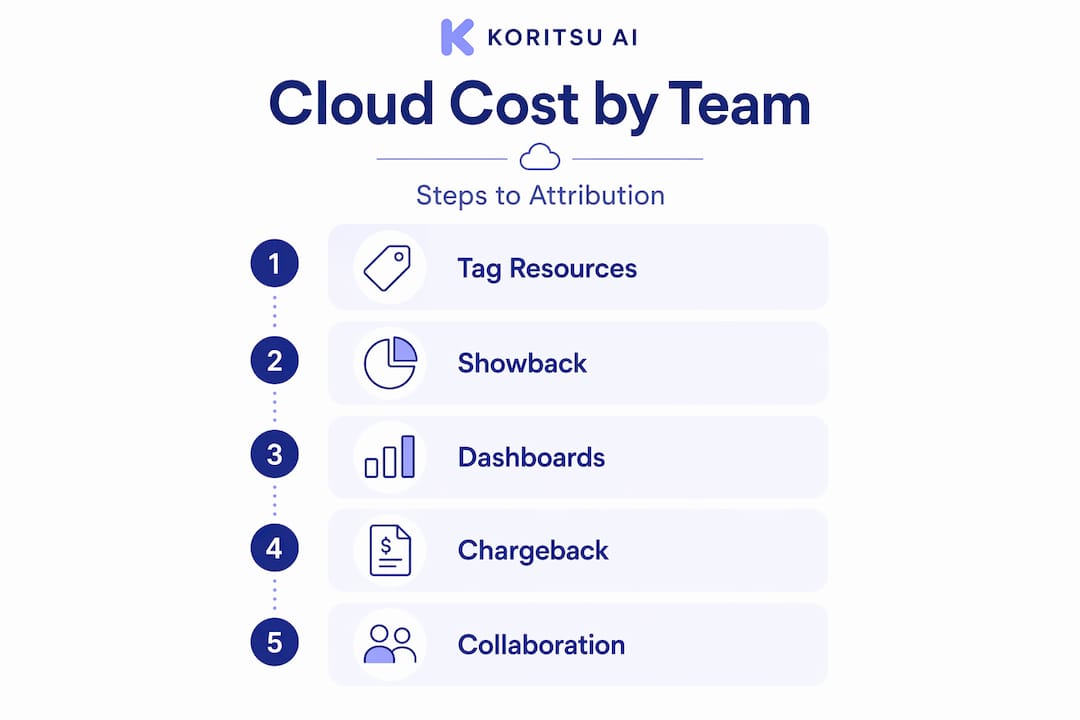
Showback dashboards and mandatory tagging form the foundation of cost attribution, giving teams visibility into what they consume without ambiguity. Once tagging is in place and consistently enforced, you can move to two models of financial accountability:
- Showback: Each team sees a report of what they spent, but the costs remain in a central budget. There is no financial penalty. The goal is building cost literacy.
- Chargeback: Costs are actually transferred to team or departmental budgets. Teams bear direct financial responsibility for their cloud consumption.
Showback should precede chargeback to build cost literacy without creating friction. Jumping straight to chargeback before teams understand their spend tends to generate resentment rather than responsibility. The path from chaos to accountability is gradual and deliberate.
Pro Tip: When designing your tagging taxonomy, include a mandatory "team" tag and an "environment" tag from day one. These two alone unlock the majority of cost attribution analysis.
Common pitfalls in cloud cost attribution
Most organisations are further from functional cloud cost attribution than they realise. The problems are predictable and deeply familiar to anyone who has tried to do a genuine team cloud expenses breakdown.
The most damaging issue is inconsistent or missing tagging. A single forgotten database can cost £600 to £2,400 per month sitting unnoticed in a shared account, attributed to no team and scrutinised by no one. Multiply that across dozens of services and the untracked spend accumulates quickly. Without automated tag enforcement, this is the rule rather than the exception.
The second major problem is the disconnect between finance reporting cycles and engineering decision-making. Finance teams typically produce cloud spending analysis monthly. Engineers make infrastructure decisions daily. By the time a finance report surfaces an anomaly, the code that caused it has been in production for three weeks.
"Many organisations treat cloud cost as a static monthly report rather than a dynamic engineering problem." Without embedding cost management in the software delivery lifecycle, meaningful control is impossible.
Other common pitfalls include:
- Overprovisioning at team level, where teams request more capacity than workloads require because there is no personal cost consequence
- Stale non-production environments left running over weekends and holidays, consuming budget for zero business value
- Fragmented ownership, particularly in organisations where platform teams provision shared infrastructure that multiple product teams consume
- Manual commitment purchasing, which creates an execution gap between when savings opportunities are identified and when they are acted upon
The fragmented ownership problem is especially persistent. When three teams share a Kubernetes cluster and the bill arrives, calculating team cloud budget fairly becomes a negotiation rather than a measurement.
Best practices for optimising cloud costs by team
Getting this right requires a combination of technical controls, process design, and cultural change. Here is a practical sequence that works.
- Enforce tagging at provisioning time. Use infrastructure-as-code policies and cloud provider policy frameworks to block resource creation without required tags. This removes the option of skipping attribution at source.
- Build showback dashboards first. Give every team a live view of their cloud consumption before attaching financial consequences. This builds the cost awareness that makes chargeback discussions productive rather than adversarial.
- Embed cost gates in your CI/CD pipeline. Embedding cost estimation in CI/CD pipelines gives engineers real-time cost feedback before code is merged, changing behaviour at the point of decision rather than weeks later. A pull request that adds £3,000 per month to the infrastructure bill should surface that figure to the engineer before it is approved.
- Schedule automated shutdowns for non-production environments. Automating off-hour shutdowns saves roughly 57% of costs for those environments, equivalent to roughly $1,800 per month per environment. This is one of the highest-return actions available and requires no architectural changes.
- Rightsize compute resources continuously. Rightsizing involves matching instance sizes to actual workload, and the savings are substantial. Moving ten overprovisioned instances to appropriately sized ones can save approximately $14,000 per year. Teams typically overprovision because they set resources once and forget them.
- Automate commitment discount purchasing. Manual purchasing cycles for commitment discounts create an execution gap that automation closes through continuous, daily-refreshed recommendations. Reserved instances and savings plans need constant adjustment to match evolving workloads; manual quarterly reviews are structurally too slow.
Pro Tip: Do not try to implement all six steps at once. Tagging enforcement and showback dashboards in the first 30 days will deliver more clarity than six months of unfocused optimisation effort.
Tools and frameworks for team-level cost management

Choosing the right tools is less about vendor selection and more about matching capability to maturity. Here is a comparison of the main approaches:
| Approach | Best for | Key benefit | Limitation |
|---|---|---|---|
| Native cloud tools (AWS Cost Explorer, Azure Cost Management) | Teams starting out with cloud spending analysis | Free, integrated, no setup required | Limited cross-cloud visibility, basic anomaly detection |
| Third-party FinOps platforms | Organisations with multi-cloud or complex environments | Richer attribution, automated recommendations, anomaly alerts | Cost and integration effort |
| AI-driven optimisation platforms | Teams wanting continuous, automated savings discovery | Real-time analysis, automated commitment purchasing, engineering integration | Requires trust in automation and clear ownership |
| FinOps practice (cultural framework) | All organisations regardless of tooling | Unites finance, engineering, and operations around shared cost responsibility | Cultural change takes time and executive support |
The FinOps framework deserves particular attention because it addresses the structural cause of most cloud waste: responsibility fragmentation. FinOps does not replace tooling. It defines who is responsible for what and how teams collaborate on cloud spending analysis and optimisation. Without that cultural foundation, even the best tooling produces reports that nobody acts on.
Beyond tooling, the practical habits that sustain optimisation include:
- Weekly rather than monthly cost reviews at team level, reducing the lag between anomaly and action
- Anomaly detection alerts routed directly to team leads, not just to a central finance inbox
- Cost discussions as a standing agenda item in sprint planning and architecture reviews
- Shared optimising cloud costs by department dashboards visible to both engineering and finance
The cloud cost is fundamentally an engineering problem, and tooling should reflect that. The most effective platforms surface cost information where engineers already work, whether in pull request comments, deployment pipelines, or Slack notifications, rather than requiring them to log into a separate finance portal.
Measuring success and sustaining progress
Implementing cloud cost attribution is the beginning, not the end. The organisations that sustain savings are those that treat optimising cloud costs by department as an ongoing process rather than a one-time project.
The key metrics to track are:
- Tag coverage rate: The percentage of resources tagged correctly. Anything below 95% means your attribution data is unreliable.
- Cost per team, per environment: Track production and non-production separately. Non-production costs are almost entirely controllable.
- Unallocated spend percentage: The share of total cloud spend that cannot be attributed to a team. This should trend towards zero.
- Savings realised versus identified: Measures how effectively your teams execute on recommendations, not just how many they receive.
- Commitment coverage rate: The proportion of eligible spend covered by reserved instances or savings plans.
Feedback loops between teams and finance are as important as the metrics themselves. When a team lead sees their cloud spend drop after rightsizing a batch of instances, that feedback is what changes behaviour permanently. Without it, cost optimisation feels abstract and disconnected from day-to-day engineering work.
Cross-team collaboration between finance, engineering, operations, and product is what sustains progress. Quarterly reviews should include all four functions, not just a finance-to-engineering handover. As cloud environments grow, the complexity of calculating team cloud budget increases and automation becomes non-negotiable. Manual processes that work at £50,000 per month in cloud spend will break at £500,000.
My perspective on what most teams are still getting wrong
I have seen a lot of organisations go through cloud cost attribution projects, and the pattern is remarkably consistent. Teams invest heavily in tooling and produce beautiful dashboards, then nothing changes. The dashboards are right. The culture is wrong.
The fundamental misunderstanding is treating cloud cost as a finance problem. Finance can measure it. Finance cannot fix it. The fixes live in infrastructure code, in deployment configurations, in the architectural decisions engineers make every day. Until cost feedback is embedded in those workflows, you are asking engineers to care about a number they never see until it is too late to act on it.
What I have learned is that the fastest path to sustainable savings is making cost visible at the moment of decision. Cost gates in CI/CD pipelines do exactly this. When an engineer sees that their proposed change adds £2,000 per month before the pull request is merged, they have the context and the agency to do something about it. That is qualitatively different from receiving a finance report three weeks later.
The other thing most teams miss is that the greatest ROI comes from simple operational fixes, not complex pricing strategies. Idle resources, over-provisioned instances, and forgotten non-production environments account for the majority of waste. Organisations that spend months negotiating enterprise discount programmes while their non-production environments run 24/7 have their priorities inverted. Fix the obvious waste first. It is faster, cheaper to implement, and the savings are immediate.
Collaboration also matters more than most finance managers expect. I would encourage you to read about what FinOps actually requires before assuming your current process qualifies. The gap between what organisations call FinOps and what it actually demands is significant.
How Koritsu helps teams take control of cloud costs
If you have read this far, you understand what cloud cost by team requires. The harder question is execution. Tagging enforcement, showback dashboards, CI/CD cost gates, rightsizing, commitment automation: each is solvable in isolation, but maintaining all of them simultaneously while delivering product work is where most teams fall short.
Koritsu combines an AI platform with hands-on expert advice to identify and fix exactly this kind of structural waste. Kori, the AI agent, continuously analyses cloud spend and surfaces where money is being lost at team and resource level. Koritsu's specialists help engineering teams act on those findings. The results are concrete: one UK-based organisation achieved a 52% reduction in cloud costs through team-level attribution and automated optimisation. There is also a detailed case study showing how an Azure backup configuration change cut 15% from a £20,000 monthly bill. Koritsu charges only on savings delivered. You can start with a free cloud cost assessment and see exactly where your team-level waste is before committing to anything.
FAQ
What is cloud cost by team?
Cloud cost by team refers to the practice of tracking, attributing, and managing cloud infrastructure spend by the engineering or business team responsible for generating it. It requires resource tagging, showback or chargeback models, and ongoing visibility into team-level consumption.
How do you attribute cloud costs to specific teams?
Cloud cost attribution starts with mandatory resource tagging at provisioning time, assigning each resource to a team, project, and environment. Cloud provider tools and third-party platforms then aggregate tagged spend into per-team reports for cloud spending analysis.
What is the difference between showback and chargeback?
Showback provides teams with visibility into their cloud costs without transferring financial responsibility, while chargeback directly assigns those costs to team budgets. Showback should precede chargeback to build cost literacy and avoid friction.
How do you budget cloud costs by team?
Calculating team cloud budget accurately requires at least 90 days of attribution data from tagged resources, combined with workload growth projections and a clear view of committed spend versus on-demand. Finance and engineering should set budgets collaboratively, not in isolation.
Why do organisations waste so much on cloud?
The primary causes are poor tagging leading to untracked resources, overprovisioning because teams face no direct cost consequence, and stale non-production environments running continuously. Organisations waste 30 to 40% of cloud spend on these preventable inefficiencies.