FinOps Inform · Application Refactoring
Application refactoring cloud savings: a CTO's guide
Discover how to maximize application refactoring cloud savings. This CTO's guide reveals strategies to avoid budget surprises and achieve quick wins.

Application refactoring cloud savings are rarely as straightforward as they appear in vendor case studies. You refactor an application, expect the bill to drop, and instead watch costs climb for the next six months. The truth is that refactoring is one of several tools available to engineering leaders, and often not the first one worth reaching for. This guide is for CTOs and engineering leaders who want to know precisely when refactoring makes financial sense, how to execute it without budget surprises, and which alternatives deliver faster results with less risk.
Key takeaways
| Point | Details |
|---|---|
| Triage before refactoring | Retire and rehost applications first; reserve refactoring for core systems that genuinely need it. |
| Expect the J-curve | Costs rise in the first 6 to 18 months of refactoring before falling; communicate this to stakeholders early. |
| Quick wins come first | Rightsizing, autoscaling, and scheduling can deliver 30 to 60% savings within six weeks. |
| Embed FinOps from day one | Cost discipline baked into architecture decisions produces financial returns, not just technical improvements. |
| Measure to validate | Define KPIs such as cost per feature and performance benchmarks before refactoring begins, not after. |
What to do before refactoring for cloud savings
Most refactoring projects fail to deliver expected cloud cost reduction because teams skip the groundwork. Before a single line of code changes, you need a clear picture of what you are actually running and what it costs.
Start with your application portfolio. Map every application to its cloud resource consumption, utilisation rate, and business criticality. This is not a one-time audit. It is the foundation for every decision that follows. Many organisations discover at this stage that a significant portion of their applications are rarely used or entirely redundant.
The strategic framework that consistently produces the best results follows this order:
- Retire applications that are no longer needed. Retiring 22 applications in one migration project saved more than the entire AWS bill for the workloads that were actually migrated. That figure is hard to argue with.
- Rehost remaining applications to the cloud with minimal changes where business requirements permit. This is faster and cheaper than refactoring.
- Replatform applications where managed services can replace self-managed infrastructure without full re-architecture.
- Refactor only the core applications where cloud-native capabilities genuinely unlock performance or scalability benefits that the business requires.
Once the triage is complete, you need measurement infrastructure in place. Tag every resource with owner, application name, and cost centre. Without strong tagging governance, you cannot attribute costs accurately, and refactoring decisions will be based on guesswork.
| Prerequisite | Purpose |
|---|---|
| Application portfolio inventory | Identify retire, rehost, replatform, and refactor candidates |
| Resource tagging and ownership | Enable accurate cost attribution and accountability |
| Baseline cost and performance metrics | Measure the impact of changes against a known starting point |
| FinOps tooling and dashboards | Continuous visibility into cloud spend by service and team |
| Team skills assessment | Identify gaps in cloud-native architecture knowledge before starting |
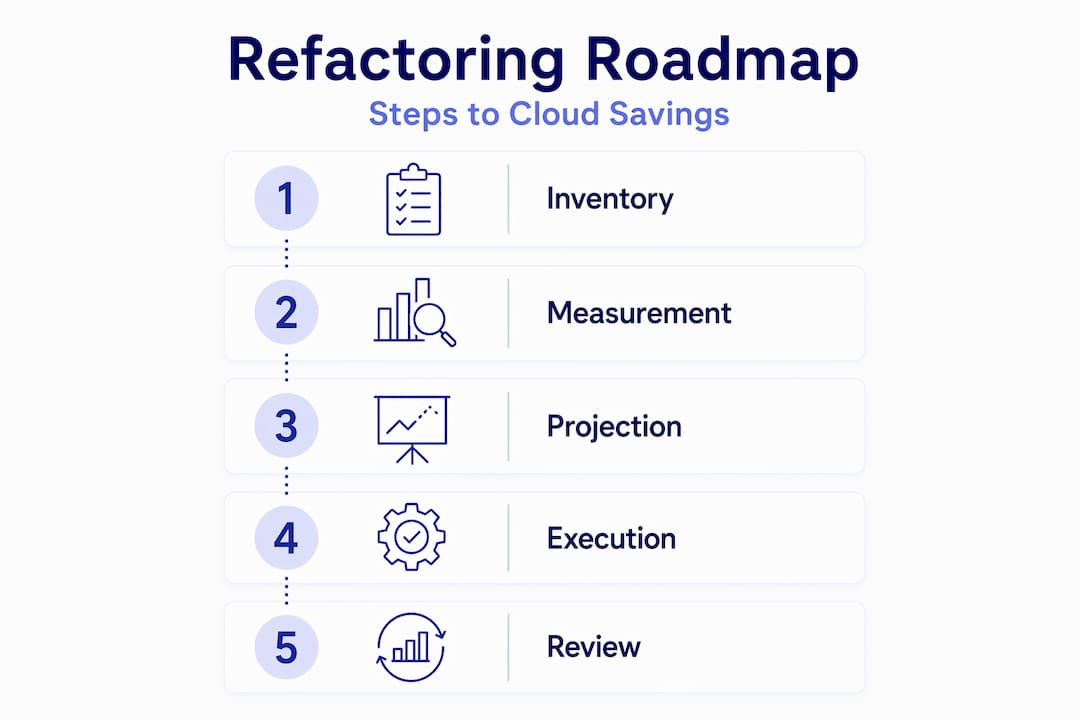
Pro Tip: Before approving any refactoring budget, ask your team to produce a cost-per-application breakdown. If they cannot, your tagging and attribution model needs fixing first. Refactoring decisions made without this data are expensive guesses.
Planning and executing refactoring projects
When you have completed triage and have clear measurement in place, you are ready to plan refactoring for the applications that genuinely warrant it. Here is a structured approach.
-
Assess application complexity and cloud fit. Score each candidate application against two dimensions: the technical effort required to refactor, and the expected operational benefit once refactored. High effort with marginal benefit is a clear signal to replatform instead.
-
Identify legacy technical debt. Look for monolithic architectures that prevent granular scaling, synchronous processing patterns that force over-provisioning, and tightly coupled services that cannot be updated independently. These are the inefficiencies that refactoring can address and that drive unnecessary cloud spend.
-
Apply a prioritisation framework. Score applications on business value, cost impact potential, and technical feasibility. Refactor only the applications that score highly across all three. Refactoring for core applications that need to evolve quickly is where the investment is justified; applying it everywhere inflates budgets without proportionate return.
-
Select appropriate refactoring patterns. Microservices decomposition allows independent scaling of high-demand components. Serverless migration eliminates idle compute costs for event-driven or bursty workloads. Event-driven architecture reduces synchronous dependencies that force over-provisioning. Each pattern has a different cost profile and engineering complexity.
-
Embed FinOps principles throughout architecture decisions. Cost discipline during architecture design is not optional. Engineering teams that treat cost as a post-migration concern routinely discover that their refactored application costs more to run than the original, because new capabilities were added without cost constraints.
-
Plan for the J-curve. Costs rise in the first 6 to 18 months of a refactoring project before falling. Development infrastructure, parallel running costs, and increased engineering time all contribute. A well-executed refactor can produce steady-state spend reductions of 34% or more, but you will not see that return for months. Set that expectation with your finance and board stakeholders before you start, not when the first inflated invoice arrives.
Pro Tip: Build a shadow cost model before committing to refactoring. Project what the refactored architecture will cost to run at current and projected load, and compare it against the cost of replatforming. You may find replatforming delivers 70% of the benefit at 20% of the engineering effort.
Quick wins that reduce costs without full refactoring

Full refactoring is expensive, slow, and carries execution risk. Before committing to it, exhaust the faster options. Many engineering teams are sitting on 30 to 60% cost savings achievable within six weeks through operational changes alone.
The most impactful quick wins are:
- Rightsizing compute instances. Moving from oversized instance types, such as an m5.2xlarge running at 15% CPU utilisation, down to an m5.large is one of the highest-return activities available. It requires no code changes and can be executed in hours.
- Implementing effective autoscaling. Static capacity is almost always a form of waste. Applications provisioned for peak load run at that cost continuously. Autoscaling aligns resource consumption with actual demand.
- Automated scheduling for non-production workloads. Development, staging, and testing environments running 24 hours a day are one of the most common sources of waste. Scheduling them to shut down outside working hours typically saves 60 to 70% of their cost immediately.
- Removing idle and orphaned resources. Misconfigured or idle resources account for 20 to 40% waste in most cloud environments. Unattached storage volumes, forgotten load balancers, and stale snapshots cost money every day without delivering anything.
- Commitment-based pricing. Reserved instances and savings plans on AWS, or committed use discounts on Google Cloud, produce substantial savings on stable workloads. Managing your commitment portfolio actively, rather than setting and forgetting, keeps savings at their maximum.
- AI-assisted code optimisation. AI tools can reduce infrastructure costs by 35% by detecting inefficiencies without requiring full re-architecture. This is one of the most underused approaches for improving code efficiency and reducing cloud costs before committing to a larger refactoring project.
| Approach | Effort | Time to savings | Typical saving |
|---|---|---|---|
| Rightsizing compute | Low | Days | 10 to 40% |
| Autoscaling configuration | Medium | 1 to 2 weeks | 15 to 35% |
| Non-production scheduling | Low | Days | 60 to 70% of dev costs |
| Removing idle resources | Low | Days | 5 to 20% |
| Commitment pricing | Medium | 2 to 4 weeks | 20 to 40% |
| AI-assisted code optimisation | Medium | 2 to 6 weeks | 15 to 35% |
Pro Tip: If you have not yet reviewed your cloud infrastructure costs in detail, run a rightsizing and idle resource audit before approving any refactoring budget. In most cases, you will find enough savings to fund the refactoring work itself.
Measuring the impact of refactoring on cloud costs
Refactoring without measurement is just expensive engineering work. You need KPIs in place before any changes begin, so you can demonstrate value clearly and catch problems early.
The metrics that matter most for engineering leaders are:
| KPI | What it measures |
|---|---|
| Cost per feature | Cloud spend attributable to individual product capabilities over time |
| CPU and memory utilisation | Whether refactored services are right-sized for actual load |
| Error rates and latency | Whether performance has improved alongside cost |
| Release frequency | Whether architectural changes have improved team delivery speed |
| Cost per transaction | Unit economics for high-volume workloads post-refactoring |
Phased delivery is your best tool for iterative validation. Rather than refactoring an entire application before measuring results, deliver in increments and compare cost and performance data at each phase against your baseline. This catches architectural decisions that increase costs before they are embedded across the whole system.
One pattern that causes refactoring savings to evaporate is poor governance after delivery. Teams refactor for efficiency, then gradually add new features and capacity without the same cost discipline. FinOps practices baked into refactoring should remain as permanent engineering standards, not temporary project constraints. A good cost per feature framework gives teams the ongoing visibility they need to maintain the gains.
Pro Tip: Set a formal cost review at 30, 90, and 180 days post-refactoring. If costs have not moved towards projections by 90 days, you have an architecture problem or a governance problem. Catching it early is far cheaper than discovering it at the end of the project.
My take on refactoring: do less of it
I have worked with enough engineering organisations to say this plainly: most teams refactor too much, too early, and for the wrong reasons.
The typical pattern I see is a cloud bill that is growing uncomfortably, a CTO who has been told refactoring is the answer, and an engineering team that is excited about modernising the codebase. All three parties are aligned, but none of them have checked whether the problem is actually the application architecture. More often than not, the cause is idle resources, misconfigured scaling, and a lack of commitment pricing discipline.
What I consistently find is that retiring unused applications delivers more savings than any refactoring project. It is unglamorous work. There is no architecture diagram to present to the board. But removing an application entirely costs nothing to run, and the savings are immediate.
When refactoring is genuinely the right answer, the teams that succeed are the ones with patience. The J-curve is real. Expecting a cost reduction in month three of a twelve-month refactoring project will produce pressure to cut corners on architecture. That pressure is where technical debt re-enters the system.
The most effective engineering organisations I have worked with treat cloud cost awareness as a permanent engineering discipline, not a project deliverable. They measure why their AWS bill is expensive at a granular level, they refactor incrementally, and they hold cost accountability at the team level. That combination, far more than any single refactoring effort, is what produces durable cloud cost reduction.
How Koritsu helps CTOs achieve cloud savings
Koritsu works with engineering teams to find where cloud money is being lost, whether the cause is code architecture, idle resources, or missing commitment pricing. Kori, Koritsu’s AI agent, continuously analyses your cloud spend and surfaces the highest-impact savings opportunities. Koritsu’s specialists then help you act on them, whether that means a targeted refactoring programme, a rightsizing project, or both.
The results speak directly to what this article covers. A UK bidding platform reduced cloud costs by 52% without wholesale re-architecture. An AWS Lambda optimisation project in financial services cut Lambda costs by 96% through targeted code and resource changes. Koritsu charges only when savings are delivered. Start with a free cloud cost assessment to see where your biggest opportunities are.
FAQ
What is application refactoring cloud savings?
Application refactoring cloud savings refer to the reduction in cloud operating costs achieved by restructuring application code and architecture to run more efficiently on cloud infrastructure. Common approaches include microservices decomposition, serverless migration, and event-driven architecture patterns.
How long does refactoring take to reduce cloud costs?
Refactoring typically increases costs for the first 6 to 18 months before delivering long-term savings. Well-executed projects can produce steady-state cost reductions of 30% or more, but engineering leaders must plan for this J-curve and set expectations accordingly.
What are faster alternatives to full refactoring for cloud cost reduction?
Rightsizing, autoscaling, automated scheduling, and removing idle resources can deliver savings of 30 to 60% within six weeks. These approaches require no code changes and should be exhausted before committing to a full refactoring programme.
Which applications should be refactored first?
Prioritise refactoring for core applications that need to scale rapidly or evolve frequently, where cloud-native architecture delivers measurable business value. Retire unused applications and rehost or replatform the rest before committing refactoring resources.
How do you measure whether refactoring has delivered cloud savings?
Track cost per feature, cost per transaction, CPU and memory utilisation, and error rates before and after each refactoring phase. Set formal cost reviews at 30, 90, and 180 days post-delivery to validate that architectural changes are producing the expected financial and performance improvements.