FinOps Inform
Run Two Billing Cycles First, FinOps Teams: Showback vs Chargeback
For FinOps and IT finance teams: decide when to keep showback, pilot soft chargeback, or enforce chargeback. Run two full billing cycles and clear...

Showback shows engineering teams what they cost without moving any money; chargeback actually bills those costs to a team's budget. Most organisations should start with showback, because it exposes the tagging and allocation gaps that would otherwise turn a chargeback invoice into a dispute. Chargeback only works once allocation data is auditable and a named budget owner exists to act on it.
TL;DR:
- Organizations should start with showback reports to identify tagging and allocation issues before transitioning to chargeback.
- Chargeback requires high-quality, auditable data and a dedicated budget owner to avoid disputes and administrative delays.
- Implementing chargeback is more complex and slower, often taking weeks to months, and only makes sense when spend is material and data is trusted.
- Hybrid and soft chargeback models can help organizations build trust by gradually allocating costs without immediate invoicing.
- Partnering with an engineering-focused FinOps provider can improve resource tagging, anomaly detection, and finance integration for successful cost allocation.
Showback vs chargeback: what chargeback actually means
Chargeback moves cloud costs onto a team's own budget or profit and loss statement. Instead of engineering costs sitting quietly on a central IT line, finance issues an internal invoice, and that team's leadership has to answer for the number. It is, in every practical sense, an internal billing system.
That shift only works if three things are already true. Allocation data has to be auditable, meaning every dollar of spend can be traced to a specific team, service, or feature with a defensible method. Someone has to own the budget line that absorbs the charge, because an invoice with no accountable recipient just generates confusion. And finance needs a ledger process to post, reconcile, and correct these internal transactions, the same way it would with any external vendor invoice.
The upside is real. Chargeback forces budget discipline in a way that a dashboard never can. When a team's own numbers move because of an idle database or an oversized instance, remediation happens faster than any FinOps newsletter will ever achieve. Microsoft's own FinOps guidance on invoicing and chargeback frames this as a finance integration exercise, not a tooling problem.
The downside is friction. Chargeback introduces:
- Formal dispute processes when a team disagrees with its allocated share
- Extra reconciliation work between cloud billing and the general ledger
- Political resistance from teams unaccustomed to owning infrastructure costs
- A higher administrative overhead that only pays off once spend is material
Chargeback tends to suit product lines with independent profit and loss statements, or platform teams whose consumption swings are large enough to justify the accounting effort. A very small team with modest monthly cloud spend rarely needs it.
Showback vs chargeback: what showback actually means
Showback leaves the bill exactly where it is, on the central cloud account, and simply reports who consumed what. No money moves. No invoice is raised. A team sees its own cost breakdown next to everyone else's, and that visibility alone tends to change behaviour, because engineers dislike appearing at the top of a cost league table almost as much as they dislike a budget cut.
This makes showback the natural entry point for most FinOps programmes. It benefits:
- Engineering teams who need to see the cost consequence of architectural decisions
- FinOps practitioners still validating whether their tagging and allocation data can be trusted
- Finance stakeholders who want visibility before committing to a formal billing process
- Organisations with shared infrastructure that is hard to attribute cleanly to one owner
The FinOps Foundation's invoicing and chargeback capability guidance is explicit that neither model is inherently more mature. Showback simply carries far less operational risk, because a wrong number in a report is an embarrassment. A wrong number on an invoice is a dispute that lands on finance's desk.
The limit is equally clear: showback has no enforcement mechanism. A team can see it is the most expensive division in the company and still do nothing, because nobody's budget actually changes. That's fine when the goal is awareness. It becomes a problem when leadership expects showback alone to fix runaway spend.

Showback vs chargeback: the practical differences side by side
The gap between these two models isn't really about reporting, it's about what happens after the report lands. Showback informs; chargeback compels.
| Dimension | Showback | Chargeback |
|---|---|---|
| Money movement | None; central bill stays intact | Internal invoice posted to a cost centre or P&L |
| Primary audience | Engineers, architects, FinOps analysts | Budget owners, finance business partners |
| Data quality bar | Directionally accurate is enough | Must be auditable and defensible |
| Enforcement | Behavioural, through visibility | Financial, through the budget itself |
| Dispute risk | Low; a wrong number is corrected quietly | Higher; a wrong number triggers a formal challenge |
| Setup effort | Days to weeks | Weeks to months, plus finance sign-off |
The behavioural mechanism is worth dwelling on. Showback relies on social pressure and engineering pride to drive change. Chargeback relies on the same lever every other business function uses: a number that hits a budget and someone whose job depends on managing it. Practitioner guides like CloudZero's comparison of the two models consistently note that organisations underestimate how much of chargeback's value comes from who the number reaches, not how the number is calculated.
Auditability requirements diverge sharply too. The same error on an invoice becomes a line-by-line argument between two department heads, usually escalated to whoever owns the FinOps programme.
How to decide between showback, chargeback, or a hybrid
Choosing the right model isn't a preference call, it's a readiness test. Run through these criteria before committing to either path.
- P&L ownership. Does a named person actually own the budget that would absorb the charge? If the answer is "sort of, several people share it," chargeback will stall on the first invoice.
- Tagging and allocation coverage. What percentage of your cloud spend can be attributed to a specific team or service without manual intervention? Anything below roughly 80 to 90% coverage means too much cost will land in an "unallocated" bucket that invites disputes.
- Auditability. Can finance trace an allocated number back to its source data and defend it under questioning? If you can't reproduce last month's report and get the same figure, you're not ready to invoice against it.
- Materiality of spend. Is cloud cost large enough, relative to the team's budget, to justify the administrative overhead of formal billing? Gartner's forecast of $723 billion in worldwide public cloud spending for 2025 is a reminder of how much this line item has grown, but materiality is relative to each team's own budget, not the market total.
- Finance buy-in. Has finance agreed on invoice format, posting frequency, and dispute resolution before the first bill goes out? Skipping this step is the single most common reason chargeback programmes collapse within a quarter.
Non-numerical signals matter just as much as the checklist above. Watch dispute rates during any pilot, watch whether teams actually change behaviour after seeing a showback report, and watch whether finance is asking for chargeback or merely tolerating it.
You rarely need an all-or-nothing answer. A workable middle path applies chargeback to teams that clear every criterion, such as a mature platform team with dedicated infrastructure and a clean tagging record, while keeping shared services, R&D sandboxes, and anything with murky attribution under showback indefinitely.
Pro Tip: Before anyone drafts an invoice template, run a short governance workshop with finance and the two or three loudest engineering leaders. Half of the disputes chargeback programmes face later were entirely predictable from that one conversation.
The implementation checklist: showback first, chargeback second
- Run showback for at least two full billing cycles, using the exact report format and allocation logic you intend to invoice from later. FinOpsForge's guidance on building a cloud chargeback model makes this the single most reliable predictor of a clean rollout, because every tagging gap and misallocation surfaces as a reporting anomaly rather than a disputed bill.
- Fix tagging and allocation before touching finance. Agree a tagging convention, decide how shared costs (networking, logging, shared databases) get split, and make sure committed-use discounts are attributed to the teams that actually earned them rather than smeared evenly across everyone.
- Build the finance integration. Define the invoice format, the posting cadence, and exactly how a disputed line item gets escalated and resolved. Microsoft's guidance treats this step as an accounting systems problem, not a dashboard export.
- Pilot with a soft chargeback. Show teams what they would owe without actually deducting it, for one or two cycles, before flipping the switch.
- Set a rollback safeguard. Agree in advance what happens if the pilot surfaces a major data error, so the response is a pause and a fix, not a scramble.
Common tagging problems worth checking before you invoice anyone:
- Resources tagged with a generic "shared" label instead of a real owner
- Commitment discounts applied at the account level with no team-level distribution
- Development and staging environments left untagged because "they don't cost much"
- Multiple naming conventions for the same team across different cloud accounts
Soft chargeback and hybrid models as a bridge
Soft chargeback allocates a cost to a team's budget line without actually deducting it, showing the number that would be billed if the invoice went live. It is chargeback's mechanics running on showback's stakes, and it is the single most useful bridge for organisations still building trust in their allocation data.
A hybrid approach applies this at different speeds across the organisation:
- Teams with clean tagging, an owned budget, and material spend move to full chargeback first
- Shared services and platform infrastructure stay on showback because attribution will never be perfectly clean
- Mid-maturity teams sit on soft chargeback until dispute rates during the pilot drop close to zero
Governance has to expand deliberately here. Each promotion from showback to soft chargeback to full chargeback should require the same readiness checklist, not a blanket policy change applied to the whole company at once.
Common pitfalls that sink chargeback programmes
The most frequent failure is obvious in hindsight: skipping showback entirely and going straight to invoicing. Practitioner guides consistently describe the same pattern, where data quality and tagging issues that showback would have caught instead surface for the first time as a disputed invoice, and trust in the whole programme takes months to rebuild.
Other recurring mistakes:
- Treating the unallocatable spend gap as someone else's problem instead of setting an explicit policy (split evenly, absorb centrally, or flag for review)
- Launching chargeback with no named budget owner, so the invoice has nobody positioned to act on it
- Leaving dispute resolution undefined until the first dispute actually happens
- Assuming a tagging tool alone solves allocation, when the real requirement is an agreement between finance and engineering on how shared costs get split
Pro Tip: If you can't name the person who will read next month's chargeback invoice and change their team's behaviour because of it, you're not ready to send that invoice.
Where an engineering-grade FinOps partner adds value
Most allocation problems aren't dashboard problems, they're architecture problems. Untagged resources, cost anomalies that only show up mid-cycle, and commitment discounts that never make it back to the team that earned them all need someone who can read the infrastructure, not just the billing export.
That is the gap continuous monitoring paired with hands-on engineering support is built to close:
- Surfacing untagged and misallocated resources before they distort a showback report
- Flagging anomalies in near real time, rather than at the end of a billing cycle
- Attributing commitment discounts and shared costs correctly across teams
- Supporting the actual finance integration work, invoice formats, reconciliation, and dispute handling, once a chargeback pilot goes live
Practitioner perspective: what actually separates a working programme
Most showback vs chargeback debates focus on which model is "better," and that's the wrong question. The FinOps Framework is right that neither is inherently more mature. The real variable is organisational readiness, and readiness is almost always overestimated by the team pushing for chargeback and underestimated by finance.
Start with showback. Run it for two full cycles using the exact reports you would eventually invoice from. Only move to chargeback where allocation is auditable and a named budget owner exists to act on the number. Keep showback running underneath chargeback permanently, with a defined dispute and correction process, because even a mature programme will misallocate something eventually.
How Koritsu AI supports your showback to chargeback rollout
If your showback reports keep surfacing the same untagged resources and unexplained cost spikes every cycle, that's an architecture problem no invoice template will fix. Koritsu AI starts every engagement with a free assessment, the Savings Opportunity Report, and only charges a success fee once real savings are verified against your actual bill, so there's no upfront cost while you're still deciding which allocation model fits your organisation.
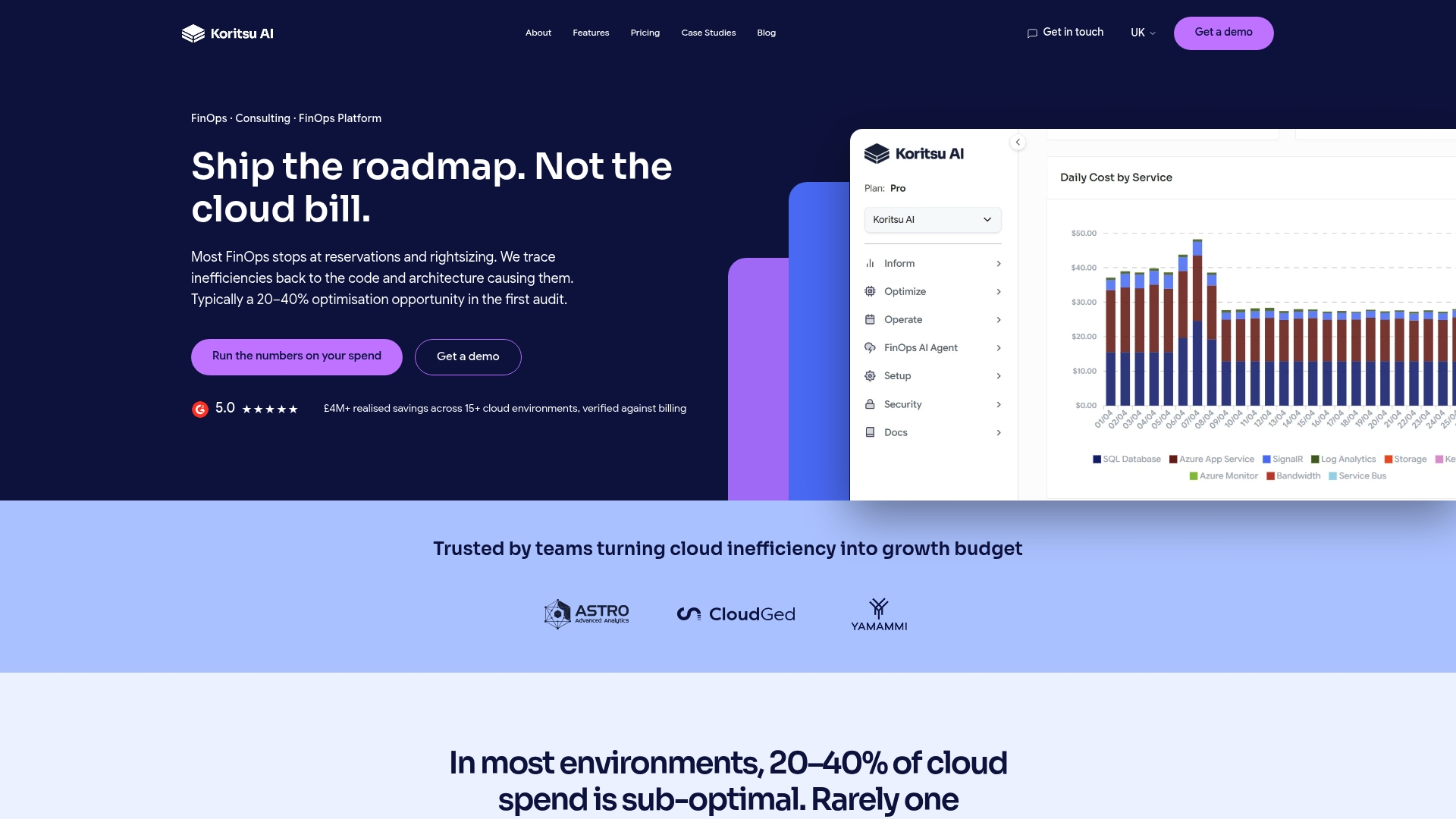
An AI agent provides continuous monitoring to detect anomalies and misallocated commitment discounts that can complicate chargeback invoicing, with specialists supporting the resolution of underlying architectural issues rather than only adjusting billing reports. From there, FinOps as a Service plans, from Monitor through to Advisor and Embedded, give you ongoing support as you move from showback into a chargeback pilot. Start with the free assessment and see what your allocation data actually looks like before you invoice anyone.
Sources
- Invoicing & chargeback capability | FinOps Foundation
- Invoicing and chargeback (Microsoft Cloud FinOps docs)
FAQ
What is the difference between chargeback and showback?
Showback reports cloud costs by team without moving any money, while chargeback formally bills those costs to a team's budget or profit and loss statement.
What is the difference between a chargeback and a billback?
The terms are used almost interchangeably in cloud FinOps, though "billback" sometimes refers more narrowly to the internal invoice document itself, while chargeback describes the full process, allocation, invoicing, and reconciliation.
What is the difference between chargeback and a refund?
A chargeback in FinOps has nothing to do with a payment dispute or refund. It's internal billing, moving cloud costs from a central account onto a specific team's budget, not a reversal of a customer transaction.
What does showback mean?
Showback means reporting cloud costs back to the teams that generated them, purely for visibility, with no financial transaction attached.
Do I need chargeback if I already have showback?
Not necessarily. Many organisations run showback indefinitely, especially for shared infrastructure, and only introduce chargeback for teams with auditable allocation data and a named budget owner ready to act on the numbers.