FinOps Inform
Protect Procurement: Success Fee Consulting Contracts With 10-20% Benchmarks
Procurement teams: a contract-first guide to success-fee consulting. Get precise clause wording, measurement and attribution rules, plus 10-20% fee benchmarks.

A success-fee consulting deal pays the consultant only when a clearly defined, verifiable outcome is achieved. It fits when the result is measurable, largely within the consultant's control, and traceable to a single agreed data source. It fails when the metric is fuzzy, attribution is contested, or the consultant has no protected base fee. Insist on a baseline, a named source of truth, and a retainer before signing anything.
TL;DR:
- Success fees should only be paid when a clear and verified outcome, based on a single, agreed-upon data source, is achieved within an established measurement window.
- The baseline data must be established before work begins, and the source of truth along with attribution rules should be documented to prevent disputes.
- Expect success fees to generally range from 10% to 20% of the directly attributed value, with the actual percentage depending on the clarity of attribution and control over outcomes.
- A protected base fee or retainer is recommended to cover diagnostic work regardless of results and reduce the risk of disputes if the engagement stalls or outcomes are delayed.
- Watch out for vague metrics, multiple data sources, or unverified baselines, which can shift risk onto the client and undermine the effectiveness of success-fee arrangements.
What is success-fee consulting and when does it work?
Success-fee consulting ties payment to a defined result rather than time spent. It sits apart from hourly billing, where you pay for effort regardless of outcome, and from flat retainers, where you pay for availability. Value-based or outcome-based pricing ties fees to measurable results, but it demands a verified baseline and audit rules agreed before work starts, not after.
The model suits engagements where the consultant genuinely drives the number: cloud cost optimisation, sales pipeline recovery, procurement renegotiation, or debt collection, especially when working with firms that are AI-native companies with the leaders who own the market. It suits situations where a clean "before and after" figure exists and nobody can seriously dispute it.
It works badly in several situations:
- The outcome depends heavily on factors outside the consultant's control (market pricing, third-party vendor behaviour).
- No reliable baseline data exists before the engagement starts.
- The client's own team will implement most of the change, diluting attribution.
- The metric can be gamed short-term without lasting benefit.
What fee structures and benchmark ranges should you expect?
Proposals rarely arrive as pure contingency. Most blend a few common shapes:
- Percentage of quantified value. The consultant takes a share of a one-off value created (a renegotiated contract, a settled dispute).
- Percentage of realised savings. Common in cost optimisation, paid against savings that actually appear on the bill, not projected ones.
- Base plus contingent. A protected retainer covers diagnostic work, with a smaller success fee layered on top.
- Staged or milestone models. Payment released at defined checkpoints (discovery complete, changes implemented, savings sustained).
Benchmark guidance suggests many value-based structures charge roughly 10-20% of the consultant-attributed value, with hourly or daily rates remaining common wherever outcomes cannot be firmly quantified.
Build three payout scenarios before you sign: worst case (minimum plausible savings), base case (the consultant's own estimate), and best case (upper bound if everything lands). If the worst case still feels fair to both sides, the structure is sound. Choose the exact model based on three questions: how cleanly can the result be attributed to the consultant, how much execution control do they actually hold, and how much timing risk sits between "identified" and "realised" savings?
How do you agree measurement, baseline and attribution?
This is where most success-fee disputes actually start, not in the payout formula itself. Before any diagnostic work begins, agree a verified baseline figure, drawn from actual data, not estimates. Agree a single named metric (monthly AWS spend on a specific service, not "overall cloud efficiency"). Agree a single source of truth, one dashboard, report, or billing extract that both sides accept as final. Structuring the clause around a defined Success Event, verified metric, and named source of truth removes the ambiguity that causes late-stage arguments over money already owed.
Attribution needs its own paragraph in the contract, not a vague reference to "results." Three common approaches exist:
- Full attribution, used when the consultant's recommendation is the sole cause of the change.
- Partial attribution, splitting credit when internal teams also contributed.
- Proportional attribution, tying the fee to a percentage of a larger initiative the consultant only partly influenced.
Whichever you pick, document it in writing with worked examples, not just a definition. Then set a sustainment window, often 3 to 6 months for operational savings and up to 12 months for structural changes, so the fee is paid on savings that hold, not on a spike that reverses in week three. Build a simple dispute-resolution step into the clause: an agreed third-party audit of the source-of-truth data if either side challenges the numbers.
Pro Tip: Ask for read access to the actual dashboard or billing export before you sign, not a summary screenshot. If the consultant resists showing you the raw source of truth, that alone tells you how the number was probably built.
Good cloud spend attribution practice treats this measurement step as engineering work, not paperwork. Get it wrong and the entire fee structure becomes unenforceable.
What contract clauses actually protect both sides?
A success-fee agreement lives or dies on clause precision. Procurement and legal teams should require these elements in writing, not implied by a proposal deck.
The Success Event itself needs five parts spelled out: the defined outcome, the exact metric, the numeric threshold that triggers payment, the named source of truth, and the measurement window that must elapse before payment is due.
Payout mechanics need equal precision:
- The calculation formula, written as an equation, not prose.
- The specific event that triggers invoicing (end of measurement window, sign-off from an agreed report).
- Payment terms, currency, and who absorbs any currency-conversion cost.
- A late-payment remedy, whether interest or a fixed penalty.
Commercial protections matter as much to the client as the consultant. A modest retainer or base fee, covering diagnostic work regardless of outcome, keeps the relationship serious on both sides. Staged payments tied to milestones reduce the size of any single dispute. Before signing, run a timing stress test: if savings only become measurable six months late, does either party face a cashflow problem that wasn't obvious at signature?
What are the red flags and how do you negotiate around them?
Some proposals are structured to look generous while quietly shifting all the risk onto you. Watch for a metric that shifts definition partway through the engagement, a baseline that was never independently verified, multiple data sources that can each be cited depending on which favours the consultant, or a headline percentage with no protected base fee behind it.
Procurement commentary is direct about the biggest structural risk here: paying consultants a straight percentage of identified savings can create perverse incentives, rewarding aggressive short-term cuts over changes that actually hold. A fee tied only to Month 1 savings, with no sustainment check, invites exactly that behaviour.
Walk away from any proposal that has vague metrics, no agreed baseline, more than one possible "source of truth," or zero retainer protecting your downside if the engagement stalls.
Negotiate from a position of structure, not distrust:
- Insist on a single source of truth in writing before discovery starts.
- Ask for a short, paid discovery phase to establish the baseline before the success fee clock starts.
- Define the sustainment window explicitly, not "reasonable period."
- Model all three payout scenarios together before anyone signs.
How does Koritsu run a success-fee engagement in practice?
Koritsu AI starts every engagement the same way: a free assessment, followed by a Savings Opportunity Report that establishes the baseline and names the exact billing data used as the source of truth, agreed with the client before any success fee is calculated. Our AI agent, Kori, continuously analyses cloud spend to surface where the money is actually being lost, and our specialists confirm attribution against the client's own infrastructure before proposing a figure.
Fee structure often follows a protected base plus contingent share of realised savings, measured against a defined window rather than a Day One snapshot. Some engagements have identified a SQL replication configuration causing unnecessary compute spend, an architectural fix that produced significant sustained savings once verified against the client's billing data over the agreed measurement period.
- Free assessment identifies where savings likely exist.
- Savings Opportunity Report documents baseline, metric and source of truth.
- Success fee is charged only against savings confirmed in that report.
- Clients can move to an ongoing FinOps subscription once the initial savings are realised.
What legal and regulatory issues should the contract cover?
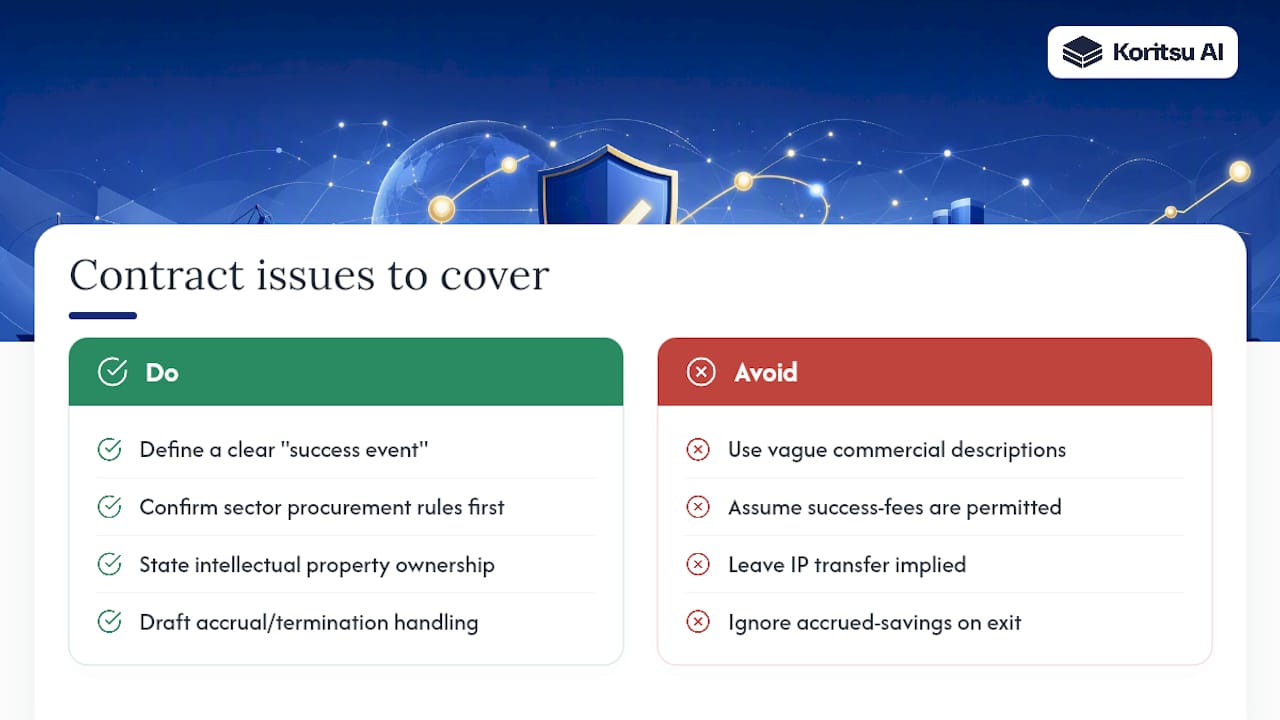
Success-fee consulting agreements are ordinary commercial contracts, but the outcome-based structure raises specific drafting issues that a standard services agreement often misses. The contract needs a clear definition of what constitutes a "success event" that would satisfy a court if the relationship soured, not just a commercial description that sounds fair to both parties at signing.
Regulated sectors add another layer. Success fees paid to intermediaries in financial services, public procurement, or government contracting can trigger specific disclosure rules, and some public bodies restrict contingency-fee arrangements outright to avoid the appearance of a conflict of interest in advisory work. Check your sector's procurement guidelines before assuming a success-fee model is permitted at all.
Intellectual property ownership needs stating explicitly when the consultant's recommendations involve proprietary methods, architecture changes, or code, since a success fee doesn't automatically transfer rights to the underlying work product. Termination clauses deserve particular care: what happens to accrued but unrealised savings if either party exits mid measurement-window? Without a clause addressing this, disputes over partial entitlement are common and expensive to resolve.
Finally, confirm which jurisdiction's law governs the contract and where disputes will be heard, especially when the consultant and client operate in different countries, and specify whether an independent auditor can be called in if the parties disagree over the source-of-truth data. None of this replaces proper legal review of the specific agreement in front of you, but it flags the areas a generic template usually skips.
How are success fees taxed for consultants and clients?
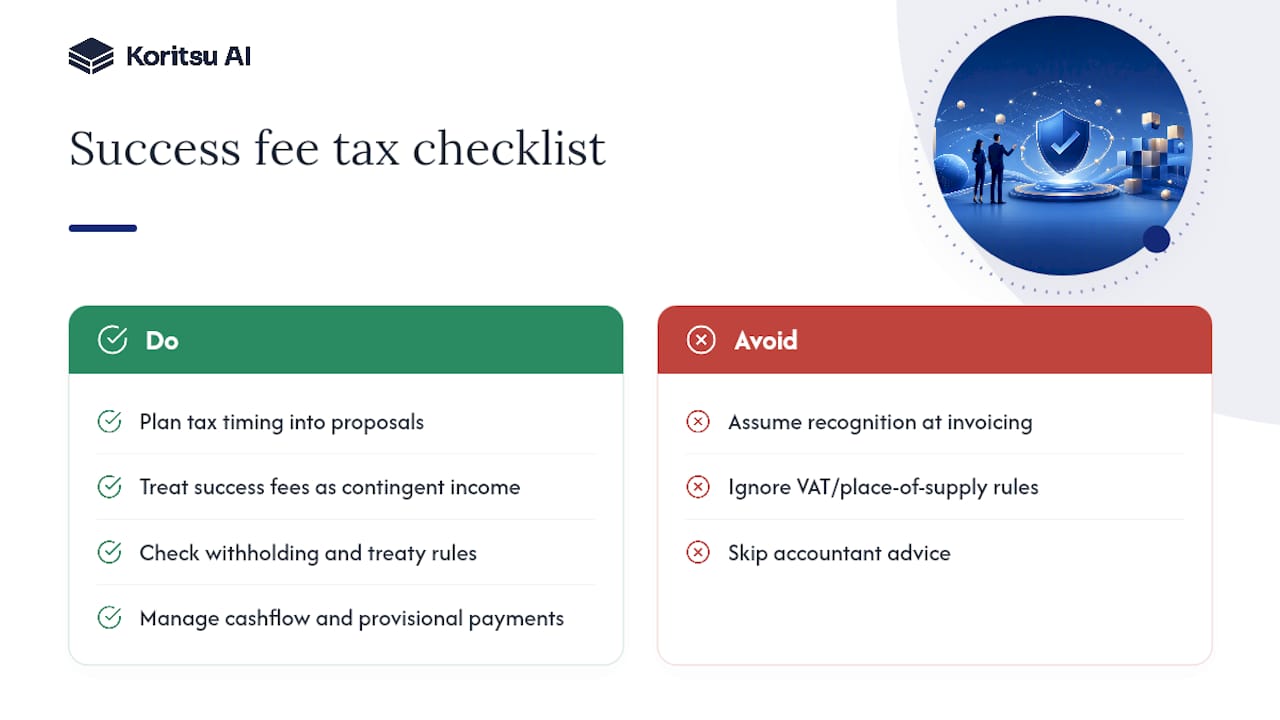
Success fees are generally treated as ordinary business income for the consultant and as a deductible business expense for the client, in the same way as any other consulting fee, but the timing of recognition can differ from a simple hourly invoice. Because payment is contingent on a future event, some tax authorities treat the fee as earned only when the success event is confirmed, not when the underlying work was performed, which affects which accounting period the income and the deduction fall into.
Cross-border engagements add complexity. If the consultant operates in a different country from the client, withholding tax rules may apply to the success fee, and the specific treaty between the two jurisdictions determines whether reduced rates or exemptions are available. VAT or sales tax treatment also depends on where the service is deemed to be supplied, not simply where the invoice is issued, which matters when a UK consultancy delivers cloud cost work for an international client.
Consultants relying heavily on contingent income should also think about cashflow and provisional tax payments, since a success fee tied to a 6 to 12 month measurement window can create a lumpy income pattern that doesn't match neatly with quarterly or annual tax instalments. None of this is a substitute for advice from a qualified accountant familiar with the specific jurisdictions involved, but it explains why sophisticated consultants build tax timing into their proposal discussions rather than treating it as an afterthought after the invoice is raised.
What conflicts of interest can success-fee consulting create?
The core tension in success-fee work is structural: a consultant paid on results has a direct financial interest in how those results are measured, which creates an obvious incentive to define the metric, baseline, or attribution rules in their own favour. This isn't a claim that consultants are dishonest. It's a reason the contract, not goodwill, has to do the protecting.
The clearest conflict shows up in savings-based work. A consultant who benefits from a percentage of identified savings has an incentive to inflate the baseline, since a higher starting point makes any given reduction look larger. This is precisely why an independently verified baseline, agreed before diagnostic work begins, matters more in success-fee arrangements than in almost any other consulting model.
A second, subtler conflict involves sustainability versus speed. A consultant paid against a short measurement window has less incentive to worry whether the change holds up in month four, which is why sustainment windows exist as a structural check rather than a courtesy. Procurement commentary on this exact problem notes that percentage-of-savings models can reward short-term cuts over durable value, reinforcing why quality checks belong in the contract rather than the relationship.
Finally, disclosure matters. If a consultant recommends a specific vendor, tool, or platform as part of achieving the success metric, and receives any commission or partnership benefit from that recommendation, this needs stating upfront. A client evaluating a recommendation has a right to know whether the advice is genuinely independent.
Is success-fee consulting actually better, or just better marketed?
Most advice on this topic treats success fees as inherently fairer than hourly billing, as if aligning incentives automatically solves the trust problem. It doesn't. A badly written success-fee contract is worse than a bad hourly contract, because the ambiguity sits in the definition of success itself, not just in the number of hours billed.
The conventional advice tells readers to "make sure the metric is measurable." That's true but incomplete. The real skill is naming a single source of truth before any diagnostic work starts, and resisting any proposal that keeps that source vague until after the savings appear. Vagueness at the measurement stage isn't an oversight. It's often the entire commercial strategy of a weak proposal.
If you take one thing from this guide, prioritise the baseline conversation over the percentage conversation.
Get a savings figure before you agree any fee
Koritsu AI is the direct alternative to negotiating a success fee on trust alone. Every engagement starts with a free assessment that produces a Savings Opportunity Report, documenting the baseline, the exact billing data used as the source of truth, and the specific savings identified, before any success fee is discussed.
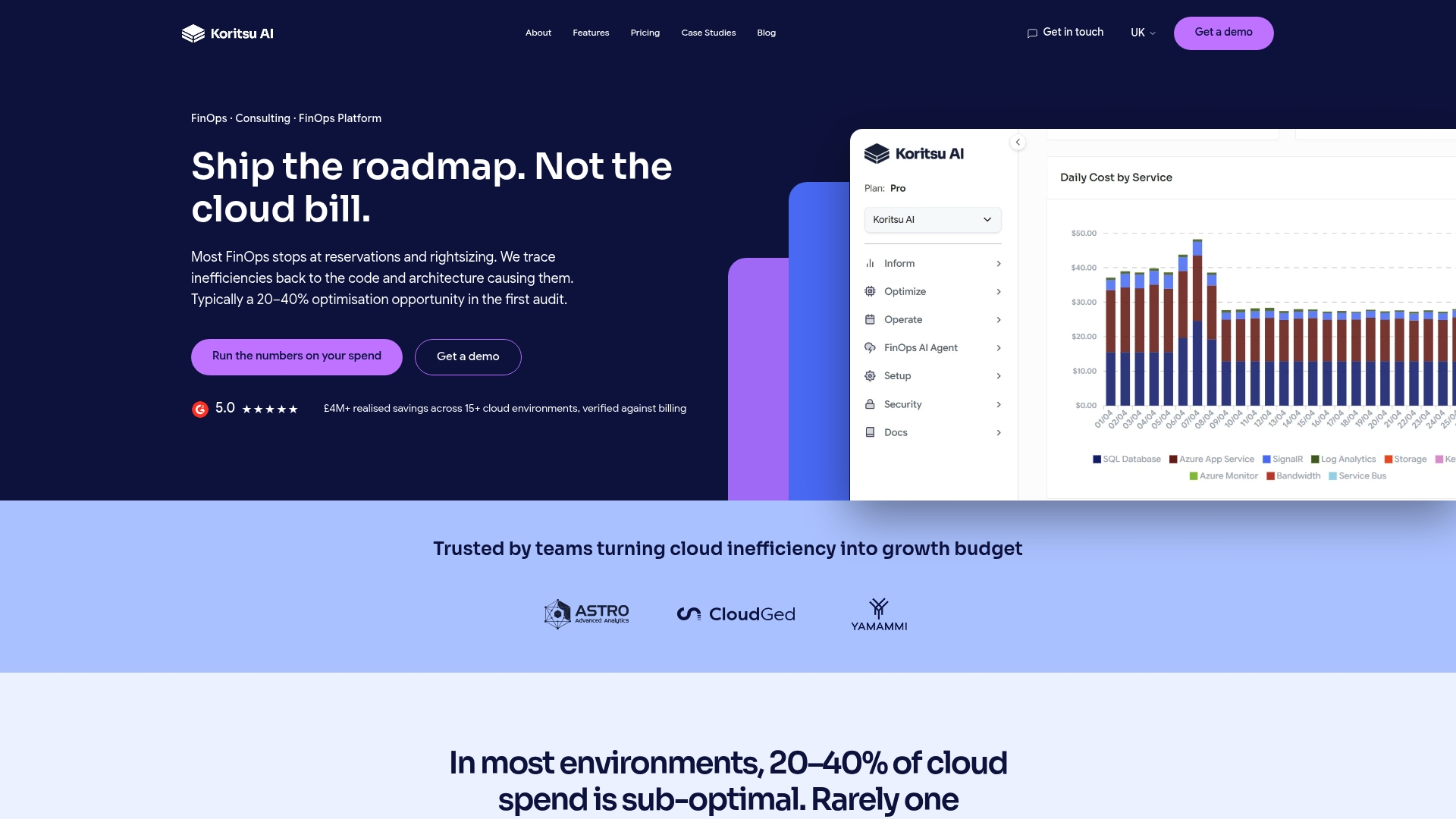
That sequencing matters. You see the verified figure first, agreed against your own AWS, Google Cloud, or Azure billing data, and only then decide whether the contingent fee attached to it makes sense. There's no vague "efficiency improvement" language and no shifting metric. Our AI agent, Kori, does the continuous analysis, and our FinOps specialists confirm attribution before a single invoice is raised. Once the initial savings are realised, clients can move onto an ongoing FinOps subscription for continued monitoring. Start with the free assessment and see the Savings Opportunity Report before committing to anything.
Request your Savings Opportunity Report and get a verified baseline before you agree any contingent fee.
Sources
- Consulting Success Fee Structure for Consulting Agreements
- Consulting Fees and Pricing in 2026: Hourly, Retainer, Fixed Fee
- Paying consultants on percentage of savings vs success fees
- Fees for Consultants: 2026 Benchmarks and How to Set Them
FAQ
How much is a success fee?
Success fees typically range from roughly 10% to 20% of the consultant-attributed value, though the exact figure depends on attribution clarity, execution risk, and whether a base fee is also in place.
What is a reasonable consulting fee?
A reasonable fee depends on the model: hourly and retainer arrangements are priced on time and availability, while value-based fees are priced against a verified, measurable outcome agreed before work starts.
What does a success fee mean?
A success fee is payment triggered only when a predefined, verifiable outcome, such as a confirmed cost saving, is achieved and measured against an agreed source of truth over a set measurement window.
How much should I charge for a consultation fee?
An initial discovery or consultation fee is usually modest and separate from any success fee, covering the diagnostic work needed to establish a baseline before contingent terms can even be calculated.