FinOps Inform · Contract Negotiation
How to negotiate cloud contracts for enterprise teams
Learn how to negotiate cloud contract enterprise agreements effectively. Secure discounts while maintaining flexibility with expert strategies.

Enterprise cloud contract negotiation is the process of securing committed spend agreements with cloud providers, such as AWS, Azure, or Google Cloud, at discounted rates while protecting your organisation’s flexibility through carefully structured contractual terms. Done well, it delivers both cost savings and risk control. Done poorly, it locks your organisation into commitments that cost more than the list price you were trying to avoid. Enterprise procurement managers and IT leaders who negotiate cloud contract terms without adequate preparation routinely leave significant value on the table. The difference between a good deal and a great one comes down to three things: preparation, commitment sizing, and contractual detail.
What prerequisites are essential before you negotiate cloud contract enterprise terms?
Preparation is the single greatest source of negotiating leverage. Cloud providers price their deals based on your willingness to commit and the credibility of your alternatives. Without a detailed consumption model and a genuine multi-cloud stance, you are negotiating blind.
Start by building a bottoms-up cloud consumption model. This means mapping every workload, service, and region to its projected spend over the contract term. A cloud spend breakdown by service gives you the unit economics you need to challenge vendor pricing assumptions. Without this, vendors will use their own estimates, which rarely favour you.

Benchmark your current unit pricing against market rates. Enterprise discount programmes offer 20–40% reductions on list price, with effective discounts ranging from 5–12% at $5M+ annual spend and up to 15–22% at $25M+ commitments. Knowing where you sit in that range tells you whether your current deal is competitive or overpriced.
Prepare a credible multi-cloud alternative. This does not mean you must migrate. It means you must be able to demonstrate, with specificity, that you have evaluated an alternative provider and that migration is technically feasible. Credible alternatives are the single most effective tool for pushing discounts above market benchmarks.
Key preparation steps:
- Gather 12–24 months of billing data, broken down by service, account, and region
- Identify your top 10 cost drivers and model their growth trajectory
- Engage your engineering team to validate consumption forecasts
- Request pricing benchmarks from an independent FinOps adviser or procurement specialist
- Identify internal stakeholders who control workload placement decisions
Pro Tip: Start your preparation 6–12 months before your renewal date. Renewal concessions are strongest 4–6 months before expiry. Beginning too late removes your ability to run a genuine competitive process.
How should you size your enterprise cloud commitment?
Commitment sizing is where most enterprise teams make their most expensive mistakes. The headline discount a vendor quotes is not the discount you will actually receive. The effective net discount depends on how much of your actual consumption falls within the committed services and tiers.
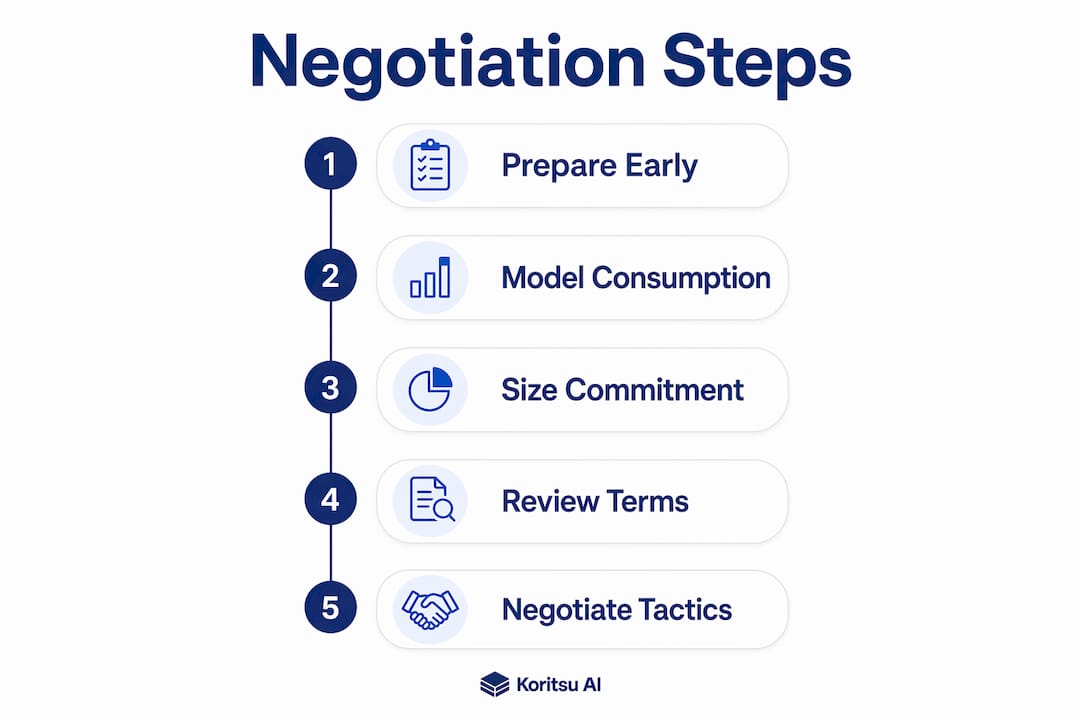
Ramped commitment schedules reduce the risk of early-term shortfall penalties by aligning payment timing with consumption growth. A ramp structure sets a lower Year 1 commitment and increases it in Years 2 and 3, reflecting realistic adoption curves rather than aspirational forecasts.
Typical discount tiers by annual commitment level:
| Annual commitment | Effective discount range |
|---|---|
| $1M–$4.9M | 5–12% off list price |
| $5M–$24.9M | 12–18% off list price |
| $25M+ | 15–22% off list price |
These ranges reflect Q1/Q2 2026 data across AWS, Azure, and Google Cloud enterprise agreements. They represent effective discounts, not headline rates, which are frequently higher but apply to a narrower service scope.
- Model your committed spend at 70–80% of your forecast, not 100%. This buffer protects you from shortfall penalties if growth is slower than projected.
- Negotiate a ramp schedule that matches your actual deployment timeline, not your vendor’s preferred revenue recognition schedule.
- Separate your committed services list from your total spend. Discounts apply only to listed services, so expanding that list is as valuable as increasing the discount rate.
- Include a growth narrative in your proposal. Vendors accept higher ramp commitments when you can show a credible expansion plan, such as a new product line or geographic rollout.
- Review why commitments go unused before finalising your commitment size. Over-commitment is a common and costly error.
Pro Tip: Never commit to a volume you cannot justify with a bottoms-up model. Aspirational forecasts are the leading cause of over-commitment penalties and wasted budget.
Which contractual terms matter most beyond the discount rate?
Contractual terms such as price protections, exit rights, and service eligibility often yield more financial impact than headline discounts. The average protected value of critical-tier clauses is £1.4M per engagement over a two-year period. That figure dwarfs the difference between a 20% and a 22% discount rate.
Focus your legal and commercial review on these clauses:
- True-up provisions: Negotiate the right to under-consume by 10–15% in any given year without penalty, with the shortfall carried forward rather than forfeited.
- Service eligibility: Expand the list of discounted services to cover your full technology stack, including newer services your engineering team is evaluating.
- Affiliate coverage: Confirm that the agreement covers all corporate entities, subsidiaries, and joint ventures. Gaps here create shadow spend outside your negotiated rates.
- Price protection: Secure a cap on list price increases for the duration of the term. Without this, a 20% discount on a price that rises 15% annually delivers far less than it appears.
- Exit and change of control: Negotiate the right to exit without penalty on a material change of control, such as an acquisition, or if the provider materially changes service terms.
- Egress fee waivers: Data egress fees represent 8–15% of total cloud spend for data-intensive organisations. Negotiate a cap or full waiver for enterprise-tier agreements.
- SLA credits: Ensure service level credits are meaningful, not symbolic. A 10% monthly credit on a service that costs £50,000 per month is worth pursuing; a credit capped at £500 is not.
Pro Tip: Treat the contractual terms review as a parallel workstream to the commercial negotiation. Do not wait until the discount is agreed before engaging your legal team. By then, vendors have less incentive to concede on terms.
The table below shows the relative financial impact of key clause categories:
| Clause type | Typical financial impact | Negotiability |
|---|---|---|
| Price protection | High, compounds annually | Moderate |
| Egress fee waiver | 8–15% of total spend | High at enterprise tier |
| True-up flexibility | Avoids shortfall penalties | High |
| Service eligibility | Extends discount scope | Moderate to high |
| Exit rights | Reduces lock-in risk | Low to moderate |
What negotiation tactics and timing strategies maximise outcomes?
Timing is a structural advantage, not a soft tactic. Aligning your contract signature with a vendor’s fiscal quarter-end or year-end creates genuine concession pressure. Sales teams face quota deadlines that make them more willing to offer additional discounts, extended payment terms, or contractual concessions in the final weeks of a quarter.
- Begin formal negotiations 4–6 months before your renewal date. This gives you time to run a competitive process without artificial urgency.
- Reframe the discount conversation as unit economics. Instead of asking for a higher percentage, ask for a lower effective price per compute hour, per TB of storage, or per API call. This shifts the discussion to measurable outcomes.
- Present a written competitive proposal from an alternative provider. It does not need to be a final offer. It needs to be specific enough to be credible.
- Escalate within the vendor’s organisation. Account executives have limited authority. Engaging a vendor’s regional director or enterprise sales lead often unlocks additional flexibility.
- Document all commitments in writing before you end the competitive process. Verbal agreements made under quarter-end pressure are frequently revised once the deadline passes.
- Avoid these common mistakes: signing at list price because the renewal arrived late, accepting the first discount offered without benchmarking, and treating the contract as a one-time event rather than an ongoing commercial relationship.
Pro Tip: Never reveal your renewal deadline to the vendor before you are ready to sign. Knowing your deadline removes their urgency and yours.
Understanding cloud total cost of ownership before entering negotiations gives you a complete picture of what you are committing to, beyond the contracted line items.
Key takeaways
Successful enterprise cloud contract negotiation requires preparation, realistic commitment sizing, and contractual rigour, not just a higher discount rate.
| Point | Details |
|---|---|
| Prepare 6–12 months early | Build a consumption model and credible alternatives before your renewal window opens. |
| Size commitments conservatively | Commit to 70–80% of forecast to avoid shortfall penalties and wasted budget. |
| Prioritise contractual terms | Price protection, egress waivers, and true-up flexibility often deliver more value than an extra 2% discount. |
| Time your signature strategically | Align signing with vendor fiscal quarter-ends to access deeper concessions. |
| Treat renewal as ongoing | Active benchmarking and renegotiation readiness prevent rollover to unfavourable terms. |
What I have learned from watching enterprise teams negotiate cloud deals
The most consistent mistake I see is treating the discount rate as the primary measure of negotiation success. Teams spend weeks pushing from 18% to 21% and then sign a contract with no price protection, no egress cap, and a true-up clause that penalises any under-consumption. That 3% gain is erased within 12 months.
The second mistake is starting too late. A team that begins preparation 6 weeks before renewal has no leverage. They cannot run a competitive process, they cannot build a credible consumption model, and they cannot engage the vendor’s escalation chain. They sign whatever is in front of them.
What actually works is treating cloud contract negotiation as a continuous process, not a periodic event. The organisations that consistently get the best deals maintain live consumption models, track vendor pricing changes quarterly, and keep a multi-cloud migration plan current even when they have no intention of migrating. That readiness is the leverage.
AI workloads are changing the calculus. As GPU-intensive services grow as a share of cloud spend, the negotiation dynamics shift. Providers are less willing to discount in categories where demand outstrips supply. That makes contractual protections, particularly price caps and service eligibility clauses, more valuable than ever. Build them into every agreement now, before your AI spend becomes material.
How Koritsu AI supports your cloud contract negotiations
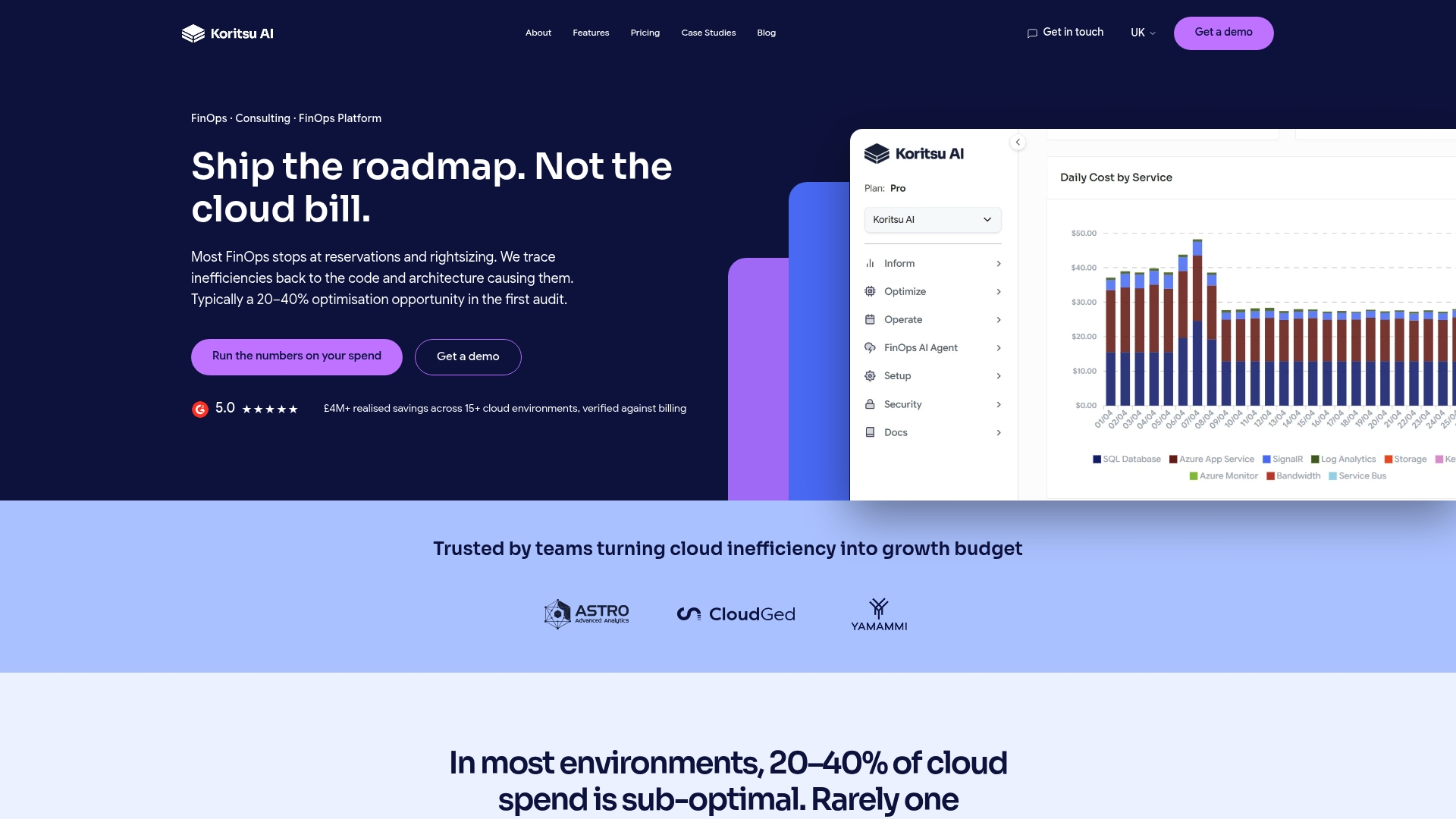
Negotiating a better contract is only half the work. The other half is knowing exactly what you are spending, where the inefficiencies are, and whether your commitments are being consumed as planned. Koritsu AI combines continuous spend analysis with hands-on expert advice to give enterprise teams both.
Koritsu’s AI agent, Kori, surfaces where money is being lost across AWS, Google Cloud, and Azure, including underused commitments, oversized resources, and services sitting outside your negotiated discount scope. The results speak for themselves: one financial services client saw a 96% reduction in AWS Lambda costs, and a UK bidding platform achieved a 52% reduction in cloud spend after working with Koritsu. Koritsu charges only on savings delivered, starting with a free assessment.
FAQ
What discount can enterprises realistically expect from cloud providers?
Enterprise cloud discount programmes offer effective discounts of 5–12% at $5M+ annual spend and 15–22% at $25M+ commitments. Headline rates quoted by vendors are typically higher but apply to a narrower range of services.
How far in advance should you start cloud contract negotiations?
Start preparation 6–12 months before your renewal date. The strongest concessions are available 4–6 months before expiry, when you still have time to run a credible competitive process.
Are egress fees negotiable in enterprise cloud contracts?
Data egress fees represent 8–15% of total cloud spend for data-intensive organisations and are highly negotiable at the enterprise tier. A full waiver or spend cap is achievable with sufficient commitment volume and competitive pressure.
What is a ramped commitment schedule?
A ramped commitment schedule sets a lower spend commitment in Year 1 and increases it in subsequent years, aligning payment obligations with actual consumption growth and reducing the risk of early-term shortfall penalties.
Why do contractual terms matter more than the discount rate?
Critical contractual clauses such as price protections, true-up flexibility, and exit rights have an average protected value of £1.4M per engagement. A higher discount rate on unfavourable terms frequently costs more than a lower rate on well-structured ones.