FinOps Inform
UK Cloud Spend: $65B Forecast, What Leaders Should Do in 2026
Global IT spending is forecast to reach $6.37 trillion in 2026, while UK cloud spend is modeled at about $65 billion. See what this means for IT budgets.

Worldwide IT spending will hit $6.37 trillion in 2026, a 14.2% jump driven largely by AI infrastructure, according to Gartner's 2026 forecast. The UK cloud market is tracking that growth, with Mordor Intelligence modelling it at roughly $65 billion this year. For UK leaders, the priority is clear: capture AI's value without letting waste eat the gains.
TL;DR:
- UK organizations allocate 62% of AI budgets to data, storage, and compute, while 72% favor hybrid storage, so forecast both environments and peak training.
- Storage fees consume 48% of UK cloud storage spending; audit billing exports, apply retention and lifecycle policies, and verify claimed savings against actual bills.
- For public sector buyers, G Cloud 15 channels around £3 billion annually, offers contracts up to 60 months, and has roughly 90% SME suppliers.
- Match reserved capacity to stable workloads and keep AI training flexible, since spikes can make flat contracts costly or inadequate; review the mix annually.
- For sensitive workloads, compare UK only availability zones and hybrid sovereign options, weighing contractual residency guarantees alongside price rather than treating compliance as an afterthought.
1. Key 2026 forecasts and numbers for global and UK cloud spend
The scale of 2026 spending is worth sitting with for a moment. Gartner's worldwide IT spending forecast puts total spend at $6.37 trillion, up 14.2% on the prior year, with infrastructure-as-a-service and data-centre systems among the fastest-growing categories. That growth is not evenly spread: it is concentrated wherever AI workloads are being built, trained and served.
The UK is a meaningful part of that picture. Mordor Intelligence models the UK cloud computing market at approximately $65 billion in 2026, with a projected compound annual growth rate of 15.86% through 2031. Statista's forecast data for UK cloud services revenue corroborates that direction, tracking continued expansion across its 2018 to 2031 modelling window.
UK cloud spend is forecast to grow at roughly 15.86% annually through 2031, according to Mordor Intelligence, a rate that should push most medium-term capacity plans and vendor negotiations.
Breaking spend down by service model shows where the growth is landing:
- Infrastructure-as-a-service is expanding fastest, pulled along by AI training and inference workloads that need raw compute and storage.
- Platform-as-a-service is growing as teams adopt managed AI and data platforms rather than building from scratch.
- Software-as-a-service remains the largest category by volume but is growing more slowly than the infrastructure layers beneath it.
For anyone building a 2026 budget, the takeaway is that infrastructure costs, not software licences, are where the variance now lives. A forecast built on last year's SaaS-heavy spending pattern will likely understate what 2026 actually demands.
2. How AI and AI workloads are changing cloud spend in 2026
AI is not a line item anymore. It is reshaping what cloud spend looks like across the whole estate, and the shift shows up clearly in how UK organisations are allocating budget.
Wasabi's Global Cloud Storage Index, surveyed by Vanson Bourne, found that UK organisations put 62% of their AI budgets into data, storage and compute buildouts rather than software or services. Seventy-two percent of UK respondents favour hybrid storage for AI workloads, blending on-premises and cloud capacity rather than committing fully to one model.
This has direct consequences for forecasting:
- Compute and storage, not licensing, now drive the majority of AI project cost, so budgets built around software spend will miss the real number.
- Hybrid storage adoption means procurement teams need to model costs across two environments rather than one, which complicates straightforward cloud-only forecasts.
- Governance, data quality and workforce skills costs sit alongside the infrastructure spend. Wavestone's 2026 survey found many technology leaders are prioritising AI tooling over operating model changes, leaving governance and capability gaps that tend to surface as unplanned cost later.
Pro Tip: When forecasting AI project costs, model for peak training runs rather than average usage. A single large training run can consume far more compute than steady-state inference, and contracts signed against average usage routinely under-provision.
3. Where UK cloud spend concentrates: sectors, service models and G-Cloud 15
UK cloud spend is not evenly distributed across industries, and it is not evenly distributed across public and private procurement routes either.
Financial services and healthcare remain among the heaviest cloud spenders in the UK, driven by regulatory reporting demands and, increasingly, AI-assisted diagnostics and fraud detection. Public sector spend follows a different route entirely, running through structured procurement frameworks rather than direct vendor negotiation.
The most significant recent development here is the relaunch of G-Cloud 15, described by government as the biggest upgrade in the framework's history. For any organisation that sells into or buys through UK public sector procurement, the figures matter:
- G-Cloud 15 is valued at approximately £14 billion over its four-year term.
- Around £3 billion in annual public-sector cloud spend is expected to flow through the framework each year.
- Call-off contracts can now run for up to 60 months, giving buyers longer commitment horizons than previous iterations allowed.
- Roughly 90% of suppliers on the framework are SMEs, which keeps competitive pressure on pricing and service quality.
For service-model distribution, the pattern mirrors the wider market: IaaS and PaaS are growing fastest as public and private sector buyers alike shift AI and data workloads onto cloud infrastructure, while SaaS procurement through frameworks like G-Cloud remains steady but less dynamic.
4. Waste, overruns and FinOps trends in 2026
Growth and waste are travelling together in 2026, and the evidence on where money leaks is specific enough to act on.
Wasabi's Vanson Bourne survey found that 48% of UK cloud storage spending is allocated to fees rather than capacity itself, a finding echoed by IT Pro's reporting on storage fee complexity pushing IT budgets towards breaking point.
Nearly half of UK cloud storage spend goes on fees rather than usable capacity, according to Wasabi's Global Cloud Storage Index, which means storage line items deserve as much scrutiny as compute.
The common leak sources show up repeatedly across organisations of every size:
- Non-production accounts left running at production scale long after a project has shipped.
- Egress and API call fees that accumulate quietly against object storage, rarely itemised in a way finance teams can query.
- Unmanaged compute instances provisioned for a test or a spike and never decommissioned.
FinOps maturity gaps compound all of this. Cost alerts often arrive after the spend has already happened rather than before, and ownership of specific cloud resources is frequently unclear, so nobody is accountable when a cost anomaly appears. The practical fix is less about new tooling and more about discipline: enforce lifecycle policies on storage, rightsize non-production environments on a schedule, and verify every claimed saving against the actual billing export rather than an estimate.
5. Sovereign cloud and data residency: what UK leaders must watch
Sovereign cloud has moved from a niche compliance concern to a budget line in its own right. Gartner forecasts worldwide sovereign cloud IaaS spending will reach $80 billion in 2026, a 35.6% increase on 2025, with Europe recording particularly strong growth.
For UK organisations, the drivers are both regulatory and practical: concerns about the reach of the US CLOUD Act, rising expectations around data residency from regulators and customers, and a geopatriation trend that is pulling workloads back toward local or regional providers.
Options available to UK buyers fall into a few practical categories:
- UK-only availability zones offered by the major hyperscalers, which keep data processing within national borders.
- Hybrid sovereign offerings that combine a local provider for sensitive workloads with a global platform for everything else.
- Procurement criteria that weigh contractual data residency guarantees alongside price, rather than treating them as an afterthought.
Sovereign demand is not purely about politics. Many UK organisations want predictable commercial terms and local support as much as compliance certainty, and that combination is increasingly available without the premium it once carried.
6. Practical implications and recommended actions for UK IT decision-makers
The forecasts are only useful if they change what you do this quarter. A short, ordered set of actions covers most of the ground:
- Run a cost triage now: pull current billing exports and identify the three largest spend categories before committing to any new AI infrastructure.
- Audit storage fees specifically, given that fees can represent close to half of storage spend; lifecycle and retention policies are the fastest lever here.
- Decommission or rightsize non-production accounts on a recurring schedule rather than as an occasional clean-up exercise.
- Forecast AI compute against peak training demand, not average usage, to avoid contractual under-provisioning.
- Time procurement decisions around framework windows such as G-Cloud 15 where public-sector buying applies, to lock in longer contract terms and SME-driven pricing competition.
Alongside these steps, track a small number of metrics consistently: cost allocation by team and feature, anomaly detection on unusual spend spikes, and bill-backed verification of any saving before it is reported as realised. Assigning clear ownership for each cloud resource closes the accountability gap that lets waste persist unnoticed.
Pro Tip: Policy-as-code catches waste before it happens rather than after the invoice arrives. Enforcing tagging, lifecycle and instance-size rules automatically removes the need to chase individual engineers for cleanup. We have a policy-as-code guide that covers common rules to stop cloud spending leaks.
7. Koritsu perspective: continuous AI monitoring plus hands-on FinOps
We built our platform around a simple observation: dashboards tell you that spend went up, but rarely why. An AI agent analyses cloud spending continuously and surfaces where the money is actually going, down to the team, service or feature level. Specialists then work directly with engineering teams to fix what the analysis finds.
The intervention points map closely to the waste categories above: storage lifecycle misconfigurations, non-production accounts left running, and architectural decisions made early in a project that quietly compound cost over time. We charge based on a share of the savings verified against the bill, aligning incentives with results rather than hours billed.
8. Impact of evolving cloud pricing models and contract structures on UK cloud spend in 2026
Pricing structures are shifting in ways that change how predictable UK cloud bills are in 2026. Longer commitment options, such as the up to 60-month call-off contracts now available under G-Cloud 15, give public-sector buyers more room to negotiate favourable terms in exchange for commitment, but they also raise the stakes of getting the initial sizing wrong.
In the private sector, hyperscalers continue to layer consumption-based pricing, reserved capacity discounts and spot or preemptible pricing for non-critical workloads. Each model suits a different kind of workload, and mismatching them is one of the quieter sources of overspend: reserved capacity bought for a workload that later moves, or on-demand pricing paid for something that should have been reserved months ago.
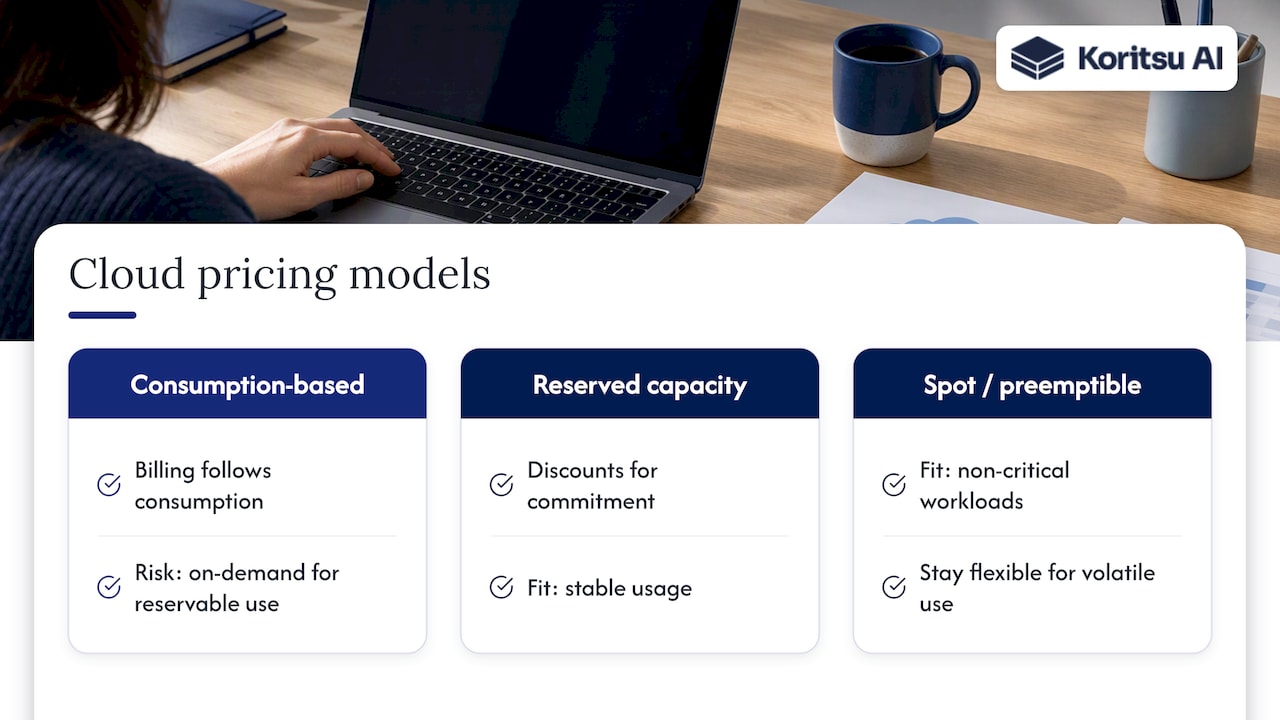
Contract structures tied to AI workloads add another layer of complexity, since usage can spike sharply during training runs and fall away during steady-state inference. Organisations that negotiate flat, usage-blind contracts for these workloads tend to either overpay during quiet periods or get caught short during a spike. The practical response is to match contract flexibility to workload volatility: commit where usage is stable, stay flexible where it is not, and review the mix at least annually as AI projects mature from experimentation into production.
9. Role of multi-cloud and hybrid cloud strategies in shaping UK cloud expenditure
Multi-cloud and hybrid strategies are no longer a resilience afterthought in the UK; they are a direct input into how organisations plan their 2026 budgets. The hybrid storage preference reported by 72% of UK respondents in Wasabi's survey for AI workloads is a clear signal: organisations are deliberately splitting workloads across environments rather than consolidating onto a single provider.
The financial logic is straightforward. Running workloads across multiple providers creates negotiating leverage, reduces exposure to a single vendor's price changes, and allows sensitive data to sit in a sovereign or on-premises environment while less sensitive workloads run wherever pricing is most favourable. The cost of that flexibility is complexity: multi-cloud environments typically require more sophisticated cost allocation, since spend is now split across billing systems with different units, discount structures and reporting formats.
For UK IT leaders, the expenditure implication is twofold. First, budget forecasting needs to account for each environment separately rather than assuming uniform pricing across providers. Second, the administrative overhead of managing multiple contracts and billing relationships is itself a cost, even when the headline unit prices look competitive. Organisations that get the governance right tend to capture the negotiating benefit without the hidden coordination tax.
10. Emerging technologies beyond AI influencing UK cloud cost dynamics
AI dominates the 2026 conversation, but it is not the only technology reshaping UK cloud bills. Edge computing is pulling processing closer to where data is generated, which reduces the volume of data that needs to travel back to central cloud regions and can lower egress costs for organisations with distributed operations such as retail, logistics or manufacturing.
Serverless architectures continue to change how compute is billed. Rather than paying for provisioned capacity that sits idle between requests, serverless models charge per execution, which suits workloads with unpredictable or spiky demand far better than reserved instances do. The trade-off is that cost visibility becomes harder: a serverless bill is the sum of many small charges rather than a handful of large, easily tracked line items, which makes granular cost allocation more important, not less.
Containerisation and infrastructure-as-code practices also feed into cost dynamics, since they make it easier to spin up environments quickly and, just as easily, to forget to tear them down. The organisations managing this well tend to pair these technologies with automated lifecycle policies and tagging enforced at deployment time, rather than relying on manual review after the fact.
Author perspective: what leaders should expect through 2026
The temptation in 2026 is to chase AI spend without matching it with equivalent discipline. That is a mistake. The cloud cost problem has never really been a technology problem: it is a process problem, and AI makes a lax process more expensive, not less.
Treat FinOps as a strategic function reporting alongside engineering and finance, not a monthly spreadsheet exercise. If there is one metric worth watching above all others, it is the gap between forecasted and billed spend per project: that number tells you whether your process is working before the bill does.
How Koritsu AI can help reduce your 2026 cloud spend
We start every engagement with a free assessment: our Savings Opportunity Report identifies where your cloud spend is being wasted, down to the service and feature level, before you commit to anything.
From there, you can move onto ongoing support through our FinOps as a Service tiers, from Monitor through to Premium, depending on how hands-on you want our specialists to be. We only take a share of the savings we actually find and verify against your bill, so there is no upfront cost to find out what is leaking.
- Start with a free Savings Opportunity Report to see where spend is being wasted.
- Choose a FinOps as a Service tier that matches how much hands-on support you need.
- Pay only on verified, bill-backed savings through our success-fee model.
If your cloud estate also needs a migration or infrastructure audit alongside cost optimisation, our partner Epicloud handles cloud migration and IT audit work. See our AI agent in action to understand how continuous monitoring fits into your existing stack.
FAQ
What is the UK cloud market forecast for 2026?
The UK cloud computing market is modelled at approximately $65 billion in 2026, according to Mordor Intelligence, with a projected compound annual growth rate of 15.86% through 2031. Statista's forecast data supports the same growth direction for UK cloud services revenue.
How is AI changing UK cloud spending in 2026?
AI is shifting UK cloud budgets toward infrastructure: Wasabi's Vanson Bourne survey found UK organisations allocate 62% of AI budgets to data, storage and compute rather than software. This makes compute and storage the main sources of cost variance in AI projects.
What is G-Cloud 15 and why does it matter for cloud spend?
G-Cloud 15 is the latest iteration of the UK public sector's cloud procurement framework, valued at approximately £14 billion over its four-year term according to GOV.UK. It is expected to channel around £3 billion in annual public-sector cloud spend, with roughly 90% of suppliers being SMEs.
How much cloud spend is wasted in the UK?
Specific UK waste figures centre on storage: Wasabi's Global Cloud Storage Index found that 48% of UK cloud storage spend goes on fees rather than usable capacity. Non-production accounts and unmanaged compute are the other commonly cited leak sources.
What is sovereign cloud and should UK businesses care about it?
Sovereign cloud refers to infrastructure and data processing kept within a specific jurisdiction to meet residency and regulatory requirements. Gartner forecasts worldwide sovereign cloud IaaS spending will reach $80 billion in 2026, a 35.6% rise, with Europe recording strong growth as UK and EU organisations respond to data residency and cross-border data transfer concerns.
Sources
- Gov
- Gartner forecasts worldwide IT spending to grow 14.2% in 2026, totaling $6.37 trillion
- Majority of UK businesses plan to increase AI infrastructure spend; With 62% of budgets allocated to data, storage and compute buildouts
- UK cloud computing market size, share & trends analysis report (Mordor Intelligence)