FinOps Inform
20–40% Cloud Savings: AI FinOps Platform and Experts for CTOs & CFOs
Start with a no-cost assessment to see how an AI FinOps platform plus specialists can unlock 20–40% first year cloud savings by fixing architecture, not...

AI FinOps pairs an AI platform that continuously analyses cloud spending with hands-on FinOps specialists who act on what it finds. It is not a dashboard subscription and it is not FinOps for AI workloads. The verdict for any CTO evaluating this now: run a no-cost cloud spend assessment first, then use a short vendor checklist before committing budget, because the savings worth chasing sit in architecture, not billing screens.
TL;DR:
- Conduct a no-cost cloud spend assessment to identify architecture-based waste before committing to a vendor.
- Rely on AI platforms paired with FinOps specialists to detect, validate, and fix anomalies rather than just using dashboards.
- Focus on architecture improvements like rightsizing, storage tiering, and spot capacity for maximum sustained savings.
- Expect first-year savings to reach 20-40 percent, with structural changes taking longer but delivering larger cumulative impacts.
- Verify vendor claims by examining baseline data, invoice reconciliation, and security practices, especially for multi-cloud environments.
What is AI FinOps and how does it differ from dashboards?
AI FinOps is the combination of continuous machine analysis of your billing and telemetry data with engineers who turn findings into fixes. The AI platform ingests cost and usage data across AWS, Azure, and GCP around the clock, flags anomalies, and ranks opportunities by size. FinOps specialists then validate each one, plan the remediation, and push changes through code and infrastructure.
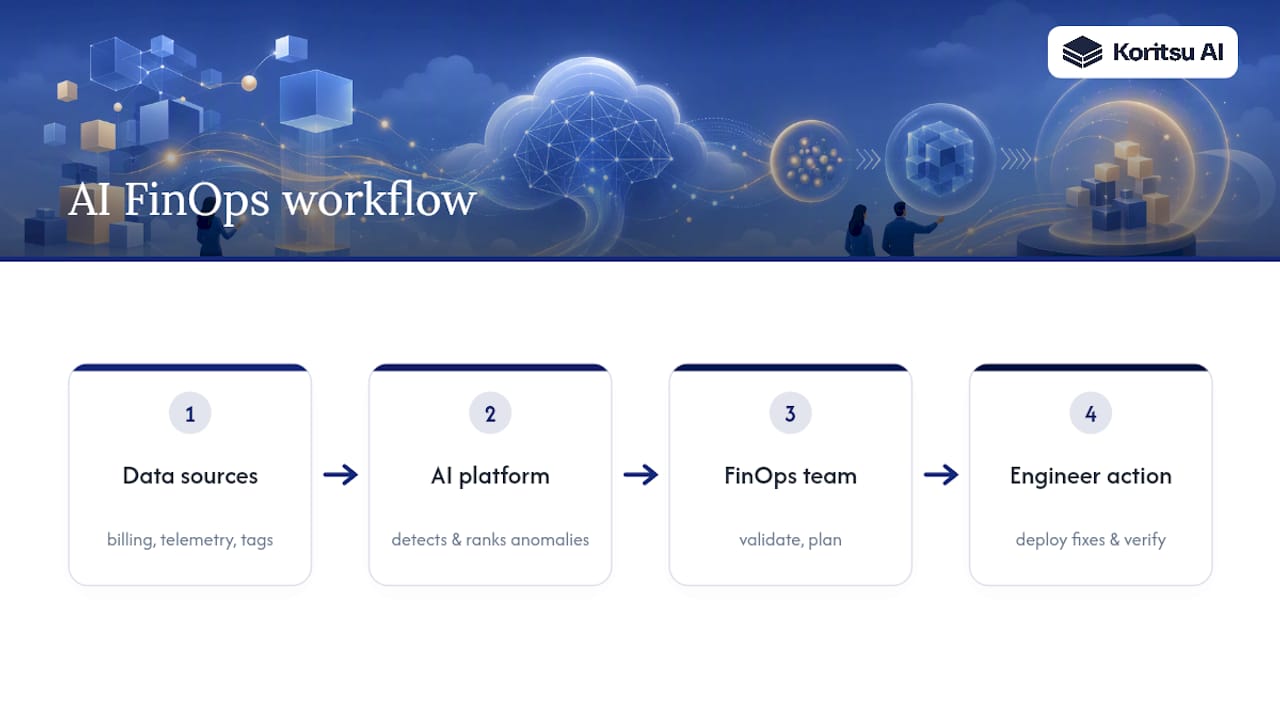
Dashboard-only tools stop at the first half of that. They will show you a spike in EC2 spend or an underused RDS instance, but someone still has to investigate why, decide what to change, and ship it. Cost management as a purely operational discipline without engineering accountability rarely produces sustained savings, because the recommendations never get executed. That gap between “here’s a chart” and “here’s a fix, deployed and verified” is the entire reason platform-plus-people exists as a category.
How do the AI platform and FinOps specialists work together?
The workflow starts with data: invoices, billing telemetry, resource tags, and observability signals feed the platform continuously, not once a quarter.
From there, the AI handles three jobs at machine speed. It detects anomalies (a sudden spike in cross-region transfer, an idle GPU cluster left running), prioritises them by potential savings, and calculates cost-per-unit metrics that tie spend to business output.
Specialists take over from there:
- Validate whether a flagged anomaly is a genuine waste or a legitimate business need
- Plan the remediation, whether that’s a rightsizing job, a re-architecture, or a commitment purchase
- Make the actual code and infrastructure changes, working alongside your engineering team
- Verify the saving against the next billing cycle before it counts
Governance runs alongside this: tagging discipline, showback or chargeback reporting by team or service, and a review cadence that keeps the loop running rather than a one-off audit. Tagging, quotas, and anomaly detection form the backbone of operational FinOps controls, and that backbone matters as much for standard cloud workloads as it does anywhere else.
Pro Tip: Insist on a tagging standard before you start measuring savings. Untagged resources make it nearly impossible to attribute cost to a team, and that ambiguity is where most FinOps programmes stall in month two.
What are the main cloud cost saving levers beyond discounts?
Reserved instances and savings plans get most of the attention, but they’re a fraction of what’s available. The bigger levers sit in how the infrastructure was actually built, and a good AI-driven cloud cost analysis surfaces them automatically instead of waiting for someone to notice.
- Rightsizing and instance-family moves: typically an 8–15% lever, triggered when utilisation sits consistently below 40%
- Commitments and savings plans: worth 10–20% on steady baseline load once usage patterns are stable enough to commit to
- Spot and interruptible capacity: 60–90% cheaper for CI pipelines, batch jobs, and other fault-tolerant work
- Storage tiering and lifecycle rules: 3–8% from moving cold data off premium tiers automatically
- Egress optimisation: 2–7% from CDN placement, VPC endpoints, and keeping traffic within a region
- Housekeeping: orphaned volumes, idle non-production environments, and unused snapshots that quietly accumulate cost
Those ranges come from practitioner benchmarks across mid-market engagements, and rightsizing, commitments, and storage tiering are consistently the highest-yield levers when applied together rather than one at a time. The order matters too: fix the architecture first, then layer commitments on top of a baseline you actually trust.
What do realistic cloud savings and timelines look like?
Typical first-year savings for a structured FinOps engagement are substantial, often with the bulk arriving during what’s usually called the optimise phase rather than the initial discovery work. That variance depends heavily on how much waste was baked into the original architecture and how quickly engineering can action the remediation backlog.
Quick wins (orphaned resources, scheduling, obvious rightsizing) show up within weeks and build credibility with finance early. Structural wins (architecture changes, re-platforming, commitment strategy) take longer, usually two to four months, but they carry the biggest sustained impact and tend to compound as usage grows.
| Phase | Typical timeframe | What it delivers |
|---|---|---|
| Discover | Weeks 1–2 | Baseline spend, tagging audit, anomaly list |
| Optimise | Weeks 3–10 | Rightsizing, commitments, architecture fixes |
| Operate | Ongoing | Continuous monitoring, alerts, governance |
Verification is where success-fee models earn their credibility. That means establishing a clean baseline month, reconciling every claimed saving against the actual invoice in the following billing cycle, and using automated alerts to catch regressions before they erase the gain. The optimise phase typically contains the majority of predictable first-year savings, which is exactly why measurement discipline needs to start before that phase, not after it.
Should you buy an AI FinOps service or build it internally?
Buying makes sense once your cloud estate has outgrown what a spreadsheet and a native billing console can track, and internal FinOps skill is thin on the ground.
- Buy when: spend is growing faster than headcount, multiple teams own separate accounts, or nobody internally has bandwidth to chase architecture-level waste
- Build when: spend is modest and stable, one platform (AWS, Azure, or GCP) covers most workloads, and you already have engineers with FinOps experience on staff
- Watch the hidden cost of building: tooling licences, the ongoing headcount to run continuous analysis, and the opportunity cost of engineers doing cost archaeology instead of product work
Native cloud tools with a simple showback dashboard are often sufficient at lower spend levels, but multi-cloud complexity changes that equation fast. Commercial models worth comparing include a no-upfront assessment paired with a success fee, fixed-price engagements, and ongoing subscriptions for continued monitoring.
How do you evaluate an AI FinOps vendor and avoid red flags?
Ask any prospective partner to show proof of architecture-level savings, not just a percentage claim on a case study page. Transparent measurement matters more than the headline number: can they show you the baseline, the invoice reconciliation, and the exact billing period the saving covers?
- Confirm they support all three major clouds if you run multi-cloud, not just AWS
- Ask how they verify savings against the actual bill, not their own dashboard
- Check whether their team can make code and infrastructure changes, or only recommend them
- Review their security and compliance posture before granting billing or infrastructure access
Pro Tip: Ask for a 30-60-90 day plan before signing anything. A credible partner can tell you what happens in the first month (discovery and tagging), the next two (remediation), and beyond (ongoing governance) without hesitating.
Data requirements and governance for effective AI FinOps
An AI platform is only as good as the data feeding it. Billing exports, resource tags, and observability telemetry all need to flow continuously, and gaps in any one of them create blind spots the AI can’t reason around.
Tagging is the single biggest governance dependency. Without a consistent tagging taxonomy across teams, services, and environments, cost allocation collapses into guesswork, and showback or chargeback reporting becomes unreliable the moment someone spins up an untagged resource. Most engagements start with a tagging audit precisely because of this: you cannot optimise what you cannot attribute.
Governance also means deciding who owns what. Cost accountability needs to sit with the engineering teams who actually control architecture decisions, not solely with finance, because engineering teams that own architecture and product outcomes are best placed to act on prioritised cost recommendations. That means a review cadence, usually monthly or per sprint, where flagged anomalies get triaged and assigned rather than left in a backlog.
Data retention and access controls matter too. Billing and usage data often reveals sensitive information about product usage patterns and customer volumes, so any AI FinOps platform needs role-based access and clear data handling policies before it touches production billing accounts. That’s a security conversation as much as a cost one, and it’s worth having before rollout rather than after.
How does AI FinOps integrate with existing cloud and finance tools?
Integration friction is the most common reason FinOps programmes stall after a promising pilot. Billing APIs from AWS, Azure, and GCP each expose data differently, and reconciling them into one consistent view of spend takes real engineering work, not a simple connector.
Finance teams typically run separate systems for budgeting and forecasting, and those rarely speak the same language as cloud billing exports. Getting cost-per-unit metrics into a format finance can actually use in a forecast model, rather than a raw AWS Cost Explorer export, is usually the difference between a FinOps programme finance trusts and one they ignore.
The practical fix is treating integration as a first project milestone, not an afterthought. That means:
- Mapping billing data from every cloud provider into one consistent taxonomy before analysis begins
- Connecting anomaly alerts into the tools engineering teams already monitor, rather than a separate dashboard nobody checks
- Feeding cost-per-unit metrics into existing finance forecasting tools so cloud spend sits alongside other operating costs
Cloud cost volatility strains finance forecasting, and that volatility only gets worse when finance and engineering are looking at two different numbers for the same month. A practical FinOps framework closes that gap by giving both sides one shared source of truth, which tends to matter more to adoption than any single feature of the AI platform itself.
What does real-world AI FinOps impact look like?
The most convincing evidence for AI FinOps isn’t a single case study headline. It’s the pattern across mid-market engagements: teams that combine continuous AI monitoring with engineering follow-through consistently land in that 20–40% first-year savings range, while teams that buy a dashboard and stop there rarely move the needle much past cleanup-level savings.

The mechanism behind that gap is straightforward. AI monitoring catches the anomaly on day one instead of during a quarterly review, and having engineers already engaged means the fix ships in weeks rather than sitting in a backlog behind feature work. Quick wins, like removing orphaned volumes, tend to happen fast and build trust with finance stakeholders early in an engagement.
Structural wins take longer but carry more weight. Re-architecting a service to use spot capacity for its batch workload, or restructuring how a data pipeline stores cold data, are the kind of changes that compound as usage grows rather than delivering a one-time saving. Quick wins build credibility while structural, architecture-level changes deliver the largest sustained savings, which is why the strongest engagements deliberately sequence both types of work rather than chasing only the fast, visible fixes.
The pattern holds across sectors because the underlying problem is universal: most cloud waste is architectural, not procedural, and architectural problems need engineers, not just reports.
What security and compliance issues matter in AI-driven FinOps?
Granting a third-party platform access to billing and infrastructure data raises legitimate questions, and any serious AI FinOps partner should answer them before you sign anything.
Access scope comes first. A platform analysing cost data typically needs read access to billing exports and resource metadata, not write access to production systems, and any specialist making infrastructure changes should work through your existing change management process rather than around it. Ask specifically what permissions the platform requires and whether they’re scoped to the minimum necessary.
Data handling matters just as much. Billing telemetry can reveal usage patterns that hint at customer volumes or product roadmaps, so encryption in transit and at rest, clear data retention limits, and documented access controls aren’t optional extras.
For regulated industries, compliance certifications and audit trails around who accessed what data and when become a procurement requirement rather than a nice-to-have. Any engagement that touches production infrastructure should also have a clear rollback plan for every change, so a remediation that goes wrong can be reversed quickly rather than debugged live.
What’s next for AI FinOps?
Unit economics are becoming the standard way teams talk about cloud cost, replacing flat “total spend” figures with metrics like cost-per-request or cost-per-feature that tie spend directly to product decisions. Tracking new unit metrics ties cloud spend to actual product economics rather than a number finance can’t act on, and that shift is likely to keep accelerating.
Cloud spend volatility is also pushing FinOps and finance closer together operationally, not just organisationally. AI and machine learning workloads already represent a material share of cloud costs at many mid-market companies, and that volatility is forcing continuous monitoring rather than the quarterly review cycle that used to be standard. Expect anomaly detection to get faster and more specific over the next few years, catching cost spikes within hours rather than at the end of a billing period.
The bigger shift is cultural: cost accountability keeps moving closer to the engineers who write the code, rather than sitting exclusively with finance or a central FinOps team. That trend favours tools that surface prioritised, specific recommendations engineers can act on immediately, over generic dashboards that require someone else to interpret them.
Publisher perspective: why Koritsu recommends a platform-plus-experts model
Continuous AI triage catches what quarterly reviews miss. Kori flags the anomaly the day it happens; our specialists decide whether it’s waste or a genuine business need, then fix it in the code. That combination is what surfaces architecture-level savings dashboards never find. We back it with a no-upfront assessment and a success fee tied to savings we actually deliver, verified against your bill.
How to start with Koritsu AI’s no-cost assessment
Koritsu AI is the alternative to committing budget on a dashboard tool that only tells you where the spend went, not what to do about it. The free assessment gives you a prioritised list of remediation candidates, specific to your architecture, with concrete savings estimates attached to each one before you pay anything.
From there, the success-fee model does the work of reducing your procurement risk: we take a share of the savings we actually find and verify against your invoices, so there’s no cost if we don’t deliver. Clients who want ongoing monitoring can move onto a subscription for continued platform access and specialist support once the initial engagement proves out.
If your cloud bill has grown faster than your confidence in where it’s going, start with the free cloud cost assessment and see what a prioritised remediation list actually looks like for your infrastructure.
Sources
- Reducing Cloud Costs — FinOps Guide for Mid-Market Companies 2026
- FinOps can manage AI computing costs — experts say
- FinOps for AI overview — FinOps Foundation
- Cloud costs now No. 2 expense at midsize IT companies behind labor