FinOps Inform · AI FinOps
Benefits of AI-driven cloud analysis for CTOs
Discover the benefits of AI-driven cloud analysis for CTOs. Optimize costs, enhance operations, and boost efficiency in your cloud strategy.

AI-driven cloud analysis is the process of using artificial intelligence to automatically monitor, assess, and optimise cloud infrastructure costs and operations to maximise business value. For CTOs and engineering leaders running workloads on AWS, Google Cloud, or Azure, this is no longer a nice-to-have capability. The benefits of AI-driven cloud analysis are measurable and immediate: organisations report cost reductions of 30% to 50%, faster fault detection, and governance that scales with complexity. The savings are rarely found in discount programmes. They are buried in how your software and infrastructure were built.
How AI-driven analysis achieves cloud cost optimisation
AI-driven cloud analysis reduces cloud spending through three core mechanisms: automated rightsizing, inefficiency detection, and continuous spend monitoring. Together, these capabilities address the structural inefficiencies that manual FinOps reviews consistently miss. The result is that cloud spend reductions of 30% to 50% are achievable through intelligent resource management alone, not through renegotiated contracts or reserved instance purchases.
Rightsizing is the process of matching compute, memory, and storage allocations to actual workload demand. AI models analyse historical utilisation patterns and recommend downsizing or terminating over-provisioned resources automatically. This is where most organisations leave significant money on the table, because manual reviews happen quarterly at best, while cloud inefficiency accumulates daily.

Machine learning anomaly detection adds another layer. AI agents can detect misconfigured auto scaling and unused resources in real time, triggering corrective actions before costs compound. A spike in data transfer costs at 2am on a Sunday is caught and flagged before it appears on your monthly bill.
Running large-scale AI analyses does carry its own infrastructure cost. Batching recommendations weekly rather than running continuous real-time analysis is more cost-effective for most workloads. This is a practical constraint that many vendors understate.
- Automated rightsizing recommendations based on utilisation history
- Real-time anomaly alerts for spend spikes and misconfigured resources
- Idle resource identification across compute, storage, and networking
- Scheduled batch analysis to reduce AI compute overhead
Pro Tip: Set your AI analysis cadence to match your deployment frequency. Teams shipping daily need near-real-time alerts. Teams on two-week sprints get better value from weekly batch reports with prioritised recommendations.
Enhancing operational efficiency through AI in cloud analysis
AI-powered cloud operations improve business agility by 20% through agentic process automation and intelligent orchestration. That figure reflects a genuine shift in how engineering teams operate, not just faster dashboards. When AI handles routine monitoring, your engineers stop reacting to noise and start working on architecture that matters.
Predictive failure detection is one of the most undervalued advantages of cloud analytics. AI models trained on infrastructure telemetry can identify degradation patterns hours before a service fails. This shifts your operations posture from reactive incident response to proactive fault prevention, which directly reduces mean time to recovery and the engineering hours spent on post-mortems.
Automated monitoring also removes a significant source of human error. Manual threshold-setting across hundreds of services is imprecise and rarely kept current. AI continuously recalibrates alert thresholds based on evolving traffic patterns, which means fewer false positives and fewer missed incidents.
The operational benefits extend into the software delivery lifecycle as well:
- Faster continuous deployment cycles through automated infrastructure validation
- AI-assisted code review flagging cost-inefficient patterns before they reach production
- Automated security scanning integrated into CI/CD pipelines
- Intelligent orchestration of cloud-native workloads across multi-region environments
- Reduced on-call burden through AI-driven triage and root cause analysis
Cloud-native environments running Kubernetes particularly benefit from AI orchestration. Tools like Kubecost surface per-namespace and per-workload cost attribution that generic cloud billing consoles cannot provide, giving platform engineering teams the granularity they need to hold product teams accountable for their infrastructure spend.
AI-driven cloud analysis for security and governance
Deploying AI-integrated cloud security platforms can deliver a 264% ROI over three years, with payback in under six months. That figure, from CrowdStrike’s Falcon platform analysis, reflects the compounded value of automated threat detection, reduced analyst workload, and faster incident containment. Security and cost governance are not separate problems. AI treats them as a unified data problem.
AI-powered anomaly detection identifies both security threats and cost policy violations using the same underlying telemetry. An unusual data egress pattern might indicate a misconfigured pipeline or a breach. AI surfaces both simultaneously, which means your security and FinOps teams are working from the same signal rather than separate dashboards.
Shift-left governance means embedding cost and security decisions at the architecture stage, not the billing review stage. AI makes this practical by surfacing policy violations in infrastructure-as-code before resources are provisioned.
FinOps has evolved into a real-time engineering discipline through AI integration, shifting cost governance left into development and architecture decisions. This includes choices about cloud region selection, GPU instance type, and data residency strategy. These decisions have significant cost implications that are invisible without AI-driven analysis at the point of design.
Pro Tip: Align your FinOps and security tooling around a shared data layer. When cost anomaly detection and threat detection share the same event stream, you reduce tooling overhead and improve signal quality for both teams.
Comparing leading AI cloud analysis tools and platforms
Choosing the wrong AI cloud platform for your workload profile can lead to 30% to 200% higher cloud costs. That variance is not a rounding error. It reflects genuine differences in how ML models handle rightsizing, anomaly detection, and workload-specific optimisation.
| Tool | Strengths | Limitations | Best suited for |
|---|---|---|---|
| AWS Bedrock | Native AWS integration, broad model selection | Limited cross-cloud visibility | AWS-native workloads requiring embedded AI |
| Spot by NetApp | Spot instance automation, significant compute savings | Primarily compute-focused | Fault-tolerant batch and stateless workloads |
| Kubecost | Granular Kubernetes cost attribution | Requires Kubernetes environment | Platform engineering teams managing K8s clusters |
| Koritsu AI | Combined AI platform and expert advisory, outcome-based pricing | Newer entrant | Engineering teams wanting hands-on FinOps support |
AWS Bedrock provides strong native integration for teams already committed to the AWS ecosystem, but its cost visibility does not extend meaningfully to Google Cloud or Azure workloads. Spot by NetApp excels at automating spot instance management for stateless workloads, delivering compute savings that can be substantial for batch processing pipelines. Kubecost is the standard choice for Kubernetes cost attribution, though it requires a Kubernetes environment to deliver value.
AI-powered cloud cost tools like these differ most significantly in their anomaly detection sophistication and the quality of their rightsizing recommendations. Generic threshold-based alerts are not AI. Look for tools that use ML models trained on workload-specific patterns, not static rules.
Event-driven architectures that trigger AI analysis on data change rather than continuous polling reduce compute overhead and improve insight freshness. This architectural pattern is worth evaluating when selecting or configuring any AI cloud analysis platform.
Best practices for implementing AI-driven cloud analysis
The organisations that extract the most value from AI cloud analysis treat it as an engineering competency, not a procurement decision. That means embedding FinOps into the software delivery lifecycle from the first architecture review, not bolting it on after costs have already escalated.
- Start with visibility before automation. Deploy cost attribution and anomaly alerting first. Understand where your spend is going before you let AI make changes automatically.
- Embed cost governance into infrastructure-as-code. Policy checks at the pull request stage catch expensive misconfigurations before they reach production.
- Align cloud region selection, GPU instance type, and data residency decisions with cost modelling at the design stage. Embedding FinOps into application development shifts these decisions to where they have the most impact.
- Use event-driven AI analysis rather than continuous polling where possible. This reduces the infrastructure cost of the analysis itself while maintaining timely insights.
- Review AI recommendations with engineering context before automating remediation. Rightsizing a database instance that is provisioned for peak load, not average load, will cause an outage.
The balance between cost and innovation is a genuine tension. Over-optimising early with AI-driven cloud tools can stifle innovation. Engineering leaders should prioritise context-aware spending aligned with business outcomes, not the lowest possible bill. A team building a new product feature needs headroom. A stable production service running at 15% CPU utilisation does not.
Pro Tip: Create a cross-functional FinOps working group with representation from engineering, finance, and security. AI surfaces the data. Humans still need to make the trade-offs between cost, reliability, and velocity.
Key takeaways
AI-driven cloud analysis delivers its greatest value when it is embedded into engineering processes from the architecture stage, not applied retrospectively to an already-expensive infrastructure.
| Point | Details |
|---|---|
| Cost reduction is structural | AI rightsizing and inefficiency detection reduce cloud spend by 30% to 50% by fixing how infrastructure was built. |
| Security and FinOps share a signal | AI anomaly detection serves both cost governance and threat detection from the same telemetry. |
| Tool selection determines outcome | Choosing the wrong platform for your workload profile can increase costs by up to 200%. |
| Shift-left governance is practical | Embedding cost and policy checks into infrastructure-as-code prevents expensive decisions at the design stage. |
| Balance automation with judgement | AI recommendations require engineering context before automated remediation to avoid reliability trade-offs. |
Where most teams get AI cloud analysis wrong
The share of organisations not measuring ROI on AI spending dropped from 27% to 18%, which tells me boards are paying attention. But measuring ROI and extracting ROI are different things. Most teams I see are doing the former without the latter.
The most common mistake is treating AI cloud analysis as a reporting tool rather than an operational one. You get dashboards showing inefficiency. You do not get a process for fixing it. The AI surfaces the opportunity. Without an engineering team empowered to act, the insight expires.
The most important shift in 2026 is moving from cost awareness to assessing the technology value delivered by AI investments. That framing changes what you measure. Instead of asking “how much did we save?”, you ask “what business outcome did this infrastructure investment enable?” That is a harder question, but it is the right one for a CTO to be asking.
The emerging FinOps Enabled Executive role reflects this shift. Cloud cost is not a technology problem. It is a process problem that sits at the intersection of engineering, finance, and product strategy. AI gives you the data to make that conversation precise. It does not replace the conversation.
My advice: start with a cloud total cost of ownership baseline before deploying any AI analysis tooling. You cannot measure improvement without a starting point, and you cannot build organisational trust in AI recommendations without demonstrating that the baseline was accurate.
See how Koritsu AI finds what your cloud bill is hiding
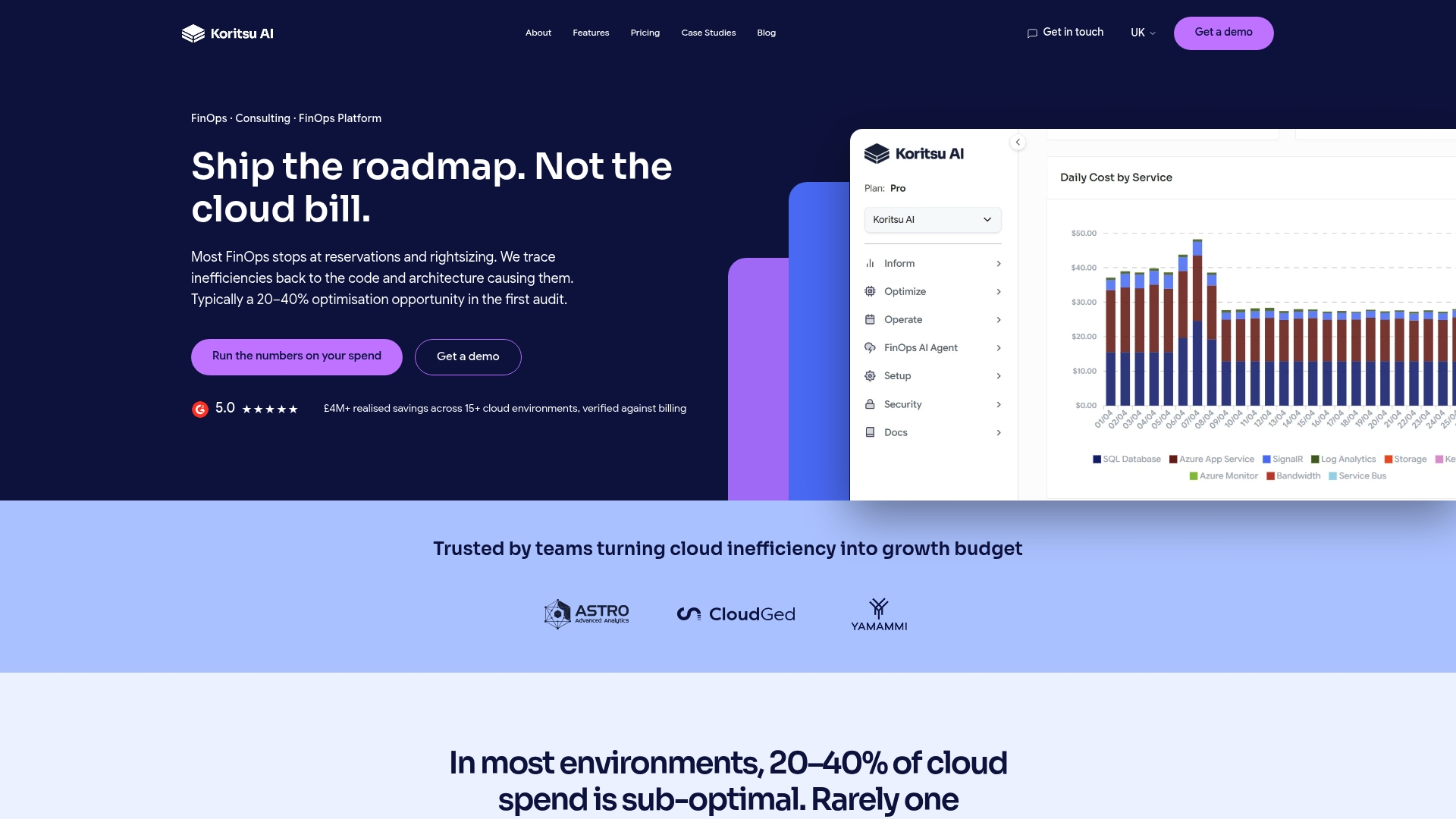
Most cloud cost problems are not visible in your billing console. They are in your architecture. Koritsu AI combines a continuously running AI platform with hands-on expert advice to surface exactly where money is being lost and help your team fix it. One UK bidding platform achieved a 52% reduction in cloud costs after working with Koritsu. You start with a free assessment, and Koritsu only charges a share of the savings actually found. If you are ready to align cloud costs with business outcomes, explore what Koritsu’s AI-driven FinOps platform can surface for your team.
FAQ
What are the main benefits of AI-driven cloud analysis?
AI-driven cloud analysis reduces cloud spending by 30% to 50% through automated rightsizing and inefficiency detection, improves operational agility by 20%, and strengthens security governance through real-time anomaly detection. It also shifts cost decisions earlier in the software delivery lifecycle, where they have the greatest impact.
How does AI help with cloud cost optimisation specifically?
AI analyses historical utilisation data to recommend rightsizing, detects misconfigured resources in real time, and flags spend anomalies before they compound. Batching these analyses weekly rather than continuously reduces the infrastructure cost of the AI tooling itself.
Which AI cloud analysis tools should CTOs evaluate?
The leading tools include Kubecost for Kubernetes cost attribution, Spot by NetApp for spot instance automation, AWS Bedrock for native AWS AI integration, and Koritsu AI for combined platform analysis with expert advisory support. Tool selection should be driven by your workload profile, as the wrong fit can increase costs by up to 200%.
How does AI-driven cloud analysis improve security governance?
AI-powered platforms like CrowdStrike Falcon deliver a 264% ROI over three years by automating threat detection and policy compliance monitoring. The same anomaly detection models that flag cost violations also surface unusual access patterns and data egress, giving security and FinOps teams a shared signal.
When should engineering teams start embedding FinOps into their development process?
FinOps should be embedded from the first architecture review, covering decisions like cloud region selection, GPU instance type, and data residency strategy. Embedding cost governance into infrastructure-as-code at the pull request stage prevents expensive misconfigurations from reaching production.