FinOps Inform · Unit Economics
What is cloud unit economics? A guide for finance leaders
Discover what cloud unit economics are and why they matter. Learn how to connect cloud costs to business value for smarter financial governance.

Cloud unit economics is defined as the measurement of cloud infrastructure cost per discrete unit of business value delivered, such as a customer served, a transaction processed, or an API call completed. Most finance and engineering teams track total cloud spend. That number tells you how much you are paying. It does not tell you whether you are getting value for it. Cloud unit economics closes that gap by linking spend to outcomes rather than aggregate billing lines. The FinOps Foundation, Datadog, and practitioners across SaaS and AI businesses treat this as the foundational metric for cloud financial governance.
What is cloud unit economics and why does it matter?
Cloud unit economics measures the cost to deliver one defined unit of business value, translating raw infrastructure bills into actionable business KPIs. Common metrics include cost per active user, cost per transaction, cost per API call, and cost per model inference. Each of these converts a line on an AWS, Google Cloud, or Azure invoice into something a product manager or CFO can reason about.
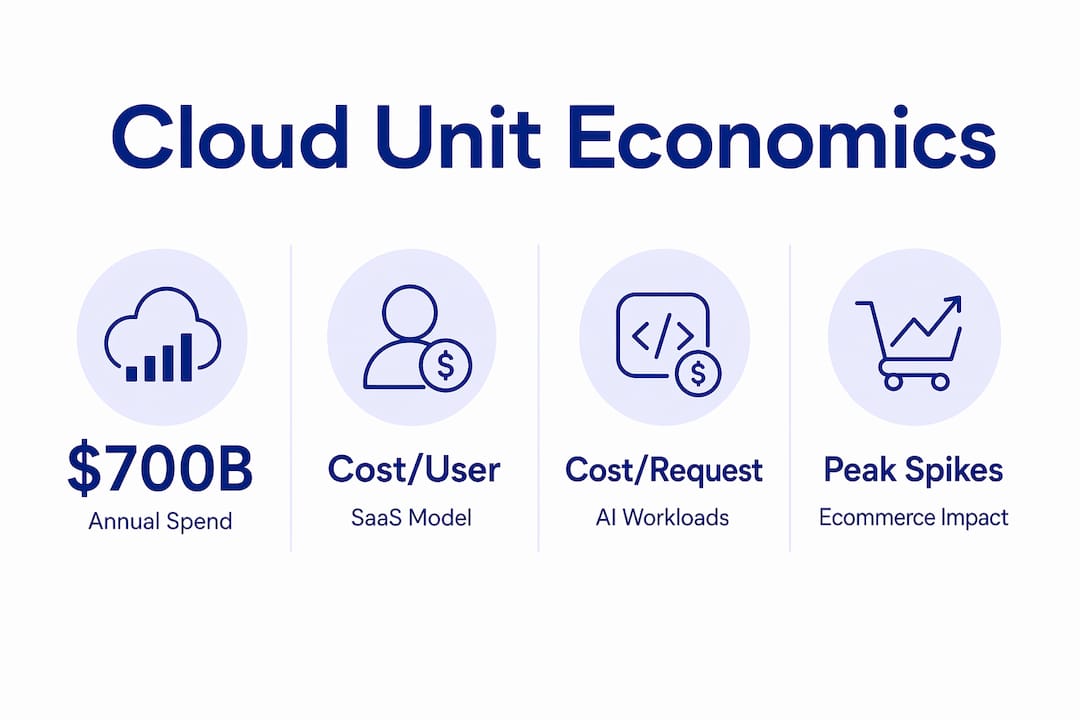
The reason this matters is straightforward. Global cloud spending now exceeds $700 billion annually, with an estimated 20 to 30 per cent of that spend wasted on inefficiency. When you manage only the total bill, you cannot tell whether a cost increase reflects growth or waste. When you manage cost per unit, the answer is immediate: if revenue per customer is rising but cost per customer is also rising, you have a margin problem that needs fixing.

Normalising cost by value delivered is what separates cloud cost management from cloud cost optimisation. The former is reactive. The latter is strategic. Unit economics is the mechanism that makes optimisation meaningful rather than arbitrary.
How cloud unit economics links costs to business outcomes
The practical power of unit economics lies in its ability to convert infrastructure decisions into business language. A reduction in compute spend is interesting to an engineer. A 12 per cent reduction in cost per customer is interesting to a CFO, a board, and an investor.
Unit metrics serve several distinct functions within an organisation:
- Forecasting: If your cost per transaction is stable at £0.003 and you project 50 million transactions next quarter, your cloud cost forecast is precise and defensible.
- Pricing strategy: SaaS businesses use cost per active user to set subscription tiers. If your cost per user exceeds your gross margin target, the pricing model is broken before you scale.
- Optimisation targeting: Unit economics turns optimisation into a value-based discussion. You are not cutting spend arbitrarily. You are reducing the cost to deliver a unit of value.
- Architectural accountability: Engineers can see the cost impact of their design choices expressed in business terms, not just compute hours.
The FinOps Foundation uses the Webpage per Dollar metric as a canonical example: how many webpages does your infrastructure serve per dollar of cloud spend? Measuring this metric over time reveals whether architectural changes improve or degrade efficiency. A refactoring project that reduces latency but doubles cost per page served is not a win, regardless of how it looks on a performance dashboard.
Pro Tip: Select your unit metric based on what your business actually charges for or what drives revenue. A SaaS business should track cost per active user. An API business should track cost per API call. If the metric does not map to how you earn money, it will not drive the right decisions.
Unit cost models across SaaS, AI, and ecommerce
Different business models require different unit denominators. There is no universal metric. The table below illustrates the most common models and the cost components typically included in each.
| Business type | Primary unit metric | Cost components included |
|---|---|---|
| SaaS | Cost per active user | Compute, storage, database, SaaS tooling licences |
| AI / LLM | Cost per inference request or token | GPU compute, model hosting, bandwidth, telemetry |
| Ecommerce | Cost per order or transaction | Compute, CDN, payment API calls, storage |
| API platform | Cost per API call | Compute, egress, rate limiting infrastructure |
| Media / streaming | Cost per stream or content hour | Bandwidth, transcoding compute, CDN, storage |
For AI workloads, the calculation is considerably more complex. Classical cloud cost models miss AI workload variability; per-request telemetry including token counts, model identifiers, and latency must be captured and reconciled against invoices to produce a true cost per inference. A business running GPT-4o class models on Azure OpenAI or AWS Bedrock cannot rely on a simple compute allocation. Token consumption varies by prompt length, model version, and user behaviour, all of which must be captured at the request level.
Ecommerce businesses face a different challenge: cost spikes during peak trading periods. Black Friday traffic can increase transaction volume tenfold. If cloud costs scale proportionally, unit economics remain stable. If costs scale faster than volume due to inefficient auto-scaling or over-provisioned reserved capacity, the cost per order rises precisely when margins are under the most pressure.
Understanding egress fees is also relevant here. Data transfer costs are often excluded from unit cost calculations because they are difficult to attribute, yet they can represent a significant share of total spend for API-heavy or media businesses.
Why unit economics is vital for cloud governance
Cloud cost is not a technology problem. It is a process problem. Without unit economics, finance teams see a total bill. Engineering teams see compute metrics. Neither group has a shared language for making decisions together.
FinOps links cloud spend to ownership and outcomes, creating operational accountability by connecting cost per transaction, per customer, or per feature to the teams responsible for building and running those services. This is the governance function of unit economics: it assigns financial ownership to engineering decisions.
The consequences of operating without unit economics are predictable and costly:
- Cost overruns are invisible until the invoice arrives, by which point the architectural decision causing them has already been deployed.
- Optimisation efforts target the largest absolute spend rather than the least efficient spend, which are rarely the same thing.
- Finance teams cannot build credible cloud budgets because spend is disconnected from the business drivers that actually determine volume.
- Engineering teams have no feedback loop between their design choices and their financial impact.
- AI workloads, where per-request compute cost varies dramatically by model and prompt, become impossible to govern without request-level attribution.
The shift from managing total spend to managing cost per unit is an operational change, not just a reporting change. It requires tagging infrastructure by product and team, building allocation models that distribute shared costs, and creating dashboards that surface unit cost trends alongside performance metrics. That is a meaningful investment. It is also the only way to know whether your cloud spend is scaling efficiently with your business.
How to implement cloud unit economics in budgeting
Implementing unit economics is a structured process. The following steps reflect how organisations with mature FinOps practices approach it.
-
Define your unit metric. Identify the output your business sells or the action that drives revenue. For most SaaS businesses, this is the active user. For API businesses, it is the API call. The choice of unit metric is critical; an incorrect denominator misleads optimisation efforts and misaligns ownership.
-
Tag your infrastructure. Apply consistent resource tags in AWS, Google Cloud, or Azure that map compute, storage, and network resources to products, features, and teams. Without tagging, cost attribution is guesswork.
-
Build your cost allocation model. Separate direct costs (resources used exclusively by one product) from shared costs (databases, monitoring, security tooling). Allocate shared costs using a defensible method, such as proportional usage or fixed percentage splits agreed with finance.
-
Calculate your baseline unit cost. Divide total attributed cost by total unit volume for a defined period, typically monthly. This is your baseline. Every optimisation effort should be measured against it.
-
Monitor unit cost as a continuous KPI. Unit economics should be a continuous KPI, not a one-time exercise. Trend analysis alongside performance metrics detects architectural drift, where costs rise without a commensurate increase in value delivered.
-
Align optimisation to unit cost reduction. Rightsizing, spot instance adoption, and caching improvements should all be evaluated by their impact on unit cost, not just their absolute saving. Spot instances offer up to 90% discount but require fault-tolerant architectures, which is itself an engineering investment that must be weighed against the unit cost benefit.
Pro Tip: Avoid tracking unit costs in isolation. Always pair them with a performance or quality metric for the same unit. A falling cost per API call that coincides with rising error rates is not an improvement. It is a degradation that happens to be cheap.
Key takeaways
Cloud unit economics works because it converts aggregate cloud spend into per-unit cost metrics that link directly to business outcomes, enabling governance, forecasting, and meaningful optimisation.
| Point | Details |
|---|---|
| Definition of unit economics | Cloud unit economics measures cost per discrete business value unit, such as per user, transaction, or API call. |
| Governance and accountability | FinOps frameworks use unit metrics to assign cost ownership to engineering teams and align finance decisions. |
| Business model determines the metric | SaaS tracks cost per active user; AI tracks cost per inference; ecommerce tracks cost per order. |
| Continuous monitoring is required | Unit cost should be tracked as an ongoing KPI with trend analysis, not calculated once and filed. |
| Incorrect metrics mislead decisions | Choosing the wrong denominator misaligns optimisation efforts and obscures true cost drivers. |
The metric that changes how you see cloud spend
I have seen organisations spend months debating whether to move workloads between AWS and Google Cloud in search of savings. In almost every case, the real problem was not the provider. It was that nobody could articulate what a unit of value actually cost to deliver. The conversation was about the total bill, not about efficiency.
The cultural shift required to adopt unit economics is underestimated. Engineering teams need visibility into cost data they have rarely seen before. Finance teams need to accept that cloud budgets are driven by product usage, not by headcount or procurement cycles. Getting those two groups to agree on a shared metric, and then to trust it, takes longer than building the tagging model.
The misconception I encounter most often is that unit economics is a reporting exercise. It is not. It is a decision-making framework. When a team proposes a new microservice architecture, the right question is not “how much will this cost?” It is “what will this do to our cost per transaction?” Those are different questions, and only the second one produces a useful answer.
The organisations that get this right do not just reduce their cloud bills. They build the financial infrastructure to scale without margin erosion. That is the practical value of cloud unit economics, and it is worth the investment to implement it properly.
How Koritsu AI makes unit economics practical
Understanding unit economics is one thing. Implementing it across a live cloud environment with multiple teams, shared infrastructure, and inconsistent tagging is another challenge entirely.
Koritsu AI combines an AI platform with hands-on expert advice to make this practical. Kori, our AI agent, continuously analyses your AWS, Google Cloud, or Azure spend and surfaces where unit costs are rising, where attribution is broken, and where engineering decisions are creating financial inefficiency. Our specialists help your teams act on those findings. You can see how this works in practice in our UK bidding platform case study, where a client achieved a 52 per cent reduction in cloud costs. Clients start with a free cloud assessment and we only charge when we deliver measurable savings.
FAQ
What is cloud unit economics in simple terms?
Cloud unit economics is the practice of measuring how much it costs to deliver one unit of business value using cloud infrastructure, such as serving one customer, processing one transaction, or completing one API call. It converts aggregate cloud bills into metrics that finance and product teams can act on.
How do you calculate unit economics for a SaaS business?
Divide your total attributed cloud cost for a period by the number of active users in that same period. The result is your cost per active user. Refine this by separating direct product costs from shared infrastructure costs using a consistent allocation model.
Why is the choice of unit metric so important?
An incorrect denominator can mislead optimisation efforts entirely. If your unit metric does not map to how your business creates and captures value, the resulting cost data will drive decisions that improve the metric without improving the business.
How does cloud unit economics apply to AI workloads?
AI workloads require per-request telemetry including token counts, model identifiers, and latency to calculate a true cost per inference. Standard compute allocation models are insufficient because AI cost variability is driven by prompt complexity and model selection, not just instance hours.
How often should unit costs be reviewed?
Unit costs should be monitored continuously as a live KPI, not reviewed quarterly. Trend analysis over time is what reveals architectural drift, where costs increase without a corresponding increase in value delivered.