FinOps Inform
Cloud savings share model explained for UK companies
Discover how the cloud savings share model explained can help UK companies save on cloud costs. Pay only when savings occur!

What is a cloud savings share model?

A cloud savings share model is a financial arrangement where a provider manages cloud commitment purchases on your behalf and takes a percentage of the savings generated. You pay nothing upfront. You pay nothing if no savings materialise. The provider’s fee comes directly out of what they actually save you.
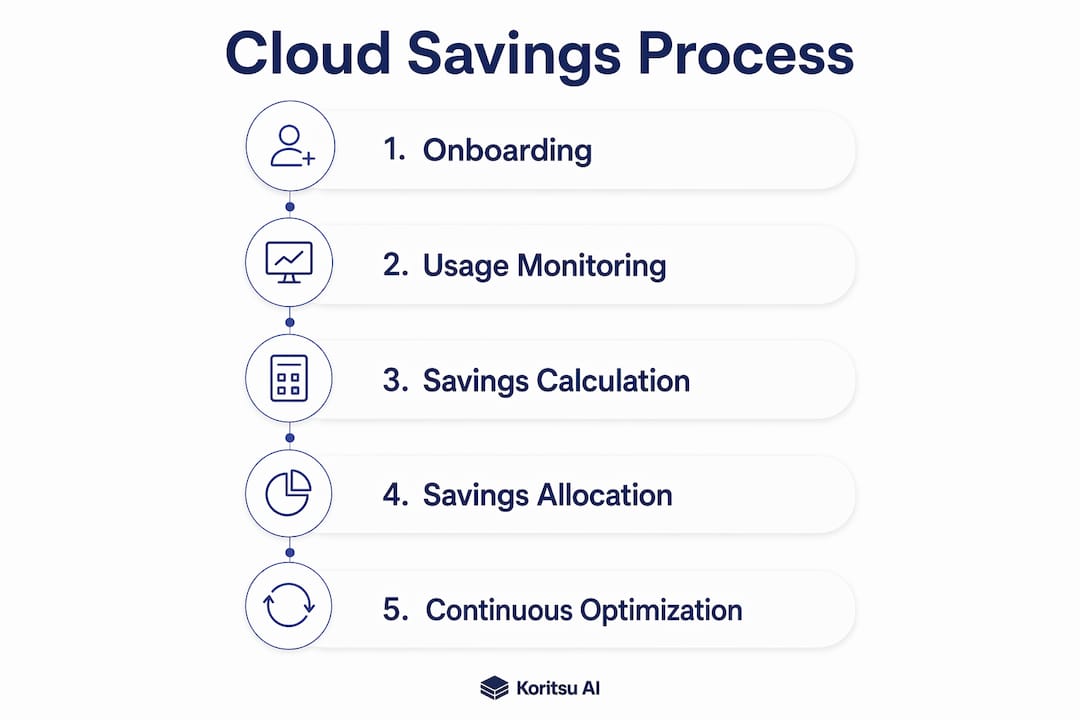
In practice, this works as follows:
- You grant the provider read-only access to your cloud billing and usage data
- They analyse your historical spend and identify commitment opportunities, typically Reserved Instances or Savings Plans on AWS, Google Cloud, or Azure
- They propose a commitment strategy, which you approve before anything is purchased
- The provider purchases and manages those commitments, pooling financial risk across their client base
- Savings are calculated net of the provider’s share and returned to you
Reserved Instances and Savings Plans can achieve 40–45% off AWS on-demand pricing. That is the pool of value the model draws from.
One important caveat: the savings share model addresses commitment-based discounts. It does not replace the internal cloud financial management work your teams must do, including rightsizing, usage monitoring, and cost allocation.
How the model works in practice, and where it gets complicated
The engagement process
Onboarding is typically quick. You grant read-only IAM role access, and automated tools begin monitoring your usage continuously, purchasing and adjusting commitments in real time as capacity changes.
Roles and responsibilities
The provider carries the financial risk of over-provisioning. Reputable providers offer buy-back guarantees, meaning if a commitment goes unused, you receive a full refund for those unused dollars. Risk pooling across multiple clients neutralises the exposure that would otherwise fall on you individually.
Your responsibilities do not disappear, though. Internal resource decisions directly affect how much the model can save. If your teams are running oversized instances or leaving idle resources running, the commitment strategy will be built on a wasteful baseline.
How savings are calculated
This is where scrutiny matters. Some providers report savings by comparing your new costs against full on-demand rates, even when you were already managing some discounts yourself. A credible provider compares against an optimised baseline, not an inflated one. Ask specifically how the baseline is defined before signing anything.
UK-specific considerations
UK companies should ensure contracts clearly document how savings are recognised and allocated across cost centres. HMRC may require this documentation for accurate financial reporting, particularly where savings affect departmental budgets or inter-company recharges. Contract design influences compliance, so involve your finance and legal teams early.
Integration with broader cloud financial management
The savings share model is one lever, not the whole strategy. Cloud financial management also encompasses forecasting, budgeting, chargeback or showback models, and building cost accountability across engineering teams. Managed IT services that align financial operations with cloud governance can reinforce this discipline. Without that internal framework, savings from commitments erode quickly as new waste accumulates.
Pro Tip: Before engaging a savings share provider, run a cloud FinOps audit internally. Providers who see clean tagging, rightsized resources, and clear cost allocation will build a more accurate commitment strategy, which means larger verified savings for you.
Common pitfalls
- Approving commitment strategies without understanding the term length or flexibility constraints
- Failing to track whether commitments go unused due to workload changes post-purchase
- Treating the model as a substitute for rightsizing rather than a complement to it
- Accepting savings reports without verifying the baseline methodology
Koritsu AI delivers savings you can verify
Most cloud cost is not a pricing problem. It is a process problem buried in how infrastructure was built and how commitments are managed. Koritsu AI addresses both.
Koritsu AI combines an AI platform that continuously analyses your AWS, Google Cloud, or Azure spend with hands-on expert guidance. The AI agent Kori surfaces exactly where money is being lost. Specialists then help your engineering teams act on it. A UK bidding platform reduced its cloud costs by 52% using this approach. There are no upfront fees. Koritsu AI takes a share of the savings actually delivered. Start with a free assessment at koritsu.ai.
Key takeaways
A cloud savings share model only delivers lasting value when paired with internal cloud financial management discipline.
| Point | Details |
|---|---|
| No upfront cost | You pay only a share of documented savings; if nothing is saved, nothing is owed. |
| Commitment discounts | Reserved Instances and Savings Plans can achieve 40–45% off AWS on-demand pricing. |
| Baseline transparency | Insist savings are measured against an optimised baseline, not inflated on-demand rates. |
| UK compliance | HMRC documentation of savings allocation is required for accurate financial reporting. |
| Koritsu AI | Combines AI-driven spend analysis with expert guidance; free assessment, pay only on results. |