FinOps Inform
Cloud Commitment Management for FinOps Teams: Verify AI Savings
Learn how FinOps teams size cloud commitments, track utilization, and use AI recommendations to verify bill savings with a repeatable lifecycle.

Commitment management cuts cloud spend and removes a meaningful source of financial risk by matching reserved capacity to actual, sustained usage. Run a coverage baseline today: pull your last 30 to 60 days of compute usage and compare it against current reserved instance and savings plan coverage. The FinOps Framework treats this as a core rate optimisation capability, and tools leveraging AI can automate the baseline for you.
TL;DR:
- Use 30 to 60 days of usage data to identify workloads running above roughly 80% continuously, and rightsize them before committing.
- Compare committed and on demand costs first; start with a one year spend based commitment covering 50 to 60% of stable usage.
- Set alerts below 85% utilization and aim for at least 95%; provider recommendations rely on past usage and cannot predict architectural changes.
- Give each commitment group a named owner, review performance quarterly, and centralize purchasing with showback so teams can spot overlap and stranded capacity.
What commitment management is and the main commitment types
Commitment management is the practice of buying discounted capacity ahead of use, then continuously adjusting that portfolio as workloads change. The FinOps Framework frames it as a portfolio exercise rather than a one-off purchase: you are managing a mix of instruments across providers, terms and payment structures, not locking in a single deal and walking away.
The main instruments split into resource-based and spend-based commitments:
- Compute savings plans: flexible, spend-based commitments that apply across instance families and regions, trading some discount depth for adaptability.
- Reserved instances: resource-based commitments tied to a specific instance type, typically offering deeper discounts in exchange for less flexibility.
- Azure reserved VM instances: Microsoft's resource-based option, which can deliver discounts of up to 72% compared with pay-as-you-go pricing depending on term and scope.
- GCP committed use discounts: Google's equivalent spend or resource commitment, following the same broad trade-off between discount size and flexibility.
The pattern holds across providers: the deeper the discount, the less room you have to change course later.
The commitment lifecycle: analyse, buy, monitor, review and adjust
Treat commitment management as a repeating cycle, not a quarterly chore. Five phases keep it operational rather than theoretical.
- Baseline and analyse: identify workloads with continuous usage above roughly 80%, since these are the safest commitment candidates.
- Model and buy small: run a break-even calculation before any purchase, and start with a conservative 1-year spend-based commitment rather than a 3-year resource-based one. Microsoft's rate optimisation guidance recommends beginning with system recommendations and modelling break-even points before expanding coverage.
- Monitor operationally: build utilisation and coverage reports with alerts, and assign a named owner to each reservation group so nobody assumes someone else is watching it.
- Review quarterly: renew, re-scope, or sell and exchange commitments where the provider allows it, based on what the monitoring data actually shows.
- Govern centrally: route purchasing through a central team, require sign-off on proposals, and use showback or chargeback so teams see the cost and benefit of their own usage patterns. The FinOps Foundation's Azure purchasing guidance points to centralised buying as the main defence against fragmented, stranded commitments.
Pro Tip: Set a recurring calendar reminder tied to each commitment's renewal date, not a generic quarterly review, so nothing slips through when a term ends mid-cycle.
How to size and prioritise commitment purchases
Sizing a commitment purchase is a modelling exercise before it is a procurement one. Start by pulling usage data for your most stable workloads and calculating what percentage of that usage has run continuously for at least the past two to three months.
- Build a break-even model that compares on-demand spend against committed spend across the proposed term before signing anything.
- Target 50 to 60% coverage on your first purchase, then expand towards a higher coverage target once your utilisation data proves reliable, a benchmark drawn from practitioner playbooks in the FinOpsForge commitment management guide.
- Weigh term length against payment structure: a 1-year term limits architectural migration risk, while a 3-year term suits only genuinely stable, core infrastructure.
- Decide upfront, partial or monthly payment based on your cash flow position, not just the headline discount.
- Document the approval checklist: workload stability evidence, break-even calculation, proposed term and payment, and sign-off from both finance and the engineering owner of the workload.
Skipping the sign-off step is where most over-commitment problems start. A purchase that looked sound in isolation can become a liability once someone decommissions the workload it was sized against.
Monitoring, telemetry and tooling for continuous commitment management
A commitment purchase is only as good as the monitoring behind it. Three metrics matter most: utilisation percentage (how much of the committed capacity you are actually using), coverage percentage (how much of your total eligible usage is covered by commitments), and anomaly detection flags that catch sudden usage drops before they turn into waste.
- Set utilisation alerts that fire when committed capacity use consistently sits below 85%, since the FinOpsForge guide treats that threshold as a sign of over-commitment.
- Pull recommendations from provider tools such as Azure Advisor or AWS Cost Explorer, but validate them against your own usage history rather than accepting them at face value.
- Automate what you can: usage alerts, auto-renewal rules for low-risk commitments, and programmatic re-scoping where the provider's API supports it.
- Feed commitment data into your chargeback or showback model so teams see how their usage patterns affect the shared commitment pool, and consider policy-as-code rules that block provisioning patterns likely to strand capacity.
Treating commitment coverage below 95% utilisation as acceptable is a common mistake. The FinOpsForge guide cites a 95%+ utilisation target on committed capacity as the practical benchmark, which means a small gap between coverage and utilisation can represent real money sitting unused.
Provider-supplied recommendations have known limits. Microsoft's own guidance notes that advisor tools work from historical usage patterns and cannot anticipate architectural changes, so a recommendation engine is a starting point, not a final answer.
Advanced strategies and practitioner patterns
Once core monitoring runs reliably, more experienced teams layer their commitment strategy rather than relying on a single instrument. Mixing spend-based and resource-based commitments within the same portfolio lets you capture deep discounts on the most stable workloads while keeping flexibility for everything else.
- Layer spend-based commitments as your flexible base layer, then add resource-based reservations only for workloads you are confident will not change shape.
- Spread commitments across accounts and regions where your provider's scope settings allow it, reducing the risk of stranded capacity if one team's usage shifts.
- Use convertible or exchangeable commitment types where available, which give you a route out if a workload's architecture changes mid-term.
- Run architectural root-cause analysis and rightsizing before committing further, since the FinOps Foundation's rate optimisation guidance is explicit that purchasing commitments against inefficient workloads locks in waste rather than removing it.
Pro Tip: Before layering a second commitment type, check whether rightsizing the underlying workload would shrink the capacity you need in the first place. That review sometimes changes the entire sizing conversation covered in our guide to shifting cost left in DevOps.
Koritsu's practitioner playbook: how an AI-assisted approach turns recommendations into realised bill savings
We built Kori to run the baseline and utilisation analysis continuously, rather than as a one-off quarterly exercise, flagging stranded commitments and under-coverage as they happen instead of three months later. That continuous telemetry feeds directly into a Savings Opportunity Report, which pairs the automated findings with engineering-grade review, so the recommendations arrive with the root-cause analysis attached rather than a generic alert.
We only charge a success fee against savings we actually verify on your bill, which means there is no upfront cost to find out what a commitment review would surface. Our approach of combining AI-assisted execution with hands-on verification is built to turn a recommendation into a realised saving, not just a dashboard entry.
Strategies for aligning commitment management with overall cloud cost optimization and FinOps practices
Commitment management only works when it sits inside a broader cost optimisation practice rather than running as an isolated purchasing exercise. Rightsizing has to come first: the FinOps Foundation is clear that usage optimisation is a precursor to rate optimisation, because committing to capacity a workload no longer needs just locks in waste at a discount.
Build the connection in both directions. Feed your rightsizing and architectural review findings into your commitment sizing model, so purchase decisions reflect where the workload is heading rather than where it sits today. At the same time, feed commitment utilisation data back into engineering conversations, so teams see the direct cost of decommissioning or resizing a workload without first checking its committed capacity.
Align the cadence, too. Many organisations run rightsizing reviews monthly and commitment reviews quarterly, which creates a lag where a resized workload sits under-using its commitment for weeks before anyone notices. Tightening that cadence, or at least triggering an ad hoc commitment check whenever a major resizing or migration happens, closes the gap.
Finally, treat commitment management as one lever among several in your FinOps operating model, alongside anomaly detection, tagging discipline and showback. A well-run commitment portfolio supports the wider cost optimisation goal; it does not replace the engineering work of building efficient infrastructure in the first place.
Common pitfalls and inefficiencies in cloud commitment management and how to address them
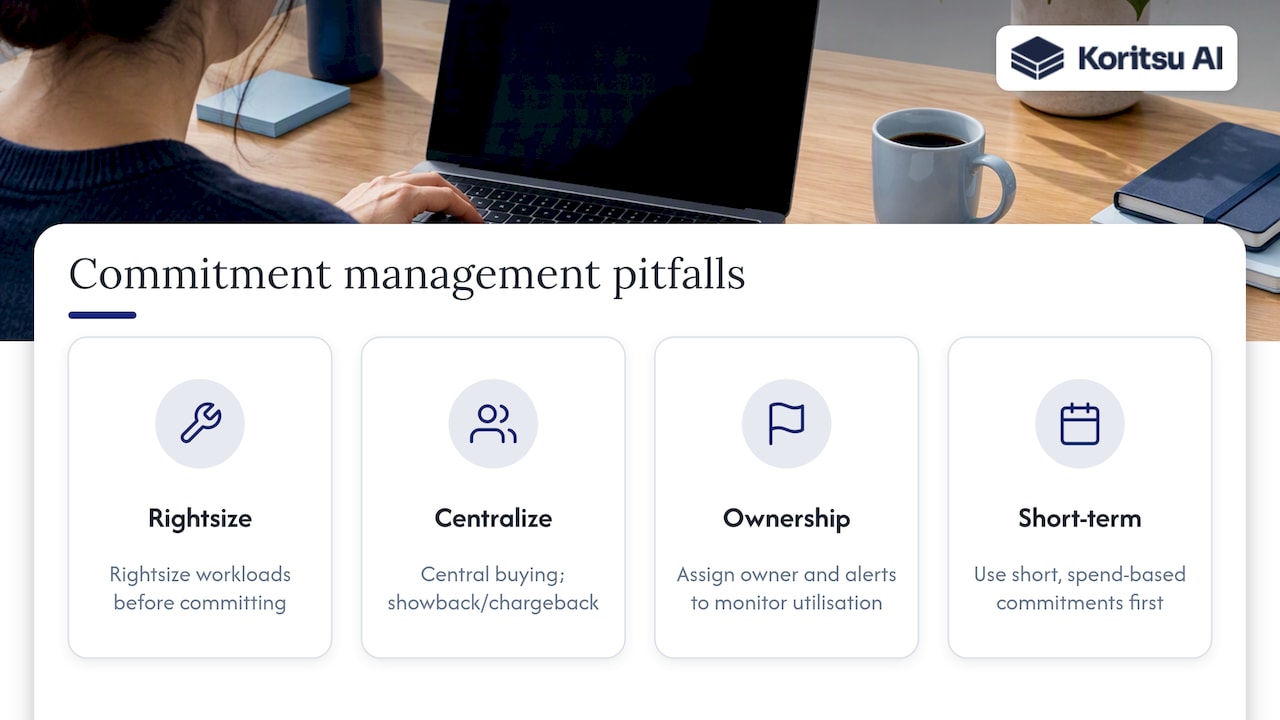
The most frequent mistake is buying commitments against workloads that have not been rightsized, which the FinOps Foundation flags directly: many savings opportunities disappear once you realise the committed workload was oversized to begin with. The fix is sequencing: rightsize first, commit second.
A second pattern is decentralised, uncoordinated purchasing, where different teams buy overlapping or conflicting commitments without visibility into each other's usage. The FinOps Foundation's Azure purchasing guidance recommends centralising the buying decision and using showback or chargeback to keep teams accountable without removing their visibility into cost.
A third is treating a commitment purchase as a one-time event rather than a managed asset. Without an assigned owner and a monitoring alert, utilisation quietly drifts downward as workloads change, and nobody notices until a quarterly review surfaces a commitment running at 60% utilisation on capacity bought for 95%.
Over-committing on long terms before usage patterns are proven causes the fourth common inefficiency. A 3-year resource-based reservation looks attractive on paper, but if the underlying architecture changes within 18 months, that capacity becomes stranded spend with no easy exit. Starting with shorter, spend-based commitments and only moving to longer terms once a workload has demonstrated genuine stability avoids this trap.
The underlying fix across all four pitfalls is the same: commitment management works as a continuous discipline with named owners, regular monitoring and centralised governance, not as a purchasing decision made once and left alone.
Case studies or examples illustrating successful commitment management implementations
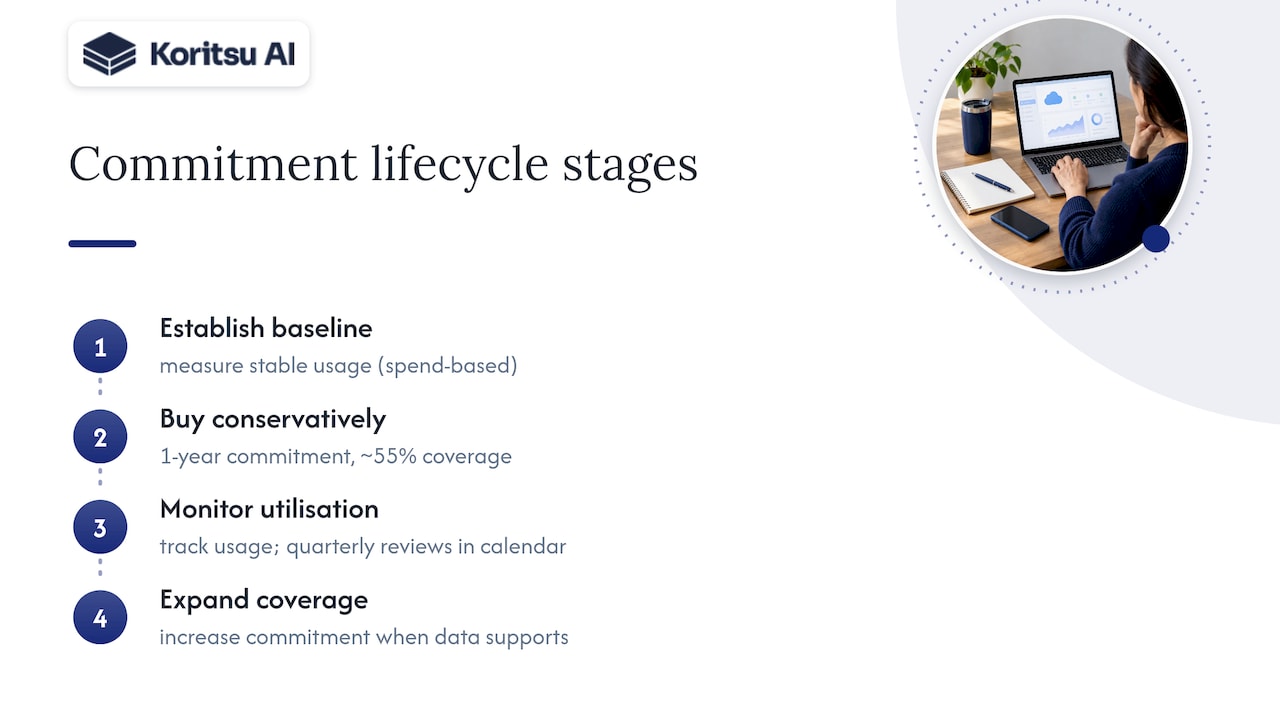
Following the sizing guidance above, they start with a 1-year spend-based commitment covering 55% of that stable usage, well within the 50 to 60% initial coverage range the FinOpsForge guide recommends.
This staged approach reflects the lifecycle model: baseline, buy conservatively, monitor, then expand once the data supports it. Teams that skip the monitoring step and jump straight to a high initial coverage target tend to find utilisation drifting downward within a year as workloads shift, since nothing was in place to catch the change early.
The common thread across implementations that hold up over time is governance discipline: a named owner per commitment group, a quarterly review built into the calendar, and a central purchasing function that prevents different teams from buying overlapping capacity. Implementations that skip governance tend to accumulate stranded commitments that nobody notices until a cost review flags them months later.
Integration of AI and machine learning in commitment management to optimize cost savings
AI and machine learning change commitment management from a periodic, manual exercise into something closer to continuous portfolio management. Instead of waiting for a quarterly review to spot a workload that has drifted below its committed capacity, a continuously running analysis can flag the shift within days, which matters because the gap between a quarterly check and a monthly one is often the difference between catching stranded spend early and absorbing months of waste.
Machine learning models applied to usage history can also improve on static provider recommendations by factoring in seasonality and workload-specific patterns that a generic advisor tool misses. This does not replace the need for human judgement on architectural changes, since no model can anticipate a planned migration or a product decision to retire a service, but it narrows the gap between what the data shows and what a human reviewer would catch manually.
At Koritsu, this is the role Kori plays: continuous analysis that surfaces utilisation and coverage shifts as they happen, paired with engineering review to confirm whether a flagged anomaly reflects a genuine architectural change or a temporary usage dip. The AI layer handles the volume of continuous monitoring that would otherwise require a dedicated analyst watching dashboards daily, while the human review step keeps the recommendations grounded in what is actually happening to the workload, not just what the numbers suggest in isolation.
Why commitment management deserves priority this quarter
Commitment management earns a place at the top of the FinOps backlog because the fix is largely process, not new technology: a baseline, an owner, and a review cadence. Continuous AI analysis shortens that cadence from quarterly to near-real-time and removes most of the manual tracking. Start with three steps: baseline your usage, assign owners, and schedule the first review.
How Koritsu can help you turn this into realised savings
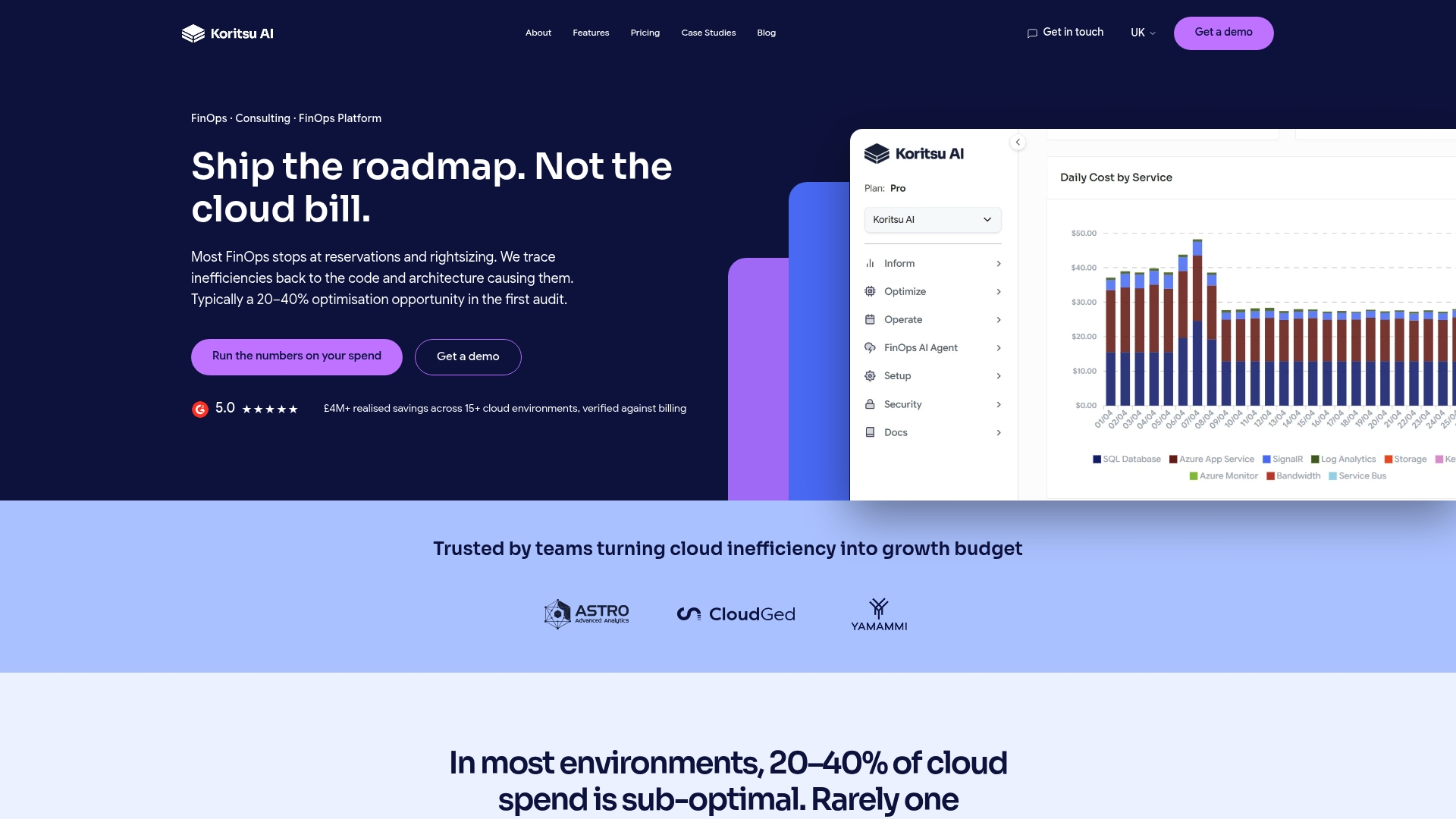
If running the full lifecycle above feels like more than your team has bandwidth for right now, we built our offerings around taking that weight off you. A Savings Opportunity Report gives you the baseline and utilisation analysis described in this guide without you having to build the tooling yourself, and it costs nothing upfront.
From there, our FinOps as a Service plans map to how much hands-on support you want:
- Monitor keeps continuous telemetry running on your commitment coverage and utilisation.
- Advisor adds expert review and recommendations on top of that monitoring.
- Embedded and Premium bring our specialists closer into your team's ongoing decisions.
We only take a success fee against savings we verify on your actual bill, so the next step costs you nothing but the time to request the report. Start with a free assessment through Koritsu AI and see what your current commitment coverage is actually costing you.
FAQ
What is commitment management in cloud cost optimisation?
Commitment management is the ongoing practice of buying discounted cloud capacity ahead of use, such as reserved instances or savings plans, then monitoring and adjusting that portfolio as workloads change. It sits within the FinOps Framework as a core rate optimisation capability rather than a one-time purchase.
What is a good utilisation target for cloud commitments?
Practitioner benchmarks suggest targeting 95% or higher utilisation on committed capacity, with utilisation consistently below 85% signalling over-commitment, according to the FinOpsForge commitment management guide.
Should I buy reserved instances or savings plans first?
Start with spend-based commitments like savings plans for your first purchase, since they offer more flexibility while you validate your usage patterns, then consider resource-based reserved instances for workloads that prove genuinely stable. AWS's own pricing documentation frames Savings Plans as the better fit for most organisations, with Reserved Instances offering deeper discounts in exchange for less flexibility.
How often should commitment coverage be reviewed?
A quarterly review is the common baseline, with an accountable owner assigned to each reservation group and monthly utilisation alerts running in between. The FinOps Foundation's Azure purchasing guidance recommends pairing this cadence with centralised purchasing and showback reporting to avoid fragmented commitments.
Does Koritsu help with cloud commitment management specifically?
Yes, our Savings Opportunity Report includes commitment coverage and utilisation analysis as part of the wider cost review, and our FinOps as a Service plans provide ongoing monitoring and expert review. We charge a success fee tied to savings verified on your actual bill rather than an upfront cost.
Sources
For readers who want to go deeper, our references pull from the FinOps Framework's rate optimisation guidance, Azure's reserved VM instance documentation, and the FinOps Foundation's purchasing playbook. For UK founders managing wider margin pressure alongside cloud spend, Keystone's 2026 playbook on shrinking margins offers useful context.
- Commitment management guide | FinOpsForge
- Azure Reserved Virtual Machine Instances | Microsoft Azure
- Rate optimization - Cloud Computing | Microsoft Learn
- Purchasing commitment discounts in Azure | FinOps Foundation