FinOps Inform · AI
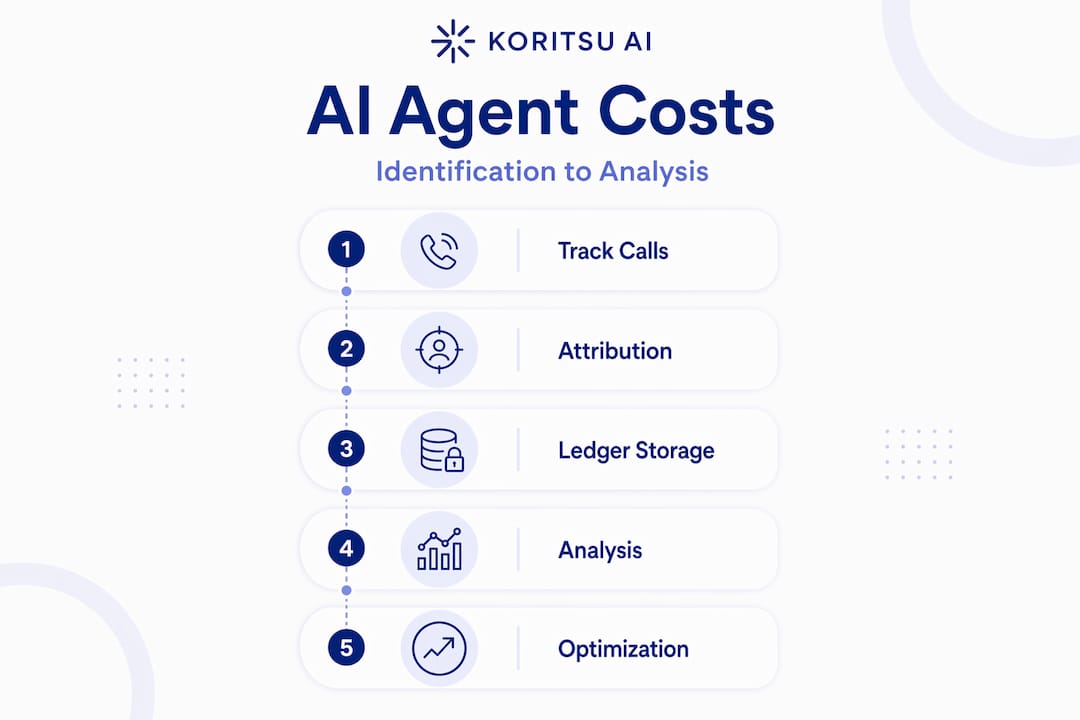
The role of AI agents in cost identification
Discover the critical role of AI agents in cost identification and learn how to implement effective strategies to avoid costly mistakes.

Most engineering leaders assume their cloud tagging strategy covers cost attribution. It does not. The moment you introduce AI agents into your infrastructure, traditional tagging schemas fall apart completely. The role of AI agents in cost identification goes far beyond attaching labels to compute resources. It requires a fundamentally different approach: per-call token ledgers, enforced metadata contracts, and runtime governance that fails loudly when attribution is missing. This guide covers how to build that system properly, and why getting it wrong leads to months of corrupted cost rollups you will not discover until the damage is already done.
Key takeaways
| Point | Details |
|---|---|
| Standard tagging is insufficient | AI agents consume tokens and invoke tools across layers that traditional cloud tags cannot capture accurately. |
| Metadata must be enforced at runtime | Rejecting untagged requests at the gateway prevents corrupted attribution data from accumulating silently. |
| A parallel cost ledger is non-negotiable | Per-call token data must be stored and joined to audit logs to produce accurate, all-in agent cost models. |
| AI-powered tools change the FinOps cadence | Natural language cost queries embedded in developer workflows turn monthly reviews into continuous cost governance. |
| Chargeback requires immutable evidence | Multiplexed multi-tenant agent calls need stable actor pairs and signed references to resolve disputes cleanly. |
The role of AI agents in cost identification
AI agents are not conventional cloud resources. A virtual machine has a start time, a stop time, and a billing dimension you can tag and forget. An AI agent has a lifecycle that spans multiple LLM calls, tool invocations, memory reads, downstream API calls, and orchestration compute, often within a single user-initiated task. Each of those layers carries a cost, and none of them map cleanly onto the resource tagging model your FinOps team built for EC2 instances.
Understanding this difference is the starting point for any serious cost identification strategy. Consider a multi-agent workflow where a planning agent breaks a task into subtasks, hands them to specialised execution agents, and then a synthesis agent assembles the results. Each step consumes tokens from a foundation model, invokes cloud functions, and potentially writes to storage. The planning agent’s token spend is invisible in your S3 cost line. The execution agents’ Lambda invocations carry no signal about which agent triggered them or why.
Standard tagging schemas are insufficient for this architecture for three reasons:
- Tags are applied at resource provisioning time, not at request time, so they cannot capture the per-call context of who triggered what and why.
- Token costs from LLM providers sit outside your cloud billing entirely, in a separate billing dimension that your cost allocation model has never been designed to ingest.
- Multi-stage workflows distribute costs across compute, storage, and external API dimensions simultaneously, making any single-resource tag an incomplete picture.
This is why cloud API cost mistakes in AI agent systems are so common. The tooling engineers rely on was built for a different era of infrastructure.
Enforcing metadata at the gateway
The answer to the attribution problem starts at the entry point of every agent request. If you want accurate cost identification for AI agents, you need mandatory metadata injection at the gateway level before any work is dispatched.
Here is how to implement this in practice:
-
Attach a metadata header to every agent request at the API gateway. A header such as
X-TFY-METADATAcarries the cost centre, project identifier, agent ID, and workspace context for every call that passes through. Zylos enforces this pattern and rejects untagged requests with HTTP 400 errors, treating missing attribution as a hard failure rather than a warning. -
Use workspace-based isolation to propagate tags automatically. When a workspace is created, it inherits cost metadata that applies to every downstream call made within that context. Workspace-level tagging adds less than 5ms of latency overhead in practice. The real overhead is organisational: keeping cost centre mappings accurate as teams reorganise.
-
Assign a primary cost centre for multi-cost-centre runs rather than attempting real-time fractional allocations. When an agent serves two teams simultaneously, the complexity of splitting costs mid-execution introduces latency penalties and reconciliation errors. Document the split logic, assign one primary owner, and settle the allocation offline.
-
Handle organisational overhead proactively. Cost centre mappings decay as teams change. Build a regular audit cadence into your FinOps process so that the metadata you inject at runtime actually reflects the current organisational structure.
Pro Tip: Set up automated alerts that fire when untagged requests reach a non-zero count. In a well-governed system, that number should always be zero. Any deviation signals a new agent being deployed outside the standard provisioning path.
The insight that governs this entire section comes from production experience: cost identification accuracy is a runtime contract, not a reporting feature. If your governance model allows untagged requests to succeed, you are accepting corrupted data silently. The corrupted rollups may not surface for months.
Building a parallel cost ledger
Even with perfect gateway tagging, you still have a gap. Your cloud provider’s billing reports capture compute, storage, and networking. They do not capture LLM token spend, which often represents the dominant cost in an AI agent system. Traditional cloud tagging cannot capture LLM token spend, so you need a parallel cost ledger that runs alongside your standard billing pipeline.

The schema for this ledger does not need to be complex. The table below shows the core fields required per LLM call and why each matters.
| Field | Purpose |
|---|---|
agent_id | Identifies which agent made the call for per-agent cost rollups |
request_id | Links the token cost to a specific user request for end-to-end attribution |
tokens_in / tokens_out | Input and output token counts for accurate cost calculation per model |
model | Needed for pricing normalisation across different foundation models |
timestamp | Supports period-bounded cost splits and time-series anomaly detection |
With these five fields captured per call, complex cost allocations reduce to simple SQL queries, enabling real-time budget alerts and FinOps tooling without bespoke reporting infrastructure.
The more powerful capability emerges when you join the ledger to your audit logs and cloud usage reports. Joining per-call token data to audit logs and pricing contracts gives you a truly all-in agent cost model: token spend, tool-invoked infrastructure usage, and orchestration compute all attributed to a single originating request. That is the level of visibility you need to understand your cost per feature in a system built on AI agents.
Pro Tip: Store your cost ledger in a queryable format your engineering team can access directly. When developers can run a query to see the token cost of a specific agent run, cost awareness becomes part of the development loop rather than a post-hoc FinOps exercise.
AI-powered tools for continuous cost analysis
Once you have attribution data flowing correctly, the next challenge is making it accessible and actionable fast enough to influence decisions. This is where AI-powered cost analysis tools change the dynamic significantly.
AWS introduced AI-powered cost analysis through Amazon Q Developer in Cost Explorer, allowing developers to ask natural language questions and receive instant visualisation updates. Instead of building a custom dashboard to investigate a spike, a developer can ask “Why did our agent orchestration costs rise 40% this week?” and get a structured answer without writing a single query.
The practical benefits for engineering leaders are significant:
- Speed of investigation drops from hours to minutes. A spike that would previously require a FinOps analyst to pull billing exports, join datasets, and prepare a report can be answered conversationally in real time.
- Accessibility improves across the organisation. Engineers who would never open Cost Explorer can ask cost questions in natural language, which means cost awareness spreads into teams that have traditionally been isolated from financial data.
- Integration with developer workflows is the key shift. Amazon Q leverages multiple datasets, including historical spending, Compute Optimizer recommendations, Savings Plans data, and pricing APIs, to answer complex cost queries without any manual dashboard work. When that capability sits inside the tools your engineering team already uses, FinOps transitions from a monthly bottleneck to a continuous engineering practice.
This matters especially for AI agent fleets, where costs can change dramatically with model updates, prompt changes, or new workflow additions. Real-time conversational access to cost data means you can catch a regression the day it happens rather than three weeks later when the invoice arrives.
Governance, chargebacks, and common pitfalls
Getting the technical architecture right is half the problem. The other half is organisational.
Chargeback and showback for AI agent spend require a specific data model. Immutable usage references, bounded periods, and actor separation are the three ingredients that make chargeback defensible in a multi-tenant environment. When multiple agents share infrastructure and an allocation dispute arises, you need signed evidence owners and stable actor pairs to resolve it without rerunning the entire allocation. Attribution disputes in chargeback scenarios are far more common in AI agent systems than in traditional cloud environments, precisely because multiplexing is the norm rather than the exception.
A few common mistakes engineering teams make when deploying AI agents for cost identification:
- Treating cost attribution as a post-deployment task. By the time you add it retrospectively, you already have weeks of corrupted data and an agent fleet that was not designed to emit the right metadata.
- Underestimating the organisational upkeep of cost centre mappings. The performance overhead of tagging is negligible. The process overhead of keeping mappings accurate as your organisation changes is significant. Build that maintenance work into your operating model from the start.
- Skipping anomaly detection. An agent with a broken prompt retry loop can generate thousands of unexpected LLM calls in minutes. Without anomaly detection rules on your cost ledger, you will not know until the bill arrives.
- Confusing showback with chargeback. Showback tells teams what they spent. Chargeback makes them accountable for it. Both require accurate data, but chargeback requires the additional layer of immutable evidence to be defensible. Decide which model you are implementing before you design your attribution schema.
Pro Tip: When you deploy a new agent to production, treat cost attribution as a launch gate, not a follow-up ticket. Require that every agent emits the correct metadata headers before it passes code review, the same way you require test coverage.
Understanding cloud cost by team becomes the foundation of any chargeback model in AI agent environments, and it is worth designing that model before your agent fleet grows beyond a handful of services.
My take: cost identification is a runtime discipline
I have seen engineering teams build genuinely impressive AI agent systems and then realise, six months in, that they have no idea what any of it actually costs. Not at the feature level, not at the team level, and certainly not at the per-request level.
What I have learned from working with production agent fleets is that the teams who struggle most are the ones who treated cost attribution as a FinOps concern rather than an engineering concern. They deferred the instrumentation work until after launch. By then, the metadata contracts were an afterthought bolted onto a system that was not designed to emit them.
The teams who get this right treat cost identification as a runtime discipline from day one. They build the ledger schema before they build the first agent. They enforce metadata at the gateway before any agent touches production traffic. They set budget alerts on the ledger before they know what normal spend looks like, so they have a baseline from which anomalies are immediately visible.
My honest view is that most cloud cost problems are not technology problems. They are process problems. The technology to capture accurate agent cost data exists today. What is missing in most organisations is the engineering discipline to treat attribution as a first-class concern, not a reporting feature that someone else owns.
If you are a CTO or engineering leader scaling an AI agent system, the time to build this discipline is before your agent fleet grows large enough to make retroactive instrumentation genuinely painful.
How Koritsu AI can help
If the attribution and ledger model described in this article sounds like work your team has been deferring, you are not alone. Most engineering teams running AI workloads on AWS, Google Cloud, or Azure are spending more than they should, and the costs are buried in exactly the kind of multi-layer, per-call complexity this article describes.
Koritsu AI combines an AI platform that continuously analyses cloud spending with hands-on expert advice to find those inefficiencies and help your team fix them. Kori, our AI agent, surfaces where money is being lost across your cloud estate. Our specialists help you act on it without months of instrumentation work before you see results.
You can start with a free cloud cost assessment and see what Kori surfaces in your environment. Or explore how a UK bidding platform achieved a 52% reduction in cloud costs using Koritsu’s approach. We only charge when we deliver.
Start with a free assessmentFAQ
What is a cost ledger for AI agents?
A cost ledger is a per-call database that captures token spend, model, agent ID, and request context for every LLM call an agent makes. It runs in parallel to standard cloud billing and is essential for accurate attribution because cloud provider invoices do not capture token costs directly.
Why does traditional cloud tagging fail for AI agent costs?
Standard tags are applied at resource provisioning time, not at request time, so they cannot capture the per-call context of AI agent workloads. Token costs from LLM providers also sit entirely outside cloud billing dimensions, making tag-based attribution fundamentally incomplete.
What is the best way to enforce cost attribution at scale?
Enforce metadata injection at the API gateway and reject any untagged request with a hard failure. Treating missing attribution as an error rather than a warning prevents corrupted data from accumulating silently over weeks or months.
How does chargeback work for multi-tenant AI agent systems?
Accurate chargeback in multi-tenant environments requires immutable usage references, bounded time periods, and clear actor separation per call. These evidence anchors allow cost disputes to be resolved without rerunning allocations across the entire period.
How do AI-powered cost analysis tools improve FinOps?
Tools such as Amazon Q in Cost Explorer allow developers to query cost data in natural language, reducing investigation time from hours to minutes and embedding cost awareness directly into engineering workflows rather than isolating it in monthly FinOps reviews.