FinOps Inform · Cost Optimisation
What is cloud cost optimisation? 2026 guide
Discover what cloud cost optimisation is and how it can help reduce unnecessary expenses while maximizing efficiency in your cloud strategy.

Cloud cost optimisation is the ongoing practice of managing cloud resources and expenditure to maximise cost-efficiency without sacrificing performance or business outcomes. 30–35% of total cloud spend is wasted on idle resources and oversized instances, which means most organisations are paying significantly more than they should. Tools like AWS Cost Explorer, frameworks like FinOps, and platforms like Koritsu AI exist precisely to close that gap. The industry term for this discipline is FinOps, short for Financial Operations, and understanding it is the first step toward taking control of your cloud bill.
What is cloud cost optimisation and why does it matter?
Cloud cost optimisation is the structured process of identifying, reducing, and preventing unnecessary cloud expenditure across AWS, Google Cloud, and Azure environments. It covers everything from rightsizing compute instances to refactoring data pipelines and applying storage lifecycle policies. The goal is not simply to cut costs. The goal is to align every pound of cloud spend with measurable business value.
The scale of waste is significant. Unplanned cloud expenses consumed 41% of budgets in 2026, up from 28% in 2024. That trajectory shows the problem is getting worse, not better, without deliberate intervention. For finance leaders, this represents a direct threat to forecast accuracy. For engineering teams, it signals that infrastructure decisions are being made without cost visibility.

The FinOps Foundation defines this discipline as a cultural practice that brings finance, engineering, and business together around shared cost ownership. Gartner consistently ranks cloud cost management among the top concerns for technology executives. The problem is not unique to any one sector. It affects every organisation running workloads at scale.
What are the main cloud cost optimisation strategies?
The most effective strategies combine technical changes with process changes. Neither works well in isolation.
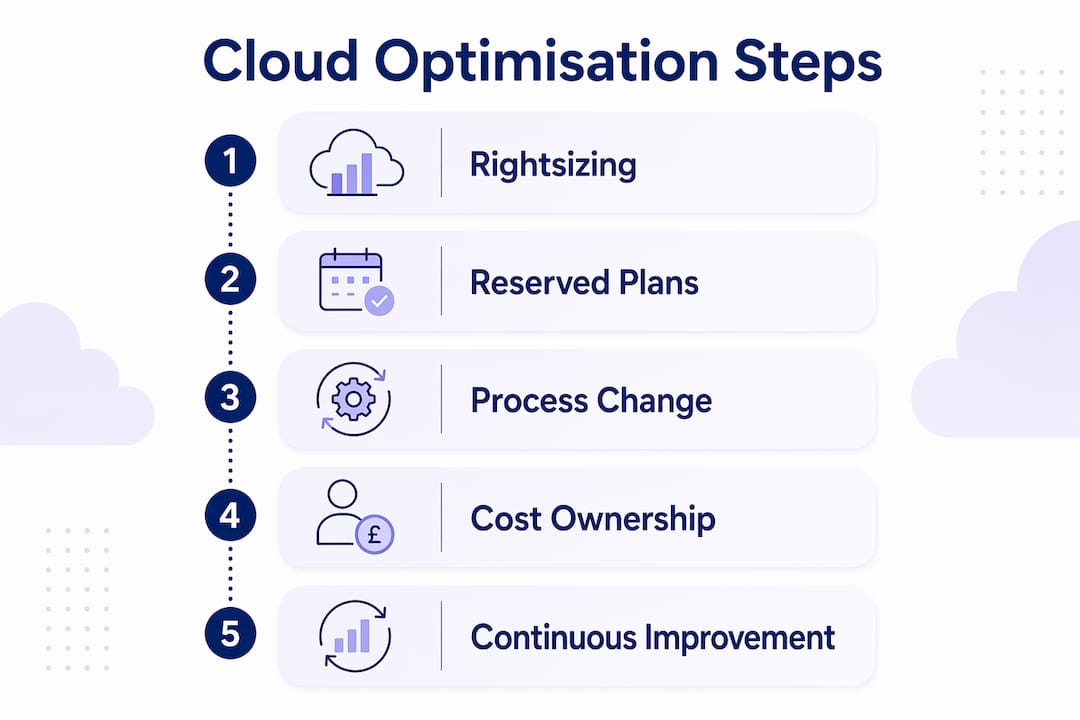
Rightsizing is the practice of matching instance size and type to actual workload requirements. Rightsizing compute and database instances can reduce costs by up to 45%. AWS Compute Optimiser and Azure Advisor both surface rightsizing recommendations automatically, but acting on them requires engineering judgement, not just a dashboard.
Reserved Instances and Savings Plans lock in discounted rates in exchange for one or three year commitments. These work well for predictable baseline workloads. Spot Instances on AWS or Preemptible VMs on Google Cloud are suited to fault-tolerant batch jobs and can reduce compute costs by 60–80% compared to on-demand pricing.
Storage optimisation is frequently underestimated. Moving infrequently accessed data from hot to warm or cold storage tiers, and applying lifecycle policies to S3 buckets or Azure Blob Storage, delivers savings that compound over time. Replacing full-refresh data jobs with incremental loads and implementing storage lifecycle policies often produces faster and more impactful savings than rightsizing alone.
Cloud cost optimisation sprints are time-boxed audit and remediation cycles, typically lasting 6–8 weeks. Structured cost reduction sprints reduce cloud spend by 30–45% within that window. The sprint methodology works because it creates urgency, assigns clear ownership, and produces measurable results before momentum fades.
- Audit current spend using AWS Cost Explorer or Google Cloud Billing reports
- Identify top ten cost drivers by service and team
- Prioritise rightsizing, reserved capacity, and storage tier changes
- Refactor data pipelines to use incremental rather than full-refresh loads
- Assign cost owners to each workload and track weekly
Pro Tip: Run your first sprint on a single business unit rather than the entire estate. A contained scope produces faster wins and builds the internal credibility needed to scale the programme.
How do multi-cloud environments affect cost optimisation?
Multi-cloud is the practice of running workloads across two or more cloud providers simultaneously. The business case is clear: avoid vendor lock-in, access best-in-class services, and improve resilience. The cost reality is more complicated.
Multi-cloud environments generate 3.4 times more budget overruns than single-cloud deployments. The primary culprits are egress fees, redundant tooling, and operational complexity. Understanding what is multi-cloud cost complexity means recognising that the overhead is not just technical. It is financial, organisational, and architectural.
| Cost Factor | Single Cloud | Multi-Cloud |
|---|---|---|
| Data egress fees | Minimal within provider | $0.08–$0.09 per GB cross-cloud |
| Security stack | One unified toolset | Redundant stacks costing $500K–$2M annually |
| Training and tooling | Provider-specific | $50K–$200K additional annual cost |
| Budget overrun risk | Baseline | 3.4x higher likelihood |
| Overall cost premium | Baseline | 28% higher on average |
The architectural response to multi-cloud cost complexity is to minimise cross-cloud data movement. Where possible, keep data processing and storage within the same provider. Use a cloud-agnostic abstraction layer only where it genuinely reduces operational risk, not as a default design choice. For Google Cloud Billing optimisation specifically, Committed Use Discounts and the Active Assist recommendation engine provide native tools to reduce spend without requiring third-party platforms.
Vendor negotiation is also underused. Large enterprises with committed annual spend above £1 million typically qualify for enterprise discount programmes with AWS, Google Cloud, and Azure. These are not advertised. They require direct commercial conversations with your account team.
Pro Tip: Before expanding to a second cloud provider, model the full cost of egress, tooling duplication, and training. The benefits of multi-cloud cost management only materialise when the architecture is designed to contain those hidden taxes from the outset.
How can organisations embed cost optimisation into their culture?
Cloud cost is not a technology problem. It is a process problem. The organisations that sustain savings over time are those that make cost visibility a shared responsibility across finance, engineering, and product teams.
FinOps frameworks achieve 2.5 times higher likelihood of meeting cloud ROI targets compared to organisations without shared cost ownership. That figure reflects a structural advantage, not just better tooling. When engineers understand the cost implications of their architecture decisions, they make different choices.
Embedding cost accountability in the agile backlog as "cost stories" is one of the most practical ways to shift behaviour. A cost story is a backlog item that targets a specific inefficiency, assigns an owner, and defines a measurable outcome. It sits alongside feature work, not separate from it. This approach prevents the common failure mode where cost optimisation is treated as a one-off project rather than a continuous practice.
The roles that matter most in a FinOps culture are:
- A FinOps practitioner or cloud financial analyst who owns the cost reporting cadence
- Engineering leads who review cost impact as part of architecture reviews
- Finance business partners who translate cloud spend into budget variance and forecast risk
- A product or business owner who prioritises cost stories alongside feature requests
Cost optimisation is most effective when integrated into developer workflows, turning complex bills into understandable cost stories that prevent bill shock. The key is making cost data visible at the team level, not just at the organisational level. When a squad can see that their service costs £12,000 per month and a specific change would reduce that by 30%, they act. Abstract billing reports do not produce the same result.
For guidance on aligning this work with broader business objectives, the cloud costs and business outcomes framework provides a practical structure for connecting spend to value.
What tools support effective cloud cost optimisation in 2026?
The tooling landscape for cloud cost management has matured considerably. Native provider tools now cover the basics well. Third-party platforms add depth for multi-cloud visibility and automation.
Native provider tools:
- AWS Cost Explorer provides spend analysis, forecasting, and rightsizing recommendations. AWS Compute Optimiser adds machine learning-driven instance recommendations based on actual utilisation data.
- Azure Cost Management and Billing offers budget alerts, cost allocation tags, and advisor recommendations integrated directly into the Azure portal.
- Google Cloud Billing provides detailed cost breakdowns, budget notifications, and the Active Assist recommendation engine for committed use and idle resource identification.
Third-party and AI-driven platforms:
Koritsu AI combines continuous spend analysis with hands-on expert advice. Its AI agent, Kori, surfaces inefficiencies at the workload level and helps engineering teams act on them. Unlike native tools that surface recommendations, Koritsu AI connects the analysis to remediation, which is where most organisations stall. For a full breakdown of how application refactoring drives savings, the architectural dimension of cost reduction is covered in detail.
For IT leaders assessing the full financial picture, understanding cloud total cost of ownership is a necessary foundation before selecting tooling or committing to a reduction roadmap.
The most important feature any tool must provide is cost attribution at the team or service level. Without that granularity, you cannot assign ownership, and without ownership, you cannot sustain change.
Key takeaways
Cloud cost optimisation delivers sustained savings only when technical changes are paired with a FinOps culture that embeds cost accountability across engineering, finance, and product teams.
| Point | Details |
|---|---|
| Waste is significant and measurable | 30–35% of cloud spend is wasted on idle or oversized resources across most organisations. |
| Sprints produce rapid results | Structured 6–8 week cost reduction sprints deliver 30–45% savings with focused audit and remediation. |
| Multi-cloud adds hidden costs | Multi-cloud environments cost 28% more on average, driven by egress fees, redundant tooling, and training overhead. |
| Culture determines sustainability | FinOps teams are 2.5 times more likely to meet cloud ROI targets by making cost a shared business discipline. |
| Architecture changes outperform rightsizing | Refactoring data pipelines and applying storage lifecycle policies produce greater savings than instance resizing alone. |
The uncomfortable truth about cloud cost optimisation
Most organisations treat cloud cost optimisation as a periodic exercise. They run a sprint, cut 20–30%, and move on. Six months later, spend has crept back up. I have seen this pattern repeatedly, and it is entirely predictable.
The root cause is almost never the cloud provider or the pricing model. It is the absence of cost ownership at the team level. When engineers are not accountable for the cost of what they build, spend grows by default. Every new service, every over-provisioned database, every forgotten test environment adds to the bill without anyone noticing until the monthly invoice lands.
What actually works is treating cost as a first-class engineering concern. That means cost stories in the backlog, cost impact in architecture reviews, and real-time visibility at the squad level. It also means accepting that the biggest savings are rarely in the obvious places. Rightsizing helps. Reserved instances help. But the greatest savings come from architectural changes, specifically refactoring data pipelines and rethinking storage tiers, not from tuning instance sizes.
Multi-cloud adds a layer of complexity that most organisations underestimate before they commit. The hidden taxes of multi-cloud including egress fees, redundant security stacks, and elevated training costs can double total operating expenses. That does not mean multi-cloud is wrong. It means the architecture must be designed to contain those costs from day one, not retrofitted after the bill arrives.
The organisations that get this right are the ones that stop treating cloud cost as a finance problem or a technology problem, and start treating it as a shared business discipline. That shift is harder than any technical fix. It is also the only one that lasts.
— Kori
How Koritsu AI can help you reduce cloud spend
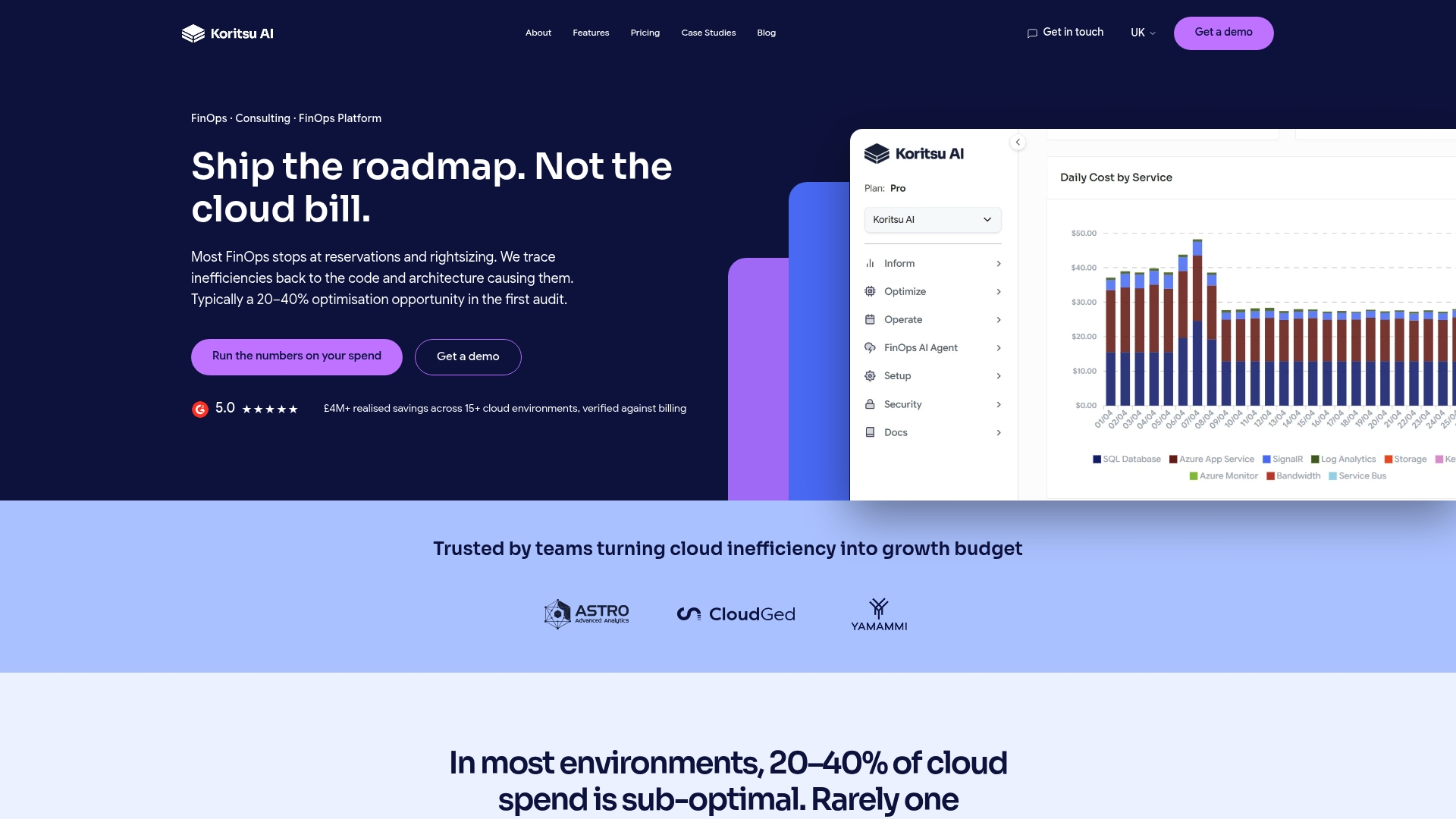
If your organisation is spending more than it should on AWS, Google Cloud, or Azure, the savings are almost certainly buried in how your infrastructure was built, not in your discount tier. Koritsu AI combines an AI-powered spend analysis platform with hands-on expert advice to find and fix those inefficiencies. Kori, our AI agent, surfaces exactly where money is being lost. Our specialists help your engineering teams act on it. A UK bidding platform achieved a 52% reduction in cloud costs using this approach. You start with a free assessment, and we take a share of the savings we actually find. Start your free assessment today.
Start with a free assessmentFAQ
What is cloud cost optimisation?
Cloud cost optimisation is the practice of continuously reducing and managing cloud expenditure to maximise cost-efficiency without compromising performance. It covers rightsizing, storage management, FinOps frameworks, and architectural refactoring across AWS, Google Cloud, and Azure.
How much cloud spend is typically wasted?
30–35% of total cloud spend is wasted on idle resources and oversized instances. Unplanned expenses consumed 41% of cloud budgets in 2026, making proactive optimisation a financial priority for most organisations.
What is a cloud cost optimisation sprint?
A cloud cost optimisation sprint is a structured 6–8 week audit and remediation cycle targeting specific inefficiencies. Structured sprints reduce cloud spend by 30–45% within that window when focused on rightsizing, storage tiers, and pipeline refactoring.
Why does multi-cloud cost more to optimise?
Multi-cloud environments generate 3.4 times more budget overruns than single-cloud deployments due to cross-cloud egress fees, redundant security tooling, and higher training costs. The average cost premium for multi-cloud is 28% compared to a single-provider approach.
What is FinOps and how does it reduce cloud costs?
FinOps is a cultural and operational framework that aligns finance, engineering, and business teams around shared cloud cost ownership. Organisations using FinOps are 2.5 times more likely to meet their cloud ROI targets than those without it.