FinOps Inform · Storage
Why cloud storage costs grow: 2026 guide for IT leaders
Discover why cloud storage costs grow and uncover hidden fees driving up your IT budget. Control expenses effectively with our 2026 guide.

Cloud storage costs grow because the majority of expenses now come from transactional fees, not raw storage capacity. 48% of cloud storage costs are attributable to fees rather than capacity, and 84% of UK firms cited fee issues as the reason they exceeded their cloud budgets. That figure tells you the problem is structural, not accidental. Understanding the real cost drivers, from API requests to data egress and AI workload demands, is the first step to controlling rising cloud storage expenses before they erode your margins further.
What are the main fees driving cloud storage cost growth?
The advertised per-gigabyte rate is rarely what you pay. Hidden costs like API requests, data egress, and retrieval fees add 30–70% to base storage rates, causing actual bills to run 3–5x higher than the headline price. That gap is where most budget overruns live.
The fee categories that matter most are:
- Data egress fees. Charges apply every time data leaves the cloud provider’s network. Egress fees can exceed $90 per TB, and they are notoriously difficult to predict because they depend on downstream application behaviour, not just data volume.
- API request charges. Every read, write, list, or delete operation carries a cost. Automated monitoring tools and backup applications generate thousands of API calls per hour, and those charges compound silently.
- Retrieval fees. Archive and infrequent-access storage tiers carry per-GB retrieval charges. Moving data back into active use can cost more than storing it did.
- Cross-region replication. Replicating data across regions for redundancy triggers both storage and egress charges simultaneously.
Operational overhead from API calls and data movement often accounts for 48–50% of storage bills. Routine audits and backup jobs generate enough API traffic to rival the cost of the storage itself. That is a significant finding: your monitoring stack may be as expensive as your data.
| Fee category | Typical cost driver | Proportional impact |
|---|---|---|
| Data egress | Outbound data transfer volume | High and unpredictable |
| API requests | Automated operations and backups | Medium to high |
| Retrieval fees | Archive tier data access | High per event |
| Cross-region replication | Redundancy and compliance requirements | Medium |
| Storage capacity | Raw data volume | Declining share of total bill |

Pro Tip: Audit your monitoring and backup tools specifically. API request volumes from automated software often match or exceed storage volume costs, yet most teams never see them broken out in their billing dashboard.
How do AI workloads accelerate cloud storage expenses?
AI projects are the fastest-growing source of cloud storage fee inflation. AI initiatives drive data access and data operation fees, leading to ROI erosion when those costs go unmanaged. The reason is access intensity: AI model training and inference pipelines read the same datasets repeatedly, generating API and egress charges on every pass.
The shift is also structural. AI infrastructure investment is moving spending towards hardware and storage rather than software licences. That means cloud storage is no longer a background line item; it is a primary cost centre for engineering teams running machine learning workloads on AWS, Google Cloud, or Azure.
“AI-driven data demands surge infrastructure needs, causing storage cost inflation, with overlooked operational fees eroding ROI. The organisations that treat API activity as invisible overhead are the ones that end up with bills they cannot explain.”
The practical consequences for IT managers include:
- Training datasets stored in standard tiers generate retrieval fees every time a model re-reads them during training runs.
- Feature stores and data lakes accessed by multiple models simultaneously multiply API charges across every pipeline.
- Uncompressed or duplicated training data inflates both storage volume and the egress cost of moving it between services.
Changing usage patterns amplify this further. As organisations move from batch processing to real-time inference, data access frequency rises sharply. More frequent access means more API calls, more egress, and more retrieval events, all billed separately and all contributing to rising cloud storage expenses that outpace data growth itself.
Why is cloud storage pricing so unpredictable?
Cloud billing is a layered, metered system where normal operations trigger multiple concurrent charges. A single backup task triggers API, storage, and egress charges simultaneously. That is the cost multiplier problem: one business action produces several billing events, and most teams only see the total, not the breakdown.
The pricing complexity compounds in four specific ways:
- Tiered pricing with access penalties. Moving data to a cheaper storage tier reduces capacity costs but introduces retrieval fees that can exceed the original savings on first access.
- Listing operations. Running a directory listing across a large bucket generates thousands of API calls. Automated compliance tools that scan storage regularly can produce substantial charges from this alone.
- Replication multipliers. Three-way replication across availability zones triples both storage and write API costs. Most organisations enable this by default without modelling the billing impact.
- Egress unpredictability. Egress fees depend on where data goes, not just how much leaves. Traffic to the public internet costs more than traffic to another service within the same region. Application changes can shift this ratio without any infrastructure change.
Retrieval and egress fees from disaster recovery testing represent a specific blind spot. Many teams skip DR verification to avoid the cost, which creates both a financial and an operational risk. Those verification costs belong in your total cost of ownership model, not treated as optional extras.
Pro Tip: Map every automated process that touches cloud storage, including monitoring agents, backup jobs, and compliance scanners. Assign each one an estimated monthly API cost. You will almost certainly find at least one process generating charges that no one budgeted for.
FinOps practices exist precisely to address layered usage-based billing models. Without dedicated cost monitoring and allocation, cloud storage pricing trends will continue to surprise even experienced IT teams. The discipline of FinOps turns billing from a monthly shock into a manageable, forecastable input.
What strategies actually control cloud storage costs?
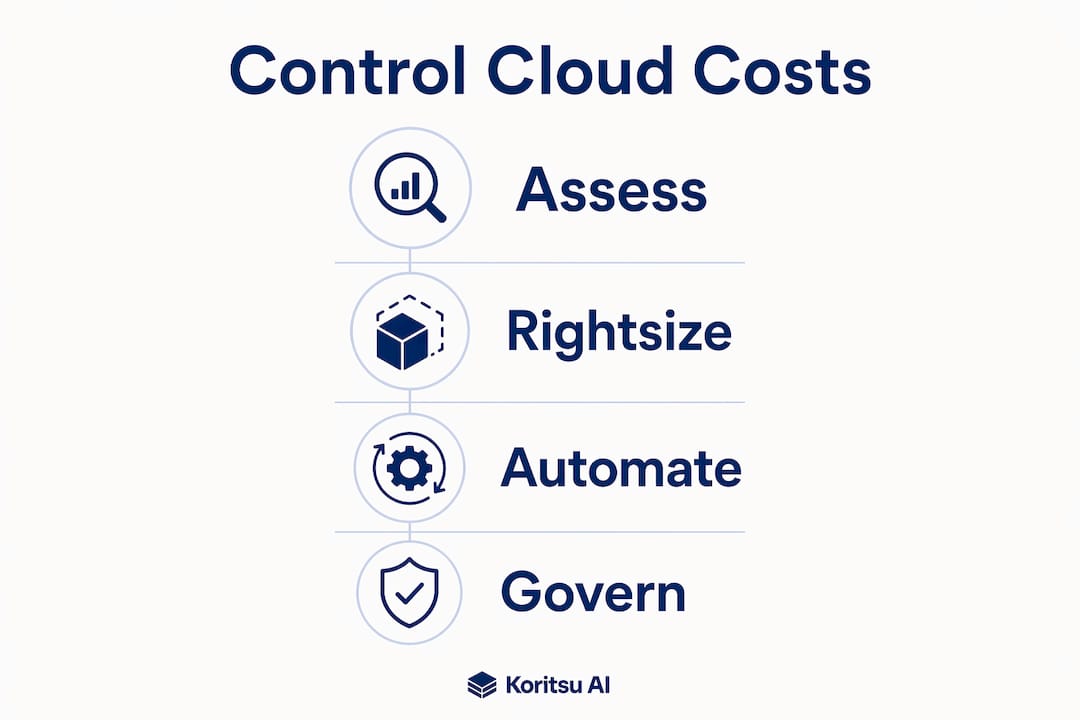
The most effective approach to managing cloud costs follows a four-step framework: assess, rightsize, automate, and govern. Each step builds on the last, and the sequence matters.
Assess your baseline
Start by pulling a full breakdown of your storage bill by fee category, not just by service. Identify which workloads generate the most API calls, the most egress, and the most retrieval events. You cannot rightsize what you have not measured. A cloud total cost of ownership analysis at this stage prevents false economies later.
Rightsize storage tiers
Match data to the correct storage class based on actual access patterns, not assumptions. Frequently accessed data belongs in standard tiers. Data accessed less than once per quarter belongs in archive tiers, provided you model the retrieval cost before moving it. Reserved Instances save 30–72% compared to on-demand pricing for predictable workloads. That range is wide because the saving depends on commitment length and usage consistency.
Automate lifecycle policies
Lifecycle policies move data between tiers automatically based on age or access frequency. Without automation, data accumulates in expensive tiers indefinitely. Set policies to transition objects after defined periods and to delete expired data rather than retaining it by default.
Govern continuously
One-off optimisation decays quickly. New workloads, new applications, and new team members all introduce spending patterns that erode previous savings. Continuous governance requires regular auditing, tagging enforcement, and budget alerts tied to specific fee categories, not just total spend.
Pro Tip: Prioritise vendors that offer zero-egress or regional data locality options for your highest-volume workloads. Architectural decisions at the vendor selection stage eliminate entire fee categories rather than just reducing them.
| Strategy | Primary saving mechanism | Expected impact |
|---|---|---|
| Storage tier rightsizing | Reduce capacity and retrieval costs | Medium to high |
| Lifecycle policy automation | Eliminate stale data in expensive tiers | Medium |
| Reserved capacity commitments | Reduce on-demand pricing | High for stable workloads |
| Zero-egress vendor selection | Eliminate egress fee category | High for data-intensive workloads |
| API call auditing | Reduce automated overhead charges | Medium |
Hybrid storage models, combining on-premises storage for high-frequency data with cloud for archival and burst capacity, also reduce egress fees materially. The cloud cost optimisation guide covers these architectural options in detail for teams evaluating their infrastructure mix.
Key takeaways
Cloud storage costs grow primarily because transactional fees, including API requests, data egress, and retrieval charges, now account for nearly half of total bills, and most organisations have no systematic process to monitor or control them.
| Point | Details |
|---|---|
| Fees outweigh capacity costs | 48% of cloud storage bills come from operational fees, not raw storage volume. |
| AI workloads amplify charges | AI pipelines generate repeated API and egress events that compound costs beyond simple data growth. |
| Pricing is a multiplier system | A single backup or DR test triggers simultaneous API, storage, and egress charges. |
| Rightsizing delivers real savings | Reserved capacity commitments reduce costs by 30–72% compared to on-demand pricing. |
| Governance prevents decay | Continuous auditing and lifecycle automation are required to sustain savings over time. |
The cost problem no one wants to admit
The uncomfortable truth I have seen repeatedly is this: cloud storage cost is not a technology problem. It is a process problem. Most organisations have the tools to see their bills. Very few have the discipline to act on what those bills are actually saying.
API activity is the clearest example. Teams treat it as invisible infrastructure overhead, something that just happens in the background. But API request volumes from automated monitoring and backup software often match or exceed storage volume costs. When I see a team shocked by their monthly bill, the culprit is almost always an automated process nobody owns.
Disaster recovery is the second blind spot. Verification costs from DR testing create retrieval and egress fees that most teams skip to save money in the short term. That decision trades a known, manageable cost for an unknown operational risk. It is a false economy, and it shows up in total cost of ownership models that have never been built honestly.
My advice is to prioritise vendors who offer predictable, transparent pricing over those with the lowest headline per-GB rate. The cheapest storage is rarely the cheapest bill. And build a FinOps culture where engineers see cost as part of their output, not someone else’s problem. That cultural shift, more than any single tool or commitment, is what separates teams that control their cloud spend from those who are perpetually surprised by it.
How Koritsu AI helps you reduce cloud storage expenses
Koritsu AI works with businesses running on AWS, Google Cloud, and Azure to find the cost inefficiencies buried in how their infrastructure was built. The savings are rarely in the obvious places. They are in the API patterns, the storage tier mismatches, and the automated processes nobody budgeted for.
Koritsu’s AI agent, Kori, continuously analyses cloud spending and surfaces exactly where money is being lost. A UK bidding platform achieved a 52% cloud cost reduction using Koritsu’s platform, with savings identified in weeks, not quarters. Koritsu only charges when it delivers results. Start with a free cloud cost assessment and see what your bill is actually telling you.
FAQ
What percentage of cloud storage costs come from fees?
48% of cloud storage costs are attributable to fees rather than raw storage capacity. That means operational charges like API requests, egress, and retrieval now represent nearly half of the average cloud storage bill.
Why do cloud storage bills often exceed initial estimates?
Hidden costs including data egress, API requests, and retrieval fees add 30–70% to base storage rates, causing actual bills to run 3–5x higher than the advertised per-GB price.
How do AI workloads affect cloud storage costs?
AI model training and inference pipelines read datasets repeatedly, generating API and egress charges on every pass. These access-intensive workloads drive operational fees well beyond what data volume alone would predict.
What is the fastest way to reduce cloud storage fees?
Audit your automated processes first. API request volumes from monitoring and backup tools frequently match storage volume costs and are the most overlooked source of savings. Pair that with storage tier rightsizing based on actual access patterns.
What is FinOps and why does it matter for cloud storage?
FinOps is the practice of applying financial accountability to cloud spending through continuous monitoring, allocation, and governance. Without it, layered usage-based billing models produce unpredictable costs that no single audit can fix permanently.