FinOps Inform
Best Apptio.com alternatives for UK teams in 2026
Discover the best Apptio.com alternatives for UK teams in 2026. Find tools that offer transparency of spend or automation of savings.

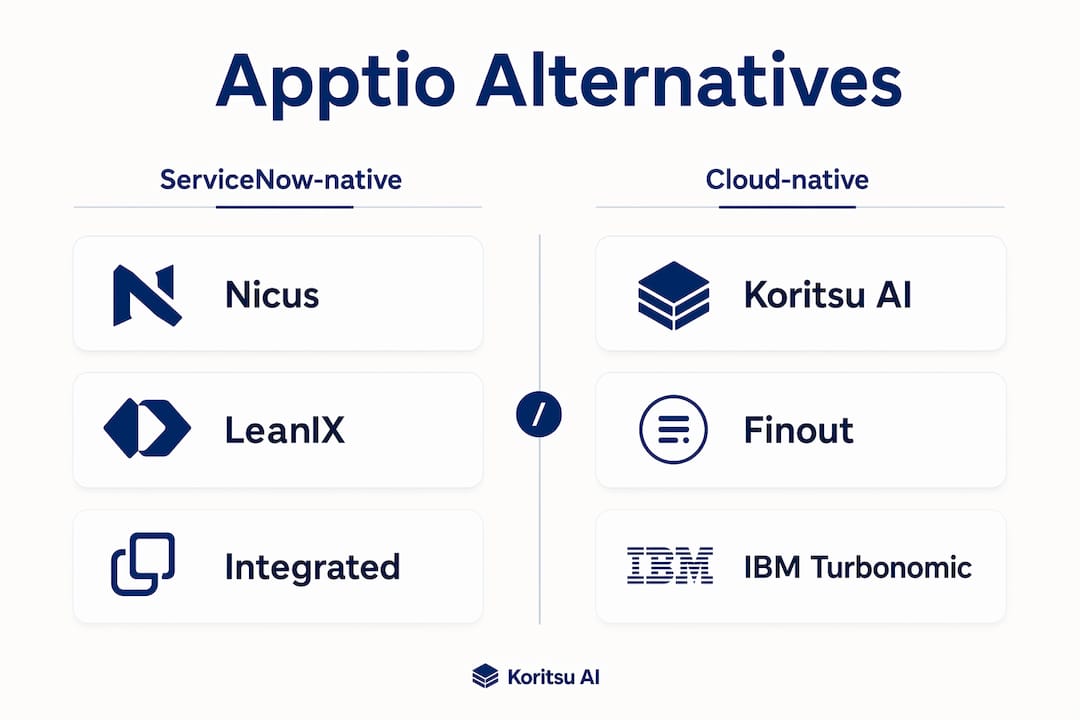
For most UK FinOps and IT finance teams, the strongest Apptio alternatives fall into two clear categories: ServiceNow-native TBM platforms (where operational integration and allocation defensibility matter most) and cloud-native FinOps tools that prioritise automated savings over spend transparency. A third category, software asset management suites with cloud cost features suit organisations that need SAM and ITFM consolidated under one governance model.
The core distinction, flagged consistently by industry analysts, is whether you need transparency of spend or automation of savings. Choosing the wrong category is the most common and most expensive mistake in this procurement.
TL;DR shortlist by buyer profile:
- ServiceNow-native TBM platforms (e.g. Nicus, LeanIX for architecture-led cost): best for organisations already standardised on ServiceNow that need real-time allocation without sync delays
- Cloud-native FinOps and automation tools (e.g. Koritsu AI, Finout, IBM Turbonomic): best for multi-cloud engineering teams prioritising automated rightsizing and anomaly detection
- SAM + cost governance suites (e.g. Flexera, CostLens): best for organisations managing software licences alongside cloud spend under a single compliance model
- Standalone ITFM platforms (e.g. Nicus): best for teams needing decision-based cost models aligned to strategic value streams rather than the TBM taxonomy
What to do next: run a short vendor RFI using the criteria in this guide, or request a free assessment from Koritsu AI to identify where your current cloud spend is leaking before you commit to a platform.
How do Apptio alternatives compare on the dimensions that matter?
Gartner Peer Insights advises evaluating alternatives across integration and deployment, service and support, and specific product capabilities. The table below maps those dimensions to the three main alternative categories, using generic labels rather than a vendor-by-vendor breakdown, because the right category choice should precede vendor selection.
| Dimension | ServiceNow-native TBM | Cloud-native FinOps & automation | SAM + cost governance suites |
|---|---|---|---|
| Best for | Orgs standardised on ServiceNow; ITFM aligned to service catalogue | Multi-cloud engineering teams; FinOps-first orgs | Orgs managing software licences + cloud spend together |
| Pricing model | Subscription; often per-user or per-module | Subscription or success-fee (e.g. Koritsu AI) | Subscription; sometimes per-device or per-asset |
| Deployment | Platform-native (ServiceNow) | SaaS | SaaS or on-premises |
| Cloud integrations | AWS, Azure, GCP via ServiceNow connectors | AWS, Azure, GCP natively | AWS, Azure, GCP; depth varies by vendor |
| Core FinOps features | Cost allocation, forecasting, budgeting, benchmarking | Allocation, anomaly detection, rightsizing, discount automation | Licence optimisation, cloud cost allocation, compliance |
| Professional services | Vendor-led or SI-led implementation | Varies; Koritsu AI offers hands-on FinOps consulting | Vendor-led; often heavy implementation |
| Time to value | Moderate (platform dependency reduces integration effort) | Fast to moderate depending on data complexity | Moderate to long (SAM data onboarding is intensive) |
| UK availability | Available; validate GBP billing and UK data residency | Available; Koritsu AI is UK-based | Available; validate UK support and GBP billing |
| Scalability | High within ServiceNow ecosystem | High for cloud-native workloads | High for licence estate; cloud scalability varies |
Which category fits your profile?
- You run ServiceNow as your ITSM backbone: a platform-native TBM tool eliminates integration handoffs and sync delays, which is the single biggest source of operational friction in TBM deployments
- You have significant multi-cloud spend and want automated rightsizing and anomaly detection: cloud-native FinOps tools, including Koritsu AI's AI-driven platform, deliver faster time to first savings
- You need to govern software licences and cloud spend under one compliance model: SAM-first suites are the natural fit, though their cloud FinOps depth is typically shallower
Market roundups are useful for building an initial longlist, but they should not drive procurement decisions on their own. UK readiness, GBP billing, and local support availability require direct validation with each vendor.
How to choose the right Apptio alternative for your organisation
Start with outcomes, not features. Define whether you need transparency of spend (allocation model, cost reporting, benchmarking) or automation of savings (rightsizing, anomaly detection, commitment optimisation). That single decision narrows the field significantly before you open any vendor demo.
Evaluation criteria, ranked by impact
- Integration fidelity with your existing systems (ServiceNow, CMDB, billing APIs)
- Allocation model defensibility: can every cost be traced to a decision owner without manual spreadsheet intervention?
- Automation capabilities: does the tool act on findings, or only surface them?
- Professional services model: is implementation vendor-led, SI-led, or supported by a FinOps consultancy with skin in the game?
- Vendor neutrality: IBM's acquisition of Apptio in 2023 is a live example of how ownership changes affect roadmap and data-handling terms
- Reporting and auditability: can finance and engineering teams both interrogate the same numbers?
- UK data residency and GBP billing: non-negotiable for regulated UK organisations
Questions to ask vendors during demos and RFI
- Show us the data lineage from raw cloud billing to a fully allocated cost centre. Where does the model aggregate or lose detail?
- How does your allocation methodology handle shared services and multi-tenant infrastructure?
- When a rightsizing recommendation is generated, what is the execution path? Who approves, who acts, and how is the saving verified?
- Can you provide references from UK customers, and do you bill in GBP?
- What is the typical implementation timeline and how many FTEs does it require from our side?
- What is your SLA for data sync latency between cloud billing APIs and your allocation model?
Red flags to watch for
- Long spreadsheets of manual cost mappings presented as "the allocation model"
- Opaque allocation rules that cannot be traced to source billing data
- Day-to-day operations that require external consultants to maintain the model
- No GBP billing or UK data residency option
- Vague SLAs for data freshness, particularly for anomaly detection use cases
Procurement tips: scope your pilot to a single cost domain (one cloud account or one business unit) so you can validate allocation accuracy against actual billing within four to six weeks. Require vendors to provide a worked TCO example for your environment, not a generic price list. Define pilot success metrics upfront: time to first actionable saving, allocation accuracy versus billing, and effort required to maintain the model week-on-week.
What each alternative category does best, and where Koritsu AI fits
ServiceNow-native TBM platforms (Nicus, LeanIX)
These platforms run inside ServiceNow rather than integrating with it via periodic data syncs. For organisations already standardised on ServiceNow, that distinction matters: it eliminates sync delays, reduces integration handoffs, and connects financial and operational data in one place. Nicus, for example, is built natively on ServiceNow and supports decision-based cost models that go beyond the standard TBM taxonomy, allowing allocations to be tied to operational drivers rather than fixed categories.

The limitation is platform dependency. If your organisation is not standardised on ServiceNow, the overhead of adopting it as a prerequisite negates the integration benefit. UK readiness: both Nicus and LeanIX operate in the UK market; validate GBP billing and local support SLAs directly.
How Koritsu AI helps here: if you are evaluating a ServiceNow-native platform, Koritsu AI can run a pre-migration assessment to map your current cloud cost domains, identify allocation gaps, and quantify the savings opportunity before you commit to a platform implementation. That assessment is free and scoped to your environment.
Cloud-native FinOps and automation tools (Koritsu AI, Finout, IBM Turbonomic)
This category prioritises automated savings over spend transparency. Tools here connect directly to AWS, Azure, and GCP billing APIs, apply continuous anomaly detection and rightsizing analysis, and in the best implementations, execute changes rather than just recommending them. Koritsu AI sits in this category, combining an AI analytics platform with hands-on FinOps consulting under a success-fee model: you pay from the savings found, not upfront.

Finout focuses on cost allocation and visibility across multi-cloud environments. IBM Turbonomic specialises in application resource management and automated rightsizing. The category limitation is that these tools are less suited to organisations that need a full TBM taxonomy aligned to IT financial management reporting for finance stakeholders.
How Koritsu AI helps here: Koritsu AI's AI agent, Kori, surfaces where money is being lost across your cloud estate. The specialist team then helps engineering teams act on those findings, from rightsizing to architectural root cause analysis. The benefits of automated cloud cost alerts are well-documented for CTOs managing multi-cloud environments.
SAM + cost governance suites (Flexera, CostLens)
Flexera and CostLens serve organisations that need software asset management and cloud cost governance under a single model. Flexera's strength is licence optimisation across hybrid estates; CostLens focuses on IT cost transparency and chargeback. Both are available in the UK market.
The trade-off is depth: SAM-first tools typically have shallower cloud FinOps automation than cloud-native platforms. If your primary pain point is cloud overspend rather than licence compliance, this category is unlikely to be the right starting point.
How Koritsu AI helps here: for organisations using a SAM suite for governance but lacking cloud cost automation, Koritsu AI can layer on top to deliver the savings realisation that governance tools alone do not provide.
Pro Tip: If your operations team already lives in ServiceNow for incident and change management, a platform-native TBM tool will reduce training friction and accelerate adoption. If they do not, a cloud-native FinOps tool with strong API integrations will almost always deliver faster time to first saving.
Switching from Apptio: what the timeline actually looks like
The typical switch from Apptio takes several months for a well-scoped migration, and longer for organisations with complex multi-tower allocation models or significant stakeholder dependencies. The most common causes of delay are data mapping complexity, allocation model rework, and stakeholder adoption, not technical integration.
Migration checklist
- Discovery: audit your current Apptio cost domains, allocation rules, and data sources. Identify which allocations are defensible and which rely on manual overrides or spreadsheet adjustments.
- Cost domain mapping: map each cost domain to the target platform's data model. Flag gaps where source data is missing or where the allocation logic differs materially.
- Pilot model: build the allocation model for one cost domain in the target platform. Run it in parallel with Apptio for four to six weeks to validate accuracy.
- Parallel run and reconciliation: compare outputs from both platforms at the cost centre level. Investigate and resolve discrepancies before cutover.
- Cutover and continuous improvement: decommission Apptio for the piloted domain, then extend the model incrementally. Establish a review cadence to catch allocation drift.
Common mistakes and remedies
- Choosing by feature checklist rather than operational fit: remedy is to run a scoped pilot before signing a multi-year contract
- Underestimating staff and consultancy effort: hidden TCO in TBM migrations includes platform administrators, model curators, and FinOps-aware engineers, not just licence fees
- Not aligning the allocation model to decision owners: remedy is to map each cost domain to a named stakeholder before building the model, not after
Timeline bands
- Short duration: single-cloud, one business unit, cloud-native FinOps tool with strong API automation. First actionable saving typically occurs within weeks.
- Medium duration: multi-cloud, two to three cost domains, ServiceNow-native TBM with existing ServiceNow expertise. First actionable saving usually occurs within a couple of months.
- Long duration: full TBM taxonomy migration, multiple towers, significant stakeholder change management required. First actionable saving may be delayed by several months.
Marketplace commentary consistently shows a trend away from spreadsheet-heavy allocation maintenance toward automated, cloud-native models that reduce ongoing overhead. That shift is not just a product preference; it reflects the real cost of keeping a manual allocation model accurate at scale.
Vendor mini-profiles: who each tool is for
Nicus
Nicus is built natively on ServiceNow and targets IT finance teams that need decision-based cost models aligned to strategic outcomes rather than the standard TBM taxonomy. Its core strength is allocation defensibility: costs are tied to operational drivers, so when capacity is reduced or assets are retired, the model deallocates those costs accordingly. Teams that have experienced "peanut-butter spreading" in Apptio deployments, where costs are distributed evenly rather than traced to actual consumption, often find Nicus's approach more defensible in finance reviews.
UK availability: Nicus operates in the UK market. Validate GBP billing and local support directly.
Flexera
Flexera serves large enterprises managing hybrid software licence estates alongside cloud spend. Its strength is breadth: licence optimisation, cloud cost management, and IT asset management under one platform. The limitation for pure FinOps use cases is that its cloud cost automation is less deep than cloud-native tools. UK availability: Flexera has UK operations and enterprise references.
IBM Turbonomic
IBM Turbonomic focuses on application resource management and automated rightsizing across on-premises and cloud environments. It is particularly strong for organisations with significant virtualised infrastructure alongside cloud workloads. As an IBM product, vendor neutrality questions are worth raising directly, particularly given IBM's ownership of Apptio. UK availability: IBM has substantial UK presence and enterprise support.
Finout
Finout is a cloud-native cost allocation and visibility platform supporting AWS, Azure, and GCP. It is well-regarded for its multi-cloud cost allocation model and virtual tagging capability, which allows cost attribution without requiring infrastructure re-tagging. Suited to FinOps teams that need fast deployment and clear cost visibility. UK availability: SaaS-delivered; validate data residency and GBP billing.
CostLens
CostLens focuses on IT cost transparency and chargeback, sitting closer to the ITFM end of the spectrum than the cloud FinOps end. It suits organisations that need to show IT cost to business units in a format finance stakeholders can interrogate. UK availability: confirm directly with the vendor.
LeanIX
LeanIX is primarily an enterprise architecture management tool with cost and technology lifecycle features. It is not a direct Apptio replacement for FinOps use cases, but it is relevant for organisations that want to connect architecture decisions to cost outcomes. UK availability: LeanIX operates across Europe with UK customers.
Koritsu AI
Koritsu AI is a UK-based FinOps platform and consultancy combining continuous AI-driven cloud cost analysis with hands-on engineering support. Unlike pure SaaS tools, Koritsu AI's specialists help teams act on findings, from rightsizing to architectural root cause analysis. The commercial model is success-fee for initial engagements, meaning fees are charged as a share of verified savings rather than upfront. That structure removes the procurement risk that makes many UK teams hesitant to switch platforms mid-year.
What do pricing models actually look like across these categories?
Pricing in this market is deliberately opaque. Most vendors do not publish list prices, and the figures that appear on comparison sites are indicative at best. What matters for procurement is understanding the shape of the cost, not a single headline number.
Subscription with per-user or per-module pricing is the most common model across TBM and SAM platforms. Licence fees are predictable but TCO is not: platform administrators, model curators, and FinOps-aware engineers add materially to the total, and market comparisons consistently show that specialist admin resources and consultancy during implementation often exceed the licence cost itself.
Success-fee models (Koritsu AI) align vendor incentives with buyer outcomes. You pay from the savings found, which removes upfront financial risk and makes the engagement self-funding. This model is particularly well-suited to organisations that are uncertain about the size of their savings opportunity before committing to a platform.
Consulting uplift is a hidden cost in almost every TBM implementation. Whether it is a vendor-led professional services engagement or a third-party SI, budget for it explicitly. Require vendors to provide a worked TCO example for your environment, including implementation, ongoing administration, and any training costs, before signing.
For cloud-native FinOps tools, pricing is often tied to cloud spend under management, which scales predictably with your environment. Validate whether the pricing model incentivises the vendor to find savings or to maximise the spend they manage.
How these options were selected, and what the reviews say
The shortlist in this guide was compiled against three criteria: category fit for UK FinOps and IT finance use cases, UK readiness (local support, GBP billing, data residency), and FinOps feature coverage across allocation, forecasting, anomaly detection, rightsizing, and discount automation.
Gartner Peer Insights lists evaluation dimensions for Apptio alternatives including integration and deployment quality, service and support responsiveness, and specific product capabilities. These dimensions map directly to the comparison columns used in this guide.
Community feedback on platforms such as Reddit's r/FinOps and G2 reviews surfaces a consistent pattern: teams that switched from Apptio most often cite allocation model rigidity, processing speed on large datasets, and concerns about vendor neutrality following IBM's acquisition as the primary drivers. Teams that stayed cite deep TBM taxonomy support and existing organisational investment in the platform as the reasons.
The methodology here is not a vendor test or a scored benchmark. It is a category-level framework designed to help UK buyers ask better questions during procurement, not to hand them a ranked list they can follow without validation.
UK legal and compliance considerations
Any cloud cost management platform processing financial or operational data for a UK organisation must be assessed against the UK General Data Protection Regulation (UK GDPR) and the Data Protection Act 2018. The key questions are where data is processed and stored, what the vendor's data processing agreement covers, and whether the platform's data handling terms have been reviewed in the context of IBM's ownership where relevant.
For regulated sectors (financial services, healthcare, public sector), additional requirements apply. The Financial Conduct Authority (FCA) expects firms to maintain operational resilience and to understand their third-party technology dependencies. A cloud cost management platform that processes billing and allocation data may fall within scope of your third-party risk management framework.
Practical steps for UK procurement:
- Require a Data Processing Agreement (DPA) compliant with UK GDPR before signing
- Confirm data residency: UK or EEA processing is strongly preferred for regulated organisations
- For IBM-owned products, review data-handling and confidentiality terms explicitly, particularly around pricing-related data
- Check whether the vendor holds ISO 27001 certification or equivalent
- Confirm GBP billing to avoid FX exposure on multi-year contracts
This article provides general information, not legal or compliance advice. Confirm the current requirements with the ICO, your legal counsel, or a qualified data protection adviser for your specific situation.
Key takeaways
The most important decision in this procurement is choosing between transparency of spend and automation of savings before you evaluate any vendor.
| Point | Details |
|---|---|
| Category choice comes first | Decide between ServiceNow-native TBM, cloud-native FinOps, or SAM governance before shortlisting vendors. |
| TCO exceeds licence fees | Hidden costs including admin staffing and consultancy often exceed the licence cost in TBM implementations. |
| UK readiness requires validation | GBP billing, UK data residency, and local support must be confirmed directly with each vendor, not assumed from analyst lists. |
| Pilot before committing | Scope a four to six week pilot on one cost domain to validate allocation accuracy and time to first saving. |
| Koritsu AI reduces switching risk | Koritsu AI's free assessment and success-fee model mean you quantify the savings opportunity before committing to a platform or ongoing subscription. |
Why feature parity is the wrong thing to optimise for
Most teams evaluating Apptio alternatives spend the majority of their RFI effort on feature checklists. Does it do allocation? Yes. Forecasting? Yes. Rightsizing? Yes. And then they sign a three-year contract and spend the first six months discovering that the operational fit is wrong.
The platforms that fail in practice are rarely missing features. They fail because the allocation model requires more manual curation than the team has capacity for, or because the integration with existing systems introduces sync delays that make the data untrustworthy for day-to-day decisions, or because the vendor's professional services model assumes a level of internal FinOps maturity that the organisation has not yet built.
What actually predicts a successful migration is whether the platform's operational model matches how your team works today, not how you aspire to work in two years. A cloud-native FinOps tool with strong automation will outperform a more feature-complete TBM suite for a team that does not have dedicated platform administrators. A ServiceNow-native platform will outperform a standalone SaaS tool for a team that already lives in ServiceNow for every other operational workflow.
The cloud cost savings opportunity is almost never in the discount layer. It is in how the infrastructure was built and how costs are allocated to the people who can actually change them. Platform choice should be made in service of that goal, not as a substitute for it.
Koritsu AI: free assessment, success-fee model, zero upfront risk
Most teams switching from Apptio are carrying two problems at once: they are overspending on cloud infrastructure and they are about to spend significant time and money on a platform migration. Koritsu AI addresses both without requiring you to commit to either upfront.
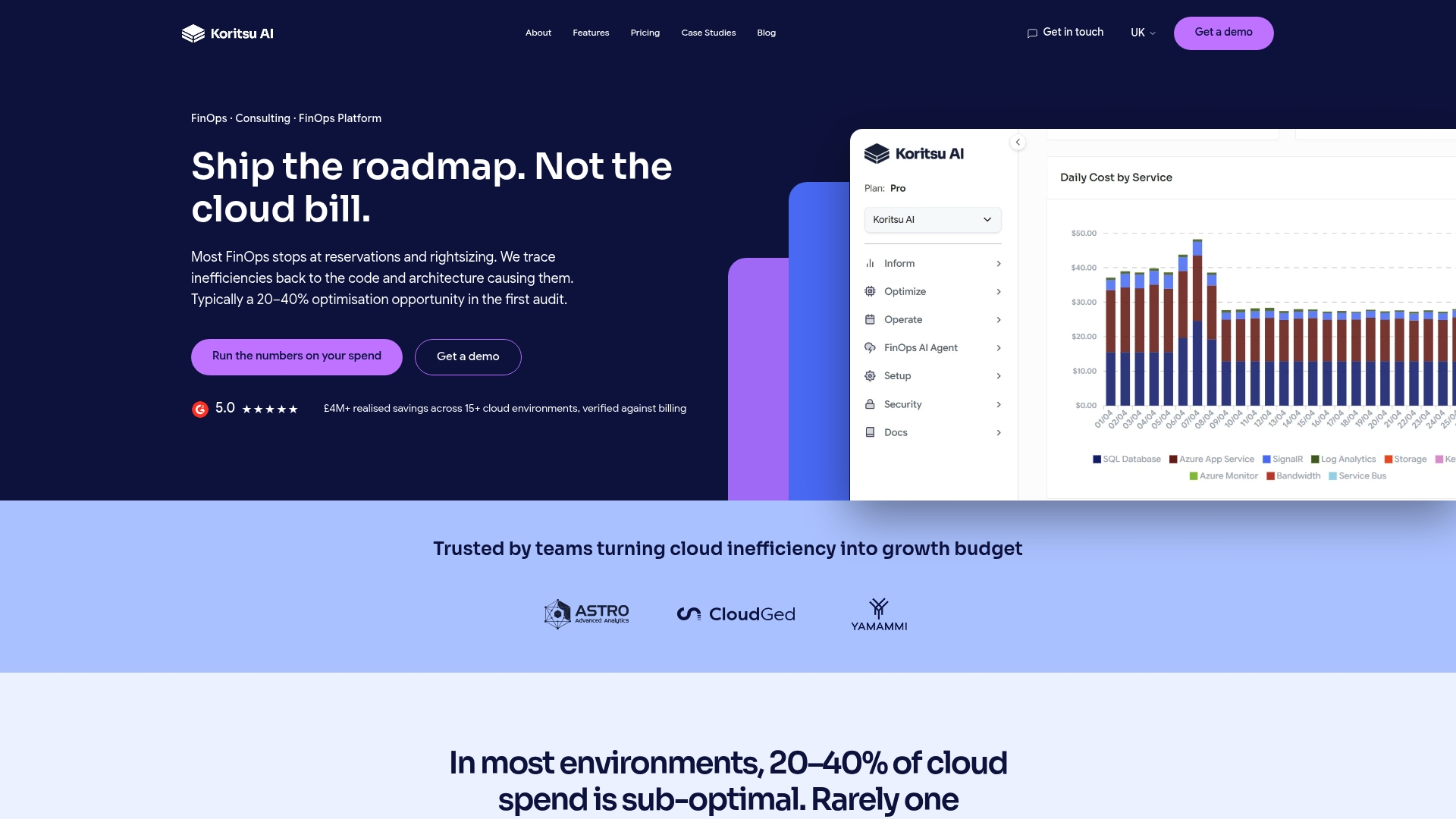
The free assessment maps your current cloud cost domains, identifies where spend is leaking, and quantifies the savings opportunity before you sign anything. From there, Koritsu AI's success-fee model means fees are charged only as a share of verified savings, making the engagement self-funding. For teams that want ongoing support, a tiered SaaS subscription provides continuous monitoring, AI-driven anomaly detection, and access to the FinOps specialist team.
Koritsu AI's deliverables for teams switching from Apptio include:
- Current-state cost domain mapping and allocation gap analysis
- Allocation model design aligned to your decision owners
- Automation implementation for rightsizing and anomaly detection
- Savings realisation and independent verification against billing
- Optional ongoing FinOps-as-a-service subscription for continuous improvement
The AI-driven cloud analysis that underpins Koritsu AI's platform is designed for engineering teams that need to act on findings, not just report them. Start with the free assessment at koritsu.ai to see where your cloud spend is going before you commit to a new platform.
Sources and further reading
- Gartner Peer Insights: IBM Apptio alternatives — evaluation dimensions and candidate alternatives list for Apptio
- Apptio on Wikipedia — background on IBM's acquisition and Apptio's product history
- ITQlick: Apptio TBM Suite alternatives — TCO breakdowns and hidden cost analysis for TBM implementations
- RFP.wiki: Apptio cloud alternatives — market roundup and trend commentary on cloud-native FinOps adoption
- Nicus Software: Apptio competitor comparison — ServiceNow-native TBM positioning and feature comparison
- Koritsu AI — free assessment, success-fee commercial model, and ongoing FinOps subscription details
Methodology note: this shortlist was compiled against three criteria: category fit for UK FinOps and IT finance use cases, UK readiness (local support, GBP billing, data residency), and FinOps feature coverage across allocation, forecasting, anomaly detection, rightsizing, and discount automation. No vendor paid for inclusion. Categories are used in preference to vendor names wherever the point applies at the category level.