FinOps Inform · Cost Optimisation
Cache strategy to reduce cloud spend: 2026 guide
Discover how a cache strategy can reduce cloud spend effectively. Learn practical techniques to cut costs and optimize your infrastructure today!

The most direct way to cut cloud infrastructure costs is to stop fetching the same data repeatedly. A well-designed cache strategy reduces cloud spend by intercepting redundant requests before they hit your database, origin server, or cross-region data transfer bill. The savings compound across every layer of your stack.
Here is what that looks like in practice:
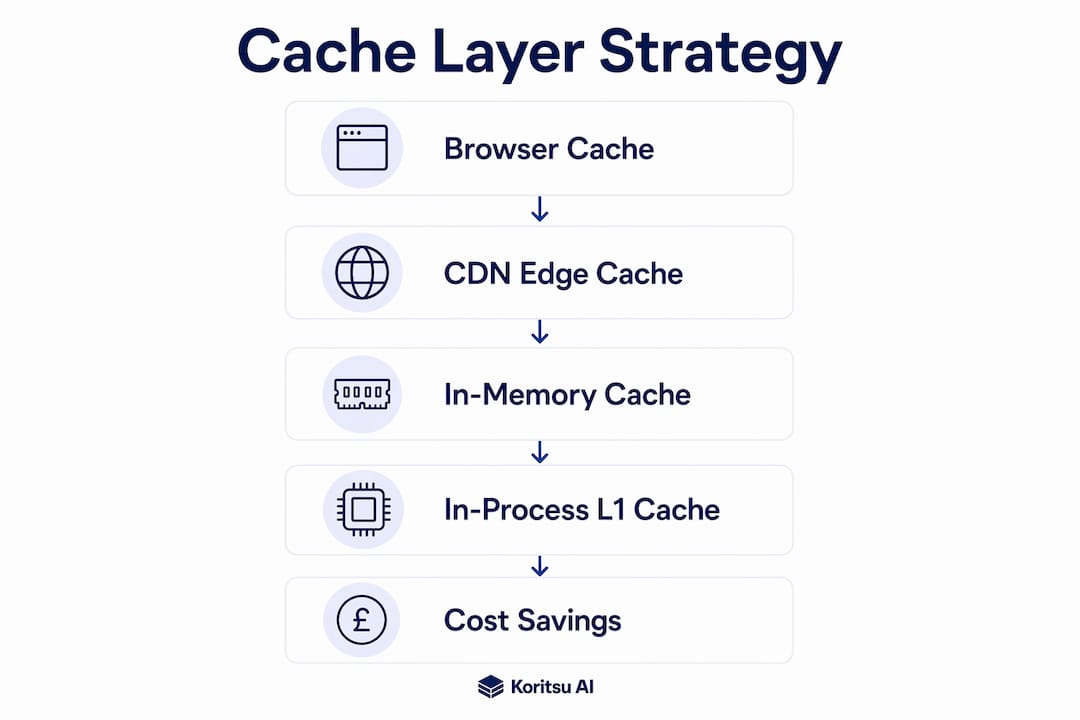
- Browser cache serves static assets and short-lived API responses locally, eliminating requests entirely before they reach your infrastructure.
- CDN edge caches (CloudFront on AWS, Azure CDN, Google Cloud CDN) absorb the next wave of traffic at the network edge, keeping origin load low.
- In-memory application caches such as Redis and Memcached store database query results and computed values in memory, slashing the query load on your RDS or Cloud SQL instances.
- API response caching prevents repeated calls to expensive downstream services, reducing both compute time and egress charges.
- Database query caching targets the highest-frequency reads, which are often the biggest line item on your cloud bill.
Each layer attacks a different cost category: compute, storage I/O, and data transfer. Used together, they produce compounding reductions rather than marginal ones.
How caching layers cut your cloud costs
The architecture of a layered cache is straightforward, but the cost mechanics at each tier are worth understanding precisely.
Browser cache
Browser caching is free. Setting aggressive Cache-Control headers for immutable static assets (hashed CSS, JS, images) means those files never touch your servers again after the first load. For API responses, stale-while-revalidate lets browsers serve cached data immediately while refreshing in the background, cutting origin hits without degrading the user experience.
CDN edge caching
A CDN cache sits geographically close to your users and serves responses without touching your origin. On AWS CloudFront, you can configure per-path cache behaviours: product catalogues might cache for an hour, search results for 60 seconds, and user-specific endpoints not at all. The cost benefit is direct: fewer origin requests means less compute time and less data transfer billed at origin egress rates.

Regional caching matters here too. Cross-region data transfer is one of the most overlooked line items in cloud bills. Serving traffic from a CDN edge node in the same region as your users avoids the inter-region transfer charges that accumulate silently. On Azure, configuring Azure CDN or Azure Front Door with region-aware routing achieves the same effect.
In-memory application caching with Redis and Memcached
This is where the largest savings typically occur. Redis and Memcached sit between your application and your database, storing query results in memory for a configurable TTL. A production case study shows a significant drop in database queries after Redis was introduced alongside a substantial reduction in the overall AWS bill.

Cache invalidation is the hard part. The most reliable pattern is explicit invalidation on write: when a product is updated, delete the relevant Redis keys immediately rather than waiting for TTL expiry. For search results, pattern-based key deletion (search:*) keeps stale data from accumulating.
TTL strategy directly affects cost. Too short a TTL means frequent cache misses and high database load. Too long means serving stale data and potentially caching objects that are never re-requested. For optimising cache TTLs, match the TTL to the natural update frequency of the data: product catalogues can tolerate an hour, session data cannot.
“Caching should be treated as a continuous systems engineering challenge. Structuring data access for reuse, batching requests, and labelling cacheable operations maximises efficiency and reduces backend computation cost far beyond what initial implementation alone achieves.” — Redis Engineering
Managed vs self-hosted caching
Managed services like AWS ElastiCache, Azure Cache for Redis, and Google Cloud Memorystore remove operational overhead but carry hidden costs. Inter-availability-zone data transfer, serialisation CPU, and over-provisioning headroom can make the true cost of ElastiCache two to three times higher than the instance price alone suggests. Self-hosted Redis on EC2 or GKE gives you more control over instance sizing and placement, but adds operational burden. The right choice depends on your team’s capacity and the workload’s access pattern.
Key techniques across all layers:
- Set
Cache-Control: immutablefor content-addressed static assets. - Use
stale-while-revalidatefor API responses where slight staleness is acceptable. - Apply per-route CDN cache rules rather than a single global TTL.
- Batch database reads and label cacheable queries explicitly in your application code.
- Place managed cache nodes in the same availability zone as your application to avoid cross-AZ transfer charges.
Broader cloud cost practices that work alongside caching
Caching reduces the load on your infrastructure, but it does not fix an over-provisioned or wasteful architecture. The two practices reinforce each other.
Rightsizing compute and cache instances
Once caching is in place and database query load drops, your compute instances are almost certainly over-provisioned for the remaining workload. Cloud infrastructure experts recommend continuous rightsizing: reviewing CPU and memory utilisation weekly and moving to smaller instance types when utilisation consistently sits below 20%. The same logic applies to cache clusters. After adding an L1 in-process cache tier, a three-node ElastiCache cluster may be safely reduced to a single node.
Removing idle resources
Idle resources are pure waste. Unused ElastiCache clusters, orphaned snapshots, and forgotten staging environments all appear on your bill. Automated tooling that flags resources with zero traffic over a rolling 7-day window makes this systematic rather than manual. For teams looking at cloud compute inefficiencies, idle cache nodes are frequently among the top five cost drivers.
Autoscaling integrated with caching
Autoscaling and caching are complementary. A well-warmed cache absorbs traffic spikes before they trigger autoscaling events, reducing the number of new instances launched and the associated cost. Conversely, autoscaling protects you during cache cold-start periods, such as after a deployment that flushes your cache. Configure your autoscaling policies to account for cache hit rate: if hit rate drops sharply, that is a signal that load is shifting to origin and scaling thresholds should respond accordingly.
Cache eviction policies and cost
Most teams default to LRU (Least Recently Used) eviction without questioning it. LRU optimises for hit rate, which is not the same as optimising for cost. In cloud environments where data egress and API request fees dominate, cost-aware eviction policies like GreedyDual make caching decisions based on the monetary cost of a cache miss rather than recency alone. The practical result is that expensive-to-fetch objects stay in cache longer, even if they are accessed less frequently than cheap ones.
Pro Tip: Before tuning eviction policies, instrument your cache to log the origin cost of each miss type. Even a rough cost-per-miss estimate will show you which object classes are driving your bill and where GreedyDual or a custom policy would have the most impact.
Compression is another underused lever. Nine Entertainment reduced their ElastiCache data transfer from 20TB per day to under 3TB per day by wrapping their Redis client with a Zstandard compression module, requiring only 46 lines of code. For JSON-heavy payloads, compression ratios are substantial and the latency overhead is negligible.
Practices to implement alongside caching:
- Review instance utilisation weekly and rightsize after cache load reductions take effect.
- Automate idle resource detection with a 7-day zero-traffic threshold.
- Tie autoscaling triggers to cache hit rate metrics, not just CPU.
- Switch from LRU to a cost-aware eviction policy for workloads with heterogeneous miss costs.
- Apply payload compression to managed cache clients handling large JSON objects.
Advanced insights: caching as a continuous engineering discipline
The teams that extract the most from caching do not treat it as a one-time configuration. They treat it as an ongoing systems problem, revisiting assumptions as workloads evolve.
The L1 plus L2 architecture
The most impactful architectural change for teams running managed caches is adding an in-process L1 cache in front of the network cache. Every read that hits the L1 returns in 31 nanoseconds with zero network overhead, zero serialisation cost, and zero cross-AZ transfer charge. The managed cache (ElastiCache, Azure Cache for Redis) becomes the L2, handling only the 5–15% of requests that genuinely require shared, mutable state.
The cost impact is concrete. One engineering analysis found that adding an L1 cache tier reduced total cache costs by 75%, dropping a monthly bill from $5,081 to $1,248. Cross-AZ transfer and serialisation CPU both fell by 90%, and the cluster shrank from three nodes to one.
Elastic caching and dynamic sizing
Static cache allocations are a form of over-provisioning. Google Research models elastic caching as a linear optimisation problem, adjusting cache size dynamically to match workload demand rather than provisioning for peak at all times. The result is a lower total cost of ownership compared to fixed allocations, particularly for workloads with variable traffic patterns. AWS ElastiCache Serverless implements a version of this: it scales compute, memory, and network resources automatically, and for applications with fluctuating traffic it can be meaningfully cheaper than a provisioned cluster.
When caching actually pays
Not every workload benefits from caching. Research extending the classic five-minute rule to cloud environments shows that caching becomes cost-effective at approximately 7 requests per second for non-latency-sensitive batch workloads, and 2 requests per hour for latency-sensitive interactive workloads. Below those thresholds, the cost of running the cache infrastructure exceeds the savings from avoided fetches. This is a useful sanity check before adding a cache tier to a low-traffic service.
“Cost-aware caching policies like GreedyDual cut dollar-regret from LRU to roughly a tenth by optimising for cloud bills that charge on data egress and API request costs, not hit ratios.” — Caching for Dollars, Not Hits
Continuous monitoring is what keeps these gains from eroding. Track L1 hit rate, L2 hit rate, cache miss cost by object type, cross-AZ transfer volumes, and eviction rates as first-class metrics alongside CPU and memory. When L1 hit rate drops below 70%, the usual cause is an undersized memory budget or a TTL that is too short for the access pattern. Fix the root cause rather than scaling up the managed cache. For teams building a cloud cost monitoring practice, cache metrics belong in the same dashboard as compute and storage spend.
The role of cloud architects in sustaining these savings is to make cache performance visible to the whole engineering team, not just the person who built it. When cache hit rate appears in weekly engineering reviews alongside deployment frequency and error rates, it gets the same attention as any other reliability metric.
Key takeaways
A layered cache strategy combining browser, CDN, in-memory, and in-process L1 caching is the highest-return infrastructure investment available to most engineering teams running on AWS, Azure, or Google Cloud.
| Point | Details |
|---|---|
| Layer your caches | Browser, CDN, in-memory, and L1 in-process caches each attack a different cost category and compound when combined. |
| L1 cache cuts managed cache costs by 75% | Adding an in-process L1 tier can drop total ElastiCache spend significantly in documented cases. |
| Use cost-aware eviction policies | GreedyDual reduces dollar-regret to roughly a tenth of LRU’s by prioritising expensive-to-fetch objects over recently used ones. |
| Compress cached payloads | Zstandard compression reduced one production workload’s cache data transfer volumes substantially. |
| Validate caching thresholds | Caching pays off when a workload hits defined minimum access frequencies for batch and latency-sensitive workloads; below those, the cache costs more than it saves. |
If you want to know exactly where your cloud bill is leaking, Koritsu AI’s free assessment maps your infrastructure against patterns like these and surfaces the fixes with the highest return. See how a UK bidding platform cut cloud costs by 52% using the same approach.