FinOps Inform · Cost Governance
What is cloud cost governance? A guide for IT leaders
Discover what cloud cost governance is and how it empowers IT leaders to optimize spending and align budgets with business goals effectively.

Cloud cost governance is defined as the structured framework of policies, controls, and accountability mechanisms that organisations use to manage, monitor, and optimise their cloud expenditure in alignment with business objectives. Without it, cloud spending becomes a reactive problem rather than a managed asset. Most organisations running workloads on AWS, Google Cloud, or Azure discover that costs grow faster than the value they deliver, not because of poor purchasing decisions, but because no formal governance structure exists to connect spending decisions to business outcomes. Cloud cost governance fixes that by embedding financial discipline directly into how teams build and operate infrastructure.

What is cloud cost governance and what does it include?
Cloud cost governance is the policy and enforcement layer that sits above day-to-day cloud cost management. It defines who can spend what, on which resources, under which conditions, and how that spending is tracked and attributed. The FinOps Foundation describes cost allocation using cloud tags as central to effective governance, enabling organisations to associate resources with cost centres, owners, and environments. That attribution is the foundation on which every other governance mechanism depends.
A mature governance framework typically includes five components:
- Cost allocation and tagging policies: Every resource carries metadata identifying its owner, environment, project, and business unit. Tagging strategies enable visibility by business unit, environment, or project and support automated chargebacks and allocation.
- Budget controls and alerting: Defined spending thresholds with automated alerts and approval workflows prevent bill shock before it occurs.
- Policy documentation: Written, measurable rules governing which resource types are permitted, which regions are approved, and what constitutes a policy violation.
- Automated enforcement: Native tools such as AWS Service Control Policies (SCPs) or Azure Policy block non-compliant resource creation before costs escalate.
- Compliance monitoring and review cycles: Regular audits confirm that policies are being followed and that governance frameworks evolve alongside the organisation’s cloud footprint.
The connection to FinOps culture is deliberate. Governance without shared financial responsibility across engineering and finance teams degrades quickly. Teams bypass manual tagging and controls when governance is not embedded in their workflows, which is why automated enforcement at resource creation is a non-negotiable requirement for any governance framework that intends to last.
Pro Tip: Embed tagging requirements directly into your infrastructure-as-code templates using Terraform defaults or IAM conditions. Governance policies that rely on engineers manually applying tags after deployment will drift within weeks.
How does governance differ from cloud cost management and optimisation?
These three terms are often used interchangeably, but they describe distinct functions that operate at different layers of cloud financial control. Conflating them leads to gaps where no one is accountable.
Cloud cost management is the practice of monitoring and reporting on cloud spend. It answers the question: what are we spending, and where? Tools like AWS Cost Explorer, Google Cloud Billing, and Azure Cost Management sit in this category. They provide visibility but do not enforce behaviour.
Cloud cost optimisation is the continuous reduction of waste while maintaining or improving the value delivered. Rightsizing underutilised instances, purchasing Reserved Instances or Savings Plans, and eliminating idle resources are all optimisation activities. Establishing review cycles, budget alerts, and rightsizing automation embeds optimisation into business as usual rather than treating it as a one-off project.
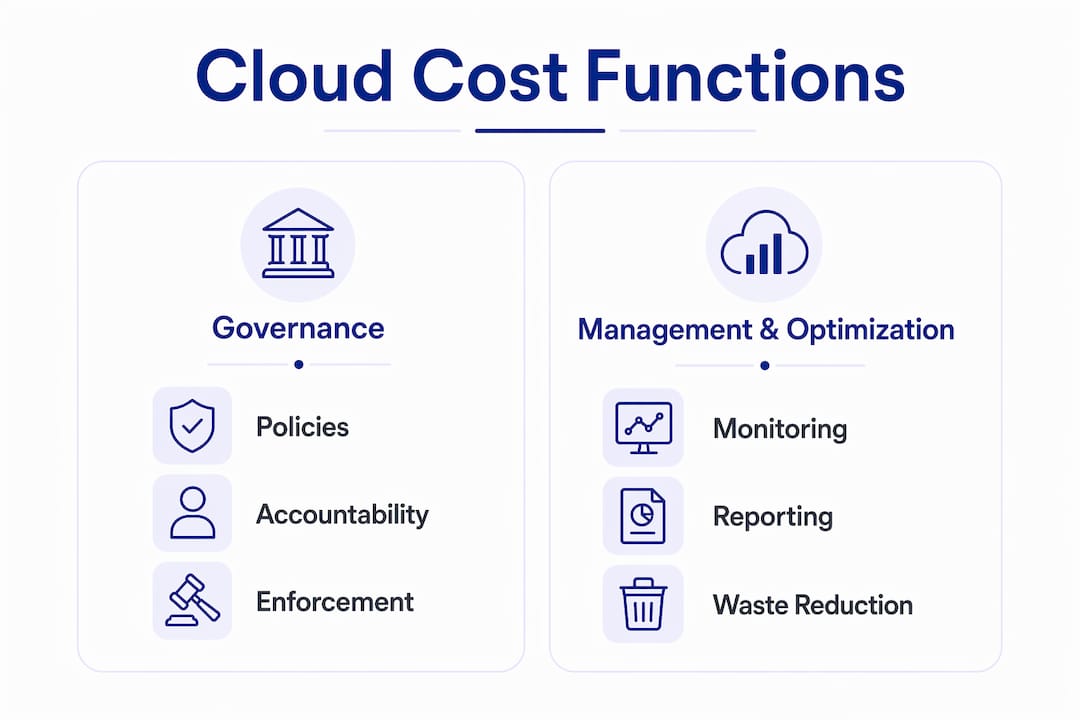
Cloud cost governance is the framework that makes both management and optimisation sustainable. It sets the rules, assigns ownership, and enforces compliance so that management and optimisation activities produce consistent results rather than isolated wins.
| Concept | Primary function | Key question answered |
|---|---|---|
| Cloud cost management | Monitoring and reporting | What are we spending and where? |
| Cloud cost optimisation | Waste reduction and efficiency | How do we spend less for the same output? |
| Cloud cost governance | Policy, enforcement, and accountability | Are we spending in line with business rules and objectives? |
Pro Tip: If your organisation has strong cost management dashboards but spending keeps rising, the missing layer is almost certainly governance. Visibility without enforcement changes nothing.
How to implement cloud cost governance in practice
Establishing governance is not a single project. It is a set of processes that need to be built, automated, and continuously maintained. The following sequence gives IT and finance leaders a practical starting point.
- Establish a tagging taxonomy. Define the mandatory tags every cloud resource must carry: owner, environment (production, staging, development), project, and cost centre. Agree this taxonomy across engineering, finance, and operations before writing a single policy.
- Enforce tags at provisioning. Governance policies for tagging must be embedded in infrastructure provisioning automation, such as Terraform defaults or IAM conditions, to prevent policy drift. Manual tagging after deployment is not governance. It is wishful thinking.
- Set budgets with threshold alerts. Define spending budgets at the account, project, and team level. Configure alerts at 50%, 80%, and 100% of budget thresholds. Integrate these alerts into Slack, Microsoft Teams, or your incident management workflow so that the right people are notified immediately.
- Deploy automated guardrails. Use AWS SCPs, Azure Policy, or Google Cloud Organisation Policies to block resource types or regions that fall outside approved parameters. Best practices in AWS environments include service-control policies that halt non-compliant actions before costs escalate.
- Assign clear budget ownership. Clear ownership and automated enforcement prevent the “tragedy of the commons” where no single team feels responsible for shared infrastructure costs. Every budget line needs a named owner.
- Establish review cycles. Monthly governance reviews should cover budget variance, tagging compliance rates, and policy violations. Quarterly reviews should assess whether the governance framework itself needs updating as the cloud footprint evolves.
Beyond native cloud tools, third-party FinOps platforms provide cross-cloud visibility and governance automation that native tools cannot match when organisations operate across AWS, Google Cloud, and Azure simultaneously. The Koritsu AI platform, for example, continuously analyses spending patterns and surfaces governance gaps that manual reviews miss.
The balance between control and agility matters here. Governance policies must balance control with the need for agility in cloud environments, or risk slowing innovation. Governance that blocks engineers from spinning up development environments quickly will be circumvented. Design policies that are firm on production workloads and financial accountability, but allow appropriate flexibility for experimentation.
What are the measurable benefits of cloud cost governance?
The business case for governance is straightforward once you understand what uncontrolled cloud spending actually costs an organisation.
- Cost predictability: Governance eliminates bill shock by replacing reactive discovery with proactive controls. Finance teams can forecast cloud spend with confidence when budgets are enforced and anomalies are flagged in real time.
- Waste reduction through accountability: When every resource is tagged to an owner and every budget has a named accountable party, teams make more deliberate provisioning decisions. Idle resources and over-provisioned instances get addressed because someone is responsible for the cost.
- Improved IT and finance collaboration: Cloud spending is now a governance issue requiring IT and finance collaboration to align operational decisions with financial discipline. Governance frameworks create the shared language and shared metrics that make that collaboration possible.
- Unit economics clarity: Leading organisations use unit economics metrics such as cost per transaction or cost per feature to assess whether cloud investment drives measurable business value. This transforms governance from a cost-cutting exercise into a strategic management tool. You can read more about this in Koritsu’s guide on aligning cloud costs with business outcomes.
- Faster, safer innovation: Counterintuitively, strong governance accelerates innovation. When engineers know which resources are approved, which regions are permitted, and what the budget boundaries are, they spend less time seeking approvals and more time building. Governance removes ambiguity, and ambiguity is what slows teams down.
The organisations that treat cloud cost governance as a strategic capability rather than a finance department concern are the ones that scale cloud adoption without losing financial control. For a deeper look at how cloud total cost of ownership fits into this picture, the financial frameworks involved are worth understanding before you set your first governance policy.
Key takeaways
Cloud cost governance is the policy and enforcement framework that makes cloud cost management and optimisation sustainable, accountable, and aligned with business value.
| Point | Details |
|---|---|
| Governance is a distinct layer | It sits above management and optimisation, setting rules and enforcing accountability rather than just reporting spend. |
| Tagging is the foundation | Every governance framework depends on consistent, automated tagging to attribute costs accurately to owners and projects. |
| Automation prevents drift | Governance policies embedded in Terraform or IAM conditions maintain efficacy; manual controls degrade within weeks. |
| Ownership drives behaviour | Assigning named budget owners to every cost centre is what converts governance from policy on paper to practice in production. |
| Unit economics add strategic value | Measuring cost per transaction or cost per feature connects cloud spend to business outcomes, not just budget lines. |
Why governance is the conversation most organisations are not having
From my experience analysing cloud spending across organisations of all sizes, the pattern is consistent. Teams invest heavily in cost management dashboards and optimisation tools, then wonder why spending keeps climbing. The answer is almost always the same: they have visibility, but they have no governance.
Cost management tells you what happened. Governance determines what happens next. The shift from reactive cost cutting to proactive governance is not a technology change. It is a process and culture change. Finance and engineering teams need shared metrics, shared accountability, and shared ownership of the outcome. That is not something a dashboard delivers on its own.
The organisations I see making real progress are the ones embedding governance directly into their engineering workflows, not bolting it on as a finance review at the end of the quarter. They are using unit economics to ask not just “how much did we spend?” but “did that spend create value?” That is the question that separates organisations managing cloud costs from organisations governing them. With AI workloads scaling rapidly in 2026, the gap between those two groups is widening fast.
How Koritsu AI supports your cloud cost governance
Koritsu AI combines an AI-driven analysis platform with hands-on specialist support to help organisations build and maintain cloud cost governance that actually works. Kori, our AI agent, continuously monitors spending across AWS, Google Cloud, and Azure, surfacing tagging gaps, budget anomalies, and policy violations before they become expensive problems. Our specialists work directly with engineering and finance teams to translate those findings into enforceable governance frameworks. If you want to see what governance improvements look like in practice, our UK bidding platform case study shows how one organisation achieved a 52% reduction in cloud costs through structured governance and optimisation. Start with a free assessment to find out where your governance gaps are.
FAQ
What is cloud cost governance in simple terms?
Cloud cost governance is the set of policies, controls, and accountability structures that determine how an organisation manages and monitors its cloud spending. It connects financial rules to engineering behaviour so that cloud costs stay aligned with business objectives.
How does cloud cost governance differ from FinOps?
FinOps is a cultural and operational framework for cloud financial management; governance is one of its core disciplines. Governance provides the policy and enforcement layer that makes FinOps practices sustainable across teams and over time.
Why do tagging policies matter for cloud governance?
Cost allocation using cloud tags is central to governance because it enables organisations to attribute every pound of cloud spend to a specific owner, project, or environment. Without consistent tagging, accountability is impossible and waste goes undetected.
What tools support cloud cost governance?
Native tools include AWS Service Control Policies, Azure Policy, and Google Cloud Organisation Policies for enforcement, alongside AWS Cost Explorer and Azure Cost Management for visibility. Third-party FinOps platforms such as Koritsu AI provide cross-cloud governance automation and AI-driven anomaly detection that native tools do not offer at scale.
How do you start implementing cloud cost governance?
Begin by defining a mandatory tagging taxonomy and enforcing it at resource provisioning through infrastructure-as-code templates. Then set budget thresholds with automated alerts, assign named owners to every budget, and establish monthly review cycles to monitor compliance and variance.