FinOps Inform
Require Four Tags: Cloud Tagging Strategy for Engineers and FinOps
Engineering first cloud tagging: require four mandatory tags enforced at deploy via IaC and policy. Get instant cost attribution and clear ownership.

Require four tags on every resource, env, team, service, and costcenter, and block anything that skips them at the point of creation. That’s the whole strategy. Enforce it through infrastructure-as-code and provider policy rather than a wiki page nobody reads, and you get immediate cost attribution, clear ownership when something breaks, and automation that doesn’t fall over because a resource was never labelled properly.
TL;DR:
- Using a four-tag schema with environment, team, service, and costcenter ensures effective cost attribution and resource ownership.
- Enforcing tags via infrastructure-as-code and provider policies at deployment prevents untagged resources from being created.
- A phased rollout starting from low-risk accounts allows smooth enforcement without disrupting existing workflows.
- Continuous compliance monitoring and backlog remediation are crucial for maintaining accurate, consistent tagging across resources.
- Native multi-cloud enforcement tools combined with unified policy layers help manage provider-specific tagging differences effectively.
Recommended cloud tagging strategy: schema and naming conventions
Four tags cover most of what a cost or governance team actually needs. env identifies the environment (prod, staging, dev). team identifies who owns the resource, ideally matching a real organisational unit rather than a person’s name that becomes stale the moment they change jobs. service ties the resource to the application or workload it supports. costcenter links spend to a finance code so bills reconcile against budgets without a spreadsheet in between.
Beyond those four, a handful of optional tags earn their place on specific resource types:
managed-by: flags resources controlled by Terraform, Pulumi, or a manual process, useful when tracking down what will break if someone deletes something by hand.lifecycle: marks temporary resources (ephemeral,permanent) so cleanup scripts know what’s safe to remove.sensitivity: flags data classification for resources holding regulated or confidential information.
Case sensitivity trips up more teams than any other part of a tagging strategy. AWS treats tag keys and values as case-sensitive, Azure does too for most resource types, and a tag written as Team in one place and team in another creates two separate cost buckets in reporting. Pick lowercase, hyphenated keys and enforce it everywhere. It’s a five-minute decision that saves weeks of reconciliation later.
Enforcing tagging at deploy time: IaC, policy and admission control
A cloud tagging strategy only works if untagged resources can’t get created in the first place. Retrofitting tags on live infrastructure is always harder than blocking the gap at source, and each provider gives you a different lever to pull.
- AWS uses tag policies through AWS Organizations, which can enforce required keys and values across accounts, and Service Control Policies can deny resource creation outright if mandatory tags are missing.
- Azure Policy offers a ‘modify’ effect that can inject default tag values automatically, alongside deny effects for resources submitted without required tags, an approach the Cloud Adoption Framework recommends pairing with a clear naming convention.
- GCP relies more heavily on Organization Policy constraints and labelling conventions, with fewer native enforcement primitives than AWS or Azure, so IaC-layer checks matter even more there.
The IaC layer catches problems before they ever reach the cloud provider. Terraform’s default_tags block applies a baseline tag set to every resource in a provider block, and validation blocks can reject a plan outright if team or costcenter is missing. Wire tflint, Checkov, or OPA/Conftest into your CI pipeline and a missing tag fails the pull request rather than reaching production.
For workloads deployed from Kubernetes, admission controllers such as OPA Gatekeeper or Kyverno enforce required labels on pods and namespaces, and those labels can propagate into cloud tags via cluster autoscaler or cloud controller manager configuration, keeping node pools and load balancers tagged consistently with the workloads running on them.
Pro Tip: Start every provider policy in audit mode before switching to deny. You’ll surface a backlog of exceptions in week one that would otherwise turn into a flood of blocked deployments and angry Slack messages.
How to implement cloud tagging: a phased rollout plan
Rolling out tagging enforcement across an entire estate in one go breaks things. A phased approach gets you full coverage without a week of firefighting.
- Define scope and align stakeholders. Agree which four tags are mandatory, which accounts or subscriptions are in scope, and who signs off on the allowlist of acceptable values for
teamandservice. - Run a pilot in a low-risk account. Pick a sandbox or a genuinely non-critical production account, measure current compliance as a baseline, and iterate on the allowlist until false positives drop to near zero.
- Scale progressively. Move from sandbox to non-production to production, tightening policy from audit to deny at each stage, with CI gating catching violations before they ever reach a cloud API.
- Operationalise it. Bake tagging into onboarding docs, bundle the required tags into shared Terraform modules so new services inherit them automatically, and add a tagging check to sprint planning for any team provisioning new infrastructure.
Governance, ownership and change management
Tagging drifts the moment nobody owns it. A Cloud Centre of Excellence should own the schema itself, deciding which tags are mandatory and arbitrating disputes over naming, while each engineering team owns applying tags correctly on their own resources.
A simple RACI keeps this honest:
- Responsible: the engineering team provisioning the resource.
- Accountable: the CCoE or platform team maintaining the schema.
- Consulted: FinOps or finance, when costcenter mappings change.
- Informed: security, when sensitivity tags shift.
Store the tag dictionary and allowlists as code, inside the same Terraform modules teams already use, rather than in a document that goes stale within a quarter. Dashboards showing per-team compliance percentages, published somewhere visible, do more to fix drift than any policy memo. Teams respond to a scorecard faster than a mandate.
Auditing and fixing legacy tagging gaps
New enforcement rules don’t touch resources that already exist. AWS states plainly that tags aren’t applied retroactively, which means every environment carries a backlog of untagged infrastructure that needs a deliberate remediation pass.
Measurement comes first. AWS Config rules and Azure Policy compliance reports both give you a live percentage of tagged versus untagged resources, and Google Cloud’s Asset Inventory API does the equivalent for GCP. A four-tag minimum schema tends to produce far higher compliance rates than programmes demanding a dozen or more mandatory fields, simply because there’s less to get wrong at creation time.
For the backlog itself:
- Script bulk remediation where the correct value is inferable (a resource’s name or its VPC often reveals the right
teamorservice). - Apply cautious defaults, such as
costcenter: unallocated, so cost reports stay usable while the real value gets tracked down. - Run a dedicated one-off backfill sprint for anything automation can’t confidently resolve.
Once the backlog clears, daily compliance dashboards plus quarterly deeper audits keep drift from creeping back in, with automated remediation handling the safe, obvious cases without waiting for a human.
Multi-cloud tagging: provider gaps and the right tooling
Running AWS, Azure, and GCP side by side means living with three different tagging models, and pretending they’re interchangeable is where most multi-cloud cost reports fall apart.
- AWS requires manual activation of cost allocation tags in the Billing console before they appear in reports, a step teams routinely forget after adding a new tag key.
- Azure tags flow into Azure Cost Management without any activation step and support inheritance from resource groups, which is more convenient but can also mask which resource actually set a tag value.
- GCP leans on labels rather than tags in the AWS/Azure sense, with fewer built-in enforcement primitives, so the discipline has to come from IaC and CI rather than the console.
Cross-cloud tools like Cloud Custodian, or a policy-as-code layer built on OPA, give you one enforcement definition that applies everywhere instead of three separate rule sets to maintain. Native tooling still wins for provider-specific enforcement (Azure’s modify effect has no real AWS equivalent), so the practical pattern is native enforcement per cloud, unified visibility on top.
Serverless functions and shared infrastructure, a shared NAT gateway or a multi-tenant database, resist clean tag-based attribution because no single team owns the whole cost. Proportional allocation based on usage metrics, layered on top of tags rather than replacing them, tends to be the least painful fix.
Templates: tag dictionaries, Terraform snippets and CI checks
A minimal tag dictionary, kept in version control alongside your IaC modules, might look like this:
| Tag | Example values |
|---|---|
| env | prod, staging, dev |
| team | platform, checkout, data |
| service | api-gateway, billing-service |
| costcenter | cc-1042 |
A Terraform provider block using default_tags applies the baseline set automatically:
provider "aws" {
  default_tags {
    tags = {
      env        = var.env
      team       = var.team
      service    = var.service
      costcenter = var.costcenter
    }
  }
}
Pair that with a validation block that rejects an empty team value, and a CI step running tflint or an OPA/Conftest policy against the plan output before merge. On Azure, a policy using the modify effect can inject a default costcenter value when one is missing, then an audit query against Azure Resource Graph reports anything the modify effect couldn’t safely fix.
Pro Tip: Keep the tag dictionary in the same repository as the Terraform modules that consume it. When the two live apart, they diverge within a month.
Designing a tagging taxonomy that scales
A schema of four mandatory tags works because it’s shallow. A taxonomy is what happens when you decide how those tags relate to each other, and getting the hierarchy wrong is what turns a clean schema into a mess eighteen months later.
Think in terms of category types rather than a flat list. Ownership tags (team, managed-by) answer who’s responsible. Classification tags (env, sensitivity) answer what kind of resource this is. Financial tags (costcenter, service) answer where the money goes. Keeping these categories distinct stops teams from overloading a single tag with meanings it was never designed to carry, a common failure mode where env quietly starts encoding both environment and criticality.
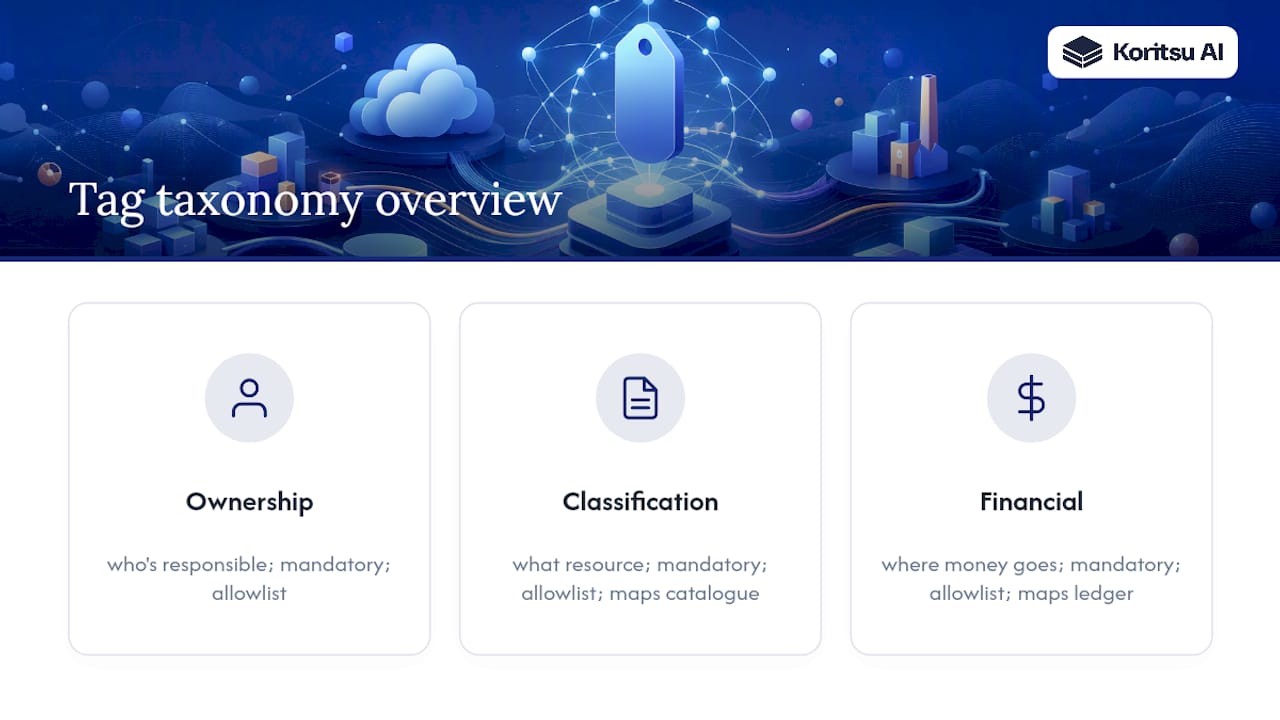
Hierarchy matters more once an organisation grows past a handful of teams. A costcenter value should map cleanly to a finance code that already exists in the general ledger, not to an ad hoc label someone invented during a sprint. A service value ideally maps to an entry in a service catalogue, if one exists, so tagging data and architecture documentation tell the same story rather than two slightly different ones.
Tag attributes, the metadata about the tag itself rather than the resource, matter more than most teams realise at the design stage. Deciding upfront whether a tag is mandatory or optional, whether its values come from a closed allowlist or free text, and whether it applies to all resource types or only specific ones, prevents the slow accumulation of inconsistent tags that makes audits painful. A closed allowlist for team and env, with free text reserved for lower-stakes optional tags, tends to hold up best in practice.
Managing the tag lifecycle: updates, retirement and versioning
Tags aren’t static once applied. Teams get renamed, cost centres merge, services get decommissioned, and a tagging strategy that has no process for handling those changes ends up with reporting that quietly diverges from reality.
Updates need a defined path rather than an ad hoc edit. When a team value changes because of a reorganisation, that change should flow through the same IaC pipeline that applied the tag originally, not a manual console edit that leaves Terraform state out of sync with the live resource. A drift check in CI, run periodically rather than only at deploy time, catches the cases where someone updated a tag by hand.
Retirement deserves as much attention as creation. A service tag for a decommissioned application shouldn’t simply vanish from the allowlist; historical cost reports still need to resolve that value correctly, so retired tag values are best moved to a documented “deprecated but valid for historical reporting” state rather than deleted outright. Deleting them retroactively breaks trend analysis for anyone querying data from before the retirement date.
Versioning the schema itself matters once an organisation has been tagging resources for more than a year or two. If a mandatory tag gets added, resources created before that change won’t have it, and a version marker (even something as simple as a schema-version tag applied at the account or subscription level) helps automated remediation scripts know which resources predate a given rule and need backfilling versus which were created under the current schema and should already comply. Without that marker, remediation scripts end up guessing.
Tagging as a security and compliance control
Tags do more than allocate cost. Security and compliance teams increasingly treat them as a primary signal for identifying which resources fall under which regulatory scope, and a tagging strategy designed only around FinOps needs will eventually need retrofitting to serve that purpose too.
A sensitivity tag, applied consistently, lets automated scanning tools identify which storage buckets or databases hold regulated data without relying on someone remembering to update a spreadsheet. Combined with policy-as-code, that tag can drive real enforcement: a storage resource tagged sensitivity: pii might trigger a policy requiring encryption at rest, restricted network access, or a specific retention configuration, all applied automatically rather than checked manually during an audit.
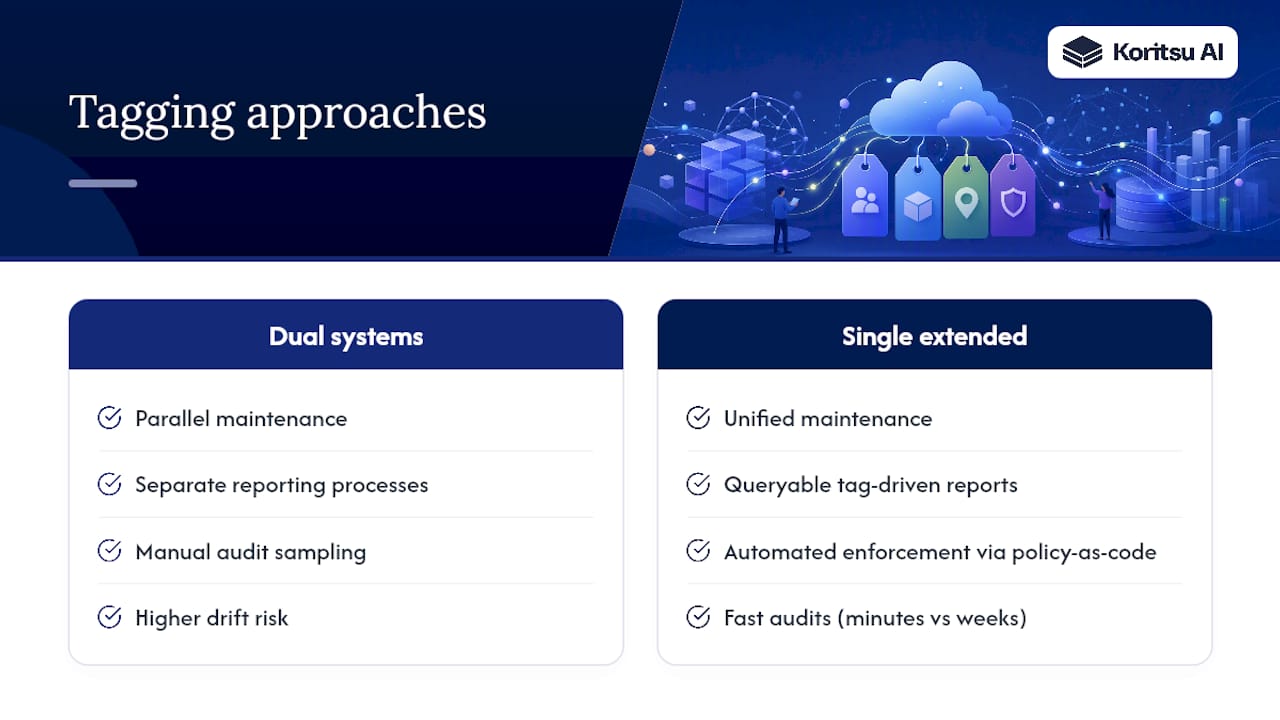
Compliance frameworks that require evidence of access control and data classification, common in sectors handling financial or health data, benefit directly from tag-driven reporting. Instead of an auditor manually sampling resources, a query against AWS Config or Azure Resource Graph can produce a complete list of resources by sensitivity classification in minutes, something that turns a multi-week audit exercise into an afternoon’s work.
The overlap with the governance structure already covers most of what’s needed here: if security is consulted whenever sensitivity tags change, as the RACI model earlier sets out, compliance reporting becomes a query against existing data rather than a separate parallel process. The mistake to avoid is building a second, security-specific tagging system that runs alongside the cost-focused one. One schema, extended with a small number of security-relevant tags, holds up far better than two schemes maintained independently.
How tags shape provisioning and deployment workflows
Enforcing tags at deploy time doesn’t just stop untagged resources from appearing. It changes how provisioning itself behaves, and that has knock-on effects worth planning for rather than discovering during an incident.
A deny-effect policy that rejects a deployment missing costcenter will, without careful design, also reject an emergency hotfix deployed at 2am by an engineer who doesn’t know the right cost centre code. That’s why the phased rollout matters: audit mode surfaces these edge cases before deny mode makes them a production incident. Break-glass exceptions, a documented path to bypass tag enforcement temporarily with an automatic follow-up ticket to backfill the correct value, keep emergency deployments from being blocked by a governance control that was never meant to slow down incident response.
CI/CD pipelines that validate tags before merge, rather than after deployment, shift the cost of a missing tag from a production remediation task to a five-second pull request comment. That shift alone changes team behaviour faster than any policy document, because the feedback is immediate and the fix is nearly free at that stage.
Modular IaC helps here too. When required tags live inside a shared Terraform module rather than being repeated in every service’s configuration, a new deployment inherits correct tagging by default, and a schema change (adding a new mandatory tag, say) only needs updating in one place rather than across every team’s repository. That single change propagates through the next deployment of every service using the module, which is a far more reliable path to full coverage than asking every team to update their own configuration on the same day.
Metrics that show whether tagging is actually working
Tagging compliance is easy to measure and easy to game if the metric is chosen carelessly. Percentage of resources tagged is the obvious headline number, pulled from AWS Config, Azure Policy compliance reports, or Cloud Asset Inventory, but it says nothing about whether the values themselves are correct.
A more useful set of metrics looks at both coverage and quality:
- Tag coverage rate: the percentage of resources carrying all four mandatory tags, tracked per account or subscription rather than as a single organisation-wide average that hides weak spots.
- Cost attribution rate: the percentage of total cloud spend that maps cleanly to a
teamandcostcenter, which is the number finance actually cares about and can differ significantly from raw resource coverage. - Drift rate: how many previously compliant resources fall out of compliance each month, a signal that catches manual console changes bypassing IaC.
- Time to remediate: how long a tagging violation sits open in CI or in a dashboard before it’s fixed, which reflects whether teams treat tagging debt seriously or let it accumulate.
- Policy exception volume: the number of break-glass exceptions granted, watched over time to make sure it’s shrinking rather than becoming a permanent workaround.
Reviewed together, these metrics tell you whether the schema is actually reducing manual reconciliation work, which is the real point of a tagging programme. A high coverage rate paired with a low cost attribution rate usually means the allowlist for team or service is too loose, letting values through that don’t map cleanly to anything finance recognises.
Why enforcement beats documentation
Most tagging programmes fail for the same reason: they’re written as policy documents instead of built as engineering controls. A fifty-page tagging standard that nobody reads produces worse compliance than a four-tag schema wired into Terraform’s default_tags and backed by a CI check.
The instinct to add more mandatory tags, more categories, more nuance, comes from a good place. It’s also usually a mistake. Every extra mandatory field is another way for a deployment to fail a policy check, and every failed check that engineers don’t understand becomes friction they’ll route around given the chance. Minimal schema, enforced ruthlessly, wins over comprehensive schema, enforced loosely, in almost every environment we’ve looked at.
There’s a point past which automation alone won’t close the gap, usually when the legacy backlog is large, cross-team ownership is genuinely contested, or cost attribution needs to hold up under an audit. That’s when bringing in outside FinOps expertise for a structured remediation sprint tends to pay for itself faster than another quarter of internal debate.
How Koritsu AI turns tagging gaps into savings you can act on
Getting a tagging schema enforced is only half the job. The other half is knowing exactly what those tags reveal once they’re in place, and that’s where most internal teams run out of time before they run out of ideas. A cloud cost optimisation platform, powered by an AI agent, can continuously analyse cloud spend once tags are consistent, surfacing cost allocation by team, service, and environment, and flagging architectural inefficiencies that tags alone won’t fix on their own.
Engagements can start with a free assessment, and pricing may be based on a share of the savings identified and verified against billing, with optional ongoing subscriptions for continuous monitoring after the initial work. One UK bidding platform cut cloud costs by 52% working with our team this way. If your tagging is already solid but the savings still aren’t showing up in your bill, that’s the gap worth having a specialist look at next.
Key documentation and whitepapers to consult
- Azure Cloud Adoption Framework: tagging strategy
- AWS Organizations tag policies for IaC
- AWS cost allocation tag activation
- HashiCorp Well-Architected: tagging cloud resources
- AWS tagging best practices whitepaper
Sources
- Define your tagging strategy - Cloud Adoption Framework
- Enforce consistent tagging across IaC deployments with AWS Organizations tag policies
- Activate user-defined cost allocation tags - AWS Billing and Cost Management
- Create and implement a cloud resource tagging strategy | HashiCorp Well-Architected
- Best practices for tagging AWS resources — AWS whitepaper