FinOps Inform
Stop Chasing Precision: Six Cost Allocation Methods for FinOps
Playbook for finance and FinOps: balance accuracy and implementability. Learn six allocation methods, governance essentials, and cloud tagging.

Good cost allocation is documented, consistent, and proportionate to the decision it supports, not to the ideal of perfect accuracy. Three principles hold it together: consistency of method across reporting periods, a documented rationale that survives an audit, and a deliberate trade-off between precision and administrative cost. None of that works without a regular review cadence and a small set of KPIs to catch drift before it distorts pricing or budgets.
TL;DR:
- Accurate cost allocation requires a well-documented, consistent methodology with regular reviews and KPIs to prevent drift and ensure reliability.
- Choosing the right allocation method depends on data quality, product diversity, and acceptable administrative effort, with simple splits suitable for straightforward cases.
- Proper documentation and governance enable quick audit sign-off and ensure allocation impacts financial statements and compliance are correctly reflected.
- Industry-specific methods, like activity-based costing or cloud tagging, are crucial for complex, variable environments such as manufacturing or SaaS businesses with shared infrastructure costs.
- AI-driven analysis and expert support can help organizations continuously refine and trust their cost allocation models, especially for dynamic cloud spending.
What cost allocation best practices actually cover
Cost allocation is the process of assigning shared costs to the parts of the business that actually use them. Two terms sit underneath everything else here. A cost pool is the bucket of shared expenses you're distributing, things like a shared data platform, a facilities budget, or an IT helpdesk. A cost object is the recipient, a product, a department, a customer segment, or in a cloud context, an engineering team or feature. Get the pool and the object wrong and every downstream number is wrong too.
Done properly, allocation serves four purposes at once:
- Transparency: showing which teams, products, or services actually drive cost, not just which ones show up on the invoice.
- Pricing and profitability: you can't price a product correctly if its true cost is buried inside a shared overhead line.
- Accountability: teams manage what they're measured on; allocate cost to the right owner and behaviour changes.
- Audit and compliance readiness: grant funded work, regulated industries, and public contracts often require a defensible cost basis, not just a plausible one.
This is why allocation shouldn't sit in the "back office admin" category. Research has found that a significant portion of finance leaders rate cost allocation as a critical priority for supporting business goals and improving transparency, which puts it closer to strategic finance work than bookkeeping. Treated well, allocation becomes a lever for cross functional collaboration between finance and operations, not just a year end reconciliation exercise.
Building blocks and the six core allocation methods
Before choosing a method, get the framework's components right. Every credible allocation model needs five things in place, and skipping any one of them is what causes disputes later:
- A defined allocation basis, the metric driving the split (headcount, square footage, machine hours, cloud tags).
- Documented assumptions, why that basis was chosen over the alternatives.
- Sign off and approvals, who reviewed and accepted the method, and when.
- Calculation steps, a repeatable formula, not a one off spreadsheet trick nobody else can reproduce.
- A storage location for records, so the rationale survives staff turnover and audit requests.
With that scaffolding in place, six methods cover most real world situations:
- Direct allocation assigns a cost straight to the object that caused it, no splitting required. Simplest and most accurate when it applies, but most shared costs don't qualify.
- Proportional allocation splits cost using a measurable driver, such as revenue share or headcount. Easy to explain, though the driver can drift from actual usage over time.
- Even split allocation divides cost equally across objects. Fast, but it punishes low usage teams and rewards high usage ones, so it only belongs where consumption genuinely is roughly equal.
- Weighted allocation adjusts the split using a factor that reflects intensity of use, such as transaction volume or storage consumed. More accurate than a flat split, more work to maintain.
- Activity based costing (ABC) traces cost to the specific activities that consume resources, then to the objects that use those activities. The most granular method, and the most expensive to run.
- Reciprocal allocation accounts for services departments provide each other (IT supporting HR, HR supporting IT) before allocating out to final cost objects. Mathematically the most rigorous option, rarely worth the effort outside large, interdependent shared service structures.
Choosing between them comes down to three practical questions: how good is your underlying data, how diverse is your product or service mix, and how much administrative cost can you justify spending on the allocation itself? A single product business rarely needs ABC. A multi product SaaS company running dozens of microservices across three cloud providers probably can't avoid something closer to it.
Best practices for design, documentation and governance
Rigour and implementability pull in opposite directions unless you build governance in from the start. A handful of rules keep allocation defensible without turning it into a full time job.
- Document methodology before or alongside the spend, not after the fact. UCSF's controller's office guidance is explicit on this: the audit trail and rationale for a chosen basis need to exist at the point costs are incurred and allocated, not reconstructed months later when a query lands.
- Keep the method consistent across periods. Changing your allocation basis every quarter destroys comparability and invites scrutiny. When a change is genuinely needed, run it through a controlled change process with sign off and a documented reason.
- Set KPIs and a review cadence. Variance analysis, comparing allocated cost against actuals, catches drift early. Quarterly reviews are typical; monthly for fast changing cost bases like cloud infrastructure.
- Use technology to reduce manual effort. Tagging in your ERP or cloud billing console, and automated data capture, cuts the manual reconciliation that causes most allocation errors. Tagging strategies and automated collection materially improve allocation accuracy for cloud and IT costs specifically, where usage shifts week to week.
Rigour pays off when it's applied where it counts. BCG's research on cost transformation found that rigorously tested initiatives capture roughly thirty percentage points more of their target value than less disciplined ones, evidence that the governance step isn't bureaucratic overhead, it's what makes the savings real.
Pro Tip: Resist the urge to chase decimal point precision. NetSuite's guidance on cost allocation warns that excessive precision causes analysis paralysis and rarely justifies the administrative cost of getting there. Aim for accuracy that changes a decision, not accuracy for its own sake.
Worked examples: from a simple split to cloud tagging
Numbers make allocation logic concrete in a way policy documents don't. Three examples, increasing in complexity:
- Even split across departments. A £120,000 shared facilities cost split evenly across four departments gives each one £30,000. No usage data needed, but if one department has twice the headcount of another, this method misrepresents true cost.
- Proportional allocation using a consumption metric. The same £120,000 split by headcount, where department A has 40 staff out of 200 total, gets 40 ÷ 200 × £120,000 = £24,000. Swap headcount for machine hours or cloud CPU hours and the formula works identically: (object's usage ÷ total usage) × total cost.
- Cloud tagging for showback and chargeback. Tag every resource by team, product, and environment at creation. Map each cloud invoice line to those tags monthly. Showback reports the allocated cost to teams without actually billing them internally, useful for building cost awareness first. Chargeback moves that allocated cost onto a team's actual budget, which changes behaviour faster but needs mature tagging discipline before you introduce it. Koritsu AI's guide to attributing cloud costs to product features covers the mechanics of getting from raw billing data to a per feature figure.
The most common mistake across all three: applying a static allocation basis (last year's headcount, an old usage snapshot) to a business that's changed shape. Refresh the driver data at least as often as your review cadence, or the allocation quietly becomes fiction.
How allocation shows up in financial statements
Allocated costs don't just sit in an internal spreadsheet. They flow directly into cost of goods sold, gross margin by product line, and segment reporting, which means a flawed allocation basis distorts the numbers investors and boards actually read. Overallocate shared overhead to one product and its reported margin looks worse than reality; underallocate and you're pricing that product on a false sense of profitability.

Inventory valuation is a direct example. Manufacturing overhead allocated to units produced affects the cost figure attached to unsold inventory on the balance sheet, which in turn affects reported profit the moment that inventory sells. Get the allocation basis wrong and the error compounds across every period the inventory sits unsold.
Segment reporting carries similar weight. Multi division businesses allocate shared corporate costs, finance, IT, facilities, across segments to show a true picture of divisional profitability. Analysts and boards use those segment margins to decide where to invest, cut, or divest. An allocation method that's inconsistent between periods makes trend analysis meaningless, because you can no longer tell whether a margin moved because the business changed or because the allocation basis did.
This is also where documentation earns its keep. When external auditors test cost of goods sold or segment disclosures, a documented, consistently applied allocation methodology is what lets them sign off quickly. An undocumented one turns into a lengthy back and forth that delays reporting and raises audit fees.
Regulatory and compliance considerations
Cost allocation carries real compliance weight wherever contracts, grants, or regulated pricing depend on demonstrable cost basis. Government contractors and organisations receiving sponsored research funding face some of the strictest scrutiny: allocation methods need to be consistently applied, documented in advance, and defensible against audit, exactly the standard set out in cost allocation methodology guidance from research institutions handling federal funding.
Regulated industries, utilities, healthcare, and telecoms among them, often have allocation rules baked into rate setting or reimbursement frameworks. A utility allocating shared network costs across customer classes, or a hospital allocating overhead across service lines for Medicare cost reporting, isn't just following internal policy, it's meeting a regulatory obligation with real financial consequences for getting it wrong.
Transfer pricing is the other major compliance pressure point, particularly for multinational groups. Tax authorities scrutinise how shared costs, management fees, shared services, intellectual property, are allocated between related entities in different jurisdictions. An allocation basis that looks reasonable internally can still fail an arm's length test if it isn't documented with the same rigour a tax authority would expect from third party pricing.
The common thread across all of these: the documentation checklist covered earlier in this guide isn't just good practice, it's frequently the actual compliance requirement. Auditors and regulators rarely object to a chosen method itself; they object to the absence of a written rationale for why it was chosen.
Cost allocation in practice across industries
A hospital allocating shared overhead, facilities, administration, medical records, across service lines typically uses a weighted allocation based on relative value units or bed days, because a flat split would badly misstate the cost of intensive care versus outpatient services. Getting this right affects both internal profitability reporting and external cost reporting tied to reimbursement.
Manufacturers with multiple product lines sharing a factory floor lean on activity based costing when product complexity varies significantly, tracing machine setup time, quality inspection, and materials handling to the products that actually consume them. A business making one product in high volume rarely needs this; a business making twenty products in varying batch sizes usually does, because a simple proportional split by revenue would systematically overcharge the high volume, low complexity product.
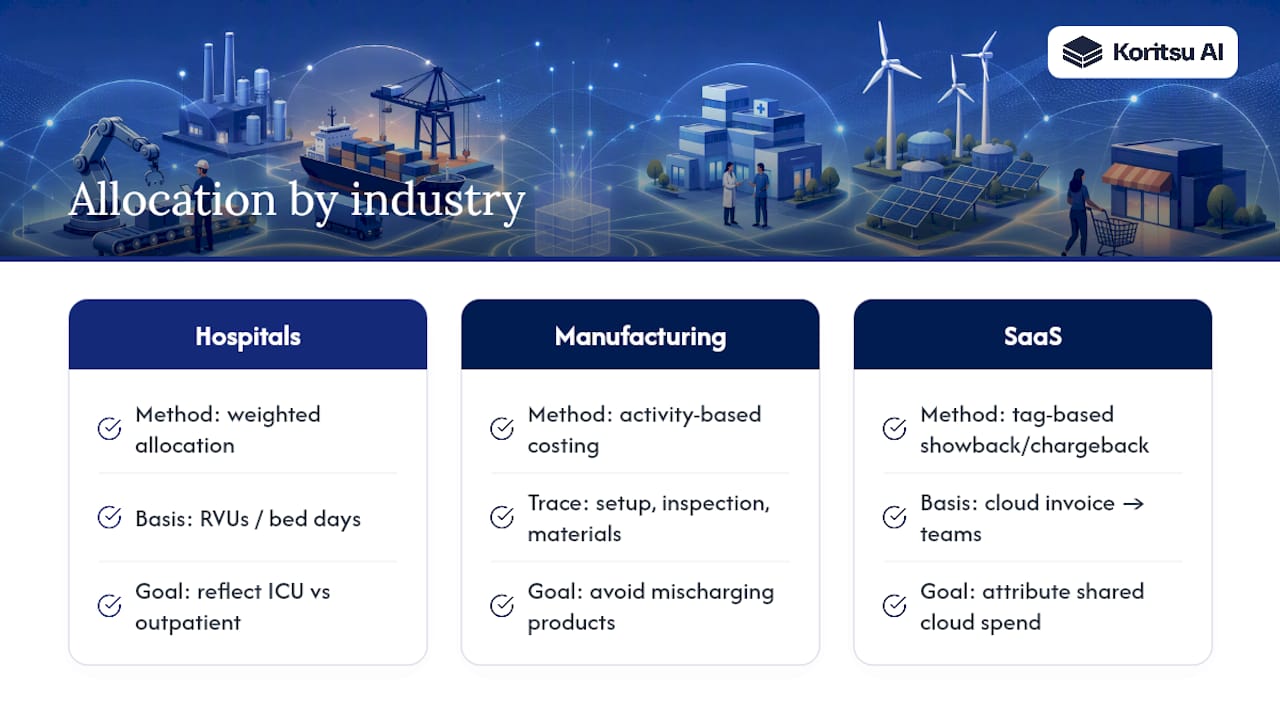
Software and SaaS companies face a newer version of the same problem: shared cloud infrastructure spanning dozens of microservices, with no natural headcount or square footage metric to allocate against. This is where tagging based showback and chargeback models have become the practical standard, mapping cloud invoice line items to the teams and features that generated them. Koritsu AI's breakdown of cloud spend attribution walks through how this mapping works when hundreds of services and dozens of teams share the same cloud bill. TrailerCast's analysis of hidden costs inside a company's sales stack makes a related point from a different angle: shared operational tooling that isn't allocated to the products or teams using it quietly distorts unit economics until someone finally traces the spend back to its source.
Balancing rigour with what actually gets implemented
The biggest failure mode I see isn't a bad allocation method, it's teams stuck refining a method nobody will ever finish, chasing precision the business doesn't need. Pick the simplest method that changes a real decision, document it, and move on. Continuous monitoring beats periodic perfection: catching a cost object drifting out of line each month is worth more than an annual deep dive that's accurate the day you run it and stale within weeks. AI backed analytics can surface counterintuitive cost behaviour that manual review misses, but only when it's paired with the governance discipline this guide has walked through. Tools without process just produce noise faster.
Putting cost allocation into practice with expert support
Getting allocation right on paper is one thing. Mapping it accurately across a live, sprawling cloud estate, where usage shifts weekly and nobody's quite sure which team owns which forgotten service, is another problem entirely. An AI platform that continuously analyses cloud spend combined with hands on FinOps specialists can help you turn that analysis into an allocation model your engineering and finance teams both trust.
Engagements can start with a free assessment: an AI platform that surfaces where cloud spend is being lost to inefficient architecture rather than genuine usage, with specialists helping you build a defensible allocation basis around it. You only pay a share of the savings actually verified against your billing, and you can see the kind of impact this produces in a case study on a UK bidding platform that achieved a substantial reduction in cloud costs. If your cost allocation is currently more guesswork than governance, requesting a savings opportunity report is the practical next step.
Sources
- Why cost allocation strategically elevates the finance function | EY
- What is cost allocation? Definition, methods, and benefits | NetSuite
- Cost allocation methodology best practices | Controller's Office
FAQ
What are the three methods of cost allocation?
Direct, proportional, and even split are often cited as the three foundational methods, though weighted allocation, activity based costing, and reciprocal allocation extend the toolkit for more complex cost structures.
What cost allocation method is the most accurate?
Activity based costing (ABC) is generally the most accurate because it traces cost to the specific activities driving consumption, but it's also the most administratively expensive, so it only pays off where product or service complexity justifies the effort.
What are the four purposes of cost allocation?
Transparency, pricing and profitability analysis, accountability, and audit or compliance readiness are the four core purposes allocation serves.
What are the three types of allocations?
Cost allocations are typically grouped as direct allocations, indirect or shared allocations split via a driver, and step down or reciprocal allocations that account for services departments provide to each other before reaching final cost objects.
How does cloud tagging improve cost allocation accuracy?
Tagging cloud resources by team, product, and environment at creation lets billing data map directly to cost objects each month, replacing manual estimates with an automated, auditable trail that platforms like Koritsu AI's monitoring tools can track continuously.