FinOps Inform
What is cloud cost ownership engineering?
Discover what cloud cost ownership engineering is and how it empowers engineering teams to manage cloud spend effectively, reducing costs by up to 40%.

Cloud cost ownership engineering is the practice where engineering teams take direct, continuous responsibility for managing and reducing cloud spend, treating cost as a quality metric alongside performance and security. The industry term most closely associated with this discipline is FinOps, but cloud cost ownership engineering goes further. It embeds cost accountability into engineering workflows rather than delegating it to a finance function. Organisations that implement this approach through rightsizing and eliminating idle resources reduce unnecessary cloud spend by 30–40%. That figure reflects what becomes possible when engineers own the problem rather than observe it from a distance.
What is cloud cost ownership engineering, and how does it work?
Cloud cost ownership engineering is defined as an engineering-led model where cost visibility, accountability, and reduction are built into daily technical workflows. It is not a finance exercise. Cost is treated as a first-class engineering concern, on the same level as latency, uptime, and security posture.
The FinOps Foundation describes this shift as moving from reactive billing reviews to proactive architectural decisions. Engineering-owned cost management improves optimisation efficacy because engineers make the decisions that actually drive spend. A finance team can flag a high bill. Only an engineer can fix the code or infrastructure that caused it.
This approach requires integrating cost awareness into CI/CD pipelines, sprint planning, and incident response. Cost becomes part of the definition of done, not an afterthought reviewed at month end. That is the core principle separating cloud cost ownership engineering from traditional cloud cost management.
How does this differ from traditional cloud cost management?
Traditional cloud cost management is finance-led. A billing report lands at the end of the month, a finance team flags overspend, and engineers receive a request to cut costs. The problem is that by the time the report arrives, the architectural decisions causing the waste are already embedded in production.

Treating FinOps as a finance function produces monthly reports that engineers ignore. The numbers are too aggregated to act on, and the feedback loop is too slow to change behaviour. Cloud cost ownership engineering fixes this by moving cost signals into the tools engineers already use.
The key distinctions are:
- Finance-led reviews are retrospective. Engineering-led ownership is continuous.
- Finance teams identify spend categories. Engineering teams identify the code, queries, and configurations driving them.
- Finance-first approaches create fear around cost cutting. Engineering ownership reframes cost as architectural health.
- FinOps as a cultural framework supports both, but engineering ownership is the operational layer that makes FinOps actionable.
The FinOps framework is not the enemy of finance involvement. It is the structure that connects finance visibility with engineering action. Cloud cost ownership engineering is what happens when that connection is working correctly.
Key components of cloud cost ownership engineering
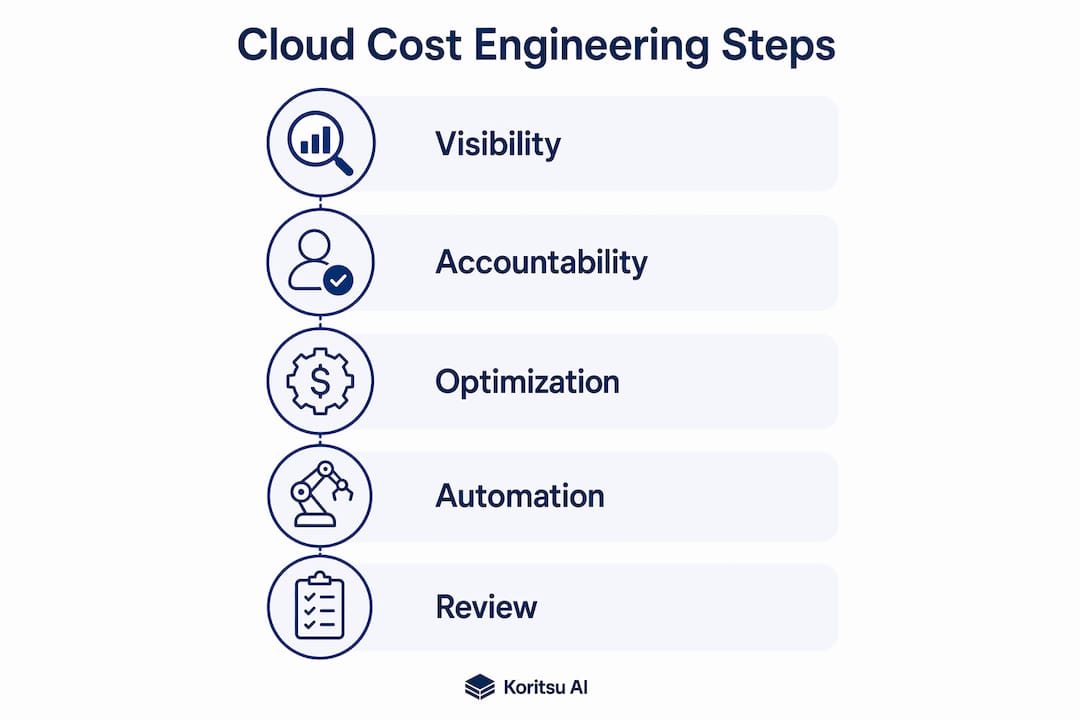
Effective cloud cost ownership engineering rests on several concrete practices. These are not aspirational principles. They are workflows that engineering teams build and maintain.
-
Continuous cost visibility. Engineers need real-time dashboards integrated into their daily tools, not monthly PDF reports. Multi-cloud dashboards covering AWS, Google Cloud, and Azure give teams the signal they need to act before costs compound.
-
Resource tagging and allocation models. Every resource must be tagged to a team, service, or product. Without tagging, cost data is too aggregated to be useful. Showback reports, which show teams what they are spending without charging them directly, build accountability without triggering defensive behaviour.
-
Rightsizing and idle resource elimination. Over-provisioned instances and idle resources are the most common sources of waste. Committed-use strategies add 40–60% in savings over on-demand pricing when combined with rightsizing. That saving only materialises when engineers understand their actual usage patterns.
-
Cost gates in CI/CD pipelines. Embedding cost checks into deployment pipelines catches expensive infrastructure changes before they reach production. Infrastructure-as-code tools make this tractable at scale.
-
Incident management integration. Cost anomalies are treated like performance incidents. A sudden spike in data transfer costs gets the same attention as a latency spike.
-
Architectural debt reduction. High cost often signals deeper engineering issues. Unnecessary microservice calls, inefficient data transfer patterns, and over-provisioned containers are engineering problems that inflate bills. Fixing them reduces cost and improves system quality simultaneously.
Pro Tip: Start tagging before you start optimising. Without a clean allocation model, you cannot tell which team or service is driving spend, and every optimisation effort becomes guesswork at the architectural level.
What metrics and tools support cloud cost ownership?
Cost per unit is the most useful metric in cloud cost ownership engineering. Raw spend figures tell you how much you are paying. Unit economics, such as cost per customer, cost per API call, or cost per feature, tell you whether that spend is proportionate to the value being delivered.
Cost and performance are deeply intertwined. Over-provisioning wastes money. Aggressive cost cuts can harm reliability. The right metric is not the lowest possible spend. It is the best spend-to-value ratio your architecture can sustain.
| Metric | What it measures | Why it matters |
|---|---|---|
| Cost per customer | Cloud spend divided by active users | Shows whether cost scales proportionately with growth |
| Idle resource rate | Percentage of provisioned capacity unused | Directly quantifies waste available for elimination |
| Tagging coverage | Percentage of resources with valid cost tags | Determines how much spend is attributable and actionable |
| Anomaly detection rate | Frequency of unexpected cost spikes caught early | Measures effectiveness of continuous monitoring |
Anomaly detection is where automation earns its place. Continuous monitoring is increasingly necessary as consumption-based pricing causes cost fluctuations that no human can track manually at scale. Automated alerts tied to budget thresholds give engineering teams the response time they need to act before a spike becomes a crisis.
The distinction between cost management and cost optimisation matters here. Cost management is visibility: knowing what you are spending and where. Cost optimisation is action: changing architecture, configuration, or purchasing to reduce that spend. Both require engineering ownership to work. Visibility without action is just an expensive dashboard.
Challenges and best practices for adopting this approach
The biggest obstacle to cloud cost ownership engineering is cultural, not technical. Engineers often associate cost conversations with budget cuts and headcount reductions. Framing cost ownership as architectural health rather than cost cutting changes that dynamic entirely.
Starting with showback rather than chargeback avoids penalisation fears and builds trust. Showback shows teams what they are spending. Chargeback bills them for it. Moving directly to chargeback without establishing data accuracy and team buy-in produces resistance and mislabelled resources. The sequence matters.
Common pitfalls to avoid:
- Applying spot instances or reserved capacity without fixing underlying architectural inefficiencies first. Micro-architectural decisions like instance choice, container over-provisioning, and inefficient data transfers cause major cost leakage that purchasing strategies cannot fix.
- Setting cost targets without giving teams the visibility or authority to meet them.
- Treating cost ownership as a one-time project rather than an ongoing engineering discipline.
- Ignoring AI and data workloads, which carry disproportionate compute costs and require specific optimisation patterns.
Pro Tip: Embed a cost review into your sprint retrospective. A 15-minute review of the team's spend against unit economics each fortnight builds cost awareness faster than any top-down mandate.
The cloud cost culture shift takes time. The teams that succeed treat cost as a shared engineering value, not a constraint imposed from outside.
How is cloud cost ownership engineering evolving?
Cloud cost ownership engineering is becoming more automated and more deeply integrated with software reliability engineering (SRE) practices. The separation between reliability and cost is collapsing. An SRE team managing uptime and latency now needs cost signals in the same dashboard.
Key trends shaping the discipline:
- AI-driven anomaly detection surfaces cost issues faster than manual review cycles.
- Cost optimisation as a strategic capability requires continuous monitoring as cloud consumption scales and pricing models grow more complex.
- Infrastructure-as-code and GitOps workflows are making cost gates in deployment pipelines standard practice rather than advanced technique.
- Engineering ownership is expanding to cover AI and machine learning workloads, where GPU compute costs can dwarf traditional infrastructure spend.
Platforms like Koritsu AI are building this engineering-grade approach into their core product. Koritsu AI's agent, Kori, surfaces cost inefficiencies continuously and connects them to the architectural decisions that caused them. That is the direction the discipline is heading: from periodic reviews to continuous, automated, engineering-integrated cost ownership. Teams that build this capability now will carry a structural cost advantage as their cloud consumption grows.
Key takeaways
Cloud cost ownership engineering works because it places cost accountability with the engineers who make the architectural decisions that drive spend.
| Point | Details |
|---|---|
| Engineering ownership beats finance reviews | Engineers fix the code and config causing waste; finance teams can only flag the bill. |
| Start with showback, not chargeback | Build trust and data accuracy before billing teams for their cloud spend. |
| Unit economics beat raw spend | Cost per customer or per feature reveals whether spend is proportionate to value delivered. |
| Tagging is the foundation | Without resource tagging, cost data is too aggregated to act on at team or service level. |
| Continuous monitoring is non-negotiable | Consumption-based pricing causes cost fluctuations that only automated anomaly detection can track reliably. |
Kori's take: cost is an engineering problem, not a finance problem
I have seen the same pattern repeat across engineering organisations of every size. A finance team sends a monthly cloud bill. Engineers look at it, shrug, and go back to their sprint. Nothing changes. The bill grows. Eventually someone panics and starts switching off services without understanding the consequences.
The organisations that break this cycle share one characteristic. They stop treating cloud cost as someone else's problem. The moment an engineering team sees cost data in the same place they see latency and error rates, their behaviour changes. Not because they are told to care, but because the signal is finally in their workflow.
What I find most telling is that high cloud costs almost always indicate something else. Redundant services that were never decommissioned. Data transfer patterns that made sense in a monolith but are ruinous in a distributed system. Over-provisioned containers that nobody dared to resize because the original sizing was never documented. Cost is a symptom. The underlying condition is architectural debt.
The teams I respect most do not talk about cost cutting. They talk about architectural health. That framing is not semantic. It changes what gets prioritised, what gets measured, and what gets fixed. Engineering leaders who adopt this mindset find that cost reduction follows naturally, without the cultural friction that comes from top-down budget mandates.
— Kori
How Koritsu AI helps engineering teams own their cloud costs
Koritsu AI combines a continuous cost analysis platform with hands-on expert advice, built specifically for engineering teams rather than finance departments.
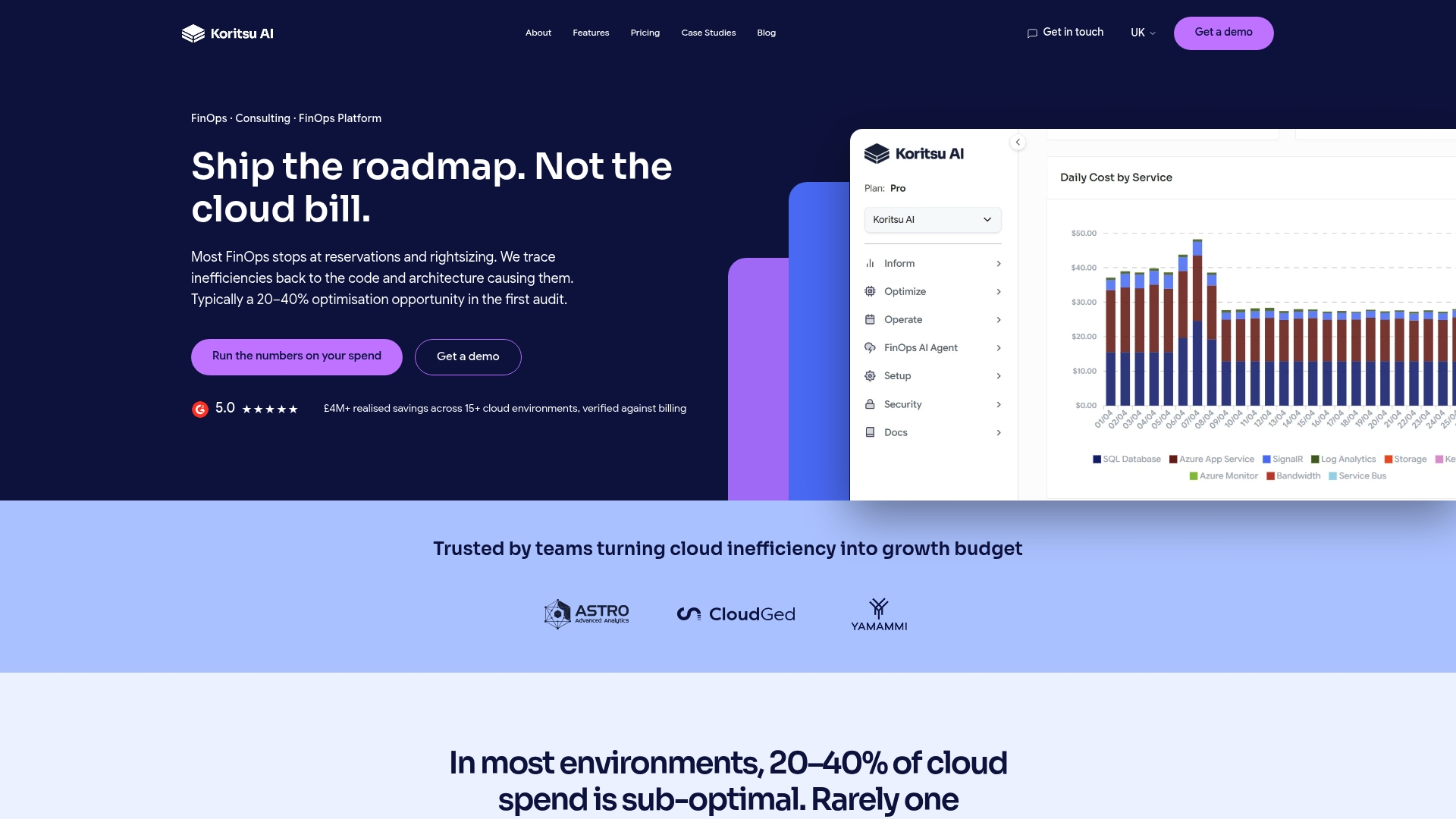
Kori, Koritsu AI's AI agent, surfaces cost inefficiencies in real time and connects them to the architectural decisions driving them. Engineering teams get the signal they need, in the workflow they already use. Koritsu AI's specialists then help teams act on those findings, from rightsizing and tagging to deeper architectural fixes. The results are concrete: one financial services client achieved a 96% reduction in AWS Lambda costs through engineering-led optimisation. Koritsu AI charges only on savings delivered, starting with a free assessment. If you are ready to treat cloud cost as an engineering discipline, explore Koritsu AI's services to see where your spend is going.
FAQ
What is cloud cost ownership engineering?
Cloud cost ownership engineering is the practice of embedding cost accountability into engineering workflows, treating cloud spend as a quality metric alongside performance and reliability. It shifts responsibility from finance-led billing reviews to continuous, engineer-led cost management.
How does cloud cost ownership engineering differ from FinOps?
FinOps is the cultural and operational framework; cloud cost ownership engineering is the engineering discipline that makes FinOps actionable. FinOps defines the principles, while cost ownership engineering embeds them into CI/CD pipelines, sprint planning, and architectural decisions.
What is the best way to start with cloud cost ownership?
Start with showback before chargeback. Show teams their spend without billing them for it first. This builds trust, improves tagging accuracy, and creates the data foundation needed for effective cost optimisation.
Why do micro-architectural decisions matter for cloud costs?
Instance choice, container sizing, and data transfer patterns cause significant cost leakage that purchasing strategies like reserved instances cannot fix. Addressing these decisions at the architectural level is the only way to achieve lasting cost reduction.
What metrics should engineering teams track for cloud cost ownership?
Track unit economics such as cost per customer or cost per API call alongside raw spend. Pair these with tagging coverage rates and anomaly detection frequency to measure both the quality of your cost data and the effectiveness of your optimisation efforts.