FinOps Inform
90-Day Cost Guardrails for Engineers: Shift-Left to Runtime Budgets
Engineering-first playbook to stop surprise cloud spend. Implement shift-left CI/CD, policy-as-code and runtime budgets, and verify savings.

Cost guardrails are automated, engineering-owned controls that prevent surprise cloud spend while preserving developer velocity. The right approach combines policy-as-code checks, CI/CD integration and runtime monitoring, not a single dashboard or a quarterly review. Done well, guardrails stop most unplanned spend before it happens, and they do it without engineers filing a ticket or waiting for finance approval.
TL;DR:
- Guardrails should be matched to risk levels, with informational alerts for low-risk changes, warnings for moderate risk, and blocking for high-risk patterns like unbounded autoscaling.
- Implementing shift-left controls involves integrating cost estimates into pull requests, enforcing resource and tagging policies through code, and gradually increasing enforcement severity over time.
- Tagging consistency and real-time budgets with anomaly detection are essential for accurate spend visibility and rapid response to unexpected cost spikes.
- Phased rollouts starting with awareness, then warnings, and finally hard blocks, help maintain engineering trust and ensure policies stay effective as architecture evolves.
- Verifying savings requires comparing pipeline estimates to actual billing data, with a focus on verified reductions before expanding guardrail enforcement.
What cost guardrails are and how to choose the right type
Cost guardrails sit at three points in the engineering lifecycle, and each catches a different kind of risk. Design-time guardrails estimate cost from infrastructure-as-code before anything is provisioned. Pre-deploy guardrails run inside CI/CD, checking a pull request against policy before merge. Runtime guardrails watch live spend through budgets, quotas and anomaly detection once workloads are running.
The FinOps Foundation’s governance and policy capability describes guardrails as formal processes and architectural controls that reduce the need for human judgement on routine decisions, which is exactly why automation matters more than another review meeting.
Not every guardrail should block a deployment. We recommend matching enforcement strength to risk:
- Informational: comment on a PR with cost delta, no action required, used for low-risk changes like dev environment tweaks.
- Warning: flag the change and require acknowledgement, used for moderate risk such as a resized cache instance.
- Blocking: stop the merge or deployment entirely, reserved for high-risk patterns like unbounded autoscaling, oversized RDS instances, or ML training jobs with no cost ceiling.
Data pipelines and ML jobs deserve the strictest tier, because a single misconfigured job can burn through a month’s budget in hours.
Shift-left patterns: CI/CD and policy-as-code you can implement this quarter
The fastest way to cut surprise spend is to catch it before it is provisioned, not after the invoice arrives. Infracost’s approach, as described on the FinOps Foundation’s member page, embeds cost estimates directly into pull requests, showing the dollar delta of a Terraform or CloudFormation change before merge.
A practical rollout looks like this:
- Add cost estimation to CI: run an IaC cost diff tool on every PR and post the delta plus per-resource breakdown as a comment.
- Write policy-as-code rules: enforce tagging completeness, instance size ceilings, approved regions and storage class choices as code, not as a wiki page.
- Set an enforcement matrix: start new rules as informational, promote to warn after two weeks of clean data, then promote to block once false positives are near zero.
- Record exceptions: every override needs a reason and an owner, logged somewhere searchable, so repeat exceptions surface as a policy gap rather than noise.
Our own policy-as-code rules for engineers cover specific examples for tagging and resource constraints that fit directly into this pipeline.
Pro Tip: Start with a single policy category, such as mandatory cost-centre tags, and get it to zero false positives before adding a second rule. Stacking untested rules at once is the fastest way to lose engineering trust in the whole system.
Visibility and runtime controls: tagging, budgets, and anomaly detection
Guardrails at the pipeline stage catch a lot, but nothing replaces watching what is actually being spent once workloads run. Tagging is the foundation: without consistent cost-centre, team and service tags, allocation reports are guesswork and budgets cannot be scoped to the right owner.
Once tagging is enforced, the next layer is runtime observation:
- Budgets with forecast alerts: set thresholds per team or service, not just one organisation-wide number.
- Anomaly detection: catch spend spikes that a static budget would miss until the month closes.
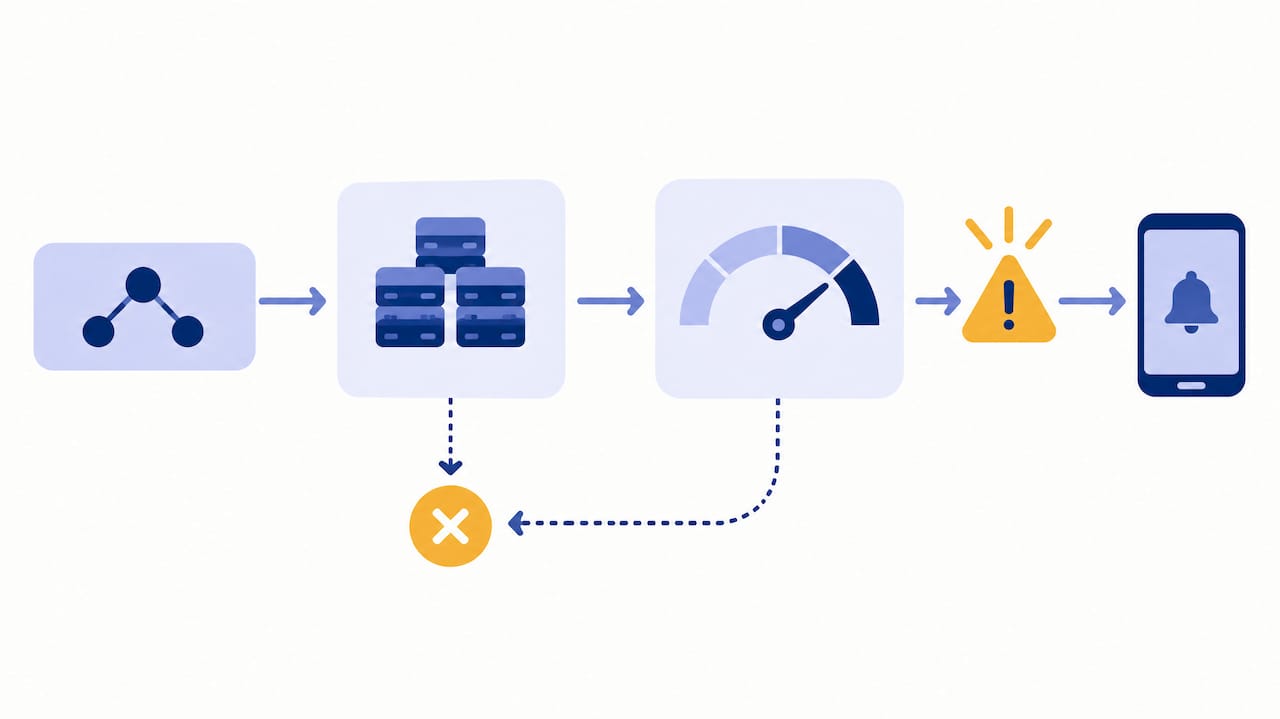
- On-call integration: route budget and anomaly alerts into the same runbook engineers already use for incidents, so a cost spike gets the same urgency as a latency spike.
- Quota controls: cap the blast radius of a runaway job before it needs a human to notice.
AWS Budgets supports automated actions, such as applying an IAM policy or SCP when a threshold is breached, which turns a budget from a notification into an actual control. Paired with AWS Cost Anomaly Detection for root-cause alerts, this gives engineering teams a runtime layer that acts without waiting for a human to read a report.
For the data engineering teams need to make these controls accurate, our piece on canonical billing exports covers how to prepare exports that make allocation and verification reliable.
Governance, phased rollout and the KPIs that prove impact
Guardrails that start as a strict mandate tend to get bypassed, quietly, within a month. A phased rollout avoids that failure mode and provides leaders a way to prove the programme is working before asking for more enforcement power.
- Awareness phase: ship informational PR comments and dashboards only, no blocking, for four to six weeks. The goal is building trust in the data, not changing behaviour yet.
- Soft gate phase: introduce warnings that require acknowledgement for specific high-risk patterns, with an easy override path and logged exceptions.
- Hard gate phase: block merges or deployments for the policies with the cleanest track record, reserved for genuinely high financial, security or compliance risk.
Rollout needs a decision forum, not just a tool. Engineering, FinOps and product should meet on a fixed cadence to review exceptions and adjust thresholds, because a policy written once and never revisited drifts out of date as architecture changes. McKinsey’s research on cost engineering frames this as lifecycle work that needs cross-functional discipline, warning that siloed savings in one team can quietly create technical debt and higher costs elsewhere.
Track these KPIs to know whether guardrails are working: override and exception rate (falling over time), cost-per-feature or cost-per-service trend, verified savings against the actual bill, and the percentage of deployments covered by automated checks.
Running a pilot and verifying savings: a practical checklist
A pilot proves the model before anyone asks for organisation-wide rollout, and it needs clear boundaries from day one.
Before starting, confirm:
- Scope: pick one high-spend workload, not the whole estate.
- Telemetry readiness: tagging coverage and billing exports are accurate enough to attribute cost to the workload.
- Success criteria: a defined savings target and a timeframe, agreed before the pilot starts.
Pilot steps, in order:
- Instrument first: get tagging and cost visibility working before adding any enforcement.
- Automate PR checks: add cost estimation and one policy category to CI.
- Enforce selectively: move that one policy to a warn or block gate once false positives are near zero.
- Collect bill evidence: map PR-level cost deltas to actual line items on the next invoice.
- Iterate: widen scope only after the first policy category shows clean, verified results.
Pro Tip: Treat verified savings as the only metric that counts. A pipeline estimate that never shows up on the bill is a forecasting error, not a result.
This is close to how we structure a Savings Opportunity Report engagement: scope a high-spend area, instrument it, and verify findings against actual billing before recommending wider rollout. Our guide to scoring and verifying cloud savings walks through turning pipeline findings into executed, confirmed fixes.
Common challenges and pitfalls when implementing cost guardrails
The most common failure is enforcing before the data is trustworthy. A blocking gate built on incomplete tagging data generates false positives, and false positives are what make engineers route around the system rather than fix the underlying cost. Trust, once lost, is expensive to rebuild.
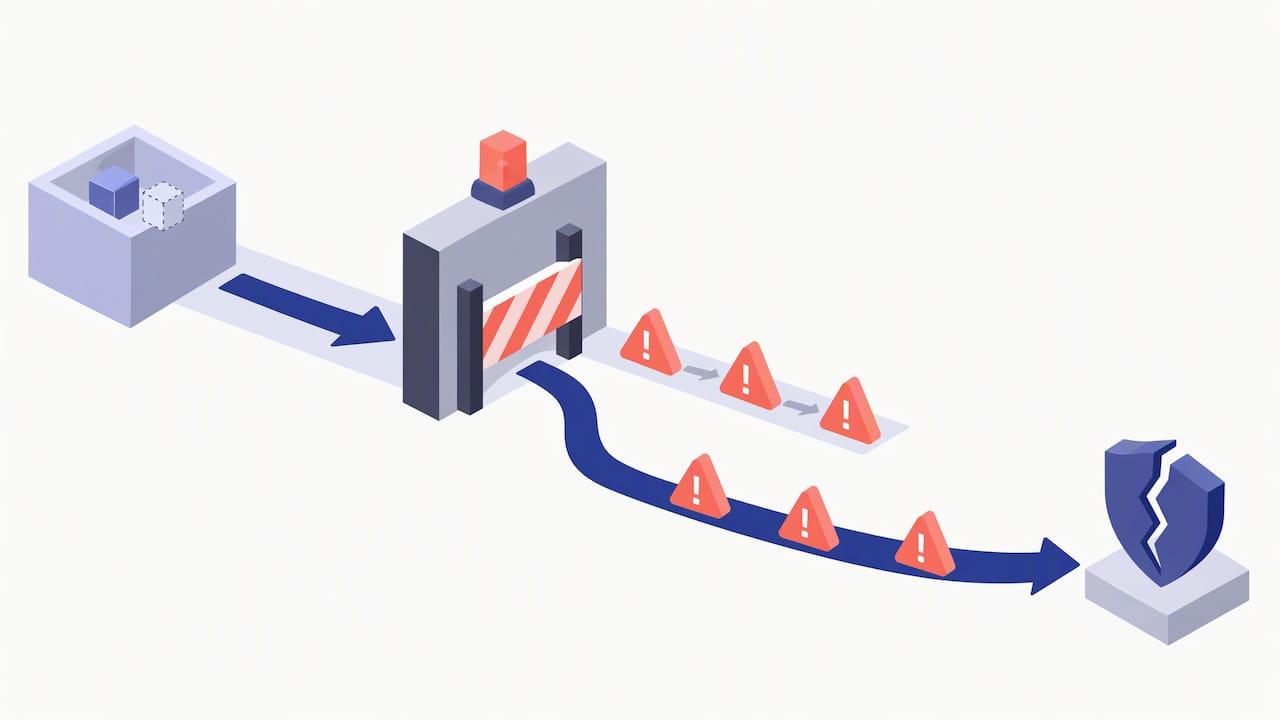
A second pitfall is treating guardrails as a one-off project rather than a maintained system. Cloud pricing changes, architecture evolves, and a rule written for last year’s instance types can silently stop catching the waste it was built for. Guardrails need an owner and a review cadence, the same way a production service does.
Siloed ownership causes a third problem. When finance writes the policy and engineering is expected to comply without input, rules tend to be either too loose to matter or too strict to be practical, because nobody involved understands both the cost model and the architecture. FinOps Foundation guidance on proportionate policy design makes this point directly: the cost of enforcing a guardrail should never exceed the risk it mitigates, which rules out blanket policies applied without regard to actual exposure.
A fourth common issue is skipping the exception path. Every guardrail needs a documented way to override it, with a reason and an owner, or engineers under deadline pressure will find an unofficial workaround instead, and that workaround becomes permanent faster than the policy it was meant to respect.
Finally, teams often measure guardrail success by rules shipped rather than money saved. A policy that nobody triggers is not necessarily a good policy. It might just be covering a resource type nobody uses any more.
Best practices for team training and communication on cost policies
Guardrails fail quietly when engineers do not understand why a rule exists. A tagging requirement with no explanation reads as bureaucracy; the same requirement framed as “this is how your team’s dashboard gets accurate numbers” gets followed. Every policy needs a one-line reason attached to its PR comment or warning message, not buried in a separate document nobody opens.
Rollout communication works best in small, specific doses rather than one large announcement. Introduce a single policy category, explain it in the team channel where engineers already work, and show the first week of real data, exceptions and all. A short, honest demonstration that a rule catches genuine waste does more for adoption than a company-wide memo.
Make the exception process visible rather than punitive. When an engineer overrides a guardrail for a legitimate reason, logging it without friction, and following up only on patterns rather than individual incidents, keeps the system credible. Treating every override as a compliance failure guarantees people stop reporting them honestly.
FinOps, platform and product teams should agree on shared language before rollout: what counts as a “cost owner,” what “allocation” means, what a “soft gate” actually blocks. Mismatched definitions between teams cause more friction than the policies themselves. A recurring, short review session, not a lengthy workshop, keeps that language aligned as the system evolves.
Integration of cost guardrails with existing cloud and infrastructure tools
Guardrails work best when they sit inside tools engineers already use rather than adding a new system to check. Infrastructure-as-code pipelines, whether Terraform, CloudFormation or Pulumi, are the natural home for design-time cost estimation, since the plan output already describes exactly what will be provisioned.
CI/CD platforms are where pre-deploy policy enforcement belongs. A PR comment with a cost delta or a failed check in the same interface engineers already use for test results gets seen; a separate cost dashboard that requires a login does not.
At the cloud provider level, AWS Service Control Policies can enforce organisation-wide permission limits, such as blocking instance types above a certain size or restricting regions. AWS documentation is explicit that SCPs should be tested on a limited scope before attaching them broadly, since an overly strict policy can lock teams out of resources they legitimately need.
Observability and incident tooling matter just as much. Routing budget alerts and anomaly detection into the same on-call system used for production incidents means a cost spike gets investigated with the same urgency as a latency spike, rather than surfacing three weeks later in a monthly report. Our 90-day plan for introducing shift-left cost management covers the sequencing of these integrations in more depth.
Teams concerned about tooling lock-in when adopting new enforcement layers can find useful guidance in this piece on avoiding vendor lock-in, which covers designing exportable, testable integrations rather than committing to a closed system.
Case studies or examples of cost guardrail implementation in engineering teams
A data pipeline team is a common first candidate for guardrails, because a single misconfigured job can run for hours before anyone notices. Teams that add a pre-deploy check enforcing a maximum cluster size, combined with a runtime budget that pages on-call when forecast spend crosses a threshold, typically catch runaway jobs within the same shift they start, rather than at month end.
Feature flags are a less obvious source of cost risk. A flag left enabled for a resource-heavy experiment can quietly keep expensive infrastructure running long after the experiment ends. Our piece on feature flag cost impact covers how to govern flags so they do not become an invisible cost centre.
Teams managing large relational databases often start guardrails with a simple rule: any RDS instance above a defined size tier requires a tagged justification and an expiry review date. Combined with tagging enforcement in CI, this turns an easy-to-miss oversized instance into something that surfaces automatically in the next policy review.
ML training workloads tend to need the strictest tier from day one, given how quickly an unbounded training job can consume budget. A hard gate on maximum instance count or a runtime quota, paired with cost estimation at the IaC stage, prevents the single most expensive failure mode: a job that scales far beyond what anyone intended and is only discovered once the invoice arrives.
An engineering leader’s view on velocity versus enforcement
Guardrails belong to engineering, not finance. A policy written without engineering input either blocks legitimate work or misses the actual risk, because only the team building the system understands which changes are routine and which are genuinely expensive.
Reserve hard gates for the cases where the downside is severe: unbounded compute, security exposure, compliance breaches. Everything else should warn, not block.
Pick one high-spend workload and run a focused pilot there before asking for anything broader.
How we can help operationalise your guardrails
Building the shift-left checks and runtime budgets described above takes engineering time most teams do not have spare. We use AI analysis of your cloud spend combined with engineering support to find and fix inefficiencies guardrails are meant to catch, charging only a share of verified savings.
A free assessment through our Savings Opportunity Report gives you a concrete starting point:
- Scoped analysis of where spend is being lost, mapped to specific resources and teams.
- Verified findings, checked against your actual billing data, not estimates.
- A clear handover to our ongoing FinOps as a Service plans if you want continued monitoring and advisory support.
Start with the free Savings Opportunity Report to see what a scoped assessment finds in your own environment.
FAQ
How much do guardrails typically cost to implement?
Costs vary by organisation and depend on existing tagging maturity, CI/CD setup and how many policy categories you enforce, so there is no single published figure. Most teams start with existing CI/CD and cloud provider tools, which keeps initial cost to engineering time rather than new licensing.
What are the main types of cost guardrails?
The three practical types are design-time guardrails that estimate cost from infrastructure-as-code before provisioning, pre-deploy guardrails that check pull requests in CI/CD, and runtime guardrails such as budgets and anomaly detection that watch live spend. The FinOps Foundation frames these as formal processes and architectural controls that reduce routine manual decisions.
Should guardrails block deployments or just warn engineers?
Start new policies as informational comments, promote to warnings once the data is reliable, and reserve hard blocks for genuinely high-risk patterns like unbounded compute or compliance exposure. This phased approach, moving from awareness to soft gates to hard gates, reduces false positives and keeps engineering trust in the system.
How does Koritsu verify that cost savings are real?
We map findings from our analysis to your actual billing data, checking that a recommended fix shows up as a verified reduction on the bill rather than a pipeline estimate. Our Savings Opportunity Report is built around this verification step before any ongoing engagement begins.
Sources
- FinOps Foundation: Governance, Policy & Risk capability
- AWS Budgets controls documentation
- McKinsey: Making cost engineering count