FinOps Inform
Infrastructure cloud services: what IT leaders need to know
Discover how infrastructure cloud services enable UK IT leaders to optimize costs, enhance performance, and ensure compliance. Learn more!

Infrastructure cloud services supply on-demand compute, storage, networking, and management capabilities so organisations can run applications without owning datacentre hardware. The provider owns the physical layer; you control what runs on top of it.
TL;DR for UK IT decision-makers:
- The primary delivery model is Infrastructure as a Service (IaaS), where providers expose virtualised resources on a pay-as-you-go basis.
- Enterprise IT teams use these services to gain elasticity, reduce capital expenditure, and access specialist hardware such as GPUs.
- Governance, data residency under UK GDPR, and cost control are the three operational priorities that most often determine whether adoption succeeds or stalls.
- Koritsu AI works with UK engineering teams to surface and fix the architectural inefficiencies that inflate cloud bills after adoption.
What does cloud infrastructure actually include?
Cloud infrastructure comprises hardware (servers, storage, networking equipment) and the software layer above it (virtualisation, orchestration, management tooling) that together create an on-demand computing environment. Organisations avoid large up-front capital expenditure because the provider absorbs those costs and amortises them across many tenants.
The scope of what counts as "infrastructure cloud services" is worth pinning down precisely, because the term is often conflated with broader cloud platform or SaaS concepts.
Included components:
- Physical servers, storage arrays, and networking switches in provider datacentres
- Virtualisation layer (hypervisors, container runtimes)
- Virtual machines, bare-metal instances, and GPU/TPU nodes
- Object, block, file, and archival storage services
- Virtual Private Clouds (VPCs), load balancers, DNS, and private connectivity options
- Identity and access management (IAM) and security tooling
- Orchestration platforms and management APIs
What sits above this layer — application runtimes, middleware, databases managed by the provider, and end-user software — falls into Platform as a Service (PaaS) or Software as a Service (SaaS) respectively.
The operational boundary matters: with IaaS, you patch the operating system, configure networking, and are accountable for data residency. The provider handles physical hardware, power, and the hypervisor. Misunderstanding this split is one of the most common governance failures in early cloud adoption.
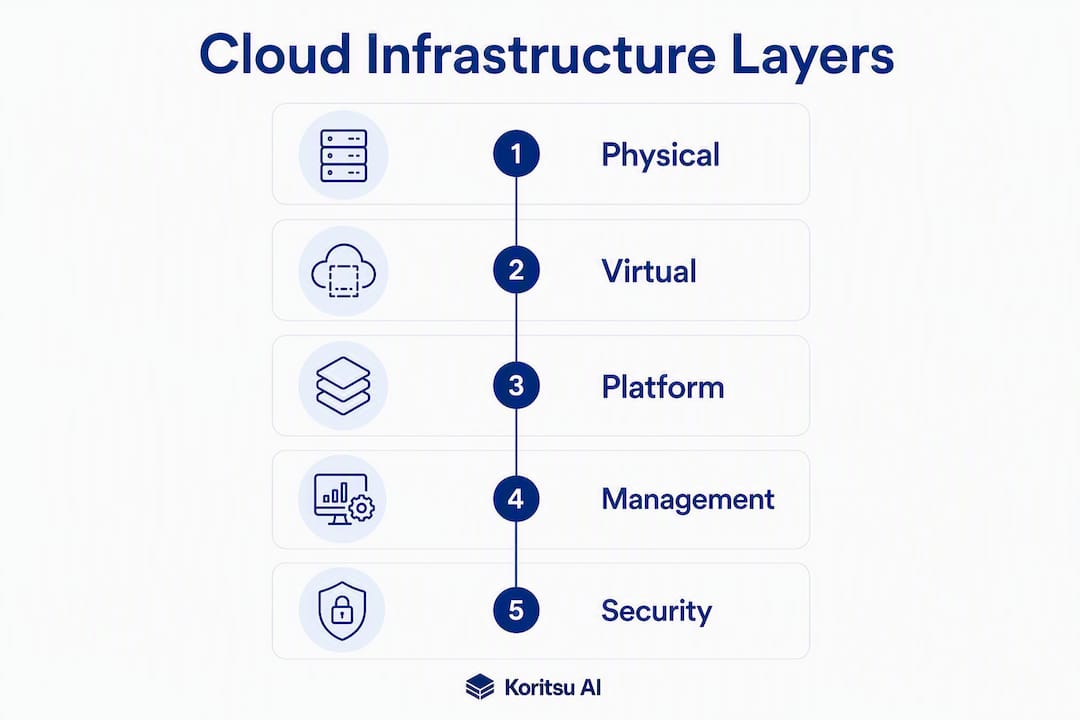
A useful mental model is three layers: physical datacentre at the base, virtualised infrastructure in the middle, and platform or application services at the top. IaaS sits in that middle layer. The further up the stack you move, the more the provider manages and the less direct control you retain.
Core components of cloud computing infrastructure
Understanding each component in isolation helps you make better architecture and cost decisions. Here is how the major building blocks behave in practice.
Compute
Virtual machines (VMs) remain the workhorse for most enterprise workloads: web servers, databases, and batch processing. Bare-metal instances remove the hypervisor overhead and suit latency-sensitive or licence-bound applications. GPU and TPU nodes are now a first-class compute category, used for AI training, inference, and high-performance analytics. Google Cloud's Compute Engine illustrates how providers offer flexible machine types with SLAs to cover this range, from small web-server instances to large compute clusters.

Choosing the wrong compute type is one of the fastest routes to unnecessary spend. A VM sized for peak load but running at 15% average utilisation is a common example of the compute inefficiencies that accumulate quietly across large estates.
Storage
Storage classes map to performance and price trade-offs:
- Block storage: low-latency, high-throughput; used for databases and boot volumes.
- Object storage: cheap, durable, and infinitely scalable; suited to backups, logs, and media.
- File storage: shared filesystem access for applications that require POSIX semantics.
- Archival storage: very low cost, high retrieval latency; appropriate for compliance retention.
For UK organisations, the storage class chosen also affects data residency. Object storage buckets must be explicitly pinned to a UK or EU region to satisfy UK GDPR obligations; the default is not always the nearest region.
Networking
Virtual Private Clouds isolate your workloads at the network layer. Load balancers distribute traffic and provide health-checking. Private connectivity options (AWS Direct Connect, Azure ExpressRoute, IBM Cloud Direct Link) bypass the public internet for sensitive or latency-critical traffic. Egress costs — charges for data leaving a provider's network — are frequently underestimated and can become a significant line item on large estates.

Security and identity
IAM is the control plane for access. Zero-trust principles (verify every request, least-privilege access, assume breach) are now the baseline expectation for enterprise deployments. Encryption at rest and in transit should be non-negotiable defaults, not optional add-ons. Secrets management tools such as HashiCorp Vault or AWS Secrets Manager prevent credentials from being embedded in code or configuration files.
Management and orchestration
Infrastructure as code (IaC) is the discipline that makes cloud infrastructure repeatable and auditable. Tools such as Terraform, Pulumi, and AWS CloudFormation define resources declaratively, so every environment can be reproduced exactly. Container orchestration platforms (Kubernetes being the dominant choice) handle scheduling, scaling, and self-healing for containerised workloads.
Pro Tip: Treat IaC, CI/CD pipelines, and policy-as-code (Open Policy Agent, AWS Service Control Policies) as first-class engineering controls from day one. Configuration drift — where live environments diverge from their declared state — is the root cause of a disproportionate share of both security incidents and cost overruns.
Delivery and deployment models: what changes operationally
Delivery models
The three delivery models define how much of the stack the provider manages:
- IaaS — provider manages physical hardware and virtualisation; you manage OS, runtime, middleware, and application. Maximum control, maximum operational responsibility.
- PaaS — provider also manages OS, runtime, and middleware; you manage application code and data. Faster delivery, less infrastructure expertise required.
- SaaS — provider manages everything; you configure and use the application. No infrastructure responsibility at all.
For most enterprise infrastructure decisions, IaaS and PaaS are the relevant choices. SaaS sits outside the infrastructure conversation except where data residency or integration architecture is concerned.
Deployment models
| Deployment model | Who controls the hardware | Typical UK use case | Key trade-off |
|---|---|---|---|
| Public cloud | Provider (shared tenancy) | Digital services, greenfield apps, dev/test | Lower cost; shared physical layer |
| Private cloud | Organisation or hosted provider | Regulated finance, NHS, defence | Higher control; higher cost |
| Hybrid cloud | Split: on-prem + public | Legacy lift-and-shift alongside new workloads | Complexity of two operating models |
| Multi-cloud | Multiple public providers | Risk distribution, best-of-breed services | Operational overhead, skills breadth |
AWS regional infrastructure gives organisations the ability to choose specific datacentre regions to meet latency, data residency, and regulatory requirements — a practical reason why UK enterprises often select providers with confirmed UK or EU regions.
Many enterprises end up with hybrid plus multi-cloud by default rather than by design: they retain on-premises systems for regulated or legacy workloads while using two or more public providers for different services. That combination multiplies governance complexity and is one of the primary drivers of uncontrolled cost growth.
How cloud infrastructure works end to end
Understanding the provisioning sequence helps you reason about latency, automation, and where failures occur.
- A developer or pipeline submits a provisioning request via API, CLI, or IaC tool.
- The cloud control plane authenticates the request against IAM policies and validates quotas.
- The scheduler selects a physical host with available capacity in the requested availability zone.
- The hypervisor or container runtime instantiates the workload and attaches virtual networking interfaces.
- Storage volumes are provisioned and attached; object storage buckets are created or referenced.
- DNS records and load-balancer rules are updated to route traffic to the new instance.
- Monitoring agents begin collecting metrics; autoscaling policies watch utilisation thresholds.
Provisioning times vary significantly by resource type: a serverless function invocation completes in milliseconds, a container starts in seconds, and a VM typically takes 30–90 seconds. Bare-metal provisioning can take several minutes. These differences matter when designing autoscaling strategies — a VM-based autoscaler needs headroom that a container-based one does not.
Automation shortens time-to-production and reduces human error. When IaC pipelines handle provisioning, the same validated configuration deploys to every environment, eliminating the "works in dev, breaks in production" class of incident.
Benefits of cloud infrastructure and the trade-offs you should expect
The case for cloud infrastructure is well-established. The operational reality is more nuanced.
Benefits:
- Elasticity: scale compute and storage up or down in minutes rather than procurement cycles.
- Access to specialist hardware: GPU clusters for AI workloads are available on demand without capital investment.
- Operational resilience: multi-availability-zone architectures provide fault tolerance that most on-premises setups cannot match economically.
- Speed of delivery: new environments can be provisioned in minutes; global reach is available without physical presence.
Trade-offs:
- Cost model shift: capital expenditure becomes operational expenditure, but without active management, cloud bills grow faster than workloads.
- Egress and data-transfer costs are often invisible during planning and painful at scale.
- Vendor lock-in is real, particularly when you adopt proprietary managed services rather than portable open standards.
- Operational skill requirements increase: cloud infrastructure demands expertise in IAM, networking, IaC, and FinOps that many teams build up gradually.
Common misconceptions worth addressing directly:
- Cloud is not automatically cheaper than on-premises. It is cheaper when you use it correctly and more expensive when you do not.
- Migrating a workload to the cloud is not the same as modernising it.
- Reserved instances and committed-use discounts reduce unit costs but do not fix architectural waste.
What actually drives your cloud bill
Cost control starts with understanding the levers. The primary drivers are compute size and uptime, storage class and volume, network egress, managed service premiums, and software licensing.
| Cost driver | Operational lever | Pricing model |
|---|---|---|
| Compute (VMs, containers) | Rightsizing, autoscaling, spot instances | Pay-as-you-go or reserved/committed |
| Storage | Lifecycle policies, tiering to archival | Per GB per month by class |
| Network egress | Architecture to minimise cross-region transfers | Per GB transferred out |
| Managed services | Evaluate build vs buy; consolidate where possible | Per request, per hour, or tiered |
| Licensing | Bring-your-own-licence (BYOL), licence-included trade-offs | Bundled or separate |
Pricing models available to UK organisations:
- Pay-as-you-go: no commitment, highest unit price, maximum flexibility.
- Reserved or committed-use: 1–3 year commitments in exchange for discounts of up to 60–70% on compute.
- Spot or preemptible instances: deeply discounted but interruptible; suited to batch workloads and fault-tolerant pipelines.
- Enterprise agreements: negotiated pricing for large-scale consumption, often including support and professional services.
UK-specific note: Azure, AWS, and IBM Cloud all bill in USD by default for many services, which introduces currency exposure for UK finance teams. Some enterprise agreements allow GBP billing. VAT applies to cloud services consumed in the UK; confirm treatment with your finance team.
FinOps basics that every UK team should implement early: consistent resource tagging (by team, service, and environment), unit cost metrics that tie spend to business output, and chargeback or showback reporting so engineering teams see the financial impact of their architectural decisions.
Security, governance, and compliance for UK organisations
Security in cloud infrastructure is a shared responsibility. The provider secures the physical layer and the hypervisor; you secure everything above it.
Essential controls:
- IAM with least-privilege policies and mandatory multi-factor authentication.
- Encryption at rest (AES-256 is standard) and in transit (TLS 1.2 minimum).
- Centralised logging and monitoring (CloudTrail, Azure Monitor, IBM Log Analysis) with alerting on anomalous behaviour.
- Secrets management: no credentials in code, rotation policies enforced.
- Incident response runbooks tested at least annually.
For UK organisations, aligning zero-trust principles with ISO 27001 provides a practical framework for both security posture and audit readiness. SOC 2 Type II reports from providers confirm the controls they operate on the physical and virtualisation layers.
UK GDPR requires that personal data is processed lawfully and that appropriate technical measures protect it. Data residency is a specific concern: personal data must not leave the UK or EEA without adequate safeguards. All three major providers (Azure, AWS, IBM Cloud) offer UK-region datacentres, but you must explicitly configure workloads to use them. The default is not always the nearest region.
Cloud environment management best practices include policy-as-code guardrails that prevent non-compliant resources from being provisioned in the first place — a far more reliable control than post-hoc auditing.
Procurement and onboarding checklist for infosec teams:
- Confirm provider certifications: ISO 27001, SOC 2 Type II, Cyber Essentials Plus where relevant.
- Validate data residency configuration before go-live.
- Review the provider's shared responsibility model documentation.
- Establish logging and alerting baselines before any production workload is deployed.
- Define and test an incident response process that covers cloud-specific scenarios.
Trends shaping cloud infrastructure in 2026 and practical next steps
Trends worth tracking
AI-optimised infrastructure is the most significant shift in enterprise cloud architecture right now. GPU and TPU nodes are now standard catalogue items across Azure, AWS, and IBM Cloud, and demand is outpacing supply in some regions. Modern enterprise strategies extend beyond IaaS to include identity-based security and unified management platforms that enforce compliance and cost guardrails across hybrid and multi-cloud estates.
Zero-trust is moving from aspiration to operational requirement, driven partly by UK government guidance and partly by the frequency of identity-based attacks. Policy-driven automation — where guardrails are encoded in policy-as-code rather than enforced by manual review — is how mature teams keep pace with deployment velocity.
FinOps as a continuous practice, rather than a quarterly review, is the operational model that separates teams with controlled cloud costs from those with runaway bills. Expert-led FinOps that combines AI analytics with hands-on consultancy surfaces the hidden inefficiencies — over-provisioning, idle resources, architectural waste — that tooling alone rarely catches.
Practical next-step checklist for UK IT leaders
- Run a discovery and inventory exercise: catalogue all cloud accounts, regions, and resource types currently in use.
- Establish a cost baseline: pull 90 days of billing data and identify the top ten cost drivers.
- Implement consistent tagging: every resource tagged by team, service, environment, and cost centre before the next billing cycle.
- Define unit metrics: agree on the business output each service produces and calculate cost per unit.
- Select a pilot workload: choose one non-critical workload to migrate or re-architect; instrument it for cost and performance from day one.
- Standardise IaC: adopt a single IaC toolchain across the team and enforce it via CI/CD pipelines.
- Encode governance policies: deploy Service Control Policies (AWS) or Azure Policy to prevent non-compliant resources from being created.
- Engage FinOps support: whether internal or via a partner such as Koritsu AI, treat cost optimisation as an ongoing engineering discipline, not a one-off project.
Pro Tip: When structuring a pilot, measure three things from the start: provisioning time, cost per transaction, and deployment frequency. These three metrics give you a before-and-after story that is credible to both engineering leadership and the CFO.
Governance and management frameworks for cloud infrastructure
Governance in cloud infrastructure is the set of policies, processes, and controls that determine who can provision what, where, and at what cost. Without it, cloud estates grow in ways that are difficult to audit, expensive to operate, and hard to secure.
The dominant framework pattern for enterprise cloud governance combines three layers. Platform guardrails (Service Control Policies, Azure Management Groups, IBM Cloud IAM hierarchies) define the outer boundary of what is permitted. Infrastructure lifecycle management (ILM) processes govern how resources are created, modified, and decommissioned. Delegated self-service allows product teams to provision within guardrails without requiring central approval for every change.
Managing multi-cloud and hybrid estates at scale requires treating IaC as non-negotiable and standardising workflows across environments. Without that discipline, configuration drift accumulates and security exposures multiply.
Practical governance instruments include:
- A cloud centre of excellence (CCoE) or platform engineering team that owns the guardrails and IaC standards.
- A tagging and cost allocation policy enforced at provisioning time, not retrospectively.
- Regular architecture reviews that assess both security posture and cost efficiency.
- A decommissioning process for idle or orphaned resources, which are among the most common sources of waste.
Key challenges and common pitfalls in cloud migration and management
Most cloud migrations encounter the same set of problems. Knowing them in advance is the difference between a controlled programme and an expensive recovery exercise.
Lift-and-shift without re-architecture rarely delivers the expected benefits. Moving a VM from an on-premises datacentre to a public cloud without changing how the application is built typically increases costs, because cloud pricing assumes elastic usage patterns that a monolithic, always-on VM does not exhibit. Cloud-native re-architecture earlier in the migration produces better outcomes for both elasticity and cost efficiency.
Tagging debt compounds quickly. Teams that skip consistent resource tagging in the early stages of adoption spend disproportionate time later trying to allocate costs retrospectively. The fix is straightforward but requires discipline from the first deployment.
Skills gaps are underestimated. Cloud infrastructure demands expertise across IAM, networking, IaC, FinOps, and security. Most teams have depth in one or two of these areas and gaps in the others. Identifying those gaps before a migration begins, rather than discovering them during an incident, is a material risk-management step.
Cost surprises are almost always architectural. Unexpected egress charges, oversized reserved instances that no longer match workload patterns, and idle resources from abandoned projects are the most common culprits. The root cause is rarely a pricing model misunderstanding; it is an architectural decision made without visibility of its financial consequences. Addressing why cloud environments over-scale requires looking at the engineering decisions, not just the billing dashboard.
Comparing major cloud providers for the UK market
The UK market is served by all three global hyperscale providers, each with confirmed UK-region datacentres and a broad catalogue of infrastructure services.
| Microsoft Azure | Amazon Web Services (AWS) | IBM Cloud | |
|---|---|---|---|
| Delivery model | IaaS, PaaS, SaaS | IaaS, PaaS, SaaS | IaaS, PaaS, SaaS |
| UK regions | UK South (London), UK West (Cardiff) | eu-west-2 (London) | London (LON) |
| Deployment models | Public, private, hybrid (Azure Arc), multi-cloud | Public, private (Outposts), hybrid, multi-cloud | Public, private, hybrid (Satellite) |
| Core IaaS components | Virtual Machines, Azure Blob Storage, Azure Virtual Network, Azure IAM | EC2, S3, VPC, IAM | Virtual Servers, Cloud Object Storage, VPC, IAM |
| Managed services and tooling | Azure Monitor, Azure Policy, Azure Autoscale, Azure Backup | CloudWatch, AWS Config, Auto Scaling, AWS Backup | IBM Cloud Monitoring, IBM Cloud Security Compliance Centre |
| Best for | Hybrid estates, Microsoft-stack organisations, regulated workloads | Greenfield cloud-native apps, AI/ML workloads, broad service catalogue | Enterprise legacy modernisation, regulated industries, hybrid deployments |
| Pricing model | Pay-as-you-go, Reserved Instances, Savings Plans, Enterprise Agreement | Pay-as-you-go, Reserved Instances, Savings Plans, Enterprise Discount Programme | Pay-as-you-go, Reserved capacity, enterprise contracts |
Azure's official documentation and AWS's documentation are the authoritative references for service-level SLAs, compliance certifications, and regional availability. IBM Cloud's technology and cloud solutions pages cover its hybrid and regulated-industry positioning in detail.
Many UK enterprises use more than one of these providers. The operational overhead of a multi-cloud estate is real, but so is the risk of single-provider dependency for critical workloads.
Environmental sustainability and cloud infrastructure
Sustainability is now a procurement criterion for many UK organisations, driven by net-zero commitments, ESG reporting obligations, and supplier due-diligence requirements.
All three major providers publish sustainability commitments and, in some cases, real-time carbon intensity data for their regions. Azure, AWS, and IBM Cloud have each made public commitments to power their datacentres with renewable energy, though the timelines and methodologies differ. UK regions benefit from the UK's relatively high proportion of renewable electricity generation, which affects the carbon intensity of compute workloads run there.
Shared infrastructure is inherently more efficient than equivalent on-premises deployments at the same utilisation rate. A hyperscale datacentre achieves Power Usage Effectiveness (PUE) ratios that most enterprise datacentres cannot match, because the capital investment in cooling, power distribution, and hardware density is spread across millions of tenants.
Practical steps for UK organisations:
- Select UK or EU regions where renewable energy commitments are strongest.
- Use provider sustainability dashboards (Azure Carbon Optimisation, AWS Customer Carbon Footprint Tool) to measure and report emissions.
- Right-size workloads: idle or oversized resources waste both money and energy.
- Prefer serverless and container-based architectures where appropriate; higher utilisation density means lower carbon per unit of compute.
Key takeaways
Cloud infrastructure services are most effective when governance, cost allocation, and IaC discipline are built in from the start, not retrofitted after adoption.
| Point | Details |
|---|---|
| IaaS is the foundation | Providers manage physical hardware; you manage OS, networking, and data residency — know the boundary. |
| Cost control requires architecture | Unexpected bills trace back to engineering decisions, not pricing models; rightsizing and tagging are the first fixes. |
| Governance must be encoded | Policy-as-code and IaC guardrails prevent drift and compliance failures more reliably than manual review. |
| UK GDPR demands explicit configuration | Personal data residency is not automatic; pin workloads to UK or EU regions and verify before go-live. |
| Koritsu AI finds what dashboards miss | Koritsu AI combines AI-driven analysis with hands-on FinOps to surface architectural inefficiencies and deliver verified savings. |
The gap between cloud adoption and cloud efficiency
Most organisations get cloud adoption right. They pick a provider, migrate workloads, and start shipping. What they get wrong, consistently, is the period that follows.
Cloud infrastructure is not a destination. It is an operating model, and operating models require continuous attention. The teams that control their cloud costs are not the ones with the best discount agreements; they are the ones that treat cost as an engineering metric, review it in sprint cycles, and fix inefficiencies at the architectural level rather than the billing level.
The conventional wisdom says "buy reserved instances and turn on autoscaling." That advice is not wrong, but it addresses perhaps 20–30% of the opportunity. The rest is buried in how services were built: oversized instance families chosen during a proof of concept and never revisited, data pipelines that transfer gigabytes across regions unnecessarily, storage buckets that accumulate indefinitely because no lifecycle policy was ever set.
AI-driven analysis changes the economics of finding those problems. Koritsu AI's platform, Kori, continuously monitors spending patterns and surfaces the architectural root causes, not just the symptoms. Pairing that with hands-on FinOps expertise means the findings translate into actual changes, not just reports.
The organisations that get the most from cloud infrastructure are the ones that treat FinOps as a permanent engineering discipline. The benefits of AI-driven cloud analysis are clearest when that analysis is continuous, not periodic.
Reduce your cloud infrastructure costs with Koritsu AI
Most UK engineering teams running on Azure, AWS, or IBM Cloud are spending more than they need to. The savings are rarely in the obvious places. They are in the architecture: the instance types chosen two years ago, the egress paths nobody mapped, the services that scaled up and never scaled back down.
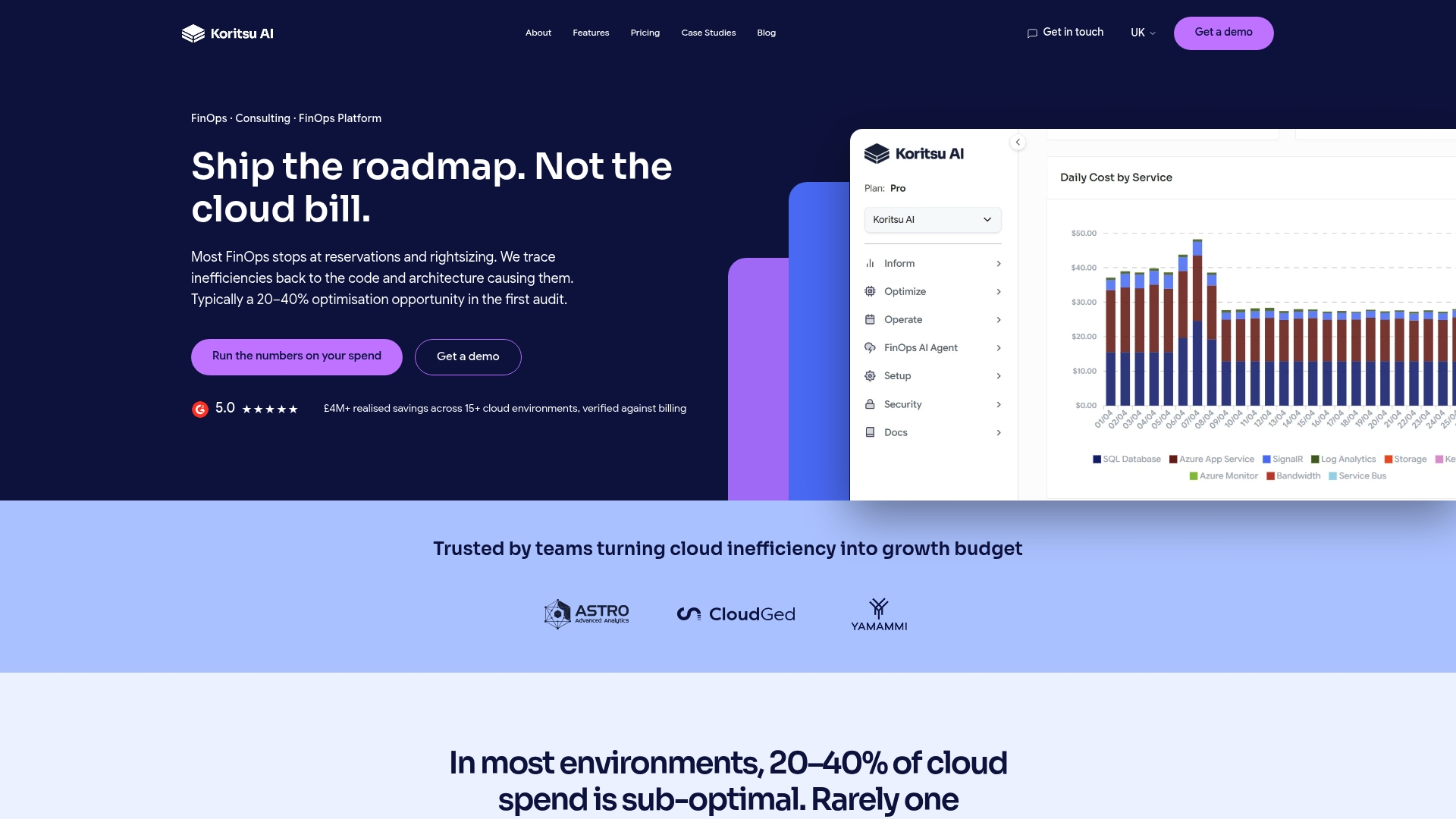
Koritsu AI delivers a free assessment that identifies exactly where your cloud bill is inflated and why. The engagement runs on a success-fee model: Koritsu AI takes a share of the savings it actually finds, so there is no upfront cost and no risk. For teams that want continuous oversight, an ongoing FinOps subscription keeps Kori monitoring your estate and your engineers focused on the fixes that matter most. See how a UK bidding platform achieved a significant reduction in cloud costs through architectural changes identified by Koritsu AI. To get started, book your free assessment today.
Useful sources for UK IT leaders
- What is Cloud Infrastructure? | Microsoft Azure — Azure's authoritative definition covering components, delivery models, and the shared responsibility model, with links to UK-region documentation.
- What is Cloud Infrastructure? | AWS — AWS's overview of cloud infrastructure components, deployment models, and regional availability, including UK (London) region details.
- Azure documentation | Microsoft Learn — Full technical reference for Azure services, compliance certifications, and architecture guidance relevant to UK deployments.
- Infrastructure Cloud | HashiCorp — Practical guidance on IaC, unified infrastructure lifecycle management, and policy-as-code for hybrid and multi-cloud estates.
- ISO 27001 zero-trust alignment tips | ISMS Calculator — Practical guidance on aligning ISO 27001 controls with zero-trust architecture, directly relevant to UK cloud security procurement.
- How to reduce cloud infrastructure costs | Koritsu AI — Stepwise FinOps tactics for UK engineering teams, covering rightsizing, tagging, and architectural cost reduction.
This article provides general information about cloud infrastructure services and is not a substitute for professional legal, financial, or technical advice. Confirm current compliance requirements, pricing, and regulatory obligations with the relevant primary sources or a qualified adviser.