FinOps Inform · CI/CD
Reduce cloud costs in CI/CD pipelines: 2026 guide
Discover essential strategies to reduce cloud costs in CI/CD pipelines. Optimize your workflows and save on compute charges today!

Cloud CI/CD cost optimisation is the practice of reducing both billed compute charges and hidden developer wait costs across continuous integration and continuous delivery workflows. Most engineering teams focus on their cloud invoice, but the real inefficiency in CI/CD pipelines sits in runner selection, matrix configurations, cold builds, and flaky tests. With GitHub Actions pricing reduced by up to 39% from January 2026 alongside a new per-minute platform fee, the levers you pull to reduce cloud costs in CI/CD pipelines have shifted. This guide covers exactly where to focus.
How does pipeline design and runner selection affect cloud costs?
Runner choice is the single most direct cost driver in any GitHub Actions workflow. GitHub Actions bills per minute by OS: Linux at $0.008/min, Windows at $0.016/min, and macOS at $0.080/min. That means a macOS runner costs ten times more than an equivalent Linux runner for the same job. Teams that default to macOS for convenience rather than necessity are paying a significant premium with no performance justification.
Matrix expansions compound this problem fast. When you add a single axis to a matrix strategy, for example testing across three Node.js versions and two operating systems, you create six parallel jobs instead of one. Add macOS to that mix and your billed minutes multiply accordingly. Matrix combinatorics spike bills in ways teams rarely anticipate until the invoice arrives. The fix is to audit which matrix axes genuinely require coverage and which are legacy configurations nobody has questioned.
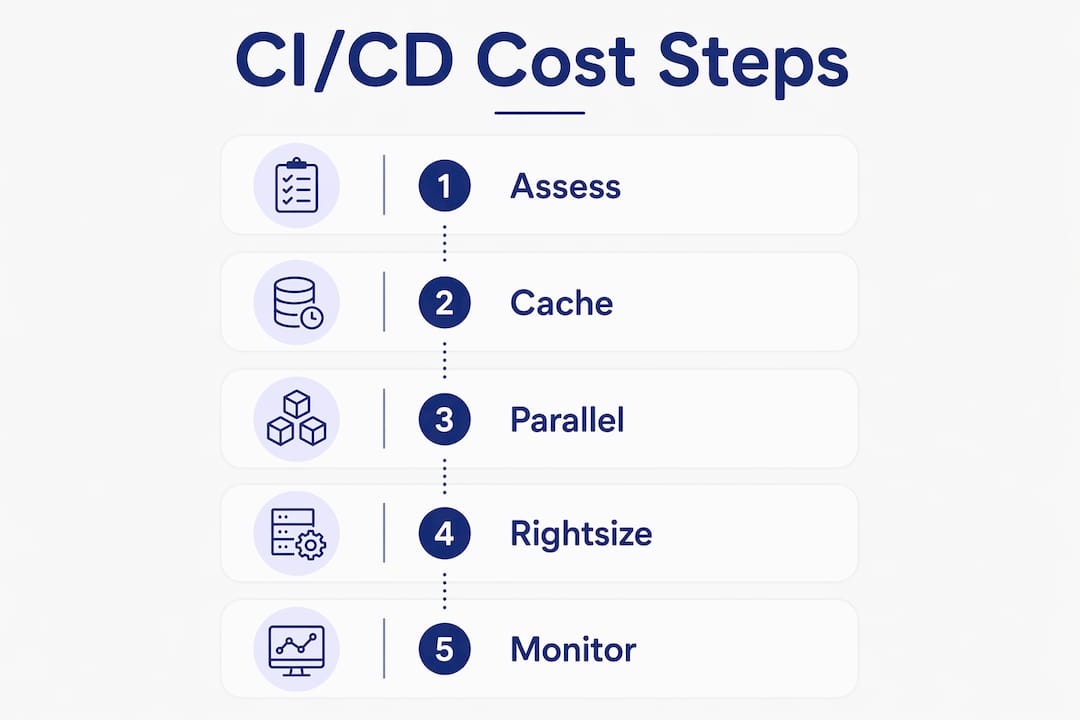
Rightsizing runners is the other half of this equation. Many teams provision large runners because they were set up once and never revisited. Monitoring actual utilisation over time reveals that most jobs use a fraction of the allocated cores. A four-core runner running a lint check is inefficiency you are paying for every single run.

| Runner type | Cost per minute | Relative cost vs Linux |
|---|---|---|
| Linux (standard) | $0.008 | 1x |
| Windows | $0.016 | 2x |
| macOS | $0.080 | 10x |
| Linux (large, 4-core) | $0.016 | 2x |
The trade-off between faster pipelines and lower cost per minute is real, but it is not always in tension. A well-cached Linux runner often outperforms an oversized macOS runner on build tasks, at a fraction of the cost. Speed and economy point in the same direction when your pipeline is well-engineered.
Pro Tip: Audit your matrix configurations quarterly. Remove any OS or runtime version axis that is not tied to a specific production requirement. A single removed macOS axis on a ten-minute job running fifty times per day saves over $2,000 per year at current rates.
What role do caching and parallelism play in lowering CI/CD spending?
Caching is the most underused cost control in CI/CD pipelines. Without it, every job starts from scratch: downloading dependencies, rebuilding artefacts, and recompiling code that has not changed. Cold builds multiply billed minutes across every runner, and the cost accumulates silently. A cache-first approach treats caching as a prerequisite for any scale-out strategy, not an afterthought.
Practical caching approaches worth implementing:
- Gradle build cache: Stores task outputs so unchanged modules are not recompiled. On large Java monorepos, this can cut build time by 60% or more.
- Docker layer cache: Reuses unchanged image layers between builds. Particularly effective when your base image and dependencies change infrequently.
- Shared dependency caches: Tools like GitHub Actions’ native
cacheaction or self-hosted cache servers (such as Artifactory or Nexus) reduce repeated package downloads across jobs. - Test result caching: Skip re-running tests for unchanged code paths using tools like Gradle’s test caching or Bazel’s remote cache.
Parallelism is where teams often create new cost problems while trying to solve speed problems. Running twenty jobs in parallel improves wall-clock time, but if those jobs all miss cache, you are paying for twenty cold builds simultaneously. Effective caching is the gate that makes parallelism genuinely cost-effective. Without it, parallelism inflates your bill without delivering proportional value.
The right sequence is: implement caching first, validate cache hit rates, then introduce parallelism. A cache hit rate below 70% on dependency caches is a signal that your caching strategy needs work before you scale out runners.
Pro Tip: Track cache hit rates as a pipeline metric alongside build duration. A drop in cache hit rate is often the first sign that a dependency update or configuration change has broken your caching strategy, and it will show up in your cloud bill before anyone notices the slowdown.
How to use cost observability to control CI/CD expenses?
Cost observability in CI/CD means having clear visibility into both what your cloud provider bills and what developer time costs. Developer wait time costs two orders of magnitude more than the compute charges on your invoice. A ten-minute pipeline running fifty times per day across a team of twenty engineers is not a $4 compute problem. It is a productivity problem worth thousands of pounds per month in lost engineering time.
Separating these two cost perspectives requires deliberate instrumentation. Here is a practical framework for building cost observability into your pipelines:
- Measure compute cost per workflow: Use GitHub’s usage reports or tools like gha-budget to attribute billed minutes to specific workflows and jobs. This tells you where the invoice cost is concentrated.
- Measure pipeline duration per developer: Track how long engineers wait for CI feedback. Multiply average wait time by daily run frequency and team size to quantify the productivity cost.
- Set cost budgets per workflow: Tools like gha-budget for pre-merge estimation allow you to estimate workflow cost before a pull request is merged, creating a cost gate in your development process.
- Integrate Infracost for infrastructure changes: Infracost adds pre-deployment cost gating to pull requests that modify Terraform, showing the cost impact of infrastructure changes before they are applied.
| Cost type | Measurement method | Typical magnitude |
|---|---|---|
| Billed compute | GitHub usage reports, gha-budget | Lower, visible on invoice |
| Developer wait time | Pipeline duration × team frequency | Higher, invisible to finance |
| Infrastructure drift | Infracost PR comments | Variable, preventable |
The organisational dimension matters here. Cost observability only changes behaviour when engineers can see the data in their normal workflow. Embedding cost estimates in pull request comments, rather than in a separate FinOps dashboard nobody checks, is what creates genuine accountability. For broader approaches to cloud cost visibility, AI-driven observability tools are increasingly effective at surfacing patterns that manual review misses.
Which CI/CD pipeline inefficiencies inflate cloud costs most?
The most expensive inefficiencies in CI/CD pipelines are not the obvious ones. They are the structural problems that compound across hundreds of daily runs.
- Flaky tests: A 3.6% rerun rate sounds negligible, but it doubles compute and wait costs for every affected execution. Flaky tests are a tax on every developer and every pipeline run until they are fixed. Treat flakiness as a cost issue, not just a quality issue.
- Dead pipelines: Workflows that run on every push but are no longer actively maintained or monitored consume resources continuously. Audit your pipeline inventory every quarter and decommission anything that does not serve a current purpose.
- Red-main blocks: When the main branch is broken, developers cannot merge. They wait, they rebase, and they re-run pipelines. Each cycle adds compute cost and developer time. Trunk-based development with small, frequent merges reduces batch sizes and debugging time, keeping pipelines green and costs predictable.
- Oversized runners for lightweight jobs: A lint check or a YAML validation job does not need a four-core runner. Matching runner size to job requirements is one of the fastest wins available. Review your workflow files and downsize runners for jobs that complete in under two minutes.
- Unoptimised Docker builds: Rebuilding entire Docker images when only application code has changed is a common source of needless minutes. Restructuring Dockerfiles to place frequently changing layers last maximises layer cache reuse.
The pattern across all of these is the same: inefficiency accumulates because nobody has assigned ownership of pipeline cost. Treating CI/CD cost as a shared engineering concern, with visible metrics and clear ownership, is what turns these individual fixes into sustained savings. You can find a broader framework for this in our guide on application refactoring for cloud savings.
How do 2026 pricing changes affect CI/CD cost strategies?
GitHub’s January 2026 pricing update changes the calculation for runner selection in two directions at once. Hosted runner prices dropped by up to 39% across runner types, which benefits teams running high volumes of short jobs on GitHub-hosted infrastructure. At the same time, a new $0.002 per-minute platform charge applies to all Actions workflows, including those using self-hosted runners. This is a meaningful change for teams that moved to self-hosted runners specifically to avoid GitHub’s per-minute billing.
| Runner strategy | Pre-2026 cost driver | Post-2026 consideration |
|---|---|---|
| GitHub-hosted Linux | Per-minute rate | Lower rate, plus $0.002 platform fee |
| GitHub-hosted macOS | High per-minute rate | Reduced, but still 10x Linux |
| Self-hosted runners | Infrastructure cost only | Now includes $0.002/min platform fee |
The practical implication is that self-hosted runners are no longer free from GitHub’s perspective from March 2026 onwards. Teams that chose self-hosted runners purely for cost reasons should recalculate their total cost of ownership, factoring in the new platform fee alongside their infrastructure spend. For many teams running moderate workloads, GitHub’s pricing calculators will show that the gap between hosted and self-hosted has narrowed considerably. The decision now depends more on control and compliance requirements than on raw cost.
The broader lesson from these pricing changes is that CI/CD cost strategies need regular review. Pricing models evolve, usage patterns shift, and the configuration that was optimal eighteen months ago may no longer be the right choice. Building a quarterly review cadence into your FinOps practice is not optional. It is how you stay ahead of changes like these rather than discovering them on your invoice. For teams evaluating cloud cost management tools, the 2026 pricing shift is a good prompt to reassess your current tooling as well.
Key takeaways
Reducing cloud costs in CI/CD pipelines requires addressing both billed compute and developer wait time, because the latter typically costs far more than what appears on your invoice.
| Point | Details |
|---|---|
| Runner selection drives cost | macOS runners cost 10x more than Linux; audit OS choices and remove unnecessary matrix axes. |
| Cache before you scale | Implement caching first and validate hit rates before adding parallelism to avoid inflated cold-build costs. |
| Observe both cost types | Track billed compute and developer wait time separately; tools like gha-budget and Infracost make this practical. |
| Fix structural inefficiencies | Flaky tests, dead pipelines, and red-main blocks compound costs across every daily run. |
| Revisit strategy after pricing changes | GitHub’s 2026 updates affect self-hosted runner economics; recalculate total cost of ownership with current rates. |
The cost problem is a process problem
Having worked across dozens of CI/CD environments, the pattern I see most consistently is this: teams treat pipeline cost as an infrastructure problem and reach for new tooling before they have fixed their development practices. That is usually the wrong order.
The most impactful changes I have seen come from trunk-based development, disciplined cache management, and quarterly pipeline audits. None of those require purchasing anything. They require engineering discipline and cross-team agreement on what good looks like. Tooling like gha-budget and Infracost amplifies that discipline, but it cannot substitute for it.
The FinOps culture shift matters too. When cost data lives only in a finance dashboard, engineers do not change their behaviour. When a pull request comment tells a developer that their workflow change will add £300 per month to the CI bill, they think twice. Embedding cost signals in the development workflow is what makes cost reduction sustainable rather than a one-off project.
My honest view is that most teams are six months of focused effort away from 30 to 40% lower CI/CD costs. The savings are not hidden in complex infrastructure changes. They are sitting in your matrix configurations, your cache hit rates, and your flaky test backlog.
How Koritsu AI can help you cut CI/CD cloud costs
Koritsu AI combines continuous cloud spend analysis with hands-on expert guidance to find the inefficiencies that engineering teams miss. Our AI agent, Kori, surfaces exactly where money is being lost across your pipelines and infrastructure. Our specialists help you act on it. One UK bidding platform achieved a 52% reduction in cloud costs after working with Koritsu, with savings identified across compute, pipeline configuration, and infrastructure design. We only charge when we deliver results. Start with a free cloud cost assessment and see where your pipelines are costing more than they should.
FAQ
What are the biggest examples of cloud cost in CI/CD pipelines?
The most common cost sources are macOS runner overuse, matrix expansion without justification, cold builds from missing caches, and flaky tests that trigger reruns. Developer wait time typically exceeds billed compute costs by a significant margin.
Which cloud CI/CD pipeline cost tools are most effective?
gha-budget estimates GitHub Actions workflow costs before execution, Infracost gates infrastructure cost changes in pull requests, and GitHub’s native usage reports attribute billed minutes to specific workflows. Each addresses a different layer of cost visibility.
How much can runner selection reduce CI/CD cloud spending?
Switching from macOS to Linux runners for jobs that do not require macOS reduces per-minute costs by 90%. Rightsizing from large to standard runners for lightweight jobs cuts those job costs by 50% or more.
Does parallelism always reduce CI/CD costs?
No. Parallelism reduces wall-clock time but increases total billed minutes when cache hit rates are low. Implement effective caching before scaling out parallel jobs, or you will pay for multiple cold builds simultaneously.
How do GitHub’s 2026 pricing changes affect self-hosted runners?
From March 2026, a $0.002 per-minute platform fee applies to all GitHub Actions workflows, including those on self-hosted runners. Teams should recalculate their total cost of ownership using GitHub’s pricing calculators to determine whether self-hosted infrastructure still offers a cost advantage.